wayground logo

Free Printable Worksheets

Font size

S
M
L
XL
Worksheets

Earth and Space Science review

Total questions: 50

Worksheet time: 41mins

Name
Class
Date
1.
At which point in the cycle shown in the first diagram would the process of cooling and hardening of melted rock occur?
a)
A. 1
b)
B. 2
c)
C. 3
d)
D. 4
2.
The second diagram shows a more detailed view of two of the processes in the rock cycle. At which point in the first diagram would these two processes occur?
a)
A. 1
b)
B. 2
c)
C. 3
d)
D. 4
3.
The transfer of heat can cause changes in rock. Which of the following describes the role heat plays at a specific point in the first diagram?
a)
A. At point 1, removing heat causes melting.
b)
B. At point 2, removing heat causes solidifying.
c)
C. At point 3, adding heat causes solidifying.
d)
D. At point 4, adding heat causes melting.
4.
Different kinds of matter make up the materials of the rock cycle. Which of the following best describes the loose sediments shown in the figure?
a)
A. solution
b)
B. pure substance
c)
C. homogenous mixture
d)
D. heterogeneous mixture
5.
Earth consist of different layers within which heat flows. The diagram below shows four layers of Earth. In part of which layer does heat flow by convection currents?
a)
A. 1
b)
B. 2
c)
C. 3
d)
D. 4
6.
The diagram below shows the boundary of two tectonic plates and a feature that forms on Earth's surface at that boundary. At which of the following plate boundaries does the feature shown in the diagram form?
a)
A. a continental plate and an oceanic plate sliding past each other
b)
B. a continental plate subducting beneath an oceanic plate
c)
C. two oceanic plates moving away from each other
d)
D. two oceanic plates moving toward each other
7.
Some air movement in the atmosphere is local, with wind blowing over a short distance. The diagram below shows one pattern of local air movement in the atmosphere. Which of the following statements best explains the movement of the air shown in the diagram?
a)
A. A sea breeze forms at night because the ocean cools off faster than the land.
b)
B. A land breeze forms at night because the ocean cools off faster than the land.
c)
C. A sea breeze forms during the day because the land warms up faster than the ocean.
d)
D. A land breeze forms during the day because the ocean warms up faster than the land.
8.
Water on the surface of the Atlantic Ocean evaporates into the air above it. Which two Earth spheres are interacting during this event?
a)
A. atmosphere and hydrosphere
b)
B. biosphere and hydrosphere
c)
C. geosphere and atmosphere
d)
D. hydrosphere and geosphere
9.
An intrusion of basalt cuts through a layer of limestone. Which of the following natural processes supports the conclusion that the basalt is younger than the limestone?
a)
A. When overturned, older layers of sedimentary rock can lie under the younger ones.
b)
B. Older layers of undisturbed sedimentary rock lie under younger ones.
c)
C. Lava can flow out and cover existing rock layers on Earth's surface.
d)
D. Magma can move upward and push into existing rock layers.
10.
As the moon moves in its orbit and Earth spins on its axis, the pull of gravity between the moon and different parts of Earth changes. Which of the following events do Florida residents observe as a result of this changing pull of gravity?
a)
A. Temperatures in Tampa are hotter in August than in February.
b)
B. Ocean water levels at Miami Beach rise and fall twice each day.
c)
C. The moon appears to rise in the east and set in the west each day.
d)
D. The phases of the moon appear to changes from one day to the next.
11.
Florida's Atlantic coastline is located along the eastern boundary of the state. Which of the following best describes a coastline?
a)
A. a wide, flat area of land
b)
B. a high, rolling area of land
c)
C. a place where land meets an ocean
d)
D. an area of land surrounded by water
12.
Florida's climate is not the same as its weather. Which of the following data would be more helpful in determining Florida's climate than its weather?
a)
A. average temperature over 1 hour
b)
B. average temperature over 10 hours
c)
C. average temperature over 1 day
d)
D. average temperature over 10 years
13.

The movement of water through Earth's systems, powered by the sun's energy, is the

a)

water cycle

b)

weather

c)

evaporation

14.

The process by which molecules of liquid water escape into the air after becoming water vapor is called

a)

evaporation

b)

condensation

c)

humidity

15.

The process by which water vapor becomes liquid water is

a)

condensation

b)

water cycle

c)

humidity

16.

Clouds that form near the ground

a)

fog

b)

ground water

c)

tornado

17.

Water in the form of a gas is called

a)

ice

b)

cloud water

c)

vapor

18.

The envelope of gasses surrounding Earth is called the

a)

atmosphere

b)

big clouds

c)

stratus

19.

The measure of the amount of water in the air is called

a)

psychrometer

b)

humidity

c)

water vapor

20.

Any form of water that falls from clouds and reaches Earth's surface

a)

precipitation

b)

rain

c)

clouds

21.

An overflowing of water in a normally dry area

a)

drought

b)

flood

c)

rain

22.

A long period of time of scarce rainfall or dry weather is known as a

a)

sleet

b)

drought

c)

channel

23.

Warm air masses that form in the tropics and have low air pressure are called

a)

tropical

b)

polar

c)

cyclone

24.

Cold air masses that form at the north or south poles that have high air pressure.

a)

tropical

b)

polar

c)

front

25.

When air masses form over oceans it is called_____________. This can cause the air to become humid.

a)

continental

b)

maritime

26.

When air masses form over land it is called ___________. This air tends to be much dryer.

a)

continental

b)

maritime

c)

cyclones

27.

The boundary where air masses meet becomes a _______

a)

front

b)

back

c)

to the left now

28.

A place where two plates slip past each other, moving in opposite directions, is known as a _______

a)

transform boundary

b)

divergent boundary.

c)

convergent boundary.

d)

rift valley.

29.

The place where two plates come together is known as a _______

a)

transform boundary.

b)

divergent boundary.

c)

convergent boundary.

d)

rift valley.

30.

Below is a picture of sea-floor spreading. How are the ocean crusts moving?

a)

Converging

b)

Diverging

c)

Sliding

d)

No movement

31.

The San Andreas Fault in California is known as an active earthquake area. What type of

boundary is it?

a)

Converging

b)

Diverging

c)

Transform

d)

Sea Floor Spreading

32.
What are the two types of crust
a)
continental and oceanic
b)
ocean and upper
c)
lower and upper
d)
pizza and subway
33.
Wegener’s proposal of a supercontinent was supported by:
a)
earthquake data
b)
seafloor magnetism
c)
rock, fossil, and climate data.
d)
convection currents in the mantle.
34.
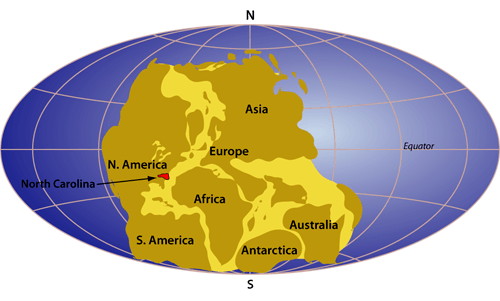
What is this a picture of?
a)
plate tectonics
b)
continental drift
c)
pangea
d)
glacier scaring
35.
What does the theory of continental drift state?
a)
The continents were once joined in a super-continent and have moved over time
b)
Continents are stationary and do not move
c)
The Earth is broken into lithospheric plates that move due to convection currents
d)
none of the above
36.
Visible light reaches Earth’s surface while infrared light is trapped as heat. Which characteristic of Earth’s atmosphere causes this to happen?
a)
the hole in the ozone
b)
the greenhouse effect
c)
atmospheric pressure
d)
the inversion layer
37.
The average temperature of the surface of Earth has increased approximately 1°C in the past century. Which reason best explains this increase in temperature?
a)
lower levels of ozone in the atmosphere
b)
lower levels of nitrogen in the atmosphere
c)
higher levels of carbon dioxide in the atmosphere
d)
higher levels of oxygen in the atmosphere
38.
Which of the following is the best conclusion that can be made from this graph?
a)
atmospheric carbon dioxide levels have been decreasing since 1960
b)
Hawaii has a lot of carbon dioxide
c)
humans have been working hard to decrease carbon dioxide levels
d)
atmospheric carbon dioxide levels have increased steadily since 1960
39.
Which of the following gases DOES NOT trap heat?
a)
carbon dioxide
b)
nitrogen
c)
water vapor
d)
methane
40.
Compared to other greenhouse gases, carbon dioxide is very effective in trapping heat near the surface of the Earth.
a)
true
b)
false
41.
Which of the following have been linked to climate change?  
a)
droughts
b)
flooding
c)
melting of polar ice caps
d)
all of the above
42.
The main human activity that releases greenhouse gases is
a)
using bottled water
b)
burning fossil fuels
c)
texting on cellphones
d)
eating meat
43.
Some greenhouse gases are naturally present in the Earth's atmosphere
a)
True
b)
False
44.
What is the definition of weather?
a)
a period of abnormally dry weather that lasts at least 2 years
b)
the specific condition of the atmosphere at a particular place and time
c)
a complex community of organisms and the community's environment
d)
a release of toxic gas
45.
What is the average weather for a particular time and region called?
a)
drought
b)
weather
c)
emissions
d)
climate
46.
Carbon is stored in
a)
Trees and other living things
b)
Oceans
c)
underground in soil and fossil fuels
d)
All are correct
47.
The warming of the atmosphere by the trapping of heat being radiated to space is called
a)
evaporation
b)
condensation
c)
the greenhouse effect
d)
radiation
48.
Increasing quantities of CO2 (Carbon Dioxide) in the atmosphere will cause air temperatures to be _____. 
a)
warmer
b)
cooler
49.
Climate change causes extreme weather conditions such as:
a)
Flooding
b)
Heat Waves
c)
Hurricanes
d)
All of the above
50.

Possible human solutions for limiting global warming and climate change are...

a)

being more energy-efficient

b)

using renewable sources of energy

c)

removing carbon from fossil fuel emissions

d)

all of the above