
Font size
 Worksheets
Atoms, elements, compounds, mixtures and the PT.
Total questions: 53
Worksheet time: 32mins
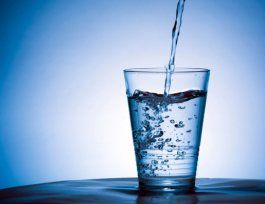
Carbon is considered an element, while carbon dioxide is considered a compound. This is because carbon dioxide is ---
a gas at room temperature.
made of two different elements.
given off by green plants.
useful to human beings

A section of the Periodic Table is shown. What is the Chemical Symbol for Magnesium?
12
Magnesium
24.31
Mg
The smallest particle of any particular type of matter is known by which of the following terms?
Element
Chemical
Atom
Compound
A compound consists of two or more elements chemically bonded together.
Na2CO3
The chemical symbol of an element always matches the element's name.
Agree
Disagree
What is the difference between Co and CO?
CO is an element but Co is a compound
Nothing is different. They are the same thing.
CO is two elements and Co is only one element
Co is not a pure substance

How many elements are in this compound?
13
6
4
3

Classify the picture with the correct label
Mixture of compounds
Mixture of elements
Element
Compound


In this diagram, X represents...
A compound
A mixture
An atom
An element
Carbon (C) and hydrogen (H) are pure substances. Each is made of only one type of atom, but carbon atoms are different from hydrogen atoms. Carbon and hydrogen chemically combine to form methane (CH4).
How many Nitrogen atoms are in the in H2C3O4N5?
2
3
4
5
How many Aluminum atoms are in Al2O3?
3
2
5
1
three hydrogen (H)
one sulfur (S)
four oxygen (O)
Select the three types of structures elements have.
Monatomic
Compound
Molecular
Lattice
All solids have a closely packed, fixed arrangement of particles.
True
False
The _______ is a measure of the average speed of the particles in a substance.
temperature
density
volume
mass
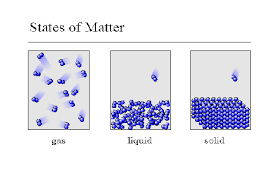
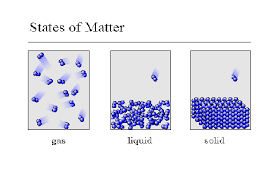
Define a liquid.
Variable shape, Variable volume
Set shape, Variable volume
Set shape, Set volume
Variable shape, Set volume
Particles of a liquid
are tightly packed together and vibrate in a fixed position.
have no viscosity.
decrease in volume with increasing temperature.
are free to slide over one another
A scientist discovers a new element and wants to give it the symbol GT. Why is this not a valid symbol?
The "T" should be lower case
Both letters should be lower case
Both letters should come from the second half of the alphabet
It should only have one letter
a unique number for each element that equals the number of protons in an atom of that element
element name
element symbol
atomic number
atomic mass
a row on the Periodic Table of Elements
family
period
row
isotope
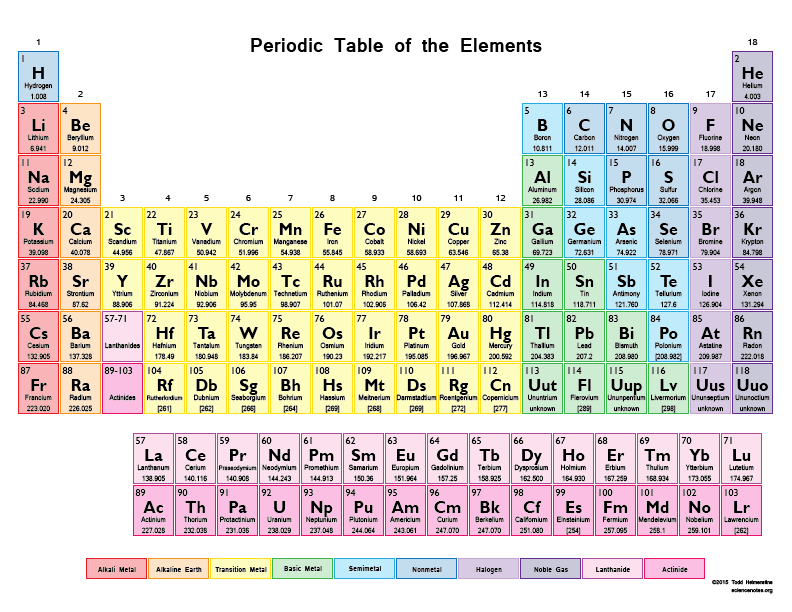
What is the atomic number of Barium, Ba? (enlarge the periodic table)
20
38
56
88
What are the vertical columns on the periodic table called?
groups
periods
protons
valence electrons
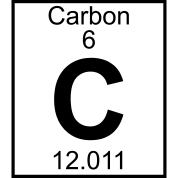
who discovered the first scientific and systematic periodic table
Henry Mosley
Dmitri Mendeleev
John Dalton
sir Isaac Newton
The element with the symbol Sn
iron
gold
silicon
tin
The element with the symbol Cu
Carbon
Copper
Cesium
Chlorine
The element named after a person
Gold
Mercury
Curium
Polonium
Where are the protons and neutrons located within an atom?
In the nucleus
In the electron cloud
Atoms don't have protons or neutrons
The vertical columns of the periodic table are called...
Periods
Families
Chemical Symbols
Groups
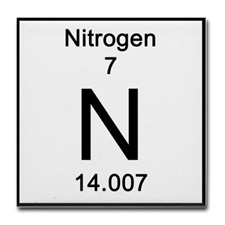
Which part represents the SYMBOL for this element?
14
7
N
Nitrogen
The periodic table is organized in horizontal rows called...
Groups
Periods
Families
Chemical Symbols
What two subatomic particles are contained in the nucleus?
Protons + Electrons
Neutrons + Electrons
Atoms
Protons + Neutrons
What is Matter?
anything that has mass
anything that takes up space
anything that has mass and takes up space
What are the three particles that make up the atom?
clouds, positives, negatives
clouds, energy levels, particles
protons, neutrons, electrons
molecules, electrons, protons
How many elements are there in the periodic table?
118
100
226
too many to count

