
 Worksheets
Topic 9 Test
Total questions: 45
Worksheet time: 23mins

What significant historical development is highlighted in the timeline?
the decline of feudalism
the Christianization of Europe
the rise of the Byzantine Empire
the invention of the printing press
Which Christian figure is credited with founding the monastic tradition in Western Christianity, influencing many religious communities?
Benedict
Augustine
Dominic
Patrick
Which territories were part of the Frankish empire under Charlemagne's rule?
The Byzantine empire and Spain.
Spain, France, and England.
England, Ireland, and Germany.
France, Germany, and parts of Italy.
In theory, feudalism was a system of mutual obligations. What phrase best characterizes feudalism in reality?
a rigid hierarchy of lords and serfs
absolute power held by a single ruler
distribution of land among nobles
economic interdependence of rural and urban areas
What was a significant benefit of implementing the three-field crop rotation system?
It allowed for the redistribution of land among peasants.
It increased the amount of land available for cultivation each year.
It enabled simultaneous planting of all fields.
It resulted in a reduced harvest for farmers.
How were craft guilds financed?

Examine the cause-and-effect diagram. It represents a significant process in early European history. What was one cause of the four effects depicted in the diagram?
Expansion of trade routes
Invasions of Europe
Advancements in agriculture
Rise of monarchies
What were the effects of the introduction of the horse-powered plow? Select the TWO correct statements.
It led to an increase in food production, allowing specialization in other professions.
It caused serfs to become more tied to their land.
It enabled the expansion of arable land.
It resulted in the establishment of the feudal system.
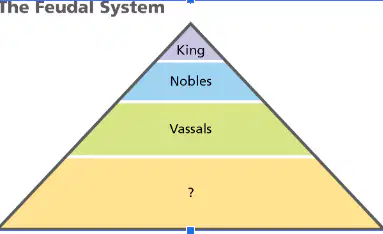
Examine the hierarchy of the feudal system. Which of the following groups are positioned at the base of the hierarchy? Select the TWO correct answers.
Knights
Peasants
Serfs
Monks
How did the function of monasteries evolve by the 13th century?
They were largely replaced by mendicant orders and ceased to exist.
They shifted their focus from education to agricultural production.
They continued to exist only in remote areas.
They became hubs of agricultural activity, often situated in urban areas.
Medieval manors were primarily known for being
self-contained agricultural estates.
centers of political power.
hubs of religious activity.
bustling urban centers.

Which of the following roles did medieval monasteries play in society? Choose the TWO correct answers.
Monasteries were centers for agricultural innovation.
Monks were involved in political governance.
Monasteries were places of refuge during conflicts.
Monks copied and preserved ancient manuscripts.
Where did many ancient European settlements develop?
deserts
forests
rivers
plains
Which of the following actions demonstrate Charlemagne's enduring influence?
Charlemagne established educational institutions that became models for future generations.
Charlemagne personally led missions to convert the Saxons to Christianity.
Charlemagne introduced a new legal code that was adopted throughout Europe.
Charlemagne's reign marked the beginning of the Carolingian Renaissance, a revival of art and culture.
What made monasteries attractive targets for Viking raids?
Monasteries were often isolated and easy to attack.
Monasteries had strong defenses that Vikings wanted to challenge.
Monasteries were the main centers of trade and commerce.
Monasteries were known for their large libraries and educational resources.
16. The Benedictine Rule mainly affected the lives of
missionaries.
bishops.
monks.
the poor and sick.
Who held the most power during this period?
the church
monks
saints
the democracy
Under the feudal system, what did lords grant to their vassals?
freedom
money
loyalty
fiefs
What principles did the code of chivalry emphasize for knights?
honorable conduct and bravery
advanced combat techniques
efficient estate management
centralized royal authority
Why did farmers practice crop rotation in medieval times?
to prevent soil depletion
to increase the number of crops grown
to allow serfs to rest
to reduce labor costs
What was the role of guilds in medieval society?
to safeguard the economic interests of artisans
to boost the production of goods
to encourage rivalry among craftsmen
to facilitate safer and easier international trade
How did bills of exchange facilitate trade for merchants? Choose two.
merchants could expand their trade routes
merchants could avoid carrying large amounts of cash
merchants earned rewards for using bills of exchange
merchants could easily convert currency
merchants could use bills as a form of advertisement
Mystery plays were a form of medieval drama that primarily depicted stories from the
Roman mythology.
Greek philosophy.
Arthurian legends.
Christian Bible.

What is a monastery?
A disease that spreads quickly during the Middle Ages
A place where monks lived and preserved Greco-Roman cultural achievements
An agreement between the pope and the ruler of a country
A group of citizens that decides whether an accused person is innocent or guilty
Which of these were important inventions in farming in the Middle Ages? CHECK ALL THAT APPLY
Crop rotation
Wheeled plow and horse collar
Bladed plow
Bug resistant crops
Charlemagne wanted his people to
burn books.
convert to Christianity.
pay the piper.
stop learning.
Business groups of craftspeople. They set standards for products and decided who could join.
A. Friar
B. Plague
C. Fief
D. Guild
association of people who have a common interest
fallow
guild
three-field system
crop-rotation
practice of changing the use of fields over time
fallow
guild
three-field system
manors
system of planting that increased the amount of land that could be planted each year
fallow
guild
three-field system
crop-rotation
unplanted
fallow
guild
three-field system
crop-rotation
code of conduct that required knights to be brace, loyal, and honest
fief
serfs
manor
chivalry
noblemen who received land from other noblemen in return for their services
fief
serfs
manor
vassals
a peasant who is legally bound to live and work on land owned by a lord
manor
fief
serfs
vassals
self-sufficient estate of a medieval lord
manor
fief
serfs
vassals
estate granted by a lord to a vassal
vassals
chivalry
serfs
fief
What was the primary purpose of the three-field system in medieval agriculture?
To reduce the need for serf labor.
To allow for crop rotation and soil recovery.
To expand the size of manors.
To increase the variety of crops grown.
What was a key characteristic of a medieval guild?
It was a political alliance.
It was a trade association that set standards for its members.
It was a group of knights.
It was a religious organization.
In what way did monasteries contribute to society during the Medieval period?
By serving as military fortresses
By preserving knowledge through the copying of manuscripts
By acting as trade centers
By providing modern medical care
What was an important advantage of three-field system of crop rotation?
It divided large land holding among vassals.
It increased the amount of land that could be planted every year.
It allowed all of the farmer's land to be planted at once.
It produced fewer crops for farmers to harvest.
Charlemagne wanted his people to
burn books.
convert to Christianity.
pay the piper.
stop learning.
Business groups of craftspeople. They set standards for products and decided who could join.
A. Friar
B. Plague
C. Fief
D. Guild
How were craft guilds fianced?
They required members to pay fees.
They accepted donations from other guilds.
They were supported by the profits from trade fairs.
They were funded by lords and large manors.

