
 Worksheets
Alg 2 Exponential Functions Review
Total questions: 150
Worksheet time: 11hrs 49mins
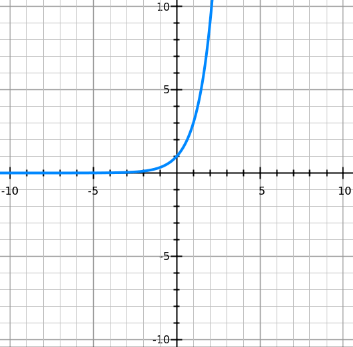
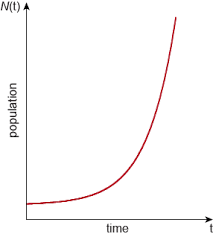
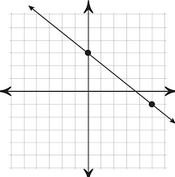
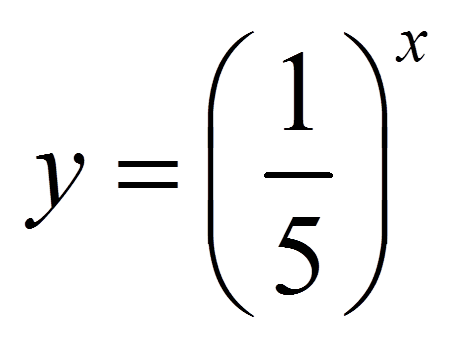


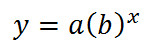
In an exponential function, what does the 'a' represent?
SLOPE
RATE OF CHANGE
Y-INTERCEPT
COMMON RATIO

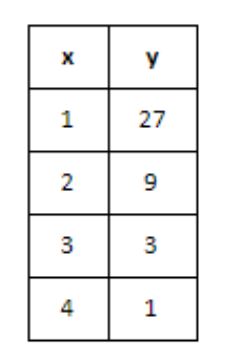
True or False: This is an exponential function.
True
False

Which function models this table?
f(x)=2⋅4x
f(x)=4x
f(x)=4⋅2x
f(x)=8x

What is the equation of the horizontal asymptote for following exponential function?
y = -4
y > -4
y < -4
(0, -3)

What is the equation of the horizontal asymptote for following exponential function?
y = -2
y > -2
y < -2
(0, -2)

What is the equation of the horizontal asymptote for following exponential function?
y = 1
y = 2
y > 1
(0, 2)
solve for x.
2x=23x−4
2
-2
1/2
4/3
solve for x.
114=11−x
-4
4
1/4
-1/4
Solve the following exponential equation:
98−x=27x−3
x=5
x=−5
x=51
x=−51
solve for x.
32x−1⋅34=3
1/2
5/8
-1
8/5
4p+2 = 64
Solve: 98-x = 27x-3
x = 5
x = -5
x = 1/5
x = -1/5
In an exponential function, what does the 'b' represent?
Input
Rate of change
Y-intercept
Output
How do you know that this was exponential growth? f(x)=0 .25 ( 1.3)x
Because the 0.25 was bigger than one
Because the 1.3 was bigger than one
Because the 0.25 was less than one
Because the 1.3 was less than one
How do you know that this was exponential decay? f(x)= 25 ( 0.20)x
Because the 25 was bigger than one
Because the 0.20 was bigger than one
Because the 25 was less than one
Because the 0.20 was less than one
A=1200(.85)6
A=10(1.01)3
What is the graph of the function
y=5⋅2x


Identify the initial value:
y = 6.87 (4)x
a = 4
a = 6.87
a = 3
a = 1
Suppose the population of a species of insects doubles every year. There are 1600 insects initially. The function for the scenario would be?
f(x)=2x+1600
f(x)=1600×2
f(x)=1600⋅2x
Samantha's hair was known to grow very rapidly. It began at a length of 6 in and grew at a rate of 14% a week.

A part of an exponential function is graphed on the grid.
Which inequality best represents the range of the part shown?
x≥−2
y≥4.5
x≥4.5
y≥−2

What appears to be the domain of the part of the exponential function graphed on the grid?
−1≤x≤3
−1≤y≤3
5.3≤x≤27
5.3≤y≤27

g(d) = 51.5d
How many downloads will the album have after 3 days?
Is the population of elephants increasing or decreasing?
What does the value 12 represent?
What does the value 1.015 represent?
g(x) = 740(.001)3x
p(x) = 13x - 5

Describe this function.
Exponential Growth
Exponential Decay
Linear Positive

Exponential Growth
Exponential Decay
Quadratic

Describe the function.
Exponential Growth
Exponential Decay
Linear

Describe the function.
Exponential Growth
Exponential Deacy
Positive Linear

Describe the function.
Exponential Growth
Exponential Decay
Quadratic
What is the "a" or y-intercept of the equation.
y = 5(21)x
What is the Growth Factor of the equation.
y = 5(3)x

What is the "a" or y-intercept of the function?
2
21
1
The graph for an exponential function is called a (a)

Growth

Decay
a
y-intercept
y = abx
Exponential Function Equation
b
Growth/Decay Factor
Describe the function. y = 5x
Growth
Deacy
Describe the function. y = 2(21)x
Growth
Deacy
Describe the translation.
y = 3x+ 2
Up 2
Down 2
Describe the translation.
y = 6x− 3
Up 3
Down 3
Describe the translation.
y = 2(3)x+ 7
(a)
Describe the function.
y = 2(21)x− 3
Exponential function that goes (a) (b)

What is the range of the function shown?
−1≤y≤3
−1≤x≤3
5.3≤y≤27
5.3≤x≤27

What is the domain of the function shown?
x>1
y>1
x>−2
y>−2
What is the range of the function shown?
x>1
y>1
x>−2
y>−2
Consider the given function that represents the balance in a bank account.
b(x)=850(1.025)x
What is the initial balance in the account?
(a)
Consider the given function that represents the balance in a bank account.
b(x)=850(1.025)x
Is the balance increasing or decreasing?
(a)
Consider the given function that represents the population of town.
f(x)=22000(0.94)x
Is the population of the town increasing or decreasing?
(a)
A small private school with a graduating class of 40 students in the year 2019 predicts that its graduating class will increase by 5% each year.
What function best represents this situation?
f(x)=40(0.95)x
f(x)=40(1.05)x
f(x)=5(0.60)x
f(x)=5(1.40)x
The value of a new video game is $40. The value is expected to decrease by 5% each year.
What function best represents this situation?
f(x)=40(0.95)x
f(x)=40(1.05)x
f(x)=5(0.60)x
f(x)=5(1.40)x

Which dashed line is the asymptote of this graph?
q
r
t
s
What is the equation for the ASYMPTOTE for every exponential function in this class?

What is the equation of this graph?
y=3x
y=2x
y=2⋅3x
y=4x

What is the equation of this graph?
y=3x+5
y=3x+4
y=5x
y=3x+5

What is the equation of this graph?
y=3x
y=3x+5
y=3x−2+5
y=3x−2
What is the graph of
y=2⋅3x ?


What is the graph of
y=−2⋅3x ?What is the graph of
y=−2⋅3x−2+5 ?What is the graph of
y=−3x−2+5 ?
What is the domain and range of the function y=2x ?
Use the graph to help!
Domain: (−∞,∞)
Range: (0,∞)
Domain: (−∞,∞)
Range: (1,∞)
Domain: (−2,∞)
Range: (0,∞)
Domain: (−∞,∞)
Range: (−∞,0)
For f(x)=4⋅3x , find the correct graph, asymptote, domain and range.


This is an example of....
an increasing exponential function
a decreasing exponential function
an increasing linear function
none of the above

This is an example of.....
exponential decay
exponential growth
constant change
a linear function
f(x)=4/5(.8)x-9

What transformations have occurred on the graphs from the parent function to the transformed function?
** Use the grap given!!
Reflection across the y-axis, shrink by a factor of 3, horizontal shift left 7
Reflection across the asymptote, horizontal shift right 3, vertical shift down 7
Reflection across the asymptote, stretch by a factor of 3, vertical shift down 7
Stretch by a factor of 3, vertical shift down 7
What is the transformation of
f(x)=−31(2)x+3 ?Reflection over x-axis
Vertical shrink by 1/3
Up 3
Vertical shrink by 1/3
Up 3
Reflection over x-axis
Vertical stretch by 2
Up 3
Vertical stretch by 2
Up 3

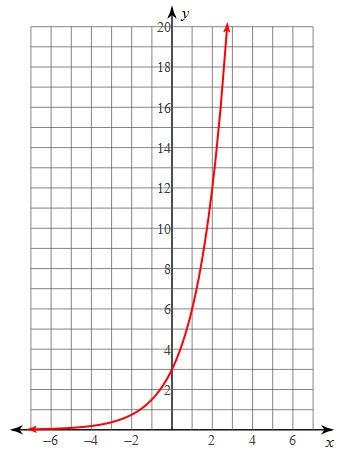
What is the horizontal asymptote of the exponential function?
y = 0
y = 3
x = 0
x = 3
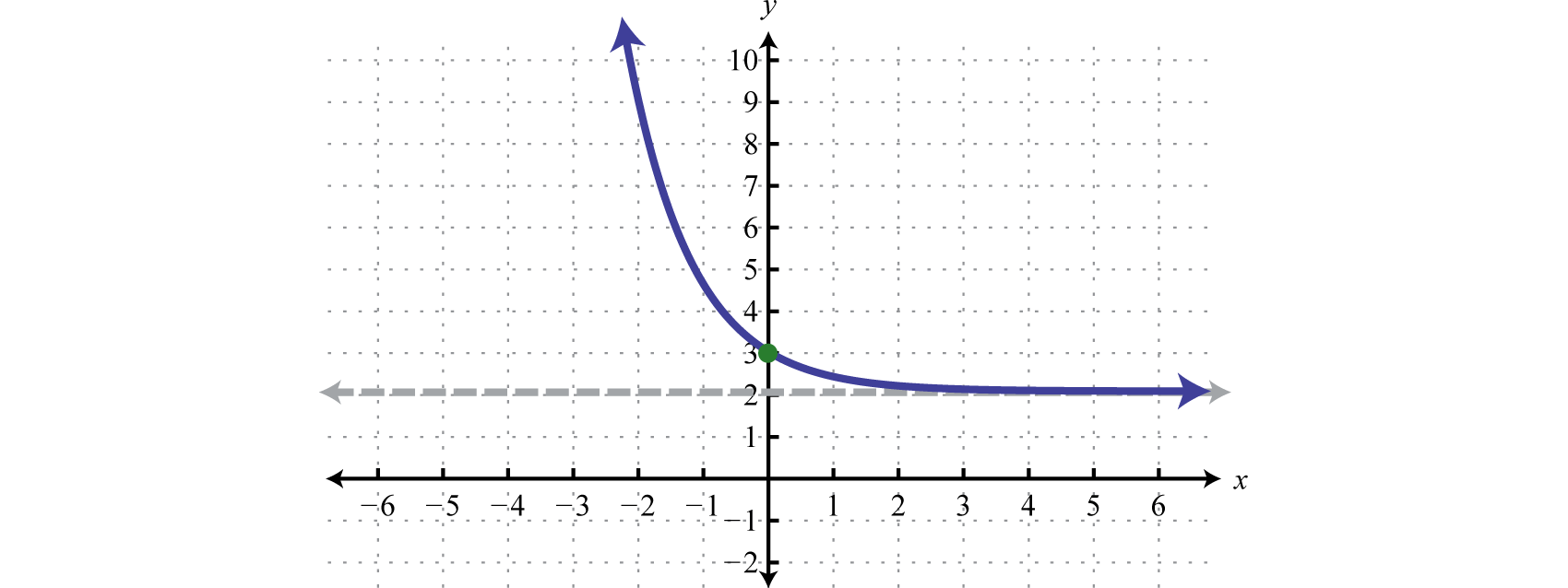
The end behavior of the graph is x →∞, f(x) →⁻∞ and x →⁻∞, f(x) →⁻∞
The end behavior of the graph is x →∞, f(x) →∞ and x→⁻∞, f(x) →∞
The end behavior of the graph is x →∞, f(x) →∞ and x→⁻∞, f(x) →2
The end behavior of the graph is x →∞, f(x) →2 and x→⁻∞, f(x) →∞
Which function below has a different asymptote than the other functions?
d(x)=ex+3
e(x)=ex−3+3
f(x)=ex+6+7
g(x)=ex+3
Describe the transformations, asymptote, domain, and range for the following function:
f(x)=−3(2)(x−4)+6Transformation: Vertically stretched factor 3, translated right 4 and down 6.
Horizontal Asymptote at y = - 6
Domain: (-∞,∞) Range: (-∞,6)
Transformation: Reflection over x-axis, vertically stretched factor 3, translated right 4 and up 6.
Horizontal Asymptote at y = 6
Domain: (-∞,∞) Range: (-∞,6)
Transformation: Reflection over x-axis, vertically stretched factor 1/3, translated Left 4 and up 6.
Horizontal Asymptote at y = 6
Domain: (-∞,∞) Range: (6,-∞)
Transformation: Reflection over x-axis, vertically stretched factor 1/3, translated Left 4 and Down 6.
Horizontal Asymptote at y =6
Domain: (-∞,∞) Range: (6,-∞)

Describe how f(x) is transformed to describe g(x).
The function f(x) would be translated left 1.
The function f(x) would be translated right 1.
The function f(x) would be translated down 1.
The function f(x) would be translated up 1.

What is the domain of the following function?
y>1
y = 1
all real numbers
What is the definition of an asymptote?
a curved line
a curve at the origin
a line that continually approaches a given curve but does not meet it at any finite distance
Determine the asymptote of the equation below:
g(x)=4⋅2x+3y = 4
y = 2
y = 3

What is the horizontal asymptote?
y =2
y =-2
x=-2

The graph
g(x)=2(x−3) is shown, which statement best describes the transformation from the parent graph f(x)=2x .Vertically shift up 3
Vertically shift down 3
Horizontally shift right 3
Horizontally shift left 3
Which graph best represents
y=2x−4


Which of the following is NOT a transformation of the equation
f(x)=3⋅2(x−3)+3Shift horizontally left 3 units
Shift vertically up 3 units
Shift horizontally right 3 units
Vertically stretched by a factor of 3

What is the equation for the asymptote for the graph of f(x)=2(x−3) ?
x=0
y=0
x=3
y=2

How has the function 3x−5 been transformed from the parent function 3x ?
Shifted up 5
Shifted down 5
Reflection over the x-axis
Reflection over the y-axis

What is the asymptote of y = 2x - 3
y = 0
y = -3
x = 0
x = -3

What is the horizontal asymptote of the exponential function?
y = 0
y = -1
x = 0
x = -1

What does the n stand for in this formula?
Initial amount
Final amount
Rate
Time
The number of times compounded per year
Match the following
quarterly
4 times
daily
365 times
monthly
12 times
biannually
2 times
annually
1 time
Label each part of the formula
End Amount
Principle/Start Point
Rate
Compound Period
Time
Jacob borrows $500 from Abraham and agrees to have the loan compounded quarterly for 5 years with an interest rate of 2.5%. How much will the total amount be that Jacob owes?
$500
P
.025
r
5 years
t
Quarterly (4)
n
Match to the formulas needed:
A = Pert
for compounding continuously
A = P(1 + nr)nt
for compound interest for specific time
A=StartPt(1±rate)time
basic/slang exponential setup
A population of bacteria doubles every 3 hours. If the initial population is 500, what will be the population after 9 hours?
4,000
1,500
2,000
3,000
g(x) = 200(1.25)x
What was the initial dollar amount put in the bank?
The following function represents a bank account.
g(x) = 200(1.25)x
What interest rate did the bank give?
200%
1.25%
25%
2%
You bought a brand new car for $45,000. The car depreciates at approximately 7% per year. How much will the car be worth after 8 years? Round to the nearest whole dollar.
$77,318
$41,850
$25,181
The value won't change at all.
Luke purchased a car for $18,500. It will depreciate (decrease in value) 16% each year. Write an equation to represent the scenario.
f(x)= 18,500 (1 + 0.16)x
f(x)= 0.16 (18,500)x
f(x)= 18,500 (1 - 0.16)x
f(x)= 0.84 (18,500)x
What is the percent (%) of increase or decrease in the following function?
f(x) = 3000 (1 + 0.4)x
Decrease by 4%
Increase by 4%
Increase by 40%
Decrease by 40%
Jimmy purchased a rare coin for $350. It will appreciate (increase) in value by about 6% each year. Write the equation that represents this.
f(x)=350(0.06)x
f(x)=0.06(350)x
f(x)=350(1 - 0.06)x
f(x)=350(1 + 0.06)x
Find the inverse of g(x)=(x−4)2+7
g−1(x)=4−x+7 D: [7, ∞)
g−1(x)=4+x−7 D: (−∞, 4]
g−1(x)=4−x+7 D: [4, ∞)
g−1(x)=4+x−7 D: [7, ∞)
Find the inverse of f(x)=x2−4
f−1(x)=x+16
f−1(x)=x−4
f−1(x)=x+4
f−1(x)=x+4
Find the inverse of f(x)=3x+2
f−1(x)=3x−2
f−1(x)=2x−3
f−1(x)=23x
f−1(x)=32+x


The same amount of principal is invested in different accounts earning the same interest rate. Which of the following accounts would have the greatest accumulated value at the end of one year?
An account earning no interest
An account earning interest compounded monthly
An account earning interest compounded annually
An account earning interest compounded daily

What does the P stand for in this formula?
Initial amount
Final amount
Rate
Time
The number of times compounded per year

