
Font size
 Worksheets
Knee Test
Total questions: 26
Worksheet time: 16mins
What are the three major bones that make up the knee joint?
Femur, Tibia, and Patella
Femur, Tibia, and Fibula
Femur, Ulna, Tibia
Fibula, Talus, and Femur
The function of the patella is to:
protect the knee joint from anterior forces
Protect from Varus forces
Protects from Valgus Forces
The knee joint is a type of joint that allows which movement?
allows flexion and extension
allows rotational movement
allows rotational movement
allows flexion, extension, and rotation
The menisci play a crucial role in the knee joint by:
providing stability and acting like a cushion for the knees
connecting muscles to bones
producing synovial fluid
facilitating blood circulation
The four main ligaments of the knee are:
Anterior Cruciate Ligament (ACL), Posterior Cruciate Ligament (PCL), Medial Collateral Ligament (MCL), Lateral Collateral Ligament (LCL)
Anterior Cruciate Ligament (ACL), Posterior Cruciate Ligament (PCL), Medial Meniscus, Lateral Meniscus
Medial Collateral Ligament (MCL), Lateral Collateral Ligament (LCL), Patellar Ligament, Quadriceps Tendon
Anterior Cruciate Ligament (ACL), Medial Collateral Ligament (MCL), Lateral Meniscus, Patellar Ligament
The ACL and PCL are called "cruciate" ligaments because:
They are located in the shoulder joint.
They cross each other in the knee joint.
They are the longest ligaments in the body.
They are found in the hip joint.
The four quadriceps muscles are responsible for extending the knee joint. Which of the following are the four quadriceps muscles?
Rectus femoris, Vastus lateralis, Vastus medialis, Vastus intermedius
Biceps femoris, Semitendinosus, Semimembranosus, Sartorius
Rectus Femoris, Vastus Lateralis, Vastus Medialis, Biceps Femoris
Adductor longus, Adductor brevis, Gracilis, Pectineus
Which of the following are symptoms and treatments for patellar tendonitis?
Pain and swelling anteriorly in the knee, develops over time
Clicking and popping, pain with squatting
Instability with rotation movements
Pain with McMurrays Test
An MCL sprain occurs due to:
a direct blow to the outside of the knee
overuse of the knee joint
a sudden twist of the knee
a fall on the knee
The Lachman Test assesses:
ACL
PCL
Quad Strength
Hamstring Strength
The Anterior Drawer Test is performed to check for:
Anterior cruciate ligament (ACL) injury
Posterior cruciate ligament (PCL) injury
Medial collateral ligament (MCL) injury
Lateral collateral ligament (LCL) injury
The McMurray Test helps diagnose a meniscus tear by:
assessing the range of motion in the knee joint
detecting a clicking sound during knee movement
measuring the swelling around the knee
evaluating the strength of the knee muscles
The Valgus Stress Test checks for:
Integrity of the Hamstrings
muscle strength in the quads
nerve function in the hamstring
Integrity of the MCL
The two muscle groups we test for around the knee are:
Quadriceps and Hamstrings
Biceps and Triceps
Deltoids and Pectorals
Abdominals and Obliques
22. The knee joint is prone to injury because:
it is a weight-bearing joint and has a complex structure.
it is not used frequently.
it is protected by strong muscles.
it is not involved in any movement.
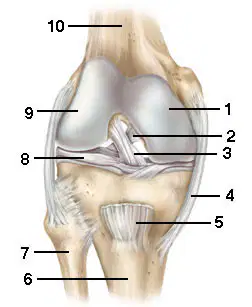
Match the names of the structures with the correct number.
9
Articular Cartilage
10
Femur
6
Tibia
7
Fibula
5
Patellar Tendon
Match the names of the structures with the correct number.
4
MCL
2
PCL
3
ACL
Ligament next to Number 8 and 9.
LCL
What condition of the knee is also known as Jumpers Knee and typically produces pain on the anterior aspect of the knee, just below the patella.
Patellar Tendonitis
Meniscus Tear
Osteoarthritis
Old Folk Knee
Scenario: You are evaluating a patient who has been complaining of their knee locking and clicking when they bend it. During your special tests, you perform the McMurray's Test. This produces a POSITIVE Test.
What injury could this patient be dealing with?
LCL Tear
Meniscus Tear
Quadriceps Strain/ Tear
Hamstring Strain/ Tear
Pick the correct MOI for the following injury:
ACL Tear
Twisting of the knee
Valgus Force
Varus Force
Falling on bent knee
Pick the correct MOI for the following injury:
PCL Tear
Twisting of the knee
Valgus Force
Varus Force
Falling on bent knee
Pick the correct MOI for the following injury:
MCL Tear
Twisting of the knee
Valgus Force
Varus Force
Falling on bent knee
Pick the correct MOI for the following injury:
LCL Tear
Twisting of the knee
Valgus Force
Varus Force
Falling on bent knee
Scenario based:
You are working for a baseball team and your starting pitcher went to field a baseball. As he runs off the mound, he steps in a hole and hyperextends his knee. He feels instability and has a positive Posterior Drawer Test.
What could be a possible diagnosis?
PCL Tear
ACL Tear
MCL Tear
LCL Tear
Match the Elements of PEACE & LOVE to the letter they correspond to:
P
Having your athlete wear a knee brace
Elevate
Athlete sleep with leg higher than heart
A
No Ice
C
Knee sleeve for swelling
Educate
Teaching athlete about their injury

