
NEW
Font size
 Worksheets
Traits and Reproduction Review
Total questions: 20
Worksheet time: 10mins
Use the information and your knowledge of science to answer the question.
Squirrels in different areas can have a range of fur colors including gray, brown, and black. For a number of years, the majority of squirrels in North America have had a gray fur color. Scientists have recently observed an increase in squirrels with black fur color from 0–5 percent of the squirrel population to as much as 25 percent of the squirrel population in some areas.
Which statement best describes how squirrels with gray fur color and squirrels with black fur color have adapted to these areas in recent years?
Squirrels with gray fur color have adapted traits that are better suited for these areas than the traits in squirrels with black fur color.
Squirrels with black fur color have adapted traits that are better suited for these areas than the traits in squirrels with gray fur color.
Squirrels with gray fur color and squirrels with black fur color have adapted equally to living in these areas.
Squirrels with gray fur color and squirrels with black fur color both have adapted traits that are less suited to living in these areas.
Two goldfish have different parents. One fish has a split tail and the other does not.
Why do the goldfish have tails with different shapes?
Each goldfish has a different tail shape because offspring from different parents will have different tail shapes.
Each goldfish has a different tail shape because they have different versions of the gene for tail shape that connect together to make different tail shapes.
The goldfish have different versions of the gene for tail shape. The genes are split inside one goldfish’s tail but not inside the other’s.
The goldfish have different versions of the gene for tail shape, which instruct for different proteins that connect in different ways to make different tail shapes.
The shape of a protein molecule directly determines its_____________.
movements through the cytoplasm
functions inside and outside of cells
roles in building water molecules
circulation throughout the body
Which of the following do proteins with several connectors create?
high silk flexibility
medium silk flexibility
low silk flexibility
no silk flexibility
Shar Peis
Chinese Shar Peis are dogs that are selectively bred by humans specifically for their wrinkly fur coat, small triangular ears, and broad muzzle. These traits are recessive and must be brought out by breeding similar dogs with the desired traits. Dominant Shar Peis are becoming less desirable, as the rare traits become more in demand.
Part A: Which statement best describes how humans select for wrinkly skin in Chinese Shar Peis?
By mating a very wrinkly female and non-wrinkly male so they have the best chance of passing on the gene for wrinkly skin.
By mating a wrinkly female and wrinkly male so they have the best chance of passing on the gene for wrinkly skin.
By inserting a gene for wrinkly skin into every Shar Pei puppy.
By mutating the DNA of one Shar Pei, hoping they will pass on the mutated trait to their offspring.
What causes a variation in traits?
Two exact copies of the same protein molecule
A variation in protein molecules within an individual’s cells.
Having the same connections among protein molecules.
A variation in cells within an individual’s protein molecule.
There are two junco birds that each have different proteins in their cells for beak pointiness. They have different parents.
What can you say about the birds' beak pointiness?
They will have the same beak pointiness because even with different proteins for beak pointiness, the proteins can connect in the same way.
They will have different beak pointiness since offspring from different parents will have different beak pointiness.
They will have different beak pointiness since their proteins for beak pointiness are different so the proteins will connect in different ways.
They will have the same beak pointiness since all junco birds have the same beak pointiness.
The body cells of scorpions have proteins that connect together. In one scorpion, the structure of the proteins in the body cells changed, but the amount of that type of protein in the cell stayed the same.
What happened to the function of that type of protein?
The changed protein connects differently, but its function doesn’t change.
The changed protein connects differently, so its function changes.
The changed protein connects in the same way, but its function changes.
The amount of that type of protein stayed the same, so its function doesn’t change.
A group of scientists is trying to bring mammoths back by modifying elephant chromosomes. The new animals would have a mixture of elephant and mammoth genes.
What will be the effect of the new genes?
The new genes will produce different proteins.
The new genes will prevent gene replication.
The new genes will require gene therapy.
The new genes will not have alleles.
Which sequence lists the hereditary material found inside cells from the smallest to the largest unit?
Chromosome, gene, nucleus
gene, nucleus, chromosome
gene, chromosome, nucleus
Scientists use methods to genetically engineer or alter many plant crops. Today, a lot of the foods available at the store, such as types of corn, are genetically modified organisms (GMOs).
What is one concern with relying on GMOs as a source of food?
decrease food supply
decreased desired traits
decreased human health
decreased pest resistance
What are alleles?
chromosomes
cells
gene versions
nuclei
Sh’qira reads an article about a family of wildcats. One of them had a mutation for tooth sharpness.
Which of these statements about the wildcat with the mutation is true?
There must have been a change in the wildcat’s genes.
The wildcat must have sharper teeth.
There will be no change to the wildcat’s teeth.
The wildcat must have less sharp teeth.
If a woman is homozygous for normal blood clotting and her husband is heterozygous for a genetically inherited disease, which of the following might represent their alleles?
Wife: A1, A2; Husband: A1, A2
Wife: C1, A1; Husband: A2, A2
Wife: A1, A1; Husband: A1, A2
Wife: A1, A2; Husband: C2, C2
A baby crawfish has a long tail. Its mother has a long tail while its father has a short tail.
Which of these statements explains why the baby has a long tail?
The baby crawfish inherited one copy of the gene for tail length from its mother and one copy from its father. Those genes connect together to make its long tail.
The baby crawfish inherited one copy of the gene for tail length from its mother and one copy from its father. That gene combination instructs for proteins that connect in ways that make a long tail.
The baby crawfish inherited its copies of the gene for tail length from its mother and not from its father. Just like its mother’s genes, those genes instruct for proteins that connect in ways that make a long tail.
The baby crawfish inherited its copies of the gene for tail length from its mother and not from its father. Those genes connect together to make a long tail.
There are two bears that both have the same proteins for ear shape in their cells. The bears have different parents.
What can you say about the bears' ear shape?
They will have the same ear shape since their proteins for ear shape are the same so the proteins will connect in the same way.
They will have the same ear shape since all bears have the same ear shape.
They will have different ear shapes because even with the same proteins for ear shape, the proteins can connect in different ways.
They will have different ear shapes since only offspring from the same parents have the same ear shape.
What causes the spider to have high silk flexibility?
proteins with many connectors
different types of proteins
proteins with no connectors
proteins with fewer connectors
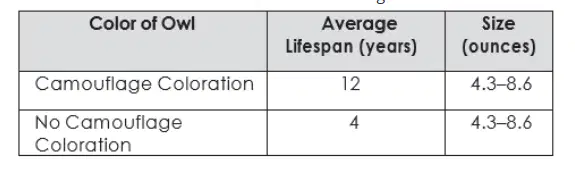
A student makes a claim that screech owls with camouflage coloration are more likely to survive and leave offspring than screech owls without camouflage coloration due to natural selection. The student makes the following chart based on collected data:
What evidence supports the student’s claim?
Camouflage coloration determines the size of the owl and its ability to fight off predators.
Owls without camouflage coloration have more offspring, so they can repopulate the species.
The size of the owl is directly related to the average lifespan of the owl, so larger owls live longer.
Owls with camouflage coloration live longer than owls without this trait.
Brayden is trying to figure out how petal shape is determined in two different roses. In the pink rose, the copies of the gene are the same as each other. In the yellow rose, the copies of the gene are different from each other.
How does this affect how many types of proteins there are in each petal cell?
The pink rose has one type of protein for the petal shape feature. The yellow rose has two types of protein for the petal shape feature.
The pink rose has one type of protein for the petal shape feature. The yellow rose has one type of protein for the petal shape feature.
The pink rose has two types of protein for the petal shape feature. The yellow rose has two types of protein for the petal shape feature.
It is impossible to say anything about proteins from the given information.
Genes are part of a _______________.
cell wall
chromosome
hormone
vitamin

