
NEW
Font size
 Worksheets
Hooke's Law and Harmonic Motion
Total questions: 15
Worksheet time: 8mins
Net forces are said to be in _______________________ if the net forces (restoration force) of a pendulum are zero.
flux
equilibrium
oscillation
displacement
In terms of simple harmonic motion, this is the time needed for one full cycle of motion to occur.
amplitude
period
frequency
spring constant
Back and forth motion.
period
equilibrium
oscillation
amplitude
What is the amplitude in terms of a spring or pendulum?
a distance
an amount of time
a speed
a resting point
If a spring is stretched or compressed, it is said to have ____________________________.
What are pendulums useful to calculate?
Force of gravity on earth
You can calculate a this by dividing the force needed to stretch or compress a spring by the distance it was stretched of compressed.
amplitude
period
spring constant
energy
The net forces that work to bring a pendulum or spring back to equilibrium is also called the _____________________.
A spring has a spring constant of 500 N/m. A force of 100 N is applied to it. How much does the spring stretch?
A rubber band has a spring constant of 15 N/m. When pulled with a force of 10 N, how far does it stretch?
0.67 m
0.34 m
A spring is compressed by 0.5 meters and has a spring constant of 350 N/m. What is the force applied to compress the spring?
A trampoline stretches downward by 0.35 meters when a force is applied. If the spring constant is 450 N/m, what force caused this displacement?
35.5 N
275 N
355.5 N
A slingshot uses a spring with a spring constant of 650 N/m. Before firing, the spring is compressed by 0.1 meters. How much potential energy is stored in the spring?
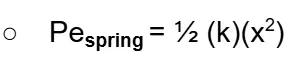
A wind-up toy has a spring inside that compresses 0.03 meters when wound up. The spring has a spring constant of 400 N/m. What is the potential energy of the compressed spring?
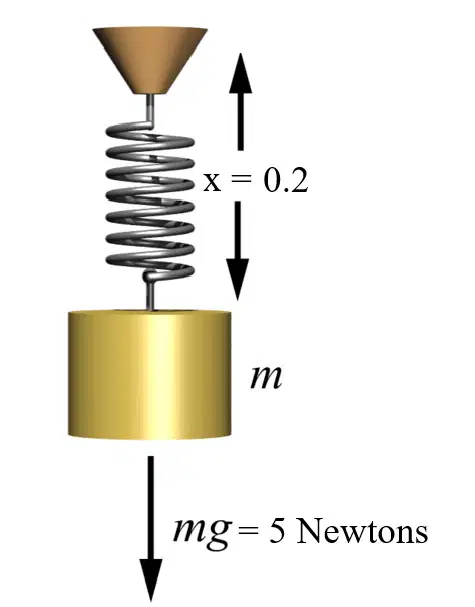
Based on the information in the picture, what is the potential energy of the stretched spring?
pe = 1/2(k)(x2)
You will first need to calculate spring constant (k).
k = f/x

