
 Worksheets
Pure Substance, Mixture, Solution - SC.8.P.8.9
Total questions: 10
Worksheet time: 5mins
Name
Class
Date
1.
(SC.8.P.8.9) After dinner, Hector demonstrated to his parents a process that he learned in science class that day. He poured a small amount of sugar into a cup of water and then stirred it until the sugar dissolved. Which process did Hector demonstrate?
a)
how dissolving a substance in water is an example of a chemical reaction
b)
how substances dissolve in water to produce a pure substance
c)
how two pure substances can be combined to form a solution
d)
how to separate components of a solution
2.
(SC.8.P.8.9) Table salt easily dissolves in water. However, cornstarch does not. If both table salt and corn starch are added to water and then stirred, what is the best way to remove the corn starch from the resulting mixture?
a)
Add a liquid to dissolve the cornstarch.
b)
Allow the mixture to stand.
c)
Pour the mixture through a filter.
d)
Heat the mixture.
3.
(SC.8.P.8.9) A solution is a mixture where one substance is dissolved in another. One example of a solution is salt water. Why does salt water appear to be a single substance even though it contains more than one substance?
a)
Each component in salt water retains its original physical properties.
b)
The components in salt water cannot be separated from each other.
c)
Salt water is a pure substance.
d)
The particles in salt water are distributed evenly among each other.
4.
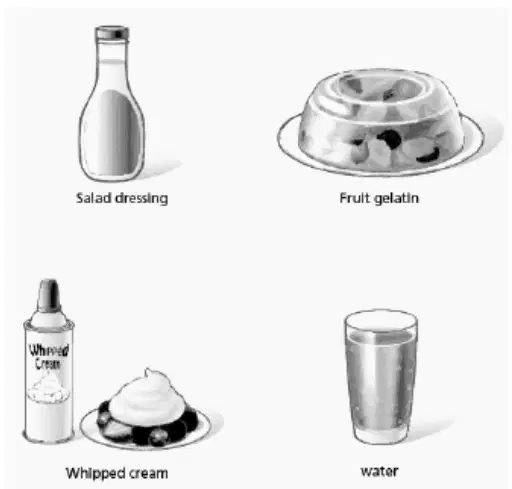
(SC.8.P.8.9) A pure substance is made up of one type of particle, such as an element or compound. The illustration below shows several common household items.
Which of the items in the illustration is a pure substance?
a)
Water
b)
Fruit gelatin
c)
Salad dressing
d)
Whipped cream
5.
(SC.8.P.8.9) Mrs. Petrone asked her science class to explain what is meant by the statement “Every solution is a mixture, but not every mixture is a solution.” Which of the following best explains this statement?
a)
Unlike other classes of mixtures, a solution is always made by dissolving a substance in water.
b)
Unlike other classes of mixtures, a solution has a uniform chemical composition.
c)
Unlike other classes of mixtures, a solution cannot be separated into its components.
d)
Unlike other classes of mixtures, a solution contains substances that are chemically combined.
6.
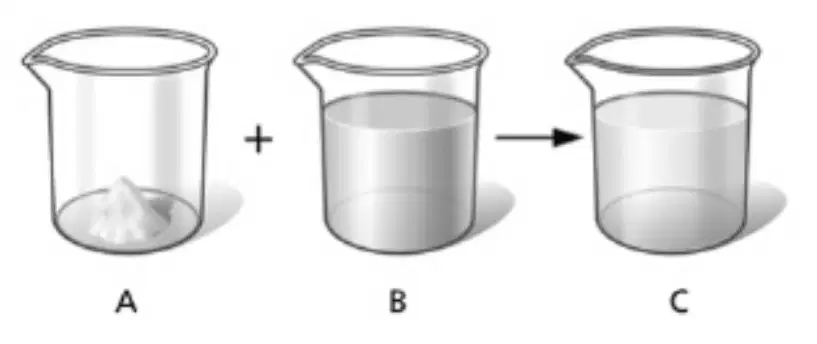
(SC.8.P.8.9) Ricardo prepared the drawing shown below to illustrate the steps in preparing a solution.
Which of the following correctly identifies each of the components in the preparation of a solution?
a)
A – solute; B – solvent; C – solution
b)
A – solute; B – solution; C – solvent
c)
A – solvent; B – solute; C – solution
d)
A – solution; B – solvent; C – solute
7.
(SC.8.P.8.9) Francine’s mother made a fruit salad for breakfast. While Francine was eating her fruit salad, she exclaimed to her mother, ”I’m enjoying this mixture!”. Why did Francine refer to the fruit salad as a mixture?
a)
The fruit salad contains components whose original chemical properties have been changed after mixing.
b)
The fruit salad contains various ingredients that can be separated only by using chemical means.
c)
The fruit salad contains various ingredients that each retains their original chemical properties.
d)
The fruit salad contains various ingredients mixed in fixed amounts.
8.
(SC.8.P.8.9) In science class, Jonathan added a small amount of sand to a beaker of water. He stirred it vigorously so that all the sand swirled around in the water. Jonathan then claimed to his classmates that he had made a solution. However, his teacher told Jonathan that he was mistaken. Why was the teacher correct?
a)
A solid substance cannot dissolve in water to form a solution.
b)
Jonathan made a compound, not a mixture.
c)
A chemical reaction did not take place, so a solution was not formed.
d)
The sand will eventually settle to the bottom and will not dissolve in the water.
9.
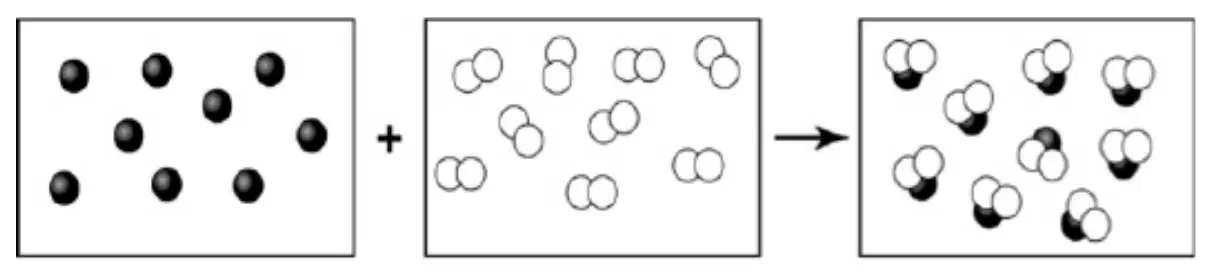
(SC.8.P.8.9) The illustration below shows the process of two different substances being combined. Which process does the illustration show?
a)
two pure substances physically combined to form a mixture
b)
a solution formed by dissolving a solid in a liquid
c)
a mixture separated into the components that were originally combined
d)
two pure substances chemically combined to form a different pure substance
10.
(SC.8.P.8.9) Air contains about 78% nitrogen and 21% oxygen. What can you conclude from this fact?
a)
Air is a pure substance.
b)
Air consists of components that are chemically joined.
c)
Air consists of different states of matter.
d)
Air is a mixture of at least two gases.
100 %

