
 Worksheets
4th and 5th Grade VA Science SOL Review
Total questions: 43
Worksheet time: 21mins
What is the term for a push or pull that can change the motion of an object?
Velocity
Acceleration
Force
Momentum
What is the measurement of how much matter is in an object?
Volume
Mass
Density
Weight
What is the energy of motion called?
Kinetic energy
Potential energy
Thermal energy
Chemical energy
What is the energy stored in an object due to its position or condition?
Kinetic energy
Potential energy
Electrical energy
Light energy
What simple machine is a rigid bar that pivots on a fixed point?
Inclined plane
Wedge
Pulley
Lever
What is the property of matter that describes how easily it can be scratched?
Density
Volume
Hardness
Conductivity
What is the process of a solid changing directly into a gas?
Melting
Condensation
Evaporation
Sublimation
What is the formula for calculating speed?
Speed = Force / Time
Speed = Mass / Volume
Speed = Distance / Time
Speed = Acceleration / Time
What is the force that opposes motion between two surfaces that are in contact?
Gravity
Magnetism
Friction
Tension
What is the ability to do work?
Power
Force
Momentum
Energy
What is a flow of electrical charges?
Voltage
Current
Resistance
Power
What type of circuit has only one path for current to flow?
Series circuit
Parallel circuit
Open circuit
Short circuit
What is the rapid back-and-forth movement that creates sound?
Compression
Rarefaction
Vibration
Wavelength
What is the measure of how high or low a sound is?
Volume
Amplitude
Intensity
Pitch
What type of wave is light?
Sound wave
Mechanical wave
Electromagnetic wave
Seismic wave
What is the bending of light as it passes from one medium to another?
Reflection
Refraction
Diffraction
Absorption
What is the bouncing of light off a surface?
Reflection
Refraction
Transmission
Dispersion
What are materials that allow electricity to flow easily?
Conductors
Insulators
Resistors
Capacitors
What are materials that resist the flow of electricity?
Conductors
Insulators
Semiconductors
Superconductors
What part of the eye allows us to see color?
Pupil
Lens
Rods
Cones
What is the process by which plants make their own food?
Respiration
Decomposition
Photosynthesis
Digestion
What is a group of organisms of the same species living in the same area?
Population
Community
Ecosystem
Biome
What is a community of organisms and their physical environment?
Population
Ecosystem
Habitat
Niche
What is an animal that eats only plants?
Herbivore
Carnivore
Omnivore
Detritivore
What is an animal that eats only meat?
Herbivore
Carnivore
Omnivore
Decomposer
What is an animal that eats both plants and animals?
Herbivore
Carnivore
Omnivore
Scavenger
What is the role an organism plays in its ecosystem?
Habitat
Population
Niche
Community
What is a diagram that shows how energy flows through an ecosystem?
Food web or food chain
Biome map
Population chart
Habitat diagram
What is the process of change in a community over time?
Adaptation
Evolution
Succession
Migration
What is the term for a living thing?
Mineral
Rock
Element
Organism
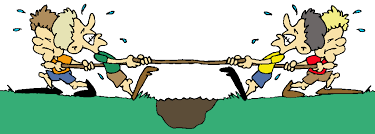
If these teams are pulling with the same amount of force what will happen?
The boy in blue will win.
They will not move at all.
The boy in red will win.
Both will fall down.
What is the force that pulls objects toward the center of the Earth?
Inertia
Gravity
Friction
Magnetism
What is the smallest unit of life?
Tissue
Atom
Cell
Molecule
What is the Earth's natural satellite?
Moon
Mars
Sun
Jupiter
What are the four inner planets of our solar system?
Mercury, Venus, Earth, Pluto
Earth, Mars, Jupiter, Saturn
Mercury, Venus, Earth, Mars
Jupiter, Saturn, Uranus, Neptune
What is the process of breaking down rocks into smaller pieces?
Weathering
Deposition
Compaction
Erosion
What is the movement of weathered rock material from one place to another?
Sedimentation
Erosion
Weathering
Deposition
What are natural resources that can be replenished over time?
Renewable resources such as forests, fish, and freshwater.
Non-renewable resources like coal and oil
Minerals and metals found in the earth's crust
Synthetic materials such as plastics
What are natural resources that cannot be replenished over time?
Timber resources
Wind energy
Solar energy
Non-renewable resources such as fossil fuels and minerals.
What is the continuous movement of water on, above, and below the surface of the Earth?
Rock cycle
Water cycle
Carbon cycle
Nitrogen cycle
What causes the phases of the moon?
Earth's rotation
The moon's revolution around the Earth
The sun's light changes
The earth's tilt.
What causes day and night?
Moon's rotation
Sun's revolution
Earth's revolution
Earth's rotation
What are the layers of the Earth?
Crust, Mantle, Outer Core, Inner Core
Lithosphere, Asthenosphere, Mesosphere, Exosphere
Core, Shell, Surface, Subsurface
Crust, Mantle, Atmosphere, Lithosphere

