
 Worksheets
Standards review Social Studies part 1
Total questions: 63
Worksheet time: 45mins
Which of the following is a continent?
Pacific Ocean
Sahara Desert
Europe
Amazon River
Which major world religion originated in the Middle East and is based on the teachings of Jesus Christ?
Buddhism
Christianity
Hinduism
Islam
What mountain range is located in Europe and is known for its high peaks and scenic beauty?
Himalayas
Andes
Alps
Rockies
Which of the following is a cardinal direction?
Northeast
Southwest
East
Northwest
Which religion is known for its Four Noble Truths and Eightfold Path?
Islam
Christianity
Buddhism
Judaism
Who was the ruler that shaped medieval Europe by creating the Holy Roman Empire?
William the Conqueror
Charlemagne
Julius Caesar
Alexander the Great
Which of the following is a geographic representation used to locate places?
Map
Compass
Globe
All of the above
Which religion is associated with the Quran as its holy book?
Hinduism
Christianity
Islam
Buddhism
What was the economic system called that was based on land ownership and personal loyalty during the Middle Ages?
Capitalism
Feudalism
Socialism
Communism
Which of the following is an intermediate direction?
North
South
Southeast
West
Which religion is known for its belief in reincarnation and karma?
Judaism
Christianity
Hinduism
Islam
What was the significance of the Magna Carta in medieval Europe?
It established the first democracy.
It limited the power of the monarch.
It ended the Hundred Years' War.
It started the Crusades.
Which line of latitude is located at 0 degrees?
Prime Meridian
Equator
Tropic of Cancer
Tropic of Capricorn
Which religion is associated with the Torah as its sacred text?
Islam
Christianity
Judaism
Buddhism
What was one of the effects of the Black Death on Europe?
Increase in population
Economic prosperity
Decline in population
Rise of new religions
Which ocean is located to the west of Europe?
Indian Ocean
Atlantic Ocean
Pacific Ocean
Arctic Ocean
Which religion spread primarily through the teachings of Siddhartha Gautama?
Islam
Christianity
Buddhism
Hinduism
What was the role of monasteries in medieval Europe?
Centers of trade
Preservation of knowledge
Military training grounds
Political headquarters
Which of the following is a desert?
Sahara
Amazon
Alps
Nile
Which religion is known for its Five Pillars, including the declaration of faith and prayer?
Hinduism
Christianity
Islam
Buddhism
What was the primary purpose of the Crusades in medieval Europe?
To develop new technologies
To spread Christianity
To establish trade routes
To explore new lands
Which geographic feature is known as the longest river in the world?
Mississippi River
Yangtze River
Nile River
Amazon River
Which document, signed in 1215, is considered a cornerstone of modern democracy?
Bill of Rights
Constitution
Magna Carta
Declaration of Independence
Which medieval European event was characterized by a series of religious wars?
Crusades
Industrial Revolution
Reformation
Renaissance
Which geographic feature is known as the largest desert in the world?
Sahara Desert
Kalahari Desert
Gobi Desert
Arabian Desert
Which major world religion is associated with the Vedas as its sacred texts?
Buddhism
Islam
Christianity
Hinduism
Which of the following events marked the end of the medieval period in Europe?
Signing of the Magna Carta
Discovery of America
Start of the Renaissance
Fall of Constantinople
Which geographic feature is known for being the longest river in the world?
Mississippi River
Yangtze River
Nile River
Amazon River
Which major world religion is associated with the Eightfold Path?
Christianity
Islam
Buddhism
Hinduism
Which geographic feature is known as the highest mountain in the world?
K2
Mount Everest
Mount McKinley
Mount Kilimanjaro
Which event in medieval Europe led to a significant decline in population due to a pandemic?
Crusades
Renaissance
Hundred Years' War
Black Death
peninsula containing Spain and Portugal
Balkan
Scandinavian
Italian
Iberian
two longest rivers in Europe
Danube and Nile
Rhine and Danube
Rhine and Tiber
Tiber and Tigris
king of the Franks, named Emperor by the pope, also called Charles the Great
Charles Martel
Charlemagne
Clovis I
all of these are correct
Charlemagne was known for all of the following EXCEPT —
strong efficient government
creating schools
spreading Christianity
ending slavery in Europe
What happened to Charlemagne's empire by the end of the century?
It continued to exist
It was conquered by the Vikings
It was divided into smaller kingdoms
It became part of the Byzantine Empire
What was the dominant system of government in Europe for 400 years?
Democracy
Communism
Monarchy
Feudalism
What was the religion of the Holy Roman Empire?
Buddhism
Christianity
Islam
Judaism
What was the system of government in which nobles gave land to lesser nobles in exchange for loyalty and military service?
Democracy
Monarchy
Feudalism
Communism
What was one of Charlemagne's greatest achievements?
Inventing the printing press
Discovering America
Establishing feudalism throughout his empire
Conquering the Byzantine Empire
What religion was established as the religion of the Holy Roman Empire?
Judaism
Buddhism
Islam
Christianity
What system of government did Charlemagne establish?
Communism
Feudalism
Monarchy
Democracy

In the end, who won the Hundreds year war?
France
Englend
Flanders
The Holy Roman Empire
Henry V most famous victory was at the Battle of...
Meaux
Agincourt
Hastings
Boulogne
Who fought each other in the crusades?
The Romans and the Greeks
The Europeans and the Muslims
The Eastern and Western Roman churches
What was the name of the 14 year old girl who led the French army to victory in the Battle of Orleans against the English?
Arc de Triomphe
John La Bel
John of Arc
Joan of Arc
The city of Jerusalem is important to what three major religions?
Buddhism, Hinduism, and Islam
Islam, Christianity, and Hinduism
Islam, Christianity, and Judaism

According to the chart, what is the approximate decrease in the population of Europe as a result of the plague?
10%
25%
50%
90%
Joan of Arc was tried for _____________
Desertion
War Crimes
Being a woman
Heresy
How did the spread of the Bubonic Plague impact the European economy?
The economy grew as Europeans researched a cure.
The economy shrank as medical costs increased.
The economy grew as trade increased.
The economy shrank as the workforce decreased.
From what continent did the Bubonic Plague most likely come?
Asia
Africa
North America
South America
Who was forced to sign the Magna Carta?
Hugh Capet
William the Conqueror
King John
Henry II
Series of wars between the Muslims and Christians to control the Holy Land.
War of the Roses
Hundred Years' War
Crusades
Battle of Hastings
England won the Battle of [blank] during the Hundred Years' War.
Hastings
increased
decreased
Agincourt
Waterloo
France won the Battle of [blank] during the Hundred Years' War.
Orleans
Agincourt
Crecy
Poitiers
Anti-Semitism is hostility toward or discrimination against which group?
a widespread poisoning of rodents
Jewish people
the Japanese
a widespread absence of fleas
a widespread bacterial disease that is contagious
How did the Black Death lead to the end of feudalism?
Lords increased the size and value of their estates.
Serfs who survived the plague demanded payment for their work.

What is one reason plague doctors dressed in this way?
They wanted to avoid touching rats.
They believed the disease was carried by bad smells.
What were the effects of the Hundred Years’ War? Select the two correct answers.
It improved trade between nations.
It left the French king in control of almost all of France.
It resulted in increased nationalism in France and England.
What is one way Henry V shaped the culture of the Middle Ages?
He encouraged the use of English in official documents and literature.
He became the leader of a movement to end vassalage.
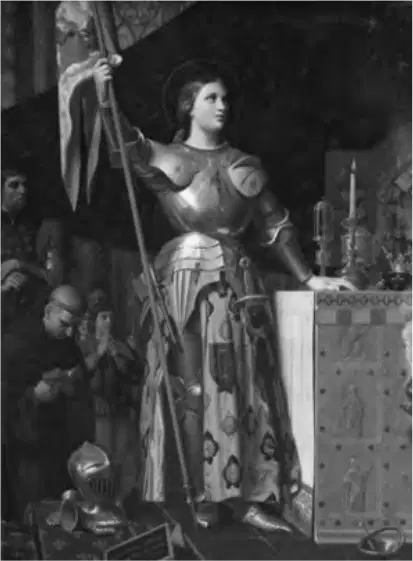
What does this image reveal about Joan of Arc?
She followed the guidance of the pope.
She became the leader of Orléans.
She came from a poor peasant family.
She was an important military leader.
What were some significant impacts of the Hundred Years’ War? (Choose 2)
England lost all its territory in France by the end of the war.
The war helped spread French language and culture in England.
England controlled new territory in France by the end of the war.
The war helped shape the national identities of both France and England.

