
 Worksheets
Similar Circles
Total questions: 24
Worksheet time: 23mins
Show that circle C with center (–1, 2) and radius 3 is similar to
circle D with center (3, 4) radius 5.
Translation: right 5 units, up 3 units
Enlargement ratio: 3/5
Translation: right 4 units, up 2 units Enlargement ratio: 3/5
Translation: right 2 units, up 4 units
Enlargement ratio: 5/3

What transformations can be used to show circles I and J are similar?
Dilate circle I with scale factor 1/2 and then translate down 4 and left 6.
Translate circle J right 4 and up 6 and then dilate about point (4, 10) with a scale factor 1/2
Translate circle J left 6 and down 4 and then dilate about point (4, 10) with scale factor 2.
Dilate circle I with scale factor 1/2 and then translate left 4 and down 6.

Circle B is the pre-image and Circle A is the image.
Which transformations map Circle B onto Circle A?
(x, y)→(x − 4, y + 8); dilation by scale factor of 3/4 at center of circle
(x, y)→(x + 4, y − 8); dilation by scale factor of 4/3 at center of circle
(x, y)→(x − 4, y + 8); dilation by scale factor of 4/3 at center of circle
(x, y)→(x − 4, y + 8); dilation by scale factor of 1/2 at center of circle
Circle A has center (2, 7) and radius 2. Circle B has center (9, 1) and radius 5. Which transformations can be used to show that the two circles are similar?
Translate circle A right 7 and down 6 and then dilate with scale factor 5/2
Translate circle A left 7, up 6 and then dilate with scale factor 2/5 .
Dilate circle A at scale factor 2/5 then translate right 7 and down 6
Reflect circle A over x = 5.5 and translate up 6 units.
Circle B is mapped to Circle D using a dilation with center (1, -7) and scale factor 3/5 followed by a translation right 2 and up 6. If the radius of Circle B is 15 units, describe Circle D.
Circle D has a radius of 9 and center (3, -1).
Circle D has a radius of 3 and center (-1, -13).
Circle D has a radius of 25 and center (3, -1).
Circle D has a radius of 12 and center (-1, -13).
Circle X is transformed to Circle Y
using a dilation with center (2, 3) and scale factor 4/7 followed by a translation left 3 and down 5.
If the radius of Circle X is 21 units, describe Circle Y.
Circle Y has a radius of 12 and center (-1, -2).
Circle Y has a radius of 6 and center (5, 8).
Circle Y has a radius of 28 and center (-1, -2).
Circle Y has a radius of 16 and center (5, 8).
Show that circle C with center (0, 2) and radius 6 is similar to circle D with center (0, –6) radius 2.
Show the two given circles are similar by stating the necessary transformations from C to D.
C: center (2, 3) radius 5;
D: center (–1, 4) radius 10.
Show the two given circles are similar by stating the necessary transformations from C to D.
C: center (0, –3) radius 2;
D: center (–2, 5) radius 6
Show the two given circles are similar by stating the necessary transformations from C to D
C: center (–2, 8) radius 4;
D: center (0, 4) radius 9

Transform circle F to circle F' by translating it and then performing a dilation. Find the translation rule and the scale factor of the dilation.
Translation rule: (x, y) -> (x - 10, y + 9); Scale factor: 1.5

Circle F to circle F' by translating it and then performing a dilation. Find the translation rule and the scale factor of the dilation.
Translation rule: (x, y) -> (x -11, y - 10); Scale factor: 0.67
Translation rule: (x, y) -> (x - 4, y + 1); Scale factor: 5
Translation rule: (x, y) -> (x -11, y - 10); Scale factor: 1.5

You can transform circle F to circle F' by translating it and then performing a dilation. Circle F (6, -6) and Circle F’ (3, 2) and the radius F is 3 and the radius of F’ is 5.
Find the translation rule and the scale factor of the dilation.
Match the following ( Big Circle to Small Circle)

(x-7, y-7) and
scale factor of 0.6

(x+9, y+4) and
Scale factor: 0.43

(x+7, y-8) and
scale factor of 0.5
Fill in the blanks using the correct word given in brackets:
All circles are (a) .
congruent
Fill in the blanks using the correct word given in brackets:
All squares are . (a)
Fill in the blanks using the correct word given in brackets:
All (a) triangles are similar. (isosceles, Right, Equilateral)
Jake says "Two circles are always similar no matter what because you can map one onto the other using similarity transformations!!" What transformations might he be referring to?
Two circles A and B have different radii.
A student dilates circle A with at its center by a scale factor of 9/4 to make it the same size as circle B.
What scale factor could have been used to make circle B the same size as circle A?
(if it was 9/4 to go from Circle A to B what would it be multiplied to go from Circle B to Circle A)
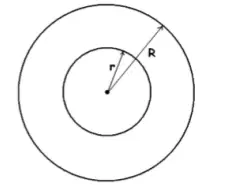
Circle A and circle B are concentric.
What does that mean?
If the radius of circle A is 24 cm and the radius of circle B is 18 cm.
What scale factor would map circle A onto circle В?
6/5
9/10
3/4
1/2
Determine the translation vector that would map the center of circle A onto the center of circle B.
Circle A (-4,5) Circe B (3,0)
<7, -5>
<0, 3>
<5, 5>
<-7, 5>
To prove Similarity between
Circle A center at A (-2,5) with radius of 5 cm.
Circle B at (5,-3) with a radius of 15 cm.
Janice translates circle A by vector <7,-8> and dilates circle A at point B by a scale factor of 3.
Provide transformation sequences to establish Similarity ?

