
 Worksheets
Review for Unit Test #11: Weather Forecasting
Total questions: 26
Worksheet time: 13mins
Name
Class
Date
1.
Which will cause a front to develop?
a)
Ocean water being pushed onto land.
b)
Wind blowing from one place to another.
c)
Water falling from clouds to the ground.
d)
Two or more air masses colliding.
2.
Local weather is affected by changes in
a)
temperature
b)
humidity
c)
atmospheric pressure
d)
all of the above
3.

Bryan is measuring the barometric pressure to make weather forecasts every hour. He records his data in the table below. Which of the following weather forecasts is reasonable?
a)
A low pressure system is moving into the area.
b)
A high pressure system is moving into the area.
c)
Tomorrow will be sunnier than today.
d)
Next week will be cooler than this week.
4.

Based on the data in the table below, what type of weather instruments were used to collect the weather data?
a)
anemometer; thermometer
b)
barometer; thermometer
c)
barometer; hygrometer/sling psychrometer
d)
hygrometer; wind vane/wind sock
5.

Observe the weather map below. What type of weather conditions are likely moving through South Carolina?
a)
rain and warmer temperatures
b)
sunny and clear skies
c)
rain for several days
d)
thunderstorm and cooler temperatures
6.
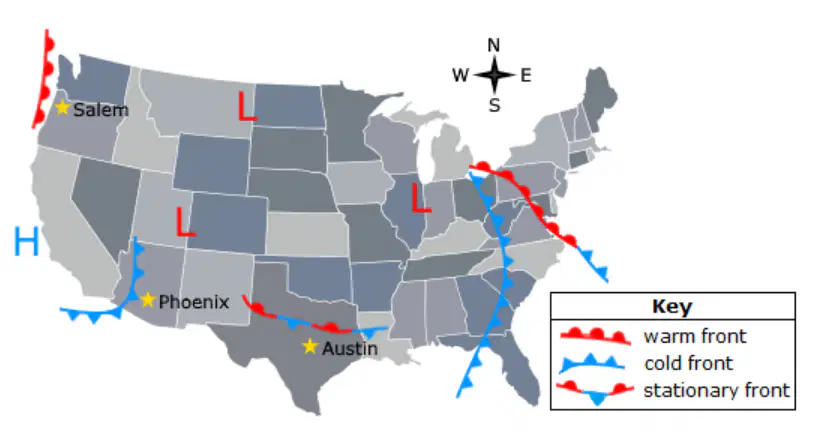
What general direction is the cold front moving as it passes over South Carolina?
a)
north
b)
east
c)
south
d)
west
7.
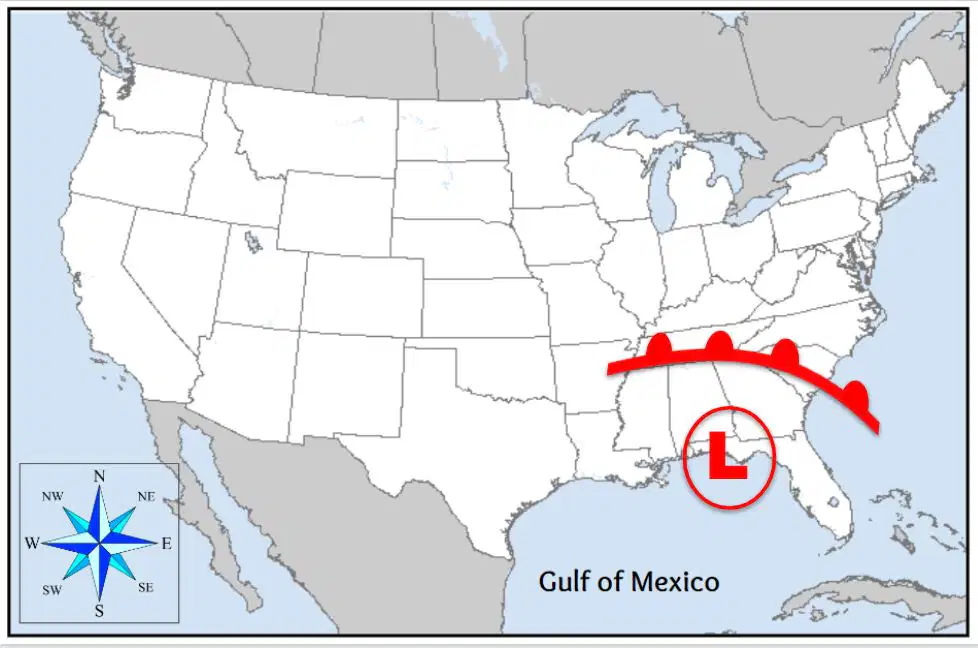
Observe the image below. Based on the map, what are the weather conditions over South Carolina?
a)
clear and sunny with cooler temperatures
b)
cloudy and rainy with warmer temperatures
c)
clear and sunny with warmer temperatures
d)
clear skies with rain cold temperatures
8.
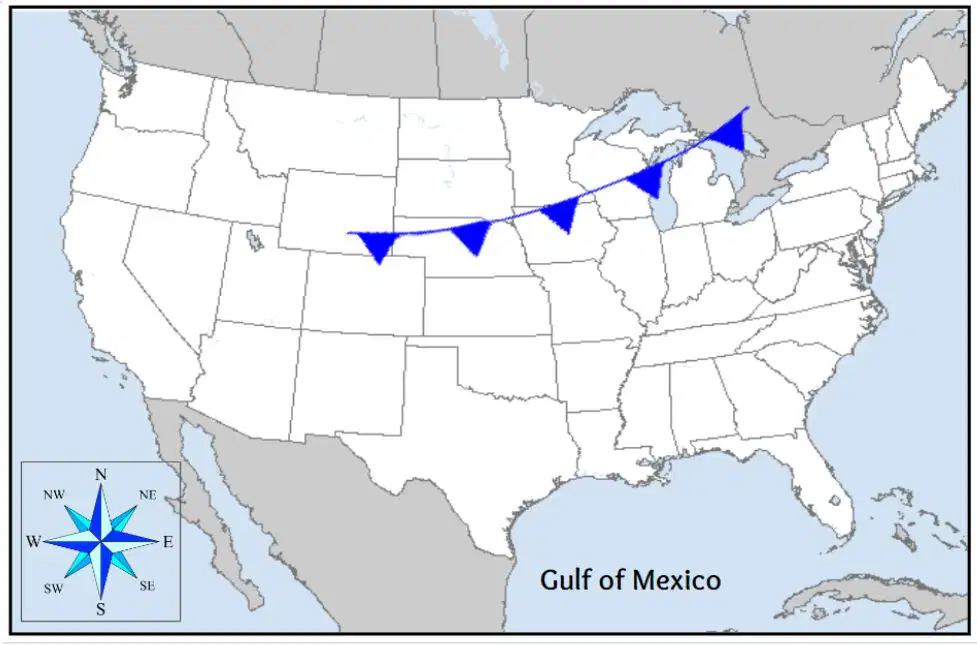
What type of air mass is influencing the front below?
a)
cold, dry
b)
cold, moist
c)
warm, dry
d)
warm, moist
9.
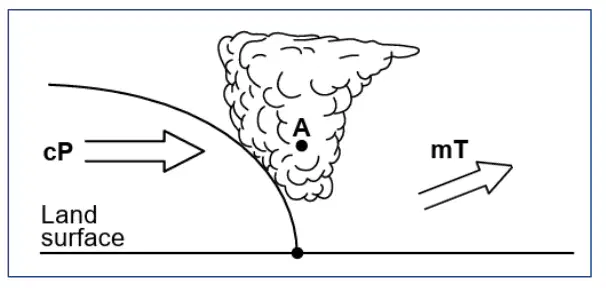
Observe the model below. What type of front is illustrated?
a)
warm front
b)
cold front
c)
stationary front
10.
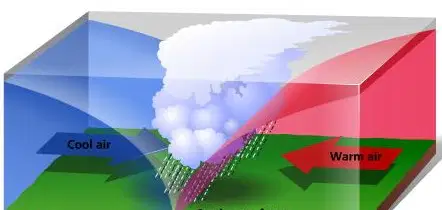
Identify the type of front that is illustrated in the model below.
a)
warm front
b)
cold front
c)
stationary front
11.
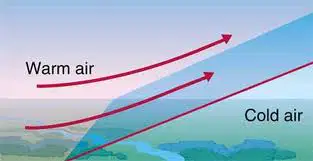
Observe the illustration below. What type of front is illustrated in the model below?
a)
cold front
b)
warm front
c)
stationary front
12.
An air mass's relative humidity is a measure of how much water vapor it contains compared to how much it can contain. Different types of air masses, with different temperatures and pressures, are able to hold different amounts of water vapor.
Which of the following could cause the relative humidity of an air mass to change?
a)
a change in its temperature
b)
a change in its water vapor content
c)
a change in its pressure
d)
all of these
13.
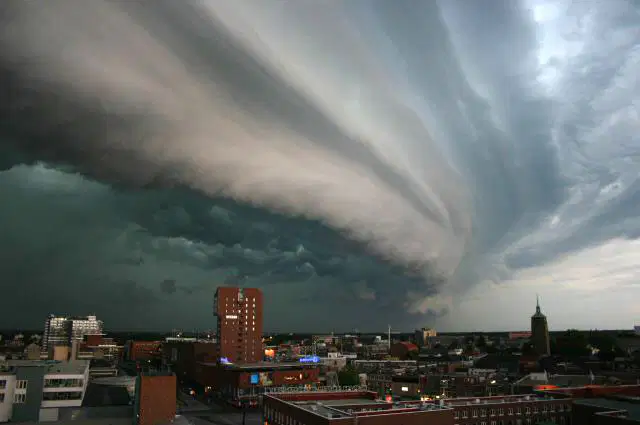
The image below shows a thunderstorm.
Thunderstorms occur as a result of convection in the atmosphere when two air masses that contain different amounts of thermal energy interact.
What type of air does cold, dense air often converge with to form a thunderstorm?
a)
colder and less dense
b)
colder and more dense
c)
warmer and less dense
d)
warmer and more dense
14.
In general, a weather "Front" occurs when two air masses of differing temperatures meet. When a cold air mass meets a warm air mass for example, what will always happen to the warm air?
a)
It will reverse directions.
b)
It will rise.
c)
Nothing will happen.
d)
It will sink.
15.
What type of meteorologicall phenomena is associated with weather that has very big or tall clouds and thunderstorms with the possibility of tornadoes?
a)
a stationary front
b)
a cold front
c)
a continental tropical system
d)
a circulatory system
16.

James measured the humidity of the air in his back yard each morning for four days. His data is recorded below. On which day did it most likely rain?
a)
Day I
b)
Day II
c)
Day III
d)
Day IV
17.
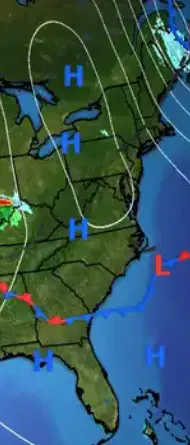
What type of weather conditions would you expect in the areas of the blue "H" symbol on the map below?
a)
Cloudy skies with light rain for several days
b)
Stormy weather with heavy rain and strong winds
c)
Clear skies, dry conditions, and calm winds
d)
Constant snowfall and freezing temperatures
18.

What type of weather conditions would you expect to see with this front in the area (like it is for Maryland, Virgina, West Virgina, Kentucky and parts of Tennessee)?
a)
light precipitation
b)
thunderstorms with possible tornadoes
c)
several days of precipitation
d)
fair/sunny weather
19.
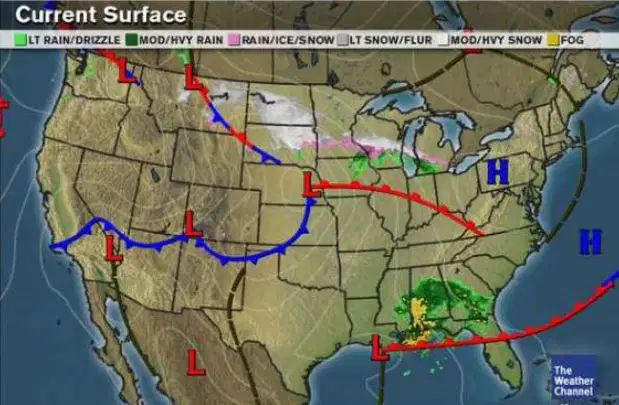
What type of air mass is likely influencing the warm fronts on the weather map below?
a)
warm and dry
b)
warm and moist
c)
cold and dry
d)
cold and moist
20.
Brandy has built a computer model of a weather system. She has included information about bodies of water, the Sun, and the atmosphere. Brandy decides to decrease the amount of atmospheric water vapor in her model. How will this likely affect the precipitation in her model?
a)
It will rain constantly.
b)
The precipitation will not change.
c)
There will be less precipitation.
d)
There will be more precipitation.
21.
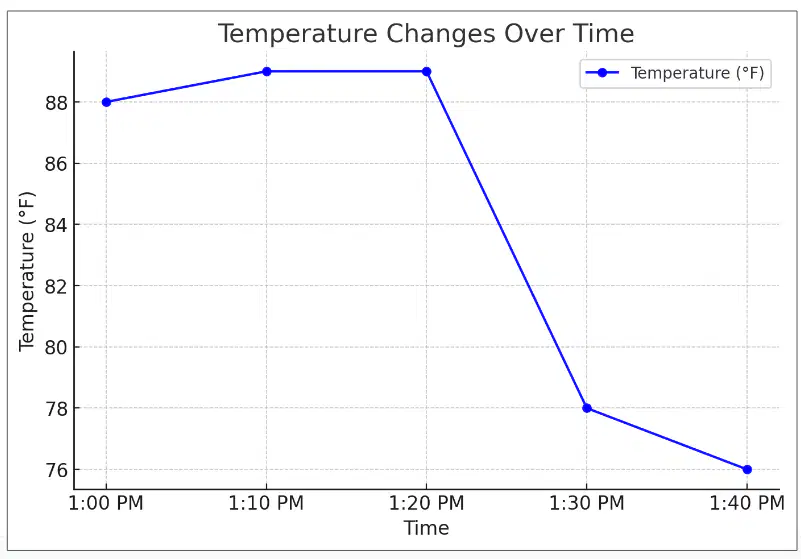
Haley has been instructed to measures the temperature outside of her school every ten minutes during her science class. She recorded her temperature data in the graph seen below. Haley notices that as she takes her last two measurements the wind begins to pick up and dark clouds are moving into the area. Which of the following is a reasonable weather forecast that Haley could make?
a)
The temperature will begin to rise, and the weather will become hotter and sunnier.
b)
The wind will die down soon, and the temperature will not change after 1:40 PM.
c)
Rain is predicted for later in the day and cooler temperatures are likely to follow.
d)
Temperatures will likely reach freezing within the hour.
22.
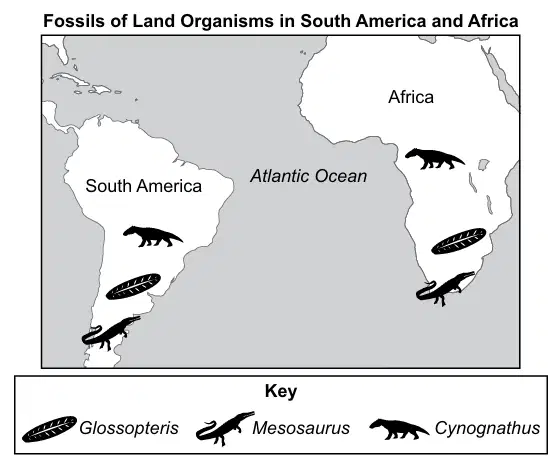
Glossopteris was an ancient fern. Mesosaurus and Cynognathus were ancient reptiles The map shows where fossils of these three organisms have been observed. Which statement best uses evidence from the map to support the theory of plate tectonics?
a)
The fossils indicate that the landmasses were once farther apart and that the organisms traveled long distances between them.
b)
The fossils indicate that the landmasses were once joined together and then became separated over a long period of time.
c)
The fossils indicate that the organisms swam from one landmass to the other landmass before they became fossilized.
d)
The fossils indicate that the organisms developed independently on both landmasses and maintained their similarity as the landmasses moved apart over time.
23.
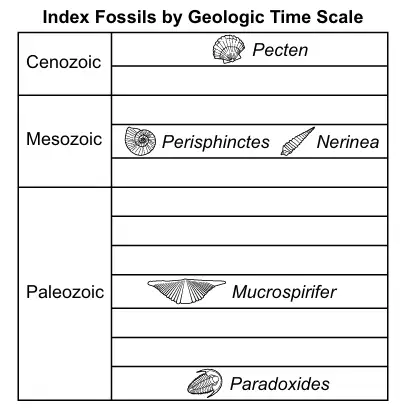
Students are learning about a certain type of fossil called an index fossil. Index fossils are easily recognizable and abundant fossils unique to a particular geologic time period. They can be used to estimate the age of the rock layer in which they appear. The table shows five index fossils by their appearance in the geologic time scale (the CenozoicEra being most recent). Which statement is best supported by the information in the table?
a)
Mucrospirifer fossils are the youngest index fossils.
b)
Pecten index fossils are older than Paradoxides index fossils.
c)
Perisphinctes and Nerinea index fossils are about the same age
24.
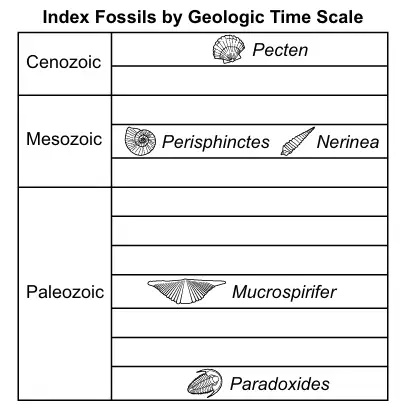
Which Era contains the oldest index fossils?
a)
Cenozoic
b)
Mesozoic
c)
Paleozoic
25.
The Law of Uniformitarianism states that the "GEOLOGICAL PROCESSES" we observe today have occurred in the past in similar ways. Which of the following is NOT an example of this principle?
a)
A volcano erupting and forming
b)
A fossil being discovered in a rock layer
c)
The erosion of a river cutting through rock over time
d)
A sudden earthquake shifting the Earth's crust
26.
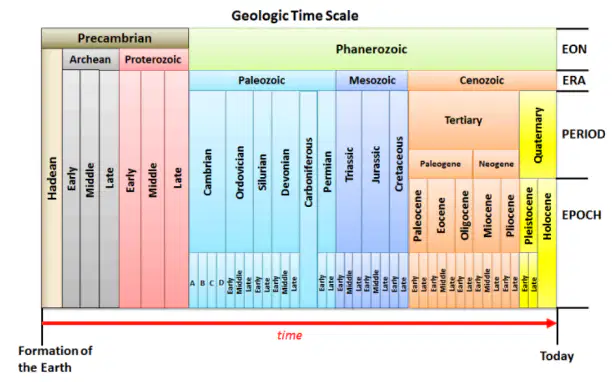
Lifeforms have changed throughout Earth's geologic history. Scientists learn about these changes by studying the fossil record. For example, scientists have learned when different groups of organisms first appeared. These events can be placed within specific periods on the geologic time scale, which is shown below. Dinosaurs first appeared during the Triassic period, and large mammals first appeared during the Tertiary period. Fish with jaws first appeared before both dinosaurs and large mammals. Using this information and the geologic time scale you see here, choose the period in which fish with jaws first appeared.
a)
Quaternary
b)
Silurian
c)
Jurassic
d)
Cretaceous
100 %

