
 Worksheets
Atomic structure and changes of state
Total questions: 25
Worksheet time: 56mins
Name
Class
Date
1.
What is the equation that links density (ρ), mass (m) and volume (V)?
a)
Density = Volume x Mass, or ρ=Vm
b)
Density = Mass / Volume, or ρ=m/V
c)
Density = Volume / Mass, or ρ=V/m
2.
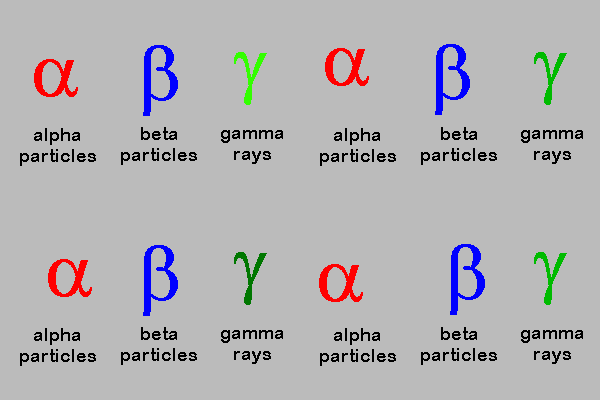
In order of most to least penetrating radiation we have
a)
Alpha , Beta, Gamma
b)
Beta , Gamma , Alpha
c)
Gamma, Beta, Alpha
d)
Gamma, Alpha, Beta
3.

What type of radiation can be stopped by a approximately 5 cm of air?
a)
Alpha radiation
b)
Beta radiation
c)
gamma radiation
4.
When does radioactive decay occur?
a)
When the nucleus of an isotope is unstable
b)
When the nucleus of an isotope is stable
c)
When the electrons of an isotope are spinning
d)
When the electrons of an isotope are shared with another isotope
5.
Alpha particles.....
a)
a) are positively charged.
b)
b) consist of two protons and four neutrons.
c)
c) can penetrate any thickness of matter
d)
d) All of the above
6.

Which type of nuclear radiation is being emitted here?
a)
Alpha
b)
beta
c)
gamma
d)
none
7.
The splitting of a nucleus into smaller nuclei is
a)
fusion
b)
fission
c)
half-life
d)
gamma radiation
8.
Takes two small nuclei and combines them into a larger nucleus
a)
fission
b)
fusion
9.
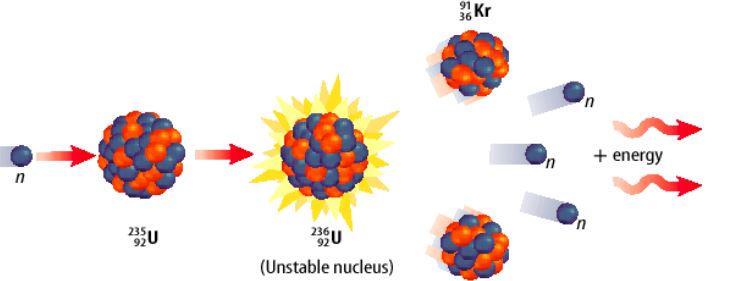
This is an example of...
a)
Fission reaction
b)
Fusion reaction
c)
Decomposition reaction
d)
Decay
10.
The half-life of strontium-90 is 25 years. How much strontium-90 will remain after 100 years if the initial amount is 4.0 g?
a)
3.0g
b)
0.25mg
c)
0.3g
d)
0.25g
11.
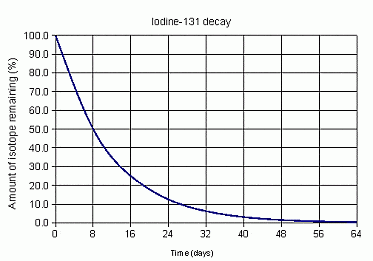
What is the half-life of iodine-131?
a)
32 days
b)
8 days
c)
16 days
d)
24 days
12.
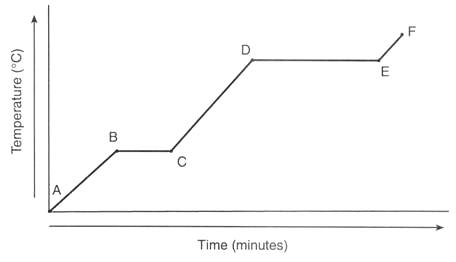
Between which points is the substance changing state?
a)
A-B only.
b)
A-B, C-D, E-F
c)
B-C only.
d)
B-C, D-E
13.
What is internal energy?
a)
The amount of heat an object contains.
b)
The sum of the kinetic and potential energy of all the particles in a system.
c)
Something we can measure easily.
d)
The sum of all the kinetic energy of all the particles in a system.
14.
How many Joules of energy are required to make 100 grams of ice at 0 οC completely melt? The specific latent heat of fusion of ice is 334000 J/kg
a)
200 J
b)
400 J
c)
33,400 J
d)
2,000,000 J
15.
How much heat energy is needed to raise the temperature of 2kg of water from 5 °C to 100 °C? The specific heat capacity of water is 4200 J/kg °C.
a)
42000 J
b)
840000 J
c)
798000 J
16.
The specific latent heat equation is used ...
a)
when a substance is increasing/decreasing in temperature
b)
when a substance is changing state
17.
The specific latent heat of vaporisation is used when ...
a)
A substance is increasing in temperature
b)
A substance is melting
c)
A substance is boiling
18.
The volume of an irregular object can't be measured by ...
a)
Taking width, length and height and multiplying together
b)
Measuring water displaced from a Eureka can
c)
Measuring the water displaced in a measuring cylinder
19.
How does the internal energy of a substance change when it is heated?
a)
decreases
b)
stays the same
c)
increases
20.
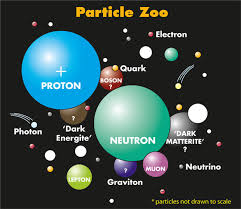
How do materials change from one state of matter to another?
a)
They gain or lose energy
b)
They break appart
c)
The particles get stickyer
d)
They are magnetised to themselves
21.
Select the state changes that latent heat of vaporisation applies to.
a)
melting
b)
evaporating
c)
freezing
d)
condensing
e)
sublimation
22.
Select the state changes that latent heat of fusion applies to.
a)
melting
b)
evaporating
c)
freezing
d)
condensing
e)
sublimation
23.
What is Specific Heat?
a)
The amount of thermal energy required to increase the temperature of 1kg of a material by 1°C.
b)
The amount of radiant energy required to increase the temperature of 1kgof a material by 1°C
c)
The amount of energy required to increase the temperature of 1kgof a material by 1°C.
d)
The amount of friction required to increase the temperature of 1kgof a material by 1°C.
24.
The unit of Specific Heat Capacity is
a)
Kilogram per Joule per Celsius degree
b)
Joule per kilogram per Celsius degree
c)
Celsius degree per Joule per kilogram
d)
Kilometre
25.
When you forget to tare a weighing scale with a beaker on before measuring the mass of a powder, you make
a)
A random error
b)
An anomalous result
c)
A systematic error
d)
A fool of yourself
100 %

