
 Worksheets
PST 1
Total questions: 51
Worksheet time: 26mins
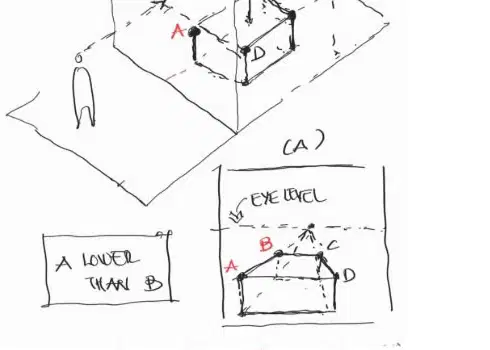
With the view as shown in the left image. In the right image, which part of the cylinder is drawn incorrectly? (See picture 1)
The top surface of the cylinder
The underside of the cylinder
The left limit line of the cylinder
The right limit line of the cylinder
In which case that the Horizon Line ( Eye Level) also is called Vanishing
Line ?
All lines which in reality are perpendicular to Picture Plane will converge toward a vanishing point on Horizon Line (Eye Level)
All lines which in reality are perpendicular to Ground Plane will converge toward a vanishing point on Horizon Line ( Eye Level)
All lines which in reality are parallel to Ground Plane will converge toward a vanishing point on Horizon Line ( Eye Level)
lines which in reality are parallel to Picture Plane will converge toward a vanishing point on Horizon Line ( Eye Level)
On the perspective of an inclined picture plane, what is the perspective of two straight lines parallel to the ground plane but not parallel to the picture plane?
Converge at a point on eye level
Duplicate
There is no common point
Cut at a point above eye level
On the perspective of an inclined picture plane, where is the vanishing point of two straight lines that parallel to both the picture plane and the ground plane?
Converge at a point on eye level
Duplicate
There is no vanishing point
Cut at a point above eye level
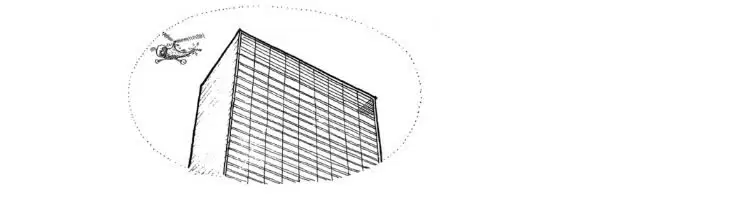
What's kind of the perspective in this picture? (see picture 2)
2-point perspective.
4-point Perspective.
Perspective of countless points.
None of them is correct
....is the intersection of the ground plane with the picture plane:
Vanishing point
The bottom line of the picture plane (the ground line)
The horizon line
If the observer lies on the ground, in this case the amount of ground area leading to the horizon line seems even less than the sky space that is from the horizon line leading to the upper sky line. So what happens to the horizon line ?
The horizon line appears at the observer's eye level.
The horizon line does not coincide with the observer's eye level
The horizon line is lower than the observer's eye level
None of them is correct
In perspective projection, in some cases, the plane placed between the center of projection and the object is called:
Vanishing point
The horizon line
The projection plane (view plane)
In perspective projection, what is the picture plane used for?
On the picture plane, we draw the perspective projection of the object
On the picture plane, we place the object to draw perspective
The picture plane is used for the observer to stand up
The horizon line is a crossroads between:
Eye level plane and picture plane
Ground plane and picture plane
Ground plane and eye level plane
Projection plane and ground plane
What perspective projection systems are there?
Inclined picture plane and vertical picture plane
Only Inclined picture plane
Only vertical picture plane
What are the characteristics of vertical picture plane?
The picture plane is inclined at an angle greater than or less than 90 degrees to the ground plane
The picture plane is parallel to the ground plane
The picture plane coincides with the ground plane
The picture plane is perpendicular to the ground plane
In perspective projection system, picture plane is:
Horizontal plane where the object is placed
A plane where the object is placed
the plane used to draw perspective projection of an object
The horizontal plane passes through the point of vision
In which situation, the perspective of the inclined picture plane is used?
When the observer looks straight, the axis of the cone of vision is parallel to the ground
When the observer looks up, the axis of the cone of vision looks upwards.
When the observer looks down, the axis of the cone of vision looks downwards
Both cases when the observer looks up or down, the axis of the cone of vision looks upwards or downwards.
In inclined picture plane, lines that perpendicular to the ground plane, are still parallel and do not converge to a vanishing point.
Correct
Incorrect
This painting shows its three-point perspective. So, what kind of perspective projection system that it is belonged to ? (see picture 23)
Vertical picture plane
Inclined picture plane (Mặt phẳng hình nghiêng)
All lines parallel or not parallel to the picture plane all converge at a vanishing point.
CCorrect
Incorrect
Eye level plane cuts the picture plane with a straight line called:
Vanishing line
Ground plane
The horizon line
A and C are both correct
Which one(s) is created by perspective projection?
One-point perspective projectior
Iwo-point perspective projection
Axonometric projection
Both A and B
in vertical picture plane, lines that are parallel to the picture plane whil perpendicular to the ground plane, are still parallel and do not converge to a vanishing poim
Correct
Incorrect
The parallel lines converge to a point on the vanishing line called the vanishing point.
Correct
Incorrect

The horizontal plane on which objects are placed is called:
Picture plane
Ground plane
The horizon line
Eye level plane
Choose the wrong statement (see picture 117)
Perspective projection give the viewer an impression of how far or near the obiect is
One-point perspective is obtained when the picture plane is parallel to one side of an object
Two-point perspective is obtained when the picture plane is parallel to one side of an object
All lines which in reality are parallel to Ground Plane will.......on the horizon line
Converge to one point
Converge to two point:
Converge to three points
Converge to four points
According to the position of the picture plane that is vertical and inclined to the ground plane, how many types of perspective projection system are there?
2
3
4
5
Eye level is the line that is ...... to the eyes of observer.
Upright
Parallel
Horizontal
All of them
Which one(s) is created by perspective projection ?
One-point perspective projection
Two-point perspective projection
Axonometric projection
Both A and B
When the ohan ver a on fat rout the migue of ero so before him
the horizon line in this case
The horizon line does not coincide with the observer's eye level
The horizon line appears at the observer's eye level
None of them is correct
The horizon line is lower than the observer's eye level
What are the principal determinants of how things appear in real life and in perspective drawing ?
Viewpoint and cone of vision
Observer's distance from a subject
Apparent direction of the subject's lines
All are correct
The shadow of a point down onto the plane is defined
The intersection of light rays passing through that point and the plane of shadow
The intersection of light rays crossing the horizon line
A line connecting the light rays to that point
Undefined
The observer is on a mountain top or descending in a parachute, the horizon line always appear on a level with his eyes. Is it right or wrong?
Right
Wrong
What are the key elements for a perspective projection system?
Point of vision, the ground plane, the picture plane
Plane of the eye level, the horizon line, eyes of observer
The vanishing point, the ground plane, the picture plane
All of them
In perspective projection, the eye level plane cuts the picture plane in a straight line and that line is called:
The bottom line of picture plane
The ground line
The horizon line
The vanishing line
The shadow of an object that falls on an ground plane or on other objects is called:
Shade
Shadows of Objects
Shade of the dark
The shade of an object is obtained when:
Place the object in front of a light source
Place the object in the dark area
Self-illuminating the object
Objects have perspective projection
The light ray is understood as:
Light comes from the sun
a infinite point
a finite point
Light is emited from the lisht source in straight lines
Choose the right concept.
The picture plane is alwavs perpendicular to the central visual ray
The horizon line is the horizontal straight line of the ground plane
The vanishing point is always on the eye level
The horizon line is not a line of eye level or a vanishing line
Lines that are parallel to the ground plane have the vanishing points at:
Bottom line of the picture plane
Horizon line
Central visual ray
None of them
When the picture plane and central visual ray are perpendicular to the ground plane, we have:
One-point perspective
Two-point perspective
Three-point perspective
None of them is correct
When the picture plane is vertical, all lines which in reality are perpendicular to Ground Plane will converge toward
a vanishing point
an endless vanishing point
two vanishing points
any vanishing point
When Picture Plane is inclined, all lines which in reality are perpendicular to Ground Plane will converge toward
a vanishing point
an endless vanishing point
two vanishing points
any vanishing point
The horizontal plane passing through the point of vision is called:
The picture plane
Plane of the eye level
The ground plane
The projection plane
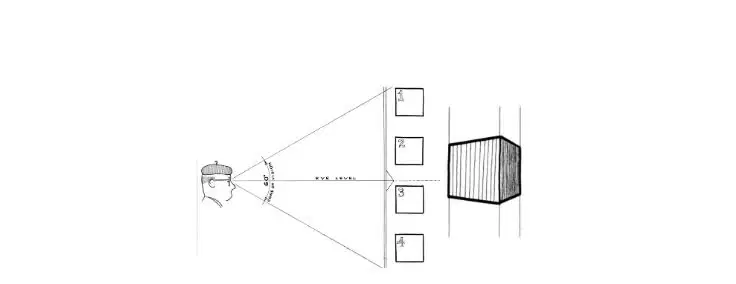
In order to avoid the deformation of the right truck, how should the observer adjust the observation position? Để tránh xe tải bên phải biến dạng, người quan sát phải điều chinh vị trí quan sát như thể nào? (see
picture 21)
The point of view must be adjusted so that the truck is within the cone of vision the observer. Điềm nhìn phải được điều chinh đề xe tải
nằm trong tầm nhìn của người quan sát.
Approach the observed object
Raise your vision higher
Lower your vision
Which visual law relates to perspective projection ?
The farther the distance from the object to the observer is, the smaller the object is
The further away the object becomes, the more faint and unclear it will be
C.
The human eye has the ability to self-regulate to focus on seeing an object more clearly
All above
Give perspective projection of two straight lines AB and CD. Determine the vanishing point of the lines AB and CD. (see picture 18)
E
F'
No vanishing point
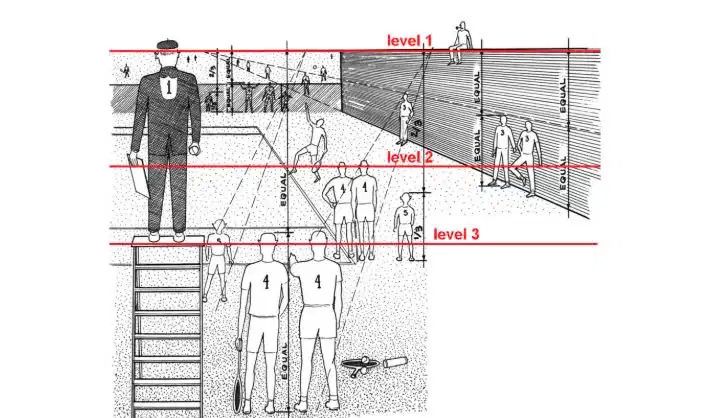
Where is the eye level in the following perspective determined? (see picture 22)
Line1
Line 2
Lộne3
No ideas
What kind of perspective projection system is this picture ? (see picture
Perspective system of vertical picture plane
Perspective system of inclined picture plane (Hệ phối canh mặt phẳng
In the following figure, which method has been used to construct a perspective projection of parallel lines equally spaced? (See picture 15)
Grid method
Diagonal method (Phương pháp đường chéo)
Cube method
When drawing shadows, what is the light source considered?
a straight line
a circle
an infinity point
a point
In which position does the observer see the perspective of the cube as shown on the right? (see picture 17)
1
2 or3
4
None of them

In the following shadows, which one has the sun as light source ? (See picture 16)
Figure a
Figure B
Figure C
Figures a and b

