
 Worksheets
Southeast Asia and China Topic 5 Test Practice
Total questions: 20
Worksheet time: 40mins
Name
Class
Date
1.
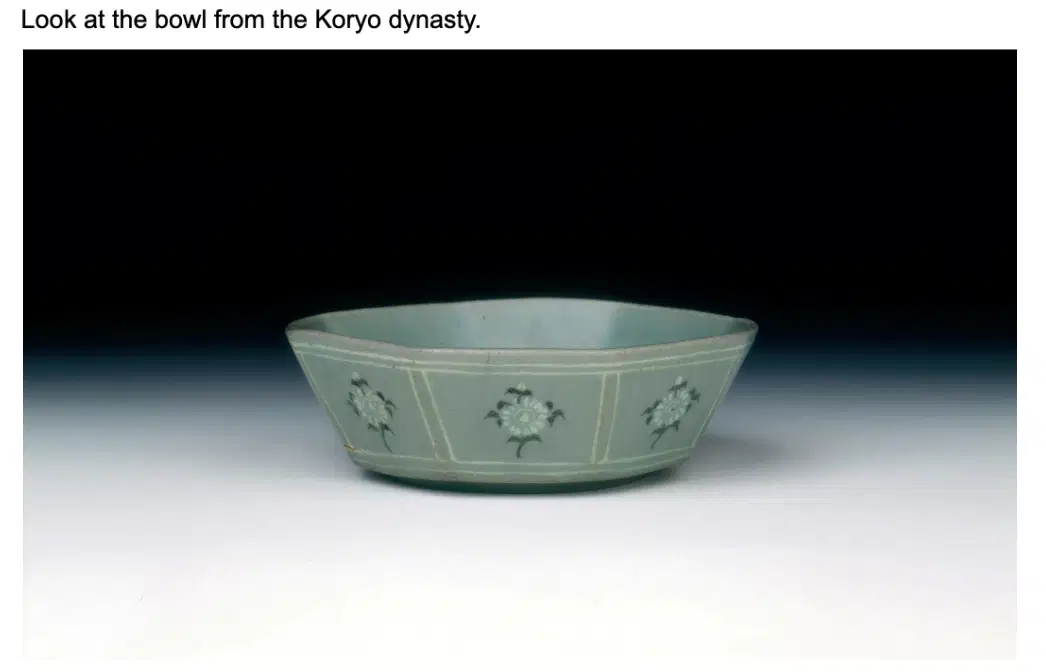
What does it reveal about Korean culture?
a)
It was heavily influenced by Japanese culture.
b)
It developed in opposition to Chinese culture.
c)
Its porcelain was imported from elsewhere in Southeast Asia.
d)
It was influenced by China but developed its own unique style.
2.
Prince Shotoku believed that both Buddhism and __________ could unify Japan.
a)
kami
b)
Confucianism
c)
Tang China
d)
Taiki Reform
3.
Which of the following ideals were bushido values that guided samurai? Choose the TWO correct answers.
a)
loyalty to one’s lord
b)
loyalty to one’s family
c)
personal honor
d)
family honor
4.
What features are associated with the dynasties of the Tang (618–907) and Song (960–1279)?
a)
economic problems and political violence
b)
prosperity, stable government, and advances in farming
c)
development of government bureaucracy
d)
overseas conquests and colonization
5.
When the Mongols came to power, they
a)
reopened the Silk Road to trade.
b)
shut down the Silk Road.
c)
raised taxes on merchants using the Silk Road.
d)
ignored the Silk Road entirely.
6.
Which of the following statements BEST describes Emperor Hongwu’s actions in the 1300s?
a)
He drove out the Mongols but kept their traditions in place.
b)
He drove out the Mongols and shared power under the merit system.
c)
He drove out the Mongols and made himself the absolute ruler of China.
d)
He drove out the Mongols and then stepped down to let others rule.
7.
Which of the following inventions proved to be of great value to European sailors?
a)
the compass
b)
tea
c)
gunpowder
d)
paper
e)
blankets
8.
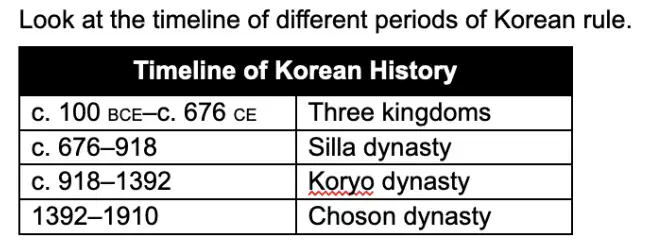
During what time period and under whose rule did Chinese monks spread Buddhist influence in Korea?
a)
c. 100 bce–c. 676 ce: Three kingdoms
b)
c. 100 bce–c. 676 ce: Silla dynasty
c)
c. 918–1392: Koryo dynasty
d)
c. 1392–1910: Choson dynasty
9.
Which of the following groups had the higher social status under the Yuan dynasty?
a)
Song scholar-officials
b)
southern Chinese merchants
c)
northern Chinese nobles
d)
Turks and other Muslims
e)
Irish Catholics
10.
Read the following quote from Buddhist scripture Dhammapada.
“Well-makers lead the water (wherever they like); fletchers bend the arrow; carpenters bend a log of wood; wise people master themselves.”
What central part of Buddhism expressed in the quote appealed to samurai who practiced Zen?
a)
patience
b)
self-control and discipline
c)
purity
d)
loyalty and obedience
11.
For three hundred years after 860, the real power in Japan was in the hands of
a)
the Fujiwara family.
b)
powerful emperors.
c)
the warlords.
d)
the samurai.
12.
The Tale of Genji provides a glimpse of life in the Heian court because
a)
it was written by a Chinese observer.
b)
its author served the emperor’s wife.
c)
it was written by a modern historian.
d)
it was based on Prince Genji’s diary.
13.
What effect did the law code of 702 have on Japan?
a)
It strengthened the power of the clans.
b)
It made the leader of the Yamato clan emperor of the entire country.
c)
It made Buddhism the state religion.
d)
It outlawed the clans.
14.
What does the map suggest to you about Marco Polo’s journey to China?
a)
He traveled almost entirely by sea.
b)
He traveled as far west as North America.
c)
The Mongol empire must have provided safety for travelers.
d)
He had to avoid Mongol lands to make the trip safely.
15.
What strategy did both Toyotomi Hideyoshi and, later, Tokugawa Ieyasu use to create peace in Japan?
a)
They both banished the daimyo from Japan.
b)
They both asked the daimyo to get rid of their samurai.
c)
They both forced the daimyo to pledge loyalty to them.
d)
They both commanded the daimyo to leave their families.
16.
How did nobles of the Heian court help strengthen the Japanese language and develop its literature?
a)
They wrote in a script called kana that represented Japanese sounds.
b)
They used Chinese characters to record events in the Japanese court.
c)
They employed Buddhist monks to teach Japanese in the court schools.
d)
They outlawed the use of Chinese in official documents.
17.
Which belief system spread first from India to China and then to Korea and Japan, helping to create cultural unity in the region?
a)
Buddhism
b)
Daoism
c)
Confucianism
d)
Christianity
e)
Pagan
18.

What important practice or teaching best completes the table?
a)
the belief in a merciful being who has achieved enlightenment but chooses to remain on Earth to help others
b)
the practice of individual efforts focused on self-control and discipline
c)
the idea that no one is too lowly to be saved
d)
the recitation of true words, or mantras, to advance one’s spiritual growth
19.
The Silla set up a statewide academy that trained government officials in which philosophy?
a)
Confucianism
b)
Buddhism
c)
Daoism
d)
Shinto
20.
How did Southeast Asia’s geography contribute to the region’s economic development?
a)
Much of Southeast Asia is separated from the rest of Asia by high mountains, making it a difficult place to invade.
b)
Many Southeast Asian countries were positioned strategically along the Silk Road and therefore developed into trade centers.
c)
Some Southeast Asian countries commanded important waterways and controlled rich trade routes.
d)
Many Southeast Asian countries were easily accessible by monks and therefore adopted Buddhist culture.
100 %

