
 Worksheets
Learning Outcomes
Total questions: 78
Worksheet time: 39mins
Describe the 3 classifications of lipids and be able to differentiate their structure.
Triglycerides, phospholipids, and sterols
Proteins, carbohydrates, and nucleic acids
Monosaccharides, disaccharides, and polysaccharides
Vitamins, minerals, and water
Explain how fat is digested, absorbed, and transported.
Fat is digested, absorbed, and transported through the lymphatic system.
Fat is digested, absorbed, and transported through the circulatory system.
Fat is digested, absorbed, and transported through the respiratory system.
Fat is digested, absorbed, and transported through the nervous system.
The functions of fat in the body include:
Energy storage, insulation, and protection of organs
Only energy storage
Only insulation
Only protection of organs
List the recommendations for total fat, essential fatty acids, saturated fat, trans fat, and cholesterol.
The recommendations for total fat, essential fatty acids, saturated fat, trans fat, and cholesterol are provided by dietary guidelines.
There are no specific recommendations for total fat, essential fatty acids, saturated fat, trans fat, and cholesterol.
Recommendations for total fat, essential fatty acids, saturated fat, trans fat, and cholesterol vary by country.
The recommendations for total fat, essential fatty acids, saturated fat, trans fat, and cholesterol are the same for everyone.
Identify different food sources for different types of fats.
Avocados, nuts, and olive oil are sources of healthy fats.
Butter, cheese, and red meat are sources of saturated fats.
Fish, flaxseeds, and walnuts are sources of omega-3 fatty acids.
All of the above
Compare and contrast different fat substitutes currently used.
Fat substitutes are identical in composition and function.
Fat substitutes vary in composition but serve similar functions.
Fat substitutes are identical in function but vary in composition.
Fat substitutes vary in both composition and function.
Explain the development of atherosclerosis and its risk of heart disease.
Atherosclerosis is the buildup of fats, cholesterol, and other substances in and on the artery walls, which can restrict blood flow and lead to heart disease.
Atherosclerosis is a condition where the heart muscle weakens, leading to heart disease.
Atherosclerosis is an infection of the heart valves, increasing the risk of heart disease.
Atherosclerosis is a genetic disorder that directly causes heart disease.
Describe dietary changes to make in order to maintain healthy blood cholesterol levels.
Increase intake of saturated fats
Consume more fruits and vegetables
Avoid whole grains
Increase sugar consumption
What elements do lipids contain?
Carbon, Hydrogen, Oxygen
Nitrogen, Oxygen, Helium
Carbon, Nitrogen, Sulfur
Hydrogen, Helium, Argon
Which of the following statements is true about lipids?
A) Lipids dissolve in water
B) Lipids are hydrophobic
C) Lipids contain only carbon
What is the common name for the type of lipid that is most abundant in foods?
Triglycerides
Phospholipids
Sterols
Waxes
Which of the following is not a group of lipids?
Triglycerides
Phospholipids
Proteins
Sterols
What is the basic unit of triglycerides and phospholipids?
Glycerol
Amino acids
Monosaccharides
Nucleotides

Fatty acids are long chains of carbon with a hydrogen off each side. True or False?
True
False
The bonds between the carbons determine the type of what?

Fatty acids can vary by which of the following?
Length of chain
Whether carbons have double or single bonds between them
Total number of double bonds
Each carbon in a fatty acid chain is bonded with how many atoms of hydrogen for the chain to be considered saturated?
1
2
3
4
Which of the following lipids are solid at room temperature due to high saturated fatty acid content?
Butter, lard
Coconut oil and palm oil (high in sat. fat)
What is another name for monounsaturated fatty acids?
PUFAs
MUFAs
Saturated fats
Trans fats
Monounsaturated fatty acids have only ______ double bond between carbons.
TEN
TWO
FOUR
The double carbon bond in monounsaturated fatty acids means the carbon is NOT saturated with what?
Oxygen
Nitrogen
Hydrogen
Carbon
Which oils have high percentages of MUFAs?
Coconut oil and palm oil
Olive oil and canola oil
Sunflower oil and corn oil
Fish oil and flaxseed oil
What are polyunsaturated fatty acids also known as?
MUFAs
PUFAs
Saturated fats
Trans fats
Polyunsaturated fatty acids contain how many double bonds between carbons?
2 or more
1
0
3
Which oils have a high percentage of PUFAs?
Olive oil
Coconut oil
Safflower, sunflower, and corn oils
Palm oil
What type of fatty acid is shown in the first diagram?
Saturated
Monounsaturated
Polyunsaturated

Identify the type of fatty acid that has one point of unsaturation.
Saturated
Monounsaturated
Polyunsaturated

Fill in the blank: The fatty acid with multiple points of unsaturation is called __________.
Polyunsaturated.
Monounsaturated.
Saturated.
Trans fat.
What is the most common type of lipid found in food and in the body?

How many fatty acids attach to glycerol to make a triglyceride?
Three fatty acids attach to glycerol to make a triglyceride.
Two fatty acids attach to glycerol to make a triglyceride.
Four fatty acids attach to glycerol to make a triglyceride.
One fatty acid attaches to glycerol to make a triglyceride.

Name the three fatty acids shown in the triglyceride diagram.
Linoleic acid, Oleic acid, Palmitic acid
Stearic acid, Myristic acid, Lauric acid
Arachidic acid, Behenic acid, Lignoceric acid
Capric acid, Caprylic acid, Caproic acid

The shape of the fatty acids in the triglycerides determine the consistency of the food. Which type of fatty acid is associated with solid consistency at room temperature?
Saturated fatty acids
Unsaturated fatty acids
What is the backbone of phospholipids composed of?
Glycerol
Glucose
Amino acids
Fatty acids
Which part of the phospholipid is hydrophilic?
Which part of the phospholipid is hydrophobic?
What is the major phospholipid in cell membranes?
Phosphatidylcholine
Phosphatidylethanolamine
Phosphatidylserine
Sphingomyelin
What are the components of a phospholipid as shown in the diagram?
Glycerol, two fatty acids, phosphate group
Glycerol, three fatty acids, phosphate group
Glycerol, one fatty acid, phosphate group
Glycerol, two fatty acids, sulfate group

Fill in the blank: In a phospholipid, the polar head ______ water and the nonpolar tail ______ water.
attracts, repels.
repels, attracts.
attracts, attracts.
repels, repels.
What do sterols NOT contain?
Glycerol or fatty acids
Proteins
Carbohydrates
Sterols are composed mainly of how many connecting rings of carbon and hydrogen?
2
3
4
Which of the following is NOT included in sterols?
Cholesterol
Bile acids
Proteins
Fill in the blank: Cholesterol plays an important role in cell membrane ________.
structure.
function.
synthesis.
degradation.
True or False: Cholesterol is required in the diet since the body cannot make all the cholesterol needed.
True
False

What are the components of Triglycerides as shown in the diagram?
A) Glycerol and Fatty acids
B) Phosphate head and Fatty acids
C) Sterol rings and HO

Identify the components of Phospholipids from the diagram.
A) Glycerol and Fatty acids
B) Phosphate head and Fatty acids
C) Sterol rings and HO

Fill in the blank: Sterols are characterized by the presence of ______ and HO as shown in the diagram.
Sterol rings.
Fatty acids.
Amino groups.
Carbohydrate chains.
What happens in the digestion of fat in the mouth?
What enzyme is secreted by the tongue for the chemical digestion of fats?
In the stomach, what process mixes food with gastric juices?
What does gastric lipase break down in the stomach?
Where does the majority of fat digestion occur?
Small intestine
Stomach
Mouth
Esophagus
What types of fats are absorbed into the bloodstream in the small intestine?
Where do small fats go once they are in the blood?
Liver
Heart
Kidneys
Lungs
Large fats such as long chain fatty acids are absorbed into the _______.
lymphatic system
circulatory system
digestive tract
respiratory system
What is the specific lipoprotein called that travels through the lymph?
In blood, an enzyme breaks _______ apart.

What is the percentage of triglycerides in Chylomicron?
90%
60%
50%
25%

What is the percentage of protein in VLDL?
10%
18%
25%
50%
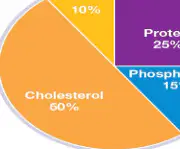
What is the percentage of cholesterol in LDL?
50%
25%
10%
5%

What is the percentage of phospholipids in HDL?
25%
50%
20%
5%
Which of the following are types of lipoproteins?
A) VLDL, LDL, HDL
B) VLDL, HDL, ATP
C) LDL, ATP, DNA
D) HDL, DNA, RNA
Where are lipoproteins produced?
Heart
Liver
Kidney
Pancreas
What do all lipoproteins contain?
A) Carbohydrates, protein, cholesterol
B) Fat, protein, cholesterol
C) Protein, cholesterol, vitamins
D) Fat, carbohydrates, vitamins
VLDL is composed mostly of ________.
triglycerides
cholesterol
proteins
phospholipids
What is left after the VLDL releases some triglyceride is now called a ________.
LDL
HDL
VLDL
Chylomicron
What does LDL stand for?
Which of the following is known as 'BAD' cholesterol carriers?
LDL
HDL
What percentage of protein does HDL contain?
50%
30%
70%
90%
Which type of lipoprotein helps remove cholesterol from the artery?
LDL
HDL
What is one of the functions of fats in foods related to energy?
Provide energy
Build muscle
Enhance flavor
Improve digestion
Fats help in the transport of ______ in blood.
nutrients
oxygen
hormones
carbon dioxide
What role do fats play in cell structure?
Fats are a major component of cell membranes, providing structural integrity and fluidity.
Fats are primarily used for energy storage and do not play a role in cell structure.
Fats are involved in the synthesis of DNA and RNA within the cell.
Fats are responsible for transporting oxygen in the bloodstream.
Fats cushion which parts of the body?
Fats cushion various parts of the body, including organs and joints.
Fats cushion only the skin.
Fats cushion the hair and nails.
Fats cushion the bones only.
What does this mean in terms of calories?
Fats provide concentrated energy.
Fats provide no energy.
Fats are the least energy-dense nutrient.
Fats provide the same energy as proteins.
Which of the following is an essential nutrient provided by fats?
Essential fatty acids
Carbohydrates
Proteins
Minerals
Fats give a flaky texture to which type of food?
Pastries
Soups
Salads
Grilled Meats
How do fats affect the texture of meats?
Fats make meats more tender and juicy.
Fats make meats dry and tough.
Fats have no effect on the texture of meats.
Fats make meats chewy and hard.
What does this mean?
Fats contribute to satiety.
Fats are harmful to health.
Fats do not affect hunger.
Fats are the main source of energy.

