Worksheets
Photosynthesis: The Power of Plants
Total questions: 19
Worksheet time: 26mins
What is the main purpose of photosynthesis?
A) To release oxygen
B) To make food for the plant
C) To produce carbon dioxide
D) To absorb sunlight
Which pigment is primarily responsible for capturing light energy in photosynthesis?
A) Chlorophyll
D) Anthocyanin
B) Carotene
C) Xanthophyll
In which part of the plant does photosynthesis primarily occur?
A) Roots
D) Flowers
C) Leaves
B) Stems
What are the end products of photosynthesis?
D) Oxygen and nitrogen
C) Nitrogen and glucose
A) Oxygen and glucose
B) Carbon dioxide and water
What are the two main stages of photosynthesis?
A) Respiration and fermentation
B) Light-dependent and light-independent reactions
C) Absorption and release of energy
D) Photosystem I and Photosystem II
What is produced as a by-product of photosynthesis?
A) Glucose
B) Oxygen
C) Water
D) Carbon dioxide
What is the chemical formula for photosynthesis?
(a)
Photosynthesis occurs in the (a) of plant cells.
The light-dependent reactions of photosynthesis take place in the (a) membrane of the chloroplast.
During photosynthesis, light energy is captured by the pigment (a) .
What is the primary function of chlorophyll in photosynthesis?
(a)
Photosynthesis is a crucial process that allows plants to produce their own food and release oxygen into the environment. It occurs primarily in the leaves of plants, where chloroplasts contain the green pigment called chlorophyll. This pigment absorbs light energy, mainly from the sun. The process of photosynthesis uses carbon dioxide from the air and water from the soil. During the light-dependent reactions, light energy is absorbed by chlorophyll and used to produce ATP and NADPH. These molecules store energy, which is then used in the second stage, the Calvin Cycle, to convert carbon dioxide into glucose. Glucose provides energy for plant growth and development, while oxygen is released as a by-product into the atmosphere, which is essential for the survival of most living organisms.
What is the main purpose of photosynthesis?
Name the two main stages of photosynthesis mentioned in the passage.
What are the light-dependent reactions of photosynthesis also known as?
A) Calvin Cycle
B) Dark reactions
C) Photorespiration
D) The Hill Reaction
During photosynthesis, what does chlorophyll absorb most effectiv
A) Green light
B) Red and blue light
C) Yellow light
D) Infrared light

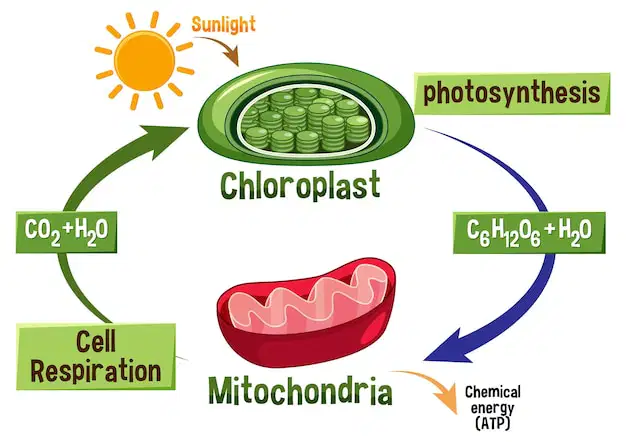
Look at the diagram of the plant cell below. Identify the part of the cell that is responsible for photosynthesis
Mitochondria
Chloroplast
Ribosome
Nucleus
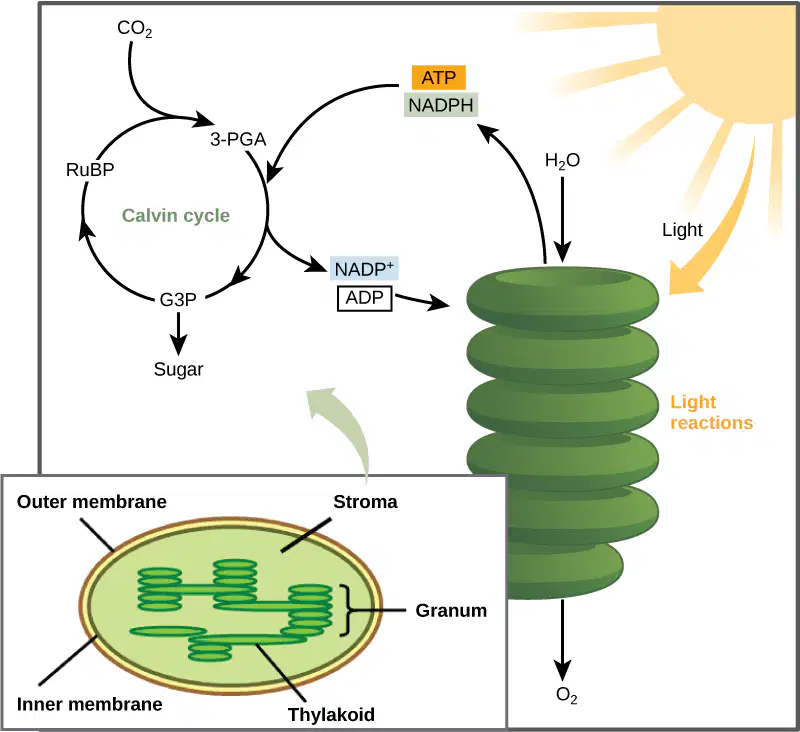
Examine the image below, which shows the process of photosynthesis. What is being released in the reaction that occurs in the thylakoid membranes?
Carbon Dioxide
Oxygen
Glucose
Water
Which molecule is a key energy carrier produced during the light-dependent reactions?
D) ADP
C) Glucose
B) NADPH
A) ATP
What is the role of water in the process of photosynthesis?
D) It absorbs sunlight
C) It is a source of electrons
B) It acts as a solvent
A) It provides carbon atoms
Look at the images below and choose the one that represents the process of photosynthesis occurring in plant cells.