
 Worksheets
3D Figures & Proportional Solids Review
Total questions: 70
Worksheet time: 6hrs 19mins

A rectangle and a horizontal line segment are shown. What is the resulting object when the rectangle is rotated around the horizontal line segment?


The right triangle as shows is rotated 360° about
the y-axis in three dimensions. What is the
3-Dimensional solid resulting from the rotation?
cone
cylinder
pyramid
prism

Select the 2D object that can be rotated to form the 3D object shown.


Which 3-D solid is created when the rectangle is rotated about the horizontal line?


Which 2-D shape could be revolved about the vertical line to create the 3-D solid?



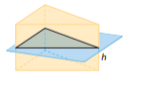
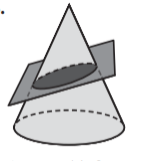
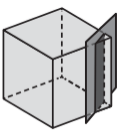
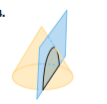

Rotating this triangle around line AB creates a ____________.
triangle
triangular prism
triangular pyramid
cone

Rotating this rectangle around line AB creates a ____________.
rectangle
rectangular prism
cylinder
cone

Rotating this circle around the diameter creates a ____________.
pyramid
sphere
cylinder
cone

Rotating this rectangle around line BD create a cylinder with:
height 15 and radius 8
height 15 and radius 4
height 8 and radius 15
height 8 and radius 7.5
Rotating this rectangle around line AB create a cylinder with:
height 15 and radius 8
height 15 and radius 4
height 8 and radius 15
height 8 and radius 7.5

Rotating this triangle around the side labeled "5" will create cone with the dimensions:
height: 5 and radius: 12
height: 5 and radius: 24
height: 12 and radius: 5
height: 12 and radius: 10

Rotating this triangle around the side QR will create cone with the dimensions:
height: 8 and radius: 6
height: 8 and radius: 3
height: 3 and radius: 8
height: 6 and radius: 8
Which three-dimensional figure will result when a rectangle 6 inches long and 5 inches wide is continuously rotated about the longer side?
a rectangular prism with a length of 6 inches, width of 6 inches, and height of 5 inches
a rectangular prism with a length of 6 inches, width of 5 inches, and height of 5 inches
a cylinder with a radius of 5 inches and a height of 6 inches
a cylinder with a radius of 6 inches and a height of 5 inches
When you stack congruent rectangles, what 3D figure is created?
Rectangular Prism
Rectangular Pyramid
Cylinder
Cone
When you stack congruent triangles, what 3D figure is created?
Triangular Prism
Triangular Pyramid
Rectangular Pyramid
Cone
When you stack similar triangles, what 3D figure is created?
Triangular Prism
Triangular Pyramid
Rectangular Pyramid
Cone
When you stack similar rectangles, what 3D figure is created?
Triangular Prism
Triangular Pyramid
Rectangular Pyramid
Cone
When you stack similar circles, what 3D figure(s) is created?
Prism
Cylinder
Sphere
Cone
When you stack congruent circles, what 3D figure is created?
Prism
Cylinder
Sphere
Cone

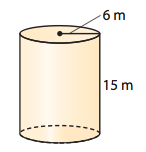


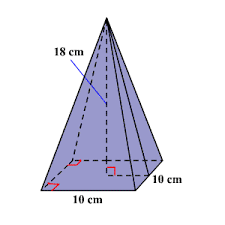


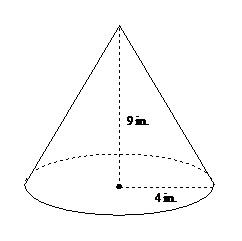


What is the LATERAL SURFACE AREA of the cylinder?
282.6
635.85
28.26
353.25

Find the TOTAL SURFACE AREA of the cylinder
493.16
177.18
354.37
211.88

What is the LATERAL SURFACE AREA of the cylinder?
552.64
1036.2
276.32
466.29

What is the LATERAL SURFACE AREA of the cylinder?
753.6
401.92
1155.52

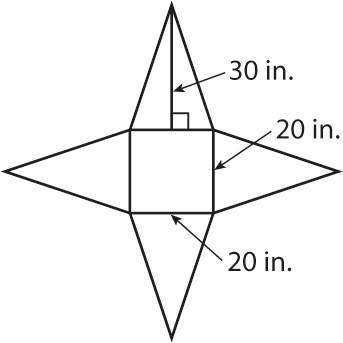


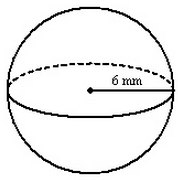
What is the surface area?
6658.56 mm2
452.16 mm2
904.32 mm2
108.8 mm2

Determine the volume of the cone shown:
2093 ft3
6280 ft3
2000 ft3
667 ft3

Determine the surface area of the cone shown.
173.3 ft2
296.6 ft2
89.5 ft2
223.7 ft2

Determine the surface area of the cone shown. Use 3.14 for pi. Round to the nearest whole number. Do not enter units.
(a)

The surface area of a rectangular prism is 166 square feet. A similar prism has a surface area of 1494 square feet. If the length of the smaller prism is 5 feet, what is the length of the larger prism?
10
15
45
50
V = 125 m3
V = ? m3
SA = 200 m2
SA = 288 m2

Each pair of figures is similar. Use the information given to find the scale factor of the figure on the left to the figure on the right.
1 : 63
7 : 9
49 : 81
343 : 729

Each pair of figures is similar. Use the information given to find the scale factor of the figure on the left to the figure on the right.
1 : 10
40 : 1
4 : 25
2 : 5

Each pair of figures is similar. Use the information given to find the scale factor of the figure on the left to the figure on the right.
1 : 7
7 : 10
49 : 100
343 : 1000

The two figures are similar. Find the scale factor of the figure on the left to the figure on the right. Then find the ratio of surface areas and the ratio of volumes.
9:8, 81:64, 729:512
9:8, 9:4, 27:8
9:8, 729:512, 81:64
9:17, 729:289, 81:4913

The scale factor between two similar figures is given. The surface area and volume of the smaller figure are given. Find the surface area and volume of the larger figure.
SA = 384 ft2, V = 576 ft3
SA = 128 ft2, V = 256 ft3
SA = 128 ft2, V = 1024 ft3
SA = 512 ft2, V = 1024 ft3
The surface area of a rectangular prism is 166 square feet. A similar prism has a surface area of 1494 square feet. If the length of the smaller prism is 5 feet, what is the length of the larger prism?
10
15
45
50
Two similar cylinders have surface areas of 40π ft2 and 90π ft2. What is the ratio of the height of the large cylinder to the height of the small cylinder?
4/9
2/3
8/27
16/81


What is the surface area of the larger solid?
50 ft2
45 ft2
81 ft2
225 ft2

What will the surface area of the smaller cone be?
Enter a number only.
(a)
What will the surface area of the smaller cone be?
Enter a number only.
(a)

