
 Worksheets
6th Grade - Formative Items Set: Exploring Planetary Systems
Total questions: 43
Worksheet time: 27mins
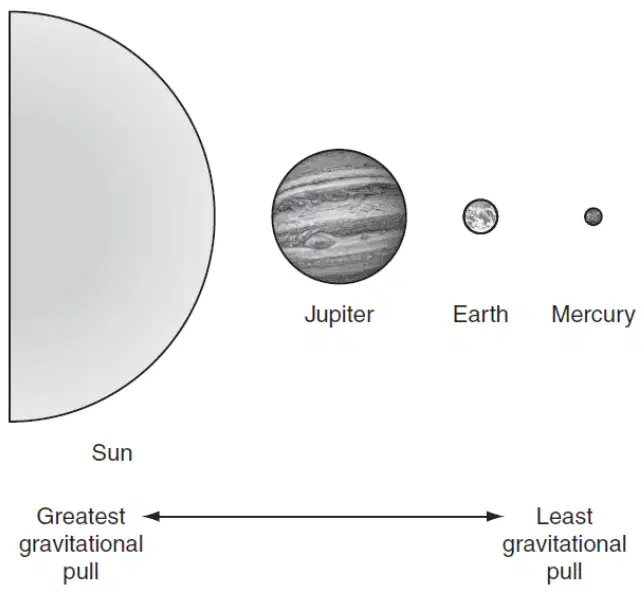
Jessica has created the diagram shown to model three planets in the order of their gravitational force with the sun. Which change to the model will make it more accurate and why?
Reorder the planets to Mercury, Earth, Jupiter, because the Sun pulls more strongly on smaller planets than on larger planets.
Reorder the planets to Mercury, Earth, Jupiter, because both distance from the Sun and the planets’ masses influence gravitational pull.
Keep the same order but move Earth and Mercury much farther away, because gravitational pull increases as distance from the Sun increases.
Put all three planets the same distance from the Sun, because the Sun’s constant mass causes the same gravitational pull on all three planets.
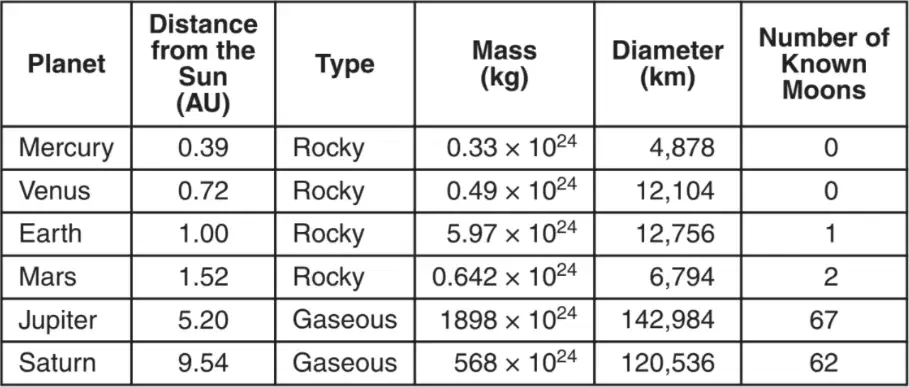
Which distance from the Sun is the most likely location where a rocky planet with a diameter of 9,500 km and three moons would be found?
0.5 AU
2.0 AU
5.0 AU
9.0 AU
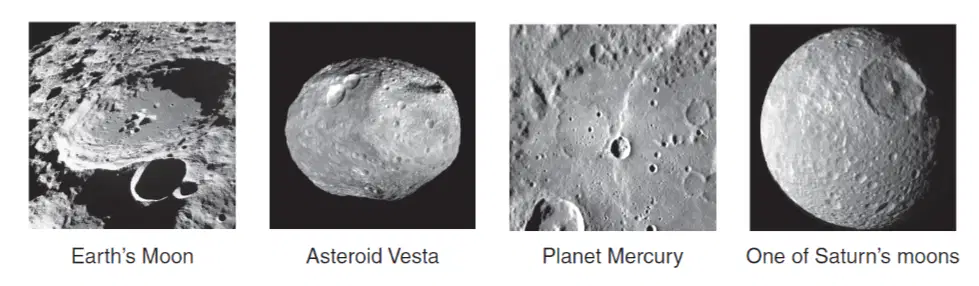
These photographs show surface features of four objects in the solar system. Which is the best conclusion about what these images could tell us about surface features on Earth?
Earth could one day have an oblong shape similar to Asteroid Vesta.
Meteorites are known to hit moons, asteroids, and other planets, but always miss Earth.
Earth has also been hit by numerous meteorites over the years, even if several impact craters are covered by the ocean, plants, or other objects.
Meteorites always burn up in the Earth’s atmosphere, meaning the Earth does not have any impact craters.
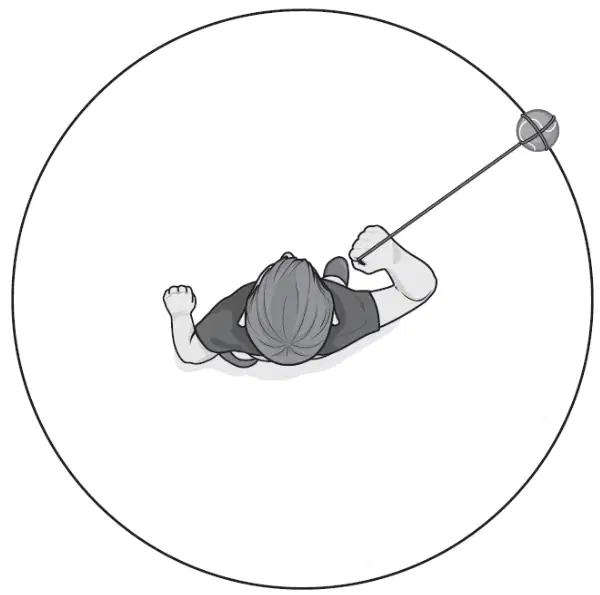
What description of this model is incorrect?
The tennis ball is spinning on an axis as it moves.
The tennis ball revolves around Ben.
The string keeps the tennis ball from traveling in a straight line.
Ben is much larger and represents a larger mass than the tennis ball.
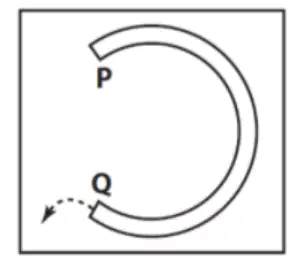
A curved groove is placed on a level table, as shown. A ball is pushed in the groove at P so that it exits the curve at Q. How would the ball move after it leaves the groove at Q?
It would curve from Q to P but just miss P.
It would curve to the left.
It would go off Q in a straight line.
It would curve from Q to P exactly.

Based on the information above, what should be the mass for the object that represents Mars?
1.0 kg
2.0 kg
4.0 kg
8.0 kg
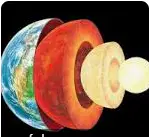
Select the correct order of the Earth's layers from the outermost layer to the innermost layer.
Mantle, outer core, inner core, crust
Outer core, inner core, crust, mantle
Crust, mantle, outer core, inner core
nner core, outer core, mantle, crust
What is the main difference between the inner core and outer core?
The inner core is solid and the outer core is liquid
The inner core is made of magma and the outer core is made of molten iron
The inner core is liquid and the outer core is solid
The outer core is made of molten iron and the inner core is made of magma
The circulation of iron in the ___ core produces the Earth's magnetic field.
Inner
Outer
High energy particles released from the sun.
Solar winds
Gamma rays
Cosmic rays
X-rays
The Earth's magnetic field protects us from thunderstorms and severe weather
True
False
Which planet do scientists refer to as "Earth's Twin," because it is so close and easy to see in the night's sky?
Jupiter
Mercury
Venus
Uranus
How does gravity affect the motion of the moon around Earth?
It causes the moon to move away from Earth.
It keeps the moon in orbit around Earth.
It has no effect on the moon's motion.
It causes the moon to spin faster.
Which of the following planets has the strongest gravitational pull?
Earth
Mars
Jupiter
Venus
What is the primary force that keeps the planets in their orbits?
Electromagnetic force
Nuclear force
Gravity
Friction
This type of galaxy has pinwheel arms around a bulge in the middle. The Milky Way Galaxy is an example of this type
quasar
irregular
spiral
elliptical
Select the correct order for a star's formation
1. Nuclear fusion begins.
2. Gravity pulls gas and dust together.
3. A large cloud of gas and dust exists.
4. A protostar is formed.
1. Nuclear fusion begins.
2. A protostar is formed.
3. Gravity pulls gas and dust together.
4. A large cloud of gas and dust exists.
1. A large cloud of gas and dust exists.
2. Gravity pulls gas and dust together.
3. A protostar is formed.
4. Nuclear fusion begins.
Our sun is a _______ massed star.
Small
Medium
Large
Choose the 4 properties that are used to classify stars.
color
temperature
shape
size
absolute brightness


Which planet takes the longest to orbit the Sun?
Neptune
Saturn
Jupiter
Uranus
Which group of planets have shorter years?
inner
outer
The inner planets are:
Mars, Jupiter, Saturn, Mercury
Mercury, Venus, Earth, Mars
Jupiter, Saturn, Uranus, Neptune
Earth, Mars, Jupiter, Saturn
The outer planets are:
Mercury, Venus, Earth, Mars
Earth, Mars, Jupiter, Saturn
Jupiter, Saturn, Uranus, Neptune
Mars, Jupiter, Saturn, Uranus
Which term describes the composition of the outer planets?
rocky
solid
water
gaseous
Which group of planets are colder?
inner
outer
Which group of planets are smaller?
inner
outer


What is the main source of Earth's magnetic field?
Rotation of the Earth's crust
Movement of molten iron in the Earth's outer core
Gravity from the Moon
Heat from the Earth's core
What is the role of Earth's magnetic field in protecting the planet?
Earth's magnetic field protects the planet from harmful solar radiation and charged particles.
Earth's magnetic field is used for navigation by animals and birds.
Earth's magnetic field is responsible for causing earthquakes and volcanic eruptions.
Earth's magnetic field helps in regulating the planet's temperature.

How many planets are there in our solar system?
6
7
8
9

Which planet is closest to the sun?
Uranus
Mercury
Neptune
Earth

