
 Worksheets
Muscular Responses
Total questions: 40
Worksheet time: 21mins
What is the threshold stimulus?
The maximum strength of stimulus required to generate an impulse
The minimum strength of stimulus required to generate an impulse
The average strength of stimulus required to generate an impulse
The strength of stimulus that does not generate an impulse
What happens when a muscle fiber reaches its threshold stimulus?
The muscle fiber becomes unresponsive
The muscle fiber releases calcium ions and contracts
The muscle fiber stops releasing acetylcholine
The muscle fiber decreases in size
What is the response of a single muscle fiber to a single impulse called?
Myogram
Latent period
Twitch
All-or-none response
What does a myogram record?
Heartbeat
Brain activity
Electrically-stimulated muscle contraction
Blood pressure
What is the latent period in muscle contraction?
The time of maximum contraction
A brief delay between stimulation and contraction
The period of relaxation
The time of muscle fatigue
What follows the latent period in a muscle contraction?
Relaxation only
Contraction and relaxation
Fatigue
Stimulation
What is the all-or-none response in muscle contraction?
Partial contraction of muscle fibers
Full contraction of muscle fibers with each twitch generating the same force
No contraction at all
Variable contraction depending on stimulus strength
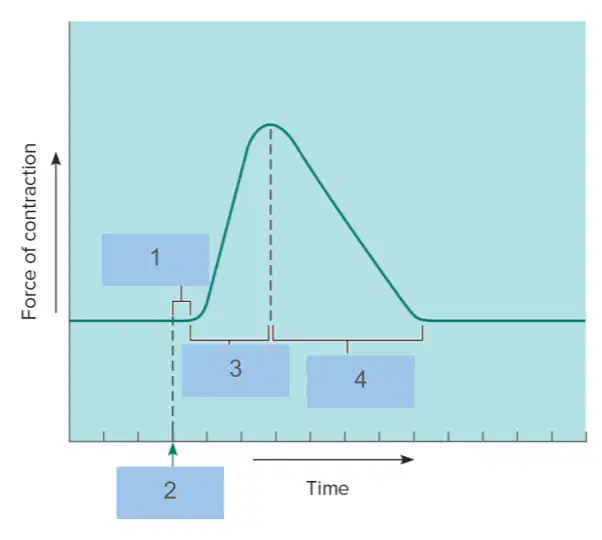
What is the phase of a single muscle twitch labeled #1 in the myogram?
Latent period
Period of contraction
Period of relaxation
Recovery phase
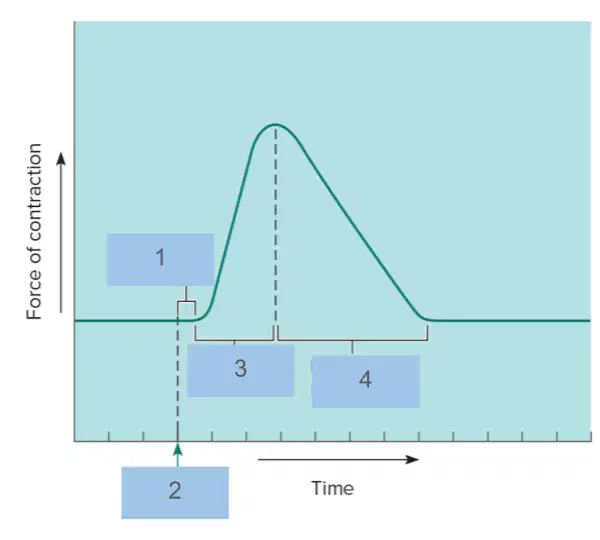
During which phase does the force of contraction increase in a single muscle twitch?
Latent period
Period of contraction
Period of relaxation
Resting phase
What happens during the period of relaxation in a muscle twitch?
The muscle returns to its resting state
The muscle force increases
The muscle is stimulated
The muscle remains contracted
What is the process called when a muscle fiber receives a series of stimuli of increasing frequency and is unable to relax completely?
Summation
Relaxation
Inhibition
Contraction
Summation allows for a greater force of contraction than a single (a) can generate?
What is the term for when relaxation time becomes very short due to higher frequency of stimulation?
Complete tetany
Partial tetany
Full contraction
Muscle fatigue
What is it called when the frequency of stimulation is very high and the sustained contraction lacks any relaxation?
Partial tetany
Complete tetanic contraction
Muscle fatigue
Relaxation
Where can complete tetany be accomplished?
In the body
In a lab
During exercise
In sleep
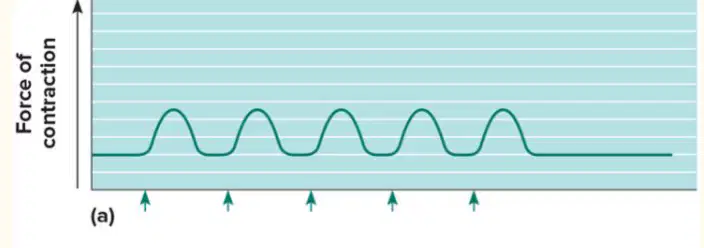
What does the myogram labeled (a) represent?
A series of twitches
Summation
Tetanus
Fatigue

Which myogram represents tetanic contraction?
(a)
(b)
(c)
None of the above
What is a motor unit composed of?
A motor neuron and the muscle fibers it controls
A single muscle fiber
Multiple motor neurons
Only muscle fibers
What happens when a motor unit is stimulated?
The muscle fibers contract all at once
Only some muscle fibers contract
The motor neuron deactivates
The muscle fibers relax
What is motor unit recruitment?
Increase in the number of activated motor units at higher intensities
Decrease in muscle fiber activation
Activation of a single motor unit
Relaxation of all motor units
What effect does recruitment have on muscle contraction?
Increases the strength of contraction
Decreases the strength of contraction
Has no effect on contraction
Causes muscle relaxation
When does a muscle achieve maximum tension?
When all of its motor units have been recruited
When only one motor unit is active
When no motor units are recruited
When the muscle is at rest
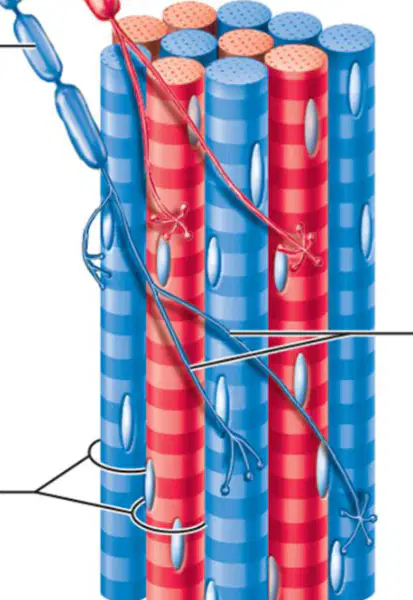
What is a motor unit composed of?
A single neuron and the muscle fibers it innervates
Multiple neurons and a single muscle fiber
A single neuron and multiple neurons
Multiple neurons and multiple muscle fibers
How are muscle fibers within a motor unit innervated?
By multiple neurons
By a single neuron
By no neurons
By alternating neurons
Where can muscle fibers within a motor unit be distributed?
Only at the ends of the muscle
Throughout the muscle
Only in the center of the muscle
Only on the surface of the muscle
What can summation and recruitment together produce?
Sustained contraction of increasing strength
Rapid muscle fatigue
Decreased muscle tone
Muscle relaxation
Why is sustained contraction of muscles important?
It allows for performance of daily activities
It causes muscle fatigue
It reduces muscle strength
It leads to muscle atrophy
What is muscle tone?
A continuous state of sustained contraction of a few motor units
A temporary increase in muscle size
A decrease in muscle flexibility
A rapid contraction of all motor units
Why is muscle tone important?
For maintenance of posture
For increasing muscle mass
For reducing muscle tension
For enhancing muscle elasticity
What is an isotonic contraction?
A contraction where the muscle lengthens without tension
A contraction where the muscle shortens and tension remains the same
A contraction where the muscle does not change length
A contraction where the muscle shortens and tension decreases
What is a concentric contraction?
Lengthening of the muscle against a force
Shortening of the muscle against a force
Muscle contraction without movement
Muscle contraction with increased tension
What is an eccentric contraction?
Shortening of the muscle against a force
Lengthening of the muscle against a force
Muscle contraction without tension
Muscle contraction with decreased tension
What is an isometric contraction?
Involves force generation without shortening
Involves muscle lengthening
Involves muscle shortening
Involves no force generation
What is an example of an isometric contraction?
Holding a weight in one position
Lifting a weight up and down
Running
Jumping
What is the purpose of force in an isometric contraction?
To resist overstretching and oppose gravity
To increase speed
To decrease muscle mass
To enhance flexibility
Distinguish between a twitch and a sustained contraction.
A twitch is a prolonged contraction, while a sustained contraction is brief
A twitch is a brief contraction, while a sustained contraction is prolonged
Both are prolonged contractions
Both are brief contractions
What is recruitment?
The process of increasing the number of active motor units
The process of decreasing muscle tone
The process of muscle relaxation
The process of muscle fatigue
How is muscle tone maintained?
Through constant muscle contraction
Through periodic muscle relaxation
Through continuous partial contraction of muscles
Through complete muscle relaxation
The all-or-none principle of muscle contraction states what?
Partial tetany occurs when there is a high frequency of stimulation, but very little (a) time.

