
Font size
 Worksheets
4/4 HW: Cold War MEGA REVIEW
Total questions: 204
Worksheet time: 2hrs 23mins
What is Détente?
An easing of tensions
Increased Tensions
What event ended the policy of Détente?
Nuclear Non- Proliferation Treaty
Invasion of Afghanistan
The Carter Doctrine
Iranian Embassy siege
What two policies did Mikhail Gorbachev adopt to try and save the Soviet Union? (click
Detente
Glasnost
Perestroika
Berlin Wall

What were the defining characteristics of the Cold War?
Prohibition, Flappers, Jazz
Arms Race, Space Race, Red Scare
Holocaust, Nazi Germany, Pearl Harbor
Poverty, Unemployment, Dust Bowl
What foreign policy guided American presidents during the Cold War to stop the spread of communism?
Open Door Policy
Dollar Diplomacy
Big Stick Policy
Containment

The main reason the U.S. went to Korea was to
Stop North Korean Aggression
Stop North Vietnam from entering South Vietnam
Berlin Airlift
Stop Normady Invasion

The idea that if a country falls to communism, neighboring countries will do as well.
Tet Offensive
Marshall Plan
Domino Theory
Molotov Plan

What was the result of the Berlin blockade?
Military conflict escalated between the U.S & USSR
Germany fell to communism
The Cold War ended
The U.S airlifted supplies to West Berlin and avoided war with the Soviet Union

A competition between nations for superiority in the development and accumulation of weapons during the Cold War.
Space Race
Vietnamization
Arms Race
Domino Theory

What does this illustration display?
Soviet nuclear weapons in Cuba pointed at the U.S
Flights from Cuba to North American cities
Exportation of sugar to the U.S
Cuban Baseball Team's travel destinations

How did some Americans show their antiwar sentiment during the Vietnam War?
participating in freedom rides
boycotting public transportation
organizing mass protests and burning draft cards
go on hunger strikes
Gave executive power so the president could station more troops in Vietnam.
Gulf of Tonkin Resolution
Wars Power Act
Execuitive Order 9066
Tet Offensive
Often tied with "Born In The USA" what song by Creedence Clearwater Revival is often considered one of if not the most recognizable antiwar song dealing with draft inequality?
Revolution 1
Silent Homecoming
Fortunate Son
Imagine

What was the term 'iron curtain' used to describe the division of?
North and South Vietnam
East and West Asia
North and South Korea
Eastern communist Europe and Western democratic Europe

Richard Nixon's policy of shifting the responsibility of the Vietnam War to South Vietnam.
Containment
Vietnamization
Dollar Diplomacy
Democracy
This policy decreased the power of the President to wage war
War Powers Resolution
Gulf of Tonkin Incident
Gulf of Tonkin Resolution
Not this one War War

Which nation or nations did President Nixon expand relations with during the Cold War?
Cuba
China
Soviet Union
China and Soviet Union

The Space Race started after what?
Soviets Launch Of Sputnik
Yuri Gagarin Went To Space
Little Curly Enter Earth's Orbit
English Want To Shoot Man From Cannon Into Orbit
Secret government documents published In 1971; revealed the U.S. government had misled Americans about the Vietnam War.
Pentagon Papers
War Powers Act
Tonkin Gulf Resolution
Tet Offensive
Agreement between French and Vietnamese that divided Vietnam into two separate countries at the 17th parallel.
Tonkin Resolution
Pentagon Papers
Treaty of Versailles
Geneva Accords
Surprise attack by NVA and Viet Cong on major cities in the South during a Vietnamese holiday; military victory for US, but political victory for V.C; was the turning point in the war
Operation Rolling Thunder
Tet Offensive
My Lai Massacre
Tonkin Raids

Which article would most likely quote this excerpt?
“Embedding Journalists in Combat during the Korean War”
“The Role of the Office of War Information during World War II”
“Improvements in Media Production during the Persian Gulf War”
“The Role of the Media during the Vietnam War”
Which cause united many college students, civil rights activists, and labor union members during the 1960s?
Opposing U.S. participation in the Vietnam War
Expanding presidential use of executive privilege
Protecting the world against climate change
Using détente as a foreign policy with China
One reason the USA was involved in the Vietnam War was to
prevent the spread of communism in Indochina
reduce French influence in Vietnam
stop china from seizing Vietnam
support the government of North Vietnam
In the ____________________, United States soldiers killed at least 450 women, children, and elderly men, shocking the American public.
My Lai Massacre
Attack on Sai Pan
Tet Offensive
Attack on Khe Sanh
The United States experience in the Vietnam War supports the idea that the outcome of a war
is determined mainly be technological superiority.
is dependent on using the greatest number of soldiers.
is assured to countries dedicated to democratic ideals.
can be strongly affected by public opinion.
Protests over military missions in Cambodia resulted in confrontation between protestors and police, with four students killed on May 4, 1970
Kent State University
Vietnamization
Domino Theory
Viet Cong
Members of the counter culture movement were mostly
Young African Americans from lower economic backgrounds
Middle aged white men
Latino youths seeking voting rights
white youths from middle and upper middle class backgrounds
Group of pro-war people who wanted to continue the war
Doves
Viet Cong
Silent Majority
Communists


What were the so-called "SALT 1" talks about?
increasing mineral trade between the U.S. and Soviet Union
reducing nuclear weapons/missile
improving the taste of bland foods
learning how to store nuclear waste in salt domes
This foreign policy helped ease issues with Communist Nations such as China and Russia
Liberalism
SALT
Conservatism
Vietnamization
Detente
What is the Tet Offensive
A surprise attack by the Vietcong on American and South Vietnamese forces
A surprise attack by the American Forces on Vietcong and North Vietnamese forces
A massive bombing campaign against North Vietnam
The Last American Invasion

What American policy provided Western European countries financial assistance so they could recover from WWII?
Marshall Plan
Domino Theory
Truman Doctrine
Big Stick Policy

What individual/group contributed to the Red Scare and accused American citizens of being communists?
Martin Luther King & Black Panthers
Jane Addams & Settlement Houses
Joseph McCarthy & HUAC
Cesar Chavez & United Farmworkers Union
During the Cuban Missile Crisis, what did JFK do when he heard that the Soviet Union was construction a missile site in Cuba.
JFK gave into the Soviet demands.
JFK bombed the Soviet Union with an atomic bomb.
JFK ordered a naval blockade of Cuba.
JFK invaded Cuba from Guantanamo Bay.
Which of the following is most characteristic of the Cold War?
The growth of nuclear arsenals in the United States and the Soviet Union
The expansion of national borders by imperialistic European countries
The implementation of isolationist foreign policies in Great Britain and China
The rapid industrialization of many Southeast Asian countries
When the United States sent military aid to African governments to help them resist communism, it was continuing a foreign policy first asserted in the
Potsdam Agreement.
Teheran Conference.
Marshall Plan.
Truman Doctrine.
Which organization was formed to provide military support to Western nations?
IWW
UN
NATO

Warsaw Pact
An alliance between the Soviet Union and other Eastern European nations. This was in response to the NATO
A 1956 term used by Secretary of State John Dulles to describe a policy of risking war in order to protect national interests
A country that is dominated politically and economically by another nation.
A 1949 defense alliance initiated by the US, Canada, and 10 Western European nations
The group that supported the war in Vietnam were known as
Hawks
Doves
Silent Majority
The group that opposed the war in Vietnam were known as
Hawks
Doves
Silent Majority

The primary goal of the U.S. Containment policy after WW II was to?
limit the use of atomic bomb and other nuclear weapons
end colonialism in Africa and Asia
stop the spread of Soviet Union influence in the world
bring German and Japanese war criminals to Justice
What was the term 'Iron Curtain' used to describe the division of?
North and South Vietnam
East and West Asia
North and South Korea
East and West Europe

President Truman adopted a new foreign policy during the Cold War know as the Truman Doctrine. It was originally designed to?
To expand trade with Europe
To limit the build up of nuclear weapons
To contain communism by giving aid to Greece and Turkey
to rebuild by extending economic aid

Why did the United States become involved in the Korean War?
President Truman wanted to unify Korea into one nation
General Mac Arthur had a plan to overthrow Communist Chine
Americans felt Korea was beyond the boundaries of the U.S. Containment Policy
American leaders felt it was important to resist Communist aggression

Trends of the 1950's
*Expansion of the middle class
*Development of the Interstate Highway System
*Growth of the suburbs
The above trends is a result of what?
increase in immigration after World War II
creation of the Dept of Housing and Urban Development
reduction in peacetime defense spending
economic prosperity following World War II

The first satellite in space launched by the Soviet Union in 1957 sparked?
The Cold War with the U.S.
Soviet aggression in Eastern Europe
American fears that the Soviets had achieve technological superiority
Disarmament between the Superpowers that were members of the NATO
What were the defining characteristics of the Cold War?
Expansion of national borders by imperialistic European powers
Growth of nuclear arsenals in the United States and Soviet Union
Implementation of isolationist foreign policies in Britain & China
Rapid industrialization of Southeast Asian countries

What foreign policy guided American presidents during the Cold War to stop the spread of communism?
Open Door Policy
Dollar Diplomacy
Big Stick Policy
Containment
What individual/group contributed to the Red Scare and accused American citizens of being communists?
Martin Luther King & Black Panthers
Jane Addams & Settlement Houses
Joseph McCarthy & HUAC
Cesar Chavez & United Farmworkers Union

How did the G.I. Bill contribute to the economic prosperity of the 1950s?
It decreased consumer spending.
It allowed Veterans to get an education and buy homes in suburbs.
It offered incentives under the Bracero Program to temporary laborers.
It created federal domestic programs as part of the Great Society.

After WWII what happened to the population of the U.S?
The population moved westward as a result of the railroad.
African Americans moved north as part of the Great Migration.
The population shifted from the Rust Belt to the Sun Belt.
The population grew due to the Baby Boom.

As a result of the Berlin Airlift, the United States was able to
transport Polish refugees to safety
bypass a Soviet blockade without provoking a military conflict
prevent the Nazi Party from reorganizing
intimidate Soviet leaders by demonstrating superior military power

Which of the following is most characteristic of the Cold War?
the expansion of national borders by imperialistic European countries
the implementation of isolationist foreign policies in Great Britain and China
the growth of nuclear arsenals in the United States and Soviet Union
the rapid industrialization of many Southeast Asian countries

Which of the following resulted from McCarthyism during the 1950's?
Membership in the U.S. Communist Party increased.
U.S. citizens were arrested for being suspected communist.
Recruitment procedures for the U.S. military branches were reformed.
U.S. diplomats began to express dissenting political viewpoints more freely.

The launch of Sputnik 1 intensified the Cold War tensions and caused the
Soviet Union to move missiles and warships to Cuba in order to threaten the United States
United States to send troops and aid to East Berlin to free it from Soviet control
Soviets to threaten Europe with nuclear attack if Soviet airspace were violated
United States to increase spending on technology and weapons to compete with the Soviet Union

Which factor links all of these modern innovations?
They were all products initially created for use in the U.S. communications industry.
They include material that was first grown on the U.S. experimental farms in the late 1900's.
They include technology originally developed for use in the U.S. space exploration.
They were special tools first created for U.S. transportation in the early twentieth century.

What was the American effort to rebuild Europe following WWII through the donation $13 billion in money, materials, and food?
The WWII Recovery Plan
Rebuilding Europe Plan
The Marshall Plan
FDR's Plan

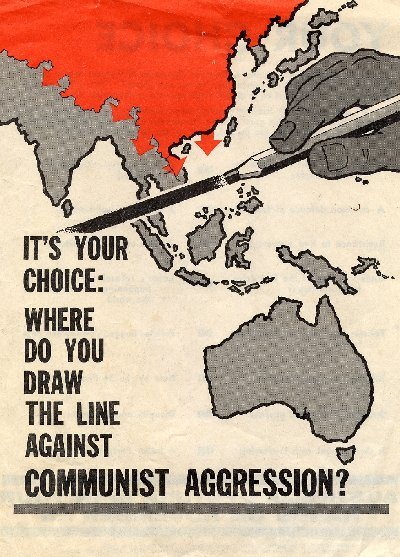
Images like this one refer to what theory about the spread of Communism in Asia (China, Korea, Vietnam)?
The Mar$hall Plan
The Domino Theory
Proxy Wars
Flexible Response

Why did the US adopt the motto in God We Trust in 1956?
to honor the financial and social contributions of religious organizations
to distinguish this nation from countries that restricted religious practices
to commemorate the social struggles uncovered by Christian leaders
to encourage growth of religious institutions throughout the country
The U.S. got involved in Korea and Vietnam because of what foreign policy?
containment
Good Neighbor policy
isolationism
Roosevelt Corollary

Which of these is an effect rock and roll had on society in the U.S. in the 1950's?
it reminded people of prewar days
contributed to a cultural divide between generations
it increased the fear of communist expansion
promoted values learned during the time of economic harship

Jonas Salk created a vaccine for what disease?
measles
mumps
meningitis
polio
How has the development of satellite technology affected the U.S. economy?
resulting in increased private funding of research institutions
increasing efficiency in telecommunications
enabling transoceanic air travel
facilitating the development of technologies that improve fuel efficiency

Which statement best summaries the primary goal of NATO?
to bring greater equality to the economics in Europe
to halt the spread of communist aggression in Asia
to aid those trying to flee communist oppression in Europe
to unite Western Europe in response to the thread of communist aggression

The term McCarthyism is sometimes used to describe
removing members of Congress
investigating civil service employees for corruption
using illegal means to obtain evidence in criminal trials
accusing people of subversive activities without sufficient evidence

Which couple was the first in American history to be given the death penalty (electrocution) for espionage?
JayZ & Beyonce
Bonnie & Clyde
Julius & Ethel Rosenberg
Tupac & Jada
Which statement explains how the Truman Doctrine guided U.S. foreign policy in Europe following World War II?
The United States provided financial aid to noncommunist governments fighting communist rebels
The United States divided countries and cities recovering from the war into zones occupied by international forces.
The United States established satellite governments in countries that share borders with the Soviet Union.
The United States boycotted international events held in countries allied with the Soviet Union.
What were the Marshall Plan and Truman Doctrine intended to do?
prevent a nuclear arms race
halt the spread of communism
help Asian countries recover from war
support former European colonies
“The free peoples of the world look to us for support in maintaining their freedoms. If we falter in our leadership, we may endanger the peace of the world—and we shall surely endanger the welfare of our own nation.” – President Harry Truman, speech to Congress, 1947
What policy does this represent?
Limitation of Arms
Collective Security
Containment of Communism
Mutually assured destruction
What title best fits this timeline of events?
- 1946- Communist government established in Albania
- 1947- Truman Doctrine announced
- 1948- Berlin Airlift begins
- 1949- NATO formed
- 1950- Korean War begins
Effects of the Marshall Plan
Developments of the early Cold War
Impacts of the Manhattan Project
Causes of the Cuban Missile Crisis
What was the purpose of the Bay of Pigs invasion?
overthrow Cuba's communist governments
Remove Soviet missiles that had been positioned in Cuba
Enforce a trade embargo on imports of Cuban sugar
Rescue Cubans who wanted to escape to the US
How did the Bay of Pigs incident and the Cuban Missile Crisis impact the Kennedy Administration?
The administration was praised for protecting the US against communism
The administration was humiliated as neither of these events were successful in overthrowing Fidel Castro
Kennedy was removed from office for spying of Cuba
These events did not impact the Kennedy administration at all
Which organization was created to disrupt communist expansion?
KGB
CIA
FCC
CSI
Which phrase best characterizes the central conflict of the Cold War?
monarchy vs democracy
intervention vs isolationism
ancient cultures vs modern cultures
free market economies vs command economies

During WWII, Stalin had only joined the Allies after which event?
German invasion of the Soviet Union
The most visible symbol of hope for world peace after WWII was the creation of which organization?
United Nations
Which was NOT one of the three nations that participated in the Potsdam Conference?
Britain
Soviet Union
At Yalta, Stalin had promised Roosevelt that he would allow free elections in Poland. What occurred after this promise?
The Soviets prevented free elections in Poland.
The Soviets formed their own fascist government in Poland.
The Soviets spent $15 million to assist Poland in their democratic elections.
The Soviets immediately withdrew from Poland.
At Potsdam, which Soviet demand did Truman object to?
As Stalin began taking over Eastern European governments, these nations became known as what?
Independent states
Satellite nations
In 1946, Stalin declared communism was incompatible with what?
totalitarianism
During Truman’s presidency, what was the policy of taking measures to prevent any extension of communist rule to other countries?
Which phrase came to stand for the division between democratic West Europe and Communist Eastern Europe?
What was the name of the policy that stated it was the duty of the U.S. to support free nations in resisting takeovers by armed minorities or outside pressures?
MacArthur Policy
Marshall Plan
Eisenhower Notes
What was the name of the policy that stated the U.S. should provide all to all European nations struggling with hunger and poverty?
MacArthur Notes
In 1948, what did France, Britain, and the U.S. decide to do with their German occupation zones?
They decided to merge their zones into a single entity, creating West Germany
In June 1948, what did Stalin do in Berlin to try to take control?
Tried to combine Berlin with other cities nearby
Captured and tortured West Berlin citizens
What was the name of the defensive military alliance created, pledging support if any were attacked?
Which communist leader came to power in China as citizens became dissatisfied with the Nationalists?
Chiang Kai-shek
Deng Xiaoping
Xi Jinping
In Korea at the end of WWII, Japan surrendered territory north of the 38th parallel to which nation?
Britain
What started the Korean War?
Who was the commander of the U.S. forces in Korea?
After U.N. forces chased North Korea’s forces northward toward the Yalu River, what did China do?
China sent troops to support North Korea
When the Korean War seemed to reach a stalemate, MacArthur wanted to use nuclear weapons against Chinese cities. Why did Truman reject his request?
Truman was worried China had weapons of mass destruction and would drop them on the U.S.
Truman feared the Soviets' pact with China would lead to WWIII
What happened when MacArthur publicly criticized Truman’s decisions regarding China?
MacArthur was fired by President Truman.
MacArthur was imprisoned by President Truman.
After the armistice ending the Korean War was signed, what was the negative result for Korea?
Continued division into North and South Korea
The high cost of the Korean War was a major factor in the American election of which president?
Harry S. Truman
Which agency investigated and fired government employees found to be disloyal to the U.S.?
Government Worker's Spy Coalition
American Oath Agency
Loyalty Review Board
Central Intelligence Agency
On which industry did the House Un-American Activities Committee primarily focus its investigations?
Movie industry
Sports industry
Why did the Hollywood Ten refuse to testify regarding communism in films?
They believed it was unconstitutional
What was the blacklist, as instituted by Hollywood executives?
A list of people denied employment due to suspected communism
What activity did the McCarran Internal Security Act make unlawful?
Engaging in actions that might lead to totalitarianism
Participating in films that had communistic themes
Expressing discontentment with the U.S. government's policies regarding China
Which conservative congressman gained fame for pursuing charges against Hiss?
Harry Truman
Which couple was named and sentenced to death for aiding the Soviets’ in atomic bomb development?
David and Sarah Rothschild
John and Mary Weidenfeld
What term refers to the unfair tactic of accusing people of disloyalty without providing evidence?
Nixonizing
Innuendo
Half-Hissing
What weapon did atomic bomb scientists believe could be an even more powerful weapon?
Helium bomb
Nitrogen bomb
What term refers to the willingness of the U.S, under Eisenhower, to go to the edge of all-out war?
McCarthyism
containment
One of the CIA’s first covert actions took place in Iraq over the control of which valuable resource?
Uranium
In which Central American country did the CIA train an army to overthrow its president in response to him giving American-owned lands to the peasants?
What was the military alliance created, linking the Soviet Union with seven Eastern European nations?
Warsaw Pact
NATO
Pact of Steel
Pact of Iron
Which warning said the U.S. would defend the Middle East against any communist attacks?
Which nation rose up against the Soviet Union in 1956, resulting in a swift and brutal Soviet response?
Hungary
Germany
Once Nikita Khrushchev took over in the Soviet Union, how did they compete with the U.S.?
Through the space race, military build-up, and ideological competition
Which incident, occurring over Soviet territory, renewed tensions between the Soviets and the U.S.?
Cuban Missile Crisis
U-2 incident


Reagan’s foreign policy called for
making an alliance with the Soviet Union.
limiting American intervention in the affairs of other nations.
protecting the island of Cuba from invasion.
taking on a strong anti-communist role in the world.

President Ronald Reagan and Soviet leader Mikhail Gorbachev signed a missile treaty in hopes of?
Reducing tensions associated with the threat of nuclear war
Providing an exchange of weapons for war hostages
Allowing secret weapons technologies to be shared
Establishing an official cease-fire

Which event signaled the end of the Cold War?
Cuban Missile Crisis
end of the Vietnam War
collapse of the Soviet Union
fall of the Berlin Wall

Who was the last Soviet premier (leader)?
Boris Yeltsin
Mikhail Gorbachev
Leonid Brezhnev
Nikita Khrushchev
Borat Sagdiyev

Which of these events led to the breakup of the Soviet Union?
The arms race & government overspending
An attempt to overthrow the government by pro-democratic forces
Democratic reforms brought on by Mikhail Gorbachev
All of these
The Berlin Wall fell in
1989
1988
1990
1991
The Soviet Union officially fell in
1991
1992
1989
1990
In quick secession the Ukraine declared independence & Gorbachev resigned as leader of the Soviet Union followed by
the announcement on Dec. 26, 1991 that the Soviet Union ceases to exist
the invasion of the Soviet Union by Chinese forces.
the quick annexation of territory by Russia.
invasion by NATO forces to ensure peace in the region.


Which of the following would be identified as a cause of the collapse of the Soviet Union?
The expensive arms race in the USSR became an enormous burden on the struggling economy
The Soviet government used their military strength to put down any resistance
The United States promised to provide economic assistance to the Soviet Union if they broke up
Winston Churchill coordinated Operation "Sea Lion"
Nuclear arms limitations were part of the the
SALT agreement
Marshall Plan
Truman Doctrine
ICBM accords
The Strategic Defensive Initiative or SDI
was a plan the United States developed as a nuclear defense system
an idea proposed by the Soviet Union to limit the amount of work that needed to be done
was scrapped by the British because the cost was too high
was developed by the French as a way to increase their ability to make fresh backed goods
As a result of a struggling Soviet system
many of the countries in Eastern Europe staged revolutions against their communist governments
people increased their personal holdings in land
a majority of people started to see the Soviet nation as a power entity
their economy grew exponentially
Which of the following was a primary cause of the Cold War between the United States and the Soviet Union?
direct, armed conflict between the two nations
the founding of the United Nations
a deep reduction in military expenditures
a competition for political influence over other countries

What US agency deals with space and was tasked with putting a man on the moon?
NASA
NATO
EPA
USAF
Peacekeeping body of nations
United Nations
Satellite Nations
Clemency
Marshall plan
Name for countries dominated by the Soviet Union
Satellite nations
United Nations
NATO
HUAC
effort to block Soviet influence by making alliances and supporting weaker nations
containment
brinkmanship
warsaw pact
foster dulles
the division of Europe between free and communist countries
iron curtain
warsaw pact
truman doctrine
iron gate
State of hostility between the soviet union and the united states but without military action
Cold War
WWII
Korean War
38th Parallel
u.s. policy of sending aid to any nation trying to prevent a communist takeover
Truman Doctrine
Marshall plan
Berlin Act
Cold war
program under which the US gave economic aid to rebuild post war Western Europe
Marshall plan
North Atlantic Treaty Organization
Mao Zedong
HUAC
resupply of west Berlin by US and British planes during Soviet blockade of 1948
Berlin Aircraft
NATO
Truman Doctrine
U-2 incident
Defensive military alliance of the United States, Canada, and ten European nations
North Atlantic Treaty Organization
Berlin Aircraft
Iron Curtain
Containment
leader of the nationalist forces in China
Ciang Kai-Shek
Mao Zedong
Hideki Tojo
Truman
leader of the communist forces in China
Mao Zedong
Ciang Kai-Shek
Taiwan
Hideki Tojo
Imaginary line that divides Korea at 38 degrees north latitude
18th parallel
38th parallel
38th line
38th demarcation
House committee on Un-American Activities
HUAC
HCUAA
HCUA
HUAA
People called before HUAC who did not cooperate
Hollywood Ten
Alger hiss
Marshall plan
Mccarthyism
list of people in the Hollywood film industry who were refused jobs because they did not cooperate with HUAC
blacklist
inferior industry
anti-american league
Hollywood nine
former state department official
Alger Hiss
Joseph McCarthy
Julius Rosenberg
Ethel Rosenberg
Activists in the American Communist party who were executed as spies
Ethel and julius Rosenberg
Joseph McCarthy and Edna Mode
Dwight D. Eisenhower and H. K. Brinkman
John Foster Dulles and Joseph McCarthy
republican senator who claimed communists were taking over the government
Joseph McCarthy
Julius Rosenberg
Alger Hiss
John Foster Dulles
Term used to refer to tactic of accusing people of disloyalty without producing evidence
McCarthyism
witch hunt
blacklist
iron curtain
34th president of the United States
Dwight D. Eisenhower
John Foster Dulles
Franklin Delano Roosevelt
John. F. Kennedy
willingness to go to the edge, or brink of war
brinkmanship
cia
warsaw pact
dulles
Intelligence-gathering, or spy agency of the United states government
CIA
NATO
HUAC
Military alliance of the Soviet Union and its satellite nations
Warsaw pact
Eisenhower doctrine
38th parallel
NATO
policy of the United States that would defend the middle east against attack by any communist country
Eisenhower Doctrine
Warsaw pact
NATO
HUAC
pilot of an American U-2 Spy plane
Francis Gary Powers
Nikita Khruschev
John Foster Dulles
Joseph McCarthy
Downing of a US spy plane and the capture of its pilot by the Soviet union in 1960
Brinkmanship
U-2 Incident
Berlin Aircraft Issue
Iron Curtain Accident
practice of what to do during a bombing attack
air-raid drills
armistice
clemency
insubordination
temporary stop to fighting by agreement of both sides
armistice
clemency
implicated
famine
intended to withstand or protect against aggression or attack
defensive
clemency
armistice
air-raid drills
an area where military forces are not allowed
demilitarized zone
no-fly zone
fallout shelters
out-of-bounds area
Underground living areas that give protection from the explosion and radiation of a nuclear attack
fallout shelters
famine
insubordiation
air-raid drills
drastic, wide reaching food shortage resulting in the starvation of many people
famine
hostage
implication
infiltration
session of an investigating committee at which testimony is taken from witnesses
hearing
hostage
jury
armistice
person or persons held prisoner in order to get a ransom or agreement to certain demands
hostage
armistice
clemency
infiltration
suggested the guilt of; incriminated
implicated
clemency
treason
famine
process of entering gradually or secretly in order to spy or gain control
infiltration
informed on
implicated
treason
implicated; gave incriminating information about others to the authorities
informed on
infilitration
offensive
tattled
act of disobeying authority
insubordination
infiltration
u-2 incident
mccarthyism
war whose objective is less than the enemy's total defeat
limited war
infilration
amistice
stalemate
formal pledge of loyalty to the government, sometimes specifically denying membership in the communist party
loyalty oath
pact of security
pledge of oath
perjury pact
attacking; starting a war
offensive
defensive
perjury
implication
False testimony under oath, as in a court of law or Congressional hearing; lying
perjury
latitude
implicated
clemency
mercy; reduction of a severe sentence given by a court
clemency
implicated
stalemate
reunification
to strike back in kind; especially to return a military attack
reunification
stalemate
latitude
famine
first artificial satellite to orbit the earth
Sputnik I
U-2
Airforce 1
Kamikaze
Situtation in which further action is blocked; a deadlock
stalemate
reunification
armistice
infiltration
most powerful and influential nations, especially those that lead a power bloc
superpowers
satellite nations
first world nations
supernations
betrayal of one's country, especially by aiding its enemies
treason
offensive
stalemate
indictment
Noncommunist countries of Western Europe and the Americas
the West
The United Nations
Southern States
The Perjury
investigation that says its purpose is to uncover illegal activities but is actually used ot harm those whose views differ
witch hunt
stalemate
breach of oath
implication of the innocent

