wayground logo

Free Printable Worksheets

Font size

S
M
L
XL
Worksheets

US History EOC Hard Core Review

Total questions: 208

Worksheet time: 2hrs 18mins

Name
Class
Date
1.
a)
Horizontal Integration
b)
Vertical Integration
c)
Monopoly
d)
Laissez-Faire
2.
Used to make steel quickly and cheaply by injecting air into iron to remove impurities.
a)
Carnegie Process
b)
Bessemer Process
c)
Rockefeller Process
d)
Drake Process
3.
Invented the Light bulb.
a)
Alexander Graham Bell
b)
Thomas Edison
c)
Edwin Drake
d)
Cornelius Vanderbilt
4.
Belief that the strong will rise to the top of society and the weak are at the bottom of society.
a)
Laissez-Faire
b)
Social Darwinism
c)
Arbitration
d)
Capital
5.
a)
Vertical Integration
b)
Horizontal Integration
c)
Trust
d)
Corporation
6.
Created by the government to try and stop monopolies.
a)
Clayton Anti-trust Act
b)
Interstate Commerce Act
c)
Sherman Anti-Trust Act
d)
Social Darwinism
7.
List of troublemakers used by business owners to keep out unwanted employees.
a)
Lockout
b)
Blacklist
c)
Redlist
d)
Pinkertons
8.
Created to oversee the activities of the railroad companies and set fair prices for shipping
a)
Sherman Anti-Trust Act
b)
Clayton Anti-Trust Act
c)
Interstate Commerce Act
d)
Social Darwinism
9.
Complete control of an industry
a)
Monopoly
b)
Subsidy
c)
Tariff
d)
Vertical Integration
10.
The government does not interfere in the economy except to protect property rights and maintain peace.
a)
Social Darwinism
b)
Horizontal Integration
c)
Vertical Integration
d)
Laissez-Faire
11.
Tax on imports and/or exports.
a)
Subsidy
b)
Tariff
c)
Capital
d)
Laissez-Faire
12.
Invented the telephone.
a)
Thomas Edison
b)
Andrew Carnegie
c)
Edwin Drake
d)
Alexander Graham Bell
13.

This method of producing steel made production cheaper and more efficient.

a)

Bessemer Process

b)

Assembly Line

c)

Blast Furnace

d)

Vertical Integration

14.

This man struck oil in Ohio in 1859, first to use a steam drill.

a)

Edwin Drake

b)

Andrew Carnegie

c)

JP Morgan

d)

John Gould

15.

Because of worker abuse and political corruption wealthy businessmen were often called:

a)

Captains of industry

b)

Visionaries

c)

Robber Barons

d)

Muckrakers

16.

Industrialist who dominated U.S banking, also merged companies to create General Electric.

a)

John Rockefeller

b)

JP Morgan

c)

Andrew Carnegie

d)

Edwin Drake

17.

Andrew Carnegie's idea that the wealthy had a moral obligation to improve society for everyone.

a)

Gospel of Wealth

b)

Social Darwinism

c)

American Dream

18.

Mark Twain coined this phrase to describe industrial America.

a)

Progressive Era

b)

Imperial America

c)

Era of Good Feelings

d)

Gilded Age

19.

Who pioneered the assembly line?

a)

Henry Ford

b)

Jan Matzeliger

c)

Thomas Edison

d)

Cyrus Field

20.

1st successfully used a steam engine to remove oil from beneath the earth's surface

a)

Eugene Debs

b)

Henry Bessemer

c)

George M. Pullman

d)

Edwin L. Drake

21.

Organized coal miners, their wives, and their children to fight for better working conditions

a)

George Pullman

b)

Henry Bessemer

c)

Pauline Newman

d)

Mary Harris "Mother" Jones

22.

Created trusts and was criticized as a robber baron while serving as head of the Standard Oil Company

a)

Christopher Sholes

b)

John D. Rockefeller

c)

Eugene Debs

d)

Andrew Carnegie

23.

Why was Pullman, Illinois an unusual town?

a)

It had one main industry

b)

it specialized in regional products

c)

it owed its prosperity to the railroads

d)

it was built by a company to house its workers

24.

In which of the following places did 146 female workers die in a fire?

a)

Haymarket Square

b)

the Pullman factory

c)

the Triangle Shirtwaist Factory

d)

Carnegie Steel's Homestead Plant

25.
Who added innovations that made electricity safer and less expensive?
a)
George Westinghouse
b)
Deere
c)
Joseph Glidden
d)
Christopher Sholes
26.

What was the first nationwide industrial union?

a)

the Knights of Labor

b)

the AFL

c)

the Pinkertons

d)

the Anarchists

27.

What was the first major national strike by American workers?

a)

Haymarket Strike

b)

Homestead Strike

c)

Pullman Strike

d)

Great Railroad Strike

28.

Which incident was a result of a Chicago labor disturbance on May 4, 1886, in which people were killed by a bomb thrown during a demonstration?

a)

the Great Railroad Strike

b)

the Haymarket Square Riot

c)

the Homestead Strike

d)

the Pullman Strike

29.

Most strikes by unions in the late 1800s were unsuccessful mainly because

a)

unions were unconstitutional

b)

strikes had never been used before to settle labor issues

c)

government supported business instead of workers

d)

strikers failed to use militant tactics

30.
The Homestead Strike was a protest 
a)
in Colorado demanding safer working conditions. 
b)
Chicago demanding an eight-hour workday.
c)
against the Pullman Palace Car Company’s unsafe working conditions
d)
against the Carnegie Steel Company’s plan to cut jobs.
31.
How did the public often perceive unions as the result of events like the Haymarket riot and the Homestead strike?
a)
The unions were viewed as champions of the common man
b)
The unions were viewed as persecuted victims 
c)
The unions were viewed as promoting violence and anarchy 
d)
The unions were viewed as being treated unfairly by the government 
32.

Andrew Carnegie dealt with striking union workers at his Pennsylvania steel factory in 1892 by

a)

firing every worker and replacing them with machines.

b)

firing half the workers and cutting pay for the rest.

c)

locking workers out of the factory and hiring strike breakers.

d)

agreeing to give workers higher wages.

33.
The political party that advocated for farmers was known as the ______party.
a)
Republican
b)
Democrat
c)
Populist
34.
Populist sought to have a typical work day last____hours.
a)
5
b)
6
c)
7
d)
8
35.
Which candidate was the Populist party's candidate?
a)
Andrew Johnson
b)
Ulyssess Grant
c)
William Jennings Bryan
d)
William McKinley
36.
Silver and gold caused________money in circulation, causing prices to________. 
a)
less, increase
b)
more, increase
37.
Farmers support the ________standard for money.
a)
Bimetalism 
b)
Gold 
38.
What was the famous speech by William Jennings Bryan called?
a)
The Cross Speech
b)
The Cross of Gold Speech
c)
Gold Standard
39.
What was the impact of initiative, referendum, & recall?
a)
gave citizens more democratic participation
b)
it gave more power to political machines
c)
it promoted indirect democracy
d)
it gave more power to smaller political parties
40.
Which laws were passed to discriminate against African Americans?
a)
18th Amendment
b)
Temperance laws
c)
Jim Crow laws
d)
14th Amendment
41.
Which African American leader believed in full political, civil and social rights rather than to accept social segregation?
a)
Booker T. Washington
b)
J.P. Morgan
c)
W.E.B. DuBois
d)
Frederick Douglass
42.
What was the purpose of the Temperance Movement?
a)
Support immigrant rights
b)
Oppose the consumption of alcohol
c)
Gain women the right to vote
d)
Prevent unsafe working conditions
43.
The 19th Amendment dealt with what?
a)
Prohibition of alcohol
b)
Women’s right to vote
c)
Naturalization laws
d)
Abolition of slavery
44.
Which group was not considered American citizens until 1924?
a)
African Americans
b)
American Indians
c)
Irish immigrants
d)
Chinese women
45.
The picture shows which negative effect of industrialization?
a)
High wages were earned
b)
Short working hours
c)
Safe working conditions
d)
Child labor was used
46.
Which of the following believed equality could be achieved through vocational education and accepted social segregation?
a)
W.E.B. DuBois
b)
Frederick Douglass
c)
Booker T. Washington
d)
Ida B. Wells-Barnett
47.
Which labor union was founded in response to the negative effects of industrialization?
a)
Temperance Union
b)
Suffrage Movement
c)
American Federation of Labor
d)
Union of Industrial Workers
48.
Which provided an absolute 10-year moratorium on Chinese labor immigration?
a)
Political Machine
b)
Chinese Exclusion Act
c)
Chinese Inclusion Act
d)
Organized labor
49.

Who were the Tuskegee Airmen

a)

African-American military pilots

b)

Navy seals

c)

Brave foot soldiers

d)

Silent and Sneaky snipers

50.
A "muckraker" is
a)
A journalist who exposed living conditions in the tenements and factories
b)
Someone who took bribes 
c)
someone who fought for women's rights
d)
a gardener
51.
A "suffragette" is
a)
A journalist who exposed living conditions in the tenements and factories
b)
Someone who took bribes 
c)
someone who fought for women's rights
d)
a gardener
52.
A "political machine" is
a)
A journalist who exposed living conditions in the tenements and factories
b)
Someone who took bribes 
c)
someone who fought for women's rights
d)
a gardener
53.
Fought for women's voting rights
a)
Susan B. Anthony
b)
Boss Tweed
c)
Jacob Riis
d)
Jane Addams
54.
The term used to remove an elected official from from office is
a)
remedy
b)
recall
55.
Who wrote "The Jungle"?
a)
Upton Sinclair
b)
Jacob Riis
56.
Founder of the Tuskegee Institute?
a)
WEB Dubois
b)
Booker T Washington
57.
Political Machines promised jobs and housing in return for votes
a)
False
b)
True
58.

The Progressive Movement from 1890-1920 called for...

a)

reforms in working conditions and eliminating corruption in the government.

b)

people to help out their families at home.

c)

better schools.

59.

During the early 1900s, people usually worked how many hours a day?

a)

5-6

b)

19-20

c)

10-12

60.

Muckraker Upton Sinclair wrote a book called The Jungle that...

a)

exposed the unclean/unsanitary processes of the meat-packing industry.

b)

told readers what the Amazon Jungle was really like,

c)

gave people a glimpse into what animals are like in the wild.

61.

Which 3 presidents are considered "Progressive Presidents" who made changes to the US government and industry during the Progressive Movement?

a)

Theodore Roosevelt, William Howard Taft, and Woodrow Wilson

b)

Franklin D. Roosevelt, John F. Kennedy, and Bill Clinton

c)

Ronald Reagan, George W. Bush, and Barack Obama

62.

The 21st Amendment...

a)

required children to attend school.

b)

gave the meat-packing industry a chance to change their ways.

c)

repealed the 18th Amendment and allowed for the manufacture and sale of alcohol in the US.

63.

Prohibition...

a)

is the 18th Amendment which placed a ban on the manufacture and sale of alcohol.

b)

is the 18th Amendment which allowed for all people to feel free to make and sell their own alcohol.

c)

is the 21st Amendment which made it illegal to make or sell alcohol.

64.
The Seventeenth Amendment allowed....
a)
Americans to vote the way they want to in all elections
b)
women the right to vote
c)
Americans to vote for president
d)
Americans to vote directly for US senators instead of having state legislatures vote for them
65.
Who may have stolen up to $200 million from New York City while boss of Tammany Hall?
a)
William Haywood
b)
Woodrow Wilson
c)
William Mary Tweed
d)
Ida B. Wells
66.
Who drew attention to the lynching of African Americans?
a)
William Haywood
b)
Ida B. Wells
c)
William Howard Taft
d)
W.E.B DeBois
67.
What set up a merit system for assigning government jobs backed by President Chester A Arthur?
a)
Pendleton Civil Service Act
b)
Pure Food & Drug Act
c)
Child Labor Act
68.
What amendment  allowed the federal government to impose direct taxes on citizens' incomes?
a)
18th Amendment
b)
16th Amendment
c)
12th Amendment
d)
28th Amendment
69.

What important waterway was built while Theodore Roosevelt was President of the United States?

a)

Erie Canal

b)

Alexander Canal

c)

Suez Canal

d)

Panama Canal

70.

Theodore Roosevelt was known for saying 'Speak softly and carry a ____ ____.'

a)

big teddy bear

b)

small spoon

c)

big stick

d)

big shoe

71.

Why did Roosevelt first become President?

a)

He won an election

b)

President McKinley died and Roosevelt was Vice President

c)

He won a war.

d)

People asked him to be President.

72.

Why did Roosevelt have the canal built in Central America?

a)

to give people jobs

b)

to stop a war from happening

c)

to make his wife happy

d)

to make a shortcut for ships

73.

When coal miners went on strike and mine owners refused to talk to them, what did Roosevelt do?

a)

He told the owners to talk to the miners or else soldiers would go to work in the mines.

b)

He told the coal minors to go back to work: the country needed coal!

c)

He asked the mine owners to close the mines.

d)

He fired both the coal miners and the mine owners.

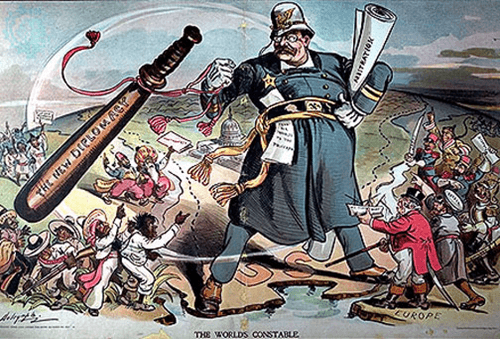
74.
This political cartoon portrays which component of American Imperialism?
a)
Great White Fleet
b)
Monroe Doctrine
c)
Roosevelt Corollary
d)
Teller Amendment
75.
Which of the following defines the Roosevelt Corollary?
a)
Europe was not allowed to imperialize the Americas
b)
America was the police force for the Western Hemisphere
76.
Which of the following defines the Monroe Doctrine?
a)
Europe was not allowed to imperialize the Americas
b)
America was the Police force for the Western Hemisphere
77.
What book did Alfred T Mahan write?
a)
The Jungle
b)
How the Other Half Lives
c)
The Influence of Naval Power Upon History
d)
Adventures of Tom Sawyer
78.
Which aspect of Imperialism does this picture represent?
a)
Roosevelt Corollary
b)
Monroe Doctrine
c)
Influence of Naval Power Upon History
d)
Spanish American War
79.

Which of the following defines Yellow Journalism?

a)

Writing about bad stuff to cause change

b)

Exaggerating events to sell newspapers

c)

Investigative journalism

d)

Reporting only the truth

80.
Which of the following describes the Teller Amendment?
a)
Promised that America would give Cuba its inedpendence
b)
Promised the US would give Hawaii its independence
c)
Promised the US would give the Philippines its independence
d)
Gave America control over Guantanamo Bay
81.
Emilio Aguinaldo fought for independence in which country that America imperilized?
a)
Hawaii
b)
Philippines
c)
Cuba
d)
Puerto Rico
82.

This foreign policy idea promotes staying out of world affairs.

a)

Imperialism

b)

Isolationism

c)

Globalism

d)

Communism

83.

This type of foreign policy encourages stronger nations to extend their influence over weaker ones.

a)

Imperialism

b)

Isolationism

c)

Globalism

d)

Communism

84.

Why was the queen of Hawaii overthrown in 1893?

a)

She was not liked by her subjects

b)

She tried to limit the influence of foreigners

c)

She tried to make the monarch too powerful

d)

She tried to give better treatment to native Hawaiians

85.

The Platt Amendment

a)

gave the U.S. the right to intervene in Puerto Rico's business at any time it wanted.

b)

gave the U.S. the right to intervene in the Philippine Island's business any time it wanted.

c)

gave the U.S. the right to intervene in Hawaii's business any time it wanted.

d)

gave the U.S. the right to intervene in Cuba's business any time it wanted.

86.
What type of warfare was used in WWI?
a)
bench
b)
trench
c)
French
d)
wrench
87.
Propaganda posters encouraged people to
a)
Go on strike
b)
Oppose the war
c)
Support the war
d)
Save money in banks
88.
Who won WWI?
a)
Allied Powers
b)
Central Powers
89.
The incident that started World War I was the assassination of 
a)
The Prince of Germany
b)
Abraham Lincoln
c)
Archduke Ferdinand
d)
the King of Austria-Hungary
90.
Who was president of the United States during World War I?
a)
Abraham Lincoln
b)
Theodore Roosevelt
c)
Bill Clinton
d)
Woodrow Wilson
91.
Which country had to accept blame for WWI?
a)
England
b)
France
c)
Austria
d)
Germany
92.
What treaty officially ended WWI?
a)
Brest-Litovsk
b)
Paris
c)
Versailles
d)
Trafalgar
93.
Which organization was created after WWI to deal with world problems, and prevent future wars?
a)
The League of Champions
b)
The United Nations
c)
The League of Nations
d)
The Justice League
94.
U-boats were German
a)
submarines used against Allied supply ship
b)
supply ships with armored hulls
c)
submarines used to find and dismantle mines
d)
supply ships that blocked Allied ports
95.
Which boat was sunk by the Germans?
a)
U.S. Maine
b)
Lusitania
c)
Titantic
d)
Princess
96.
This Allied leader brought his "Fourteen Point Peace Plan" to the treaty conference to end WWI.
a)
David Lloyd George
b)
Georges Clemenceau
c)
Woodrow Wilson
d)
Vittorio Orlando
97.
What did the writer F. Scott Fitzgerald nickname the decade of the 1920s?
a)
The Fun Age
b)
The Jazz Age
c)
The Blues Age
d)
The Dancing Age
98.
What name was given to the great achievements in art and learning by African Americans during the 1920s?
a)
The Roaring 20s
b)
The Best of Times
c)
Harlem Renaissance
99.
Which African American writer wrote poems, books, and plays about the lives of African Americans?
a)
Bessie Smith
b)
Louis Armstrong
c)
Langston Hughes
100.
Who became the first person to fly alone across the Atlantic Ocean in 1927?
a)
Babe Ruth
b)
Charles Lindbergh
c)
Amelia Earhart
101.
Who became the first woman to fly across the Atlantic Ocean in 1928?
a)
Amelia Earhart
b)
Charles Lindbergh
102.
The _________________________ was a movement in which large numbers of African Americans began leaving the South to take jobs in northern factories.
a)
Great Migration
b)
Trail of Tears
c)
Red Scare
d)
fundamentalism
103.
women in the Jazz Age that wore short skirts, short hair, and lots of make up
a)
The 80's
b)
Flappers
c)
Flip Floppers
d)
The 90's
104.
______ a system in which workers stand in one place and put parts together as the pieces go by on a moving belt.
a)
Mass production
b)
Mass Media
c)
Assembly line
d)
Prohibition
105.
What name was given to the great achievements in art and learning by African Americans during the 1920s?
a)
The Roaring 20s
b)
The Best of Times
c)
Harlem Renaissance
106.
Which amendment in 1920 gave women the right to vote?
a)
17th amendment
b)
29 amendment
c)
19th amendment
d)
3rd amendment
107.
Who was targeted for discrimination during the Red Scare?
a)
Immigrants
b)
African Americans
c)
Jews
d)
Migrant Workers
108.
What is the word for anti-immigrant attitudes?
a)
isolationism
b)
Neutrality
c)
Nativism
d)
Federalism
109.
What scandal during Warren Harding led a member of his cabinet to go to jail?
a)
Cabaret Scandal
b)
Speakeasy Scandal
c)
Teapot Dome Scandal
d)
Big Oil Scandal
110.
What did Harding promise America in the election of 1920?
a)
No income tax
b)
lower wages
c)
no immigrants
d)
Return to Normalcy
111.
What was the fear of Communist infiltration of America?
a)
red Scare
b)
Mexican Repatriation
c)
Prohibition
d)
Domino Theory
112.
Who caused African Americans to reexamine their African heritage?
a)
Eli Whitney
b)
Willard Filmore
c)
Marcus Garvey
d)
Francis Willard
113.
What was one major result of Prohibition?
a)
No one drank in USA
b)
Lower immigration rates
c)
Rise in organized crime or mafia
d)
increased taxes for government
114.
When did the Stock Market crash?
a)
October 31, 1929
b)
September 29, 1931
c)
August 29, 1991
d)
October 29, 1929
115.
What is another name for the Stock Market Crash?
a)
Black Friday
b)
Taco Tuesday
c)
Black Tuesday
d)
Throwback Thursday
116.
Who was President of the US when the stock market crashed and Depression began?
a)
Theodore Roosevelt
b)
Franklin D. Roosevelt
c)
Herbert Hoover
d)
William McKinley
117.
Who was elected president because he had a plan to pull America out of the Great Depression?
a)
William McKinley
b)
Woodrow Wilson
c)
Theodore Roosevelt
d)
Franklin D. Roosevelt
118.
What was the name of FDR's plan to reconstruct America following the Great Depression?
a)
No Deal
b)
New Deal
c)
Reconstruction
d)
FDR's Plan
119.
During the Great Depression, there was a severe drought in the Great Plains. Strong prairie winds picked up the topsoil and spread dust everywhere. Many farm families packed everything up and moved west. What was this event called?
a)
Dust Bowl
b)
Salad Bowl
c)
Great Plains Panic
d)
Depressing Dust
120.
The Great Depression that began in 1929 hit farmers especially hard. Farmers had not been doing well in the 1920s and several years of severe drought turned the land into a "dust bowl." What was an immediate result of this?
a)
Many farmers decided to grow crops that did not use as much water. 
b)
The government built large dams in the West for irrigation. 
c)
Many farmers and their families lost their farms and moved west. 
d)
The government helped farmers by buying their land and equipment. 
121.

FDR's most famous quote says, "The only thing we have to fear is _________________.

a)

God himself

b)

fear itself

c)

the Great Depression

d)

debt

122.

FDR closed all of the ___________in order to audit them and make sure all their records were in order. Only the strongest banks survived.

a)

banks

b)

stock markets

c)

businesses

d)

corporations

123.

In FDR's first ___________________in office, he sent many bills through congress.

a)

term

b)

100 days

c)

month

d)

week

124.
FDR addressed the American public in weekly broadcasts known as:
a)
FDR Hour
b)
Hangin' With Franklin
c)
Fireside Chats
d)
Around the Fire
125.
What was the name of FDR's plans and programs designed to meet the needs and problems of the Great Depression?
a)
New Deal
b)
Great Deal
c)
Social Security
d)
the New Liberalism
126.
What popular southern Governor opposed FDR with a Share or Wealth program proposal that would have provided a guaranteed income to all Americans?
a)
Geroge Wallace
b)
Lester Maddux
c)
Orval Faubus
d)
Huey Long
127.
This Program helped retirees
a)
Social Security Act
b)
Social Service Act
c)
Stock Market Advice
d)
CCC
128.
Why did Franklin Roosevelt close banks when he became president?
a)
to prevent "runs" on the banks
b)
to consolidate the assets fo several banks
c)
to reduce the number of banks in operation
d)
to allow the banks to receive money from the federal government
129.
In the 1930’s, the enactment of New Deal programs demonstrated a belief that
a)
corporations were best left to operate without government interference
b)
state governments should give up control over commerce inside their states
c)
the government should be more involved in regulating economy
130.
The New Deal pulled America out of its economic mess!  Several New Deal agencies, such as the CCC, WPA, and the TVA, were important because ____________________.
a)
they built bridges, dams, and other useful projects
b)
they helped create jobs and put Americans back to work
c)
they offered assistance to farmers
d)
they provided electricity to a poor region
131.
What was the name given to President Roosevelt's plan to alter the Supreme Court to increase his power in having his New Deal legislation passed instead of having it struck down on constitutional grounds? 
a)
The New Deal
b)
The Great Depression
c)
Court Packing 
d)
Second New Deal 
132.
What effect did the Dust Bowl storms have on the Great Depression?
a)
Many farmers were forced to leave the Great Plains.
b)
Unemployment decreased gradually.
c)
Many homes long the Mississippi River were flooded.
d)
Hoover was re-elected as president.
133.
What were the major goals of the New Deal?
a)
no gold standard and free coinage of silver
b)
abolition and suffrage
c)
relief, recovery, and reform
d)
expanding the size and economic influence of the United States
134.
Who was the dictator of Germany that rose to power with the Nazi Party?
a)
Joseph Stalin
b)
Winston Churchill
c)
Adolf Hitler
d)
Franklin D. Roosevelt
135.
In which WWII event did Japan use the strategy of surprise attack to bomb the United States? 
a)
D-Day on the shores of France
b)
Pearl Harbor
c)
Invasion of Poland
d)
V-E Day
136.
Which countries belonged to the Axis Powers?
a)
U.S., Italy, and Great Britain
b)
U.S., Great Britain, and France
c)
Germany, Italy, and Japan
d)
Germany, France, and Japan
137.
Why were natural resources, like gasoline, scarce during WWII?
a)
The U.S. government did not want to spend money on natural  resources.
b)
The U.S. had all the  natural resources it needed.
c)
Natural resources were scarce because they were needed for the  war effort. 
d)
Americans were greedy and did not want to share the natural resources. 
138.
What did allied forces do on D-Day, June 6, 1944?
a)
They sent thousands of troops to Berlin.
b)
They stormed the beaches of Normandy, France.
c)
The fought the Nazi troops in Russia.
d)
They took control of many Japanese islands.
139.
Which famous WWII leader was the dictator of the  Soviet Union that had an alliance with Germany at the beginning of the war but later joined forces with the allied powers.
a)
Benito Mussolini
b)
Adolf Hitler
c)
Winston Churchill
d)
Joseph Stalin
140.
Which WWII leader became President after FDR passed, wanted  to save American lives in the Pacific, and decided to drop the  atomic bombs?
a)
Franklin D. Roosevelt
b)
Winston Churchill
c)
Harry S. Truman
d)
Joseph Stalin
141.
What strategy did the United States develop to help defeat Japan?
a)
island hopping
b)
total war
c)
Anaconda plan
d)
blockade
142.
Which organization was created after World War II to help countries peacefully resolve conflicts?
a)
League of Nations
b)
Warsaw Pact
c)
North American Treaty Organization
d)
United Nations
143.
What role did women  take during WWII?
a)
house wives that took care of the house and  children
b)
drove tanks and fought in the war
c)
created black out curtains for everyone 
d)
filled many traditionally male jobs
144.
Who was Rosie the  Riveter?
a)
The first woman to work in a factory during WWII
b)
a representation of American women that went to work during WWII
c)
A pretty girl used for make-up advertisements
d)
A famous pilot
145.

Who transmitted code messages for the allies during WWII?

a)

women

b)

Navajo

c)

African Americans

146.

The Munich Pact incorporated this policy

a)

Isolationism

b)

Neurality

c)

Appeasement

147.

What is Genocide?

a)

prejudice, racism, hatred against Jews

b)

systematic attempt to eliminate an entire race

c)

organized attack on Jewish homes and businesses

148.

What do Adolf Hitler, Benito Mussolini, and Joseph Stalin all have in common?

a)

they are Communist dictators

b)

they are Fascist rulers

c)

they are Totalitarian dictators

149.

What stated that the US would not sell war materials or give loans to nations at war?

a)

Neutrality Acts

b)

Lend-Lease Act

c)

Atlantic Charter

150.

This was a major reason for dropping the atomic bomb on Japan

a)

promote US Isolationism

b)

destroy Japan's industrial centers and save American lives

c)

Scare Hitler

151.
- "Germany, Austria-Hungary, and Italy form the Triple Alliance." 
- "Serbian Nationalism Grows in the Balkans" 
- "Archduke Franz Ferdinand Assassinated in Bosnia."
The events in these headlines contributed most directly to the... 
a)
Beginning of WWI
b)
Outbreak of the Cold War
c)
Development of Fascist Europe
d)
Beginning of WWII 
152.
The United States president at the beginning of WWII was
a)
Hirohito
b)
Harry Truman
c)
Franklin D. Roosevelt
d)
Winston Churchill
153.

What years did WWII begin and end?

a)

1938-1951

b)

1945-1951

c)

1939-1945

d)

1936-1944

154.

African American pilots who fought in WWII

a)

Wright Brothers

b)

War Bonds

c)

Tuskegee Airmen

d)

Navajo Code Talkers

155.

This poster was an icon for

a)

women factory workers during WWII

b)

housewives

c)

women soldiers

d)

nurses

156.
What two nations were in competition with each other during the Cold War?
a)
Spain and Portugal
b)
England and France
c)
Germany and Italy
d)
United States and Soviet Union
157.
What was the term 'iron curtain' used  to describe the division of?
a)
North and South Vietnam
b)
East and West Asia
c)
North and South Korea
d)
East and West Europr
158.
President Truman adopted a new foreign policy during the Cold War know as the Truman Doctrine. What was the main goal of the Truman Doctrine?
a)
To expand trade with Europe
b)
To limit the build up of nuclear weapons
c)
To stop the spread of communism
d)
to send financial aid to Europe
159.
How did the Marshall plan try to stop the spread of communism in Western Europe after WWII?
a)
by providing government housing for refugees
b)
by providing military assistance to Vietnam
c)
by providing money to stop poverty
160.
Why was the United States involved in the Berlin Airlift?
a)
to airlift food to the people of West Berlin
b)
to bomb East Berlin
c)
to demolish the Berlin Wall
d)
to transport people out of East Berlin
161.
Why did the United States become involved in the Korean War?
a)
to contain communism
b)
to colonize Korea
c)
to spread communism
d)
to Christianize Koreans
162.
Where was Korea divided?
a)
18 parallel
b)
34 parallel
c)
38 parallel
d)
15 parallel
163.
In 1950, Korea fought a civil war over the spread of communism.  Communists from the north tried to take over the south.  What role did he US play in this war?
a)
The US and its allies went to Vietnam to fight Korean Communists.
b)
The US and its allies join the fight to keep communism from spreading.
c)
The US and its allies did not join the Korean War.
d)
The US and its allies fought to defend the North.
164.
In the 1950s, the United States became involved in the Vietnam War. Why did the United States become involved in this war?
a)
to prevent the collapse of the government of North Vietnam
b)
to stop Vietnam from taking over Hong Kong
c)
to stop the spread of communism to South Vietnam
d)
to prevent attacks against United States shipping
165.
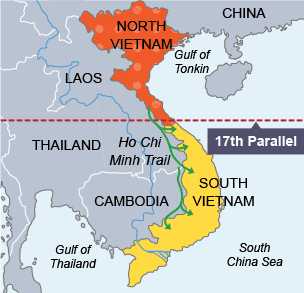
Where was Vietnam divided? 
a)
17th Parellel
b)
20thParellel
c)
38th Parellel
d)
34th Parellel
166.
How did the US respond to finding out that the Soviets had missiles in Cuba?
a)
They sent the Air Force to bomb Cuba
b)
They began placing missiles in the Soviet Union.
c)
They placed a naval blockade around Cuba.
d)
They invaded Cuba and the Soviet Union.
167.
Who were the two participants in the Space Race?
a)
The US and Cuba
b)
China and US
c)
The USSR and US
d)
US and North Vietnam
168.
What was the name of the first satellite in space launched by the Soviet Union?
a)
Gagarin
b)
Apollo 11
c)
Sputnik
d)
Apollo 13
169.

Which individual/group contributed to the Red Scare by accusing American citizens of being communist spies?

a)

McCarthy/HUAC

b)

NAACP/Farm Workers Union

c)

Nativists/Muckrakers

d)

Philanthropists/Entrepreneurs

170.

What legislation helped American soldiers get an education and buy homes in the suburbs during the Cold War?

a)

Interstate Commerce Act

b)

Federal Housing Authority Act

c)

Social Security Act

d)

GI BIll

171.

What was the name of the rapid increase of population following the end of WWII called?

a)

Baby Boom

b)

Columbian Exchange

c)

Great Migration

d)

Demographic Shift

172.

What theory caused the U.S. to enter the Vietnam War in order to stop the expansion of communism across Southeast Asia?

a)

Marshall Plan

b)

Domino Theory

c)

Open Door Policy

d)

Dollar Diplomacy

173.

What amendment was passed to lower the voting age because it was unfair that 18-20 year olds could be drafted into the army but not vote?

a)

17th amendment

b)

21st amendment

c)

22nd amendment

d)

26th amendment

174.
The physical barrier separating Communist East Berlin and Democratic West Berlin--
a)
Berlin Bloackade
b)
Berlin Base
c)
Berlin Wall
d)
Berlin Barrier
175.
Nations that were aligned with, but also under the influence and pressure of, the Soviet Union were called--
a)
European Nations
b)
NATO
c)
Warsaw Pact
d)
Satellite Nations
176.
What was the mutual defense alliance of non communist nations?
a)
NATO
b)
Warsaw Pact
c)
Truman Doctrine
d)
Open Skies
177.
What was the name for the 1955 alliance of Soviet-dominated countries of Eastern Europe  that were the counterpart to the western alliance?
a)
NATO
b)
Warsaw Pact
c)
European Alliance
d)
Iron Curtain
178.

Which leader promoted communism in North Vietnam?

a)

Ho Chi Minh

b)

Mao Zedong

179.

Mikhail Gorbachev agreed to arms reduction treaties with the United States in the 1980s because

a)

Soviet economy couldn't handle another arms race

b)

He wanted to compete against STAR WARS

c)

The Soviet Union wanted to become democratic

180.
This man was responsible for the Cuban Missile Crisis and was a leader of the Soviet Union. 
a)
JFK
b)
Joseph McCarthy
c)
Nikita Khrushchev
d)
Adolf Hitler
181.

Atlanta born Civil Rights activist that believed in non-violent protests.; gave his famous "I Have a Dream" speech at the March on Washington.

a)

Rosa Parks

b)

Martin Luther King, Jr.

c)

Cesar Chavez

d)

Thurgood Marshall

182.

More than 200,000 Americans gathered in Washington, D.C., for a political rally for jobs and freedom.

a)

Civil Rights Act of 1964

b)

Montgomery Bus Boycott

c)

Freedom Riders

d)

March on Washington

183.

Refused to give up her seat to a white man on a bus.

a)

Mary Washington

b)

Jackie Kennedy

c)

Cesar Chavez

d)

Rosa Parks

184.

Desegregated all public schools. This was a major court case that involved Linda Brown attending an all-black school when an all-white school was closer to her home.

a)

Brown vs. the Board of Education

b)

13th Amendment

c)

Civil Rights Act of 1964

d)

Jim Crow Laws

185.

First African American Supreme Court judge. He was the attorney for Linda Brown with Brown vs. the Board of Education.

a)

Martin Luther King, Jr.

b)

John F. Kennedy

c)

Thurgood Marshall

d)

Rosa Parks

186.

President who was assassinated during a campaign visit in Dallas, Texas, by Lee Harvey Oswald for his Civil Rights efforts

a)

Robert Kennedy

b)

Thurgood Marshall

c)

Martin Luther King, Jr.

d)

John F. Kennedy

187.

When African Americans refused to ride the public busses as a sign of protest; this began when Rosa Parks was jailed for refusing to give up her seat to a black man.

a)

Voting Rights Act of 1965

b)

March on Washington

c)

Montgomery Bus Boycott

d)

15th Amendment

188.

Prohibits racial discrimination in voting (voting people, voting)

a)

13th Amendment

b)

Jim Crow Laws

c)

Civil Rights Act of 1964

d)

Voting Rights Act of 1965

189.

This amendment abolished (ended) slavery

a)

13th Amendment

b)

14th Amendment

c)

15th Amendment

d)

16th Amendment

190.

Gave all citizens born in the United States citizenship (rights of citizens); look for the amendments in your notebook!!!

a)

13th Amendment

b)

14th Amendment

c)

15th Amendment

d)

16th Amendment

191.

Gave all male United States citizens over the age of 21 the right to vote

a)

13th Amendment

b)

14th Amendment

c)

15th Amendment

d)

16th Amendment

192.

Leader who worked to improve treatment, pay, and working conditions for farm workers; you should know this one because you have already used three of these!

a)

Martin Luther King, Jr.

b)

John F. Kennedy

c)

Thurgood Marshall

d)

Cesar Chavez

193.

The Chicano Civil Rights Movement wanted-

a)

extension on their visas

b)

better pay and working conditions

c)

work longer hours with little pay

d)

government grants for college

194.

There was a growth in political engagement by minorities with the passage of legislation to end-

a)

Literacy tests, voter intimidation, and gerrymandering

b)

Poll taxes, sit-ins, and freedom rides

c)

Labor unions, marches, and protests

d)

Literacy tests, integration, and desegregation

195.

Governors of Southern States who were devoted to the idea of racial segregation.

a)

George Maddox, JFK, Huey P. Newton

b)

LBJ, Lester Maddox, & Thurgood Marshall

c)

Orval Faubus, Earl Warren, & MLK

d)

Orval Faubus, George Wallace, & Lester Maddox

196.

The Civil Rights Movement is mostly characterized by-

a)

non-violent civil disobedience

b)

violence and riots

c)

economic prosperity

d)

political corruption

197.

President who imposed a ruling to integrate public schools

a)

Lyndon B. Johnson

b)

John F. Kennedy

c)

Harry S. Truman

d)

Dwight D. Eisenhower

198.

Growth in economic and political chances for minority citizens was achieved by civil disobedience methods like-

a)

Marches, Freedom Rides, and Sit-ins

b)

Riots, Boycotts, and Guerilla Warfare

c)

Protests, Sit-ins, and Riots

199.

Court case that made legal justification for segregation

a)

Delgado v. Bastrop ISD

b)

Brown v. Board of Education

c)

Plessy v. Ferguson

d)

Tinker v. Des Moines

200.

Challenged the federal government to enforce Supreme Court rulings against discrimination in interstate transportation

a)

Freedom Rides

b)

Sit-ins

c)

Marches

d)

Boycotts

201.
Court case that created "Separate-but-equal" doctrine.
a)
Sweatt v. Painter
b)
Brown v. Board of Education
c)
Plessy v. Ferguson
d)
Mendez v. Kirby ISD
202.
Nonviolent protest, where protesters occupied space in order to protest segregation.
a)
Sit-In
b)
Freedom Rides
c)
Selma March
d)
Filibuster
203.
Black nationalist leader who for awhile was a spokesman for the Nation of Islam; talked about black freedom “by any means necessary;” was assassinated on February 21, 1965, in NYC by Nation of Islam members  
a)
Malcolm X
b)
Martin Luther King, Jr.
204.
_______________ wrote "I Have a Dream" and delivered it to thousands in Washington, DC. 
a)
Harry Belafonte
b)
Barack Obama
c)
Martin Luther King, Jr. 
d)
Jesse Jackson
205.
These black teenagers were the first to integrate into Little Rock Central High
a)
Elite Eight
b)
Little Rock Nine
c)
Arkansas Seven
d)
Final Four
206.
Who was the 1st female judge to be placed on the supreme court ?
a)
Sonia sotomayor
b)
Sandra Day O'Connor
c)
Ruth Bader Ginsburg
d)
Elena Kagan
207.
Which proposed amendment  that was designed to ensure  equal rights for women , was rejected by Congress?  
a)
Equal Rights amendment
b)
13th amendment
c)
Women's Rights amendment
d)
18th amendment
208.

Recognized for the affect it had on women's involvement in organized sports at the college and high school levels.

a)

Title XI

b)

19th Amendment

c)

Title IX

d)

Women's suffrage