
Font size
 Worksheets
Clues to Earth's Past Quiz
Total questions: 25
Worksheet time: 14mins
What is a fossil?
A living organism
A type of rock
preserved remains of ancient living things
A volcanic rock
Which principle states that Earth's history was shaped by a series of sudden, violent catastrophes, such as floods and volcanic eruptions
Catastrophism
Superposition
Uniformitarianism
Radioactive dating
Who is considered the father of modern geology for promoting uniformitarianism?
Georges Cuvier
Alfred Wegener
James Hutton
Charles Lyell
What type of fossil forms when minerals fill in a mold?
Trace fossil
Carbon film
Mold fossil
Cast fossil
Which of the following is a type of trace fossil?
Petrified wood
Footprint
Shell
Leaf imprint
What condition increases the chances of fossil formation?
Slow burial and decay
Lack of hard parts
Rapid burial and hard body parts
Dry environment
What is a petrified fossil?
A soft tissue preserved in ice
An organism's remains turned to stone
A hollow impression in rock
A fossil made of carbon
Which principle helps determine the relative age of rock layers?
Radiometric dating
Superposition
Fossil succession
Catastrophism
What does the principle of lateral continuity state?
Older rocks are always found at the bottom
Sediments extend in all directions until they thin or meet a barrier
Layers are always tilted
Fossils appear in a predictable order
What process is used to determine the absolute age of rocks?
Superposition
Inclusion
Correlation
Radiometric dating
Fossils only form from soft parts of organisms.
True
False
Trace fossils can include footprints, nests, and burrows.
True
False
Carbon film fossils are formed when an organism's carbon outline is preserved.
True
False
Catastrophism supports slow and steady changes over time.
True
False
In geology, an inclusion is a piece of older rock that becomes trapped inside a newer rock during the formation process.
True
False
Unconformities represent gaps in the geologic record.
True
False
Mold fossils are 3D replicas of organisms.
True
False
True-form fossils can be preserved in amber, tar, or ice.
True
False
Relative age tells the exact number of years a rock has existed.
True
False
Geologists study fossils to learn about Earth's past.
True
False
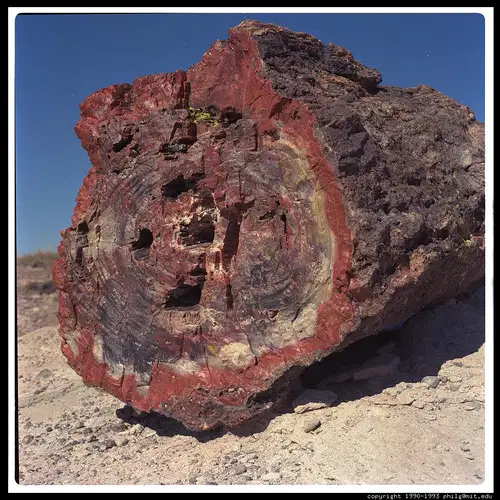
A (a) fossil is formed when the organic material of an organism is replaced by minerals, turning it into stone over time. Usually they are wood or bones.
(a) decay is the process where isotopes break down into stable ones over time.
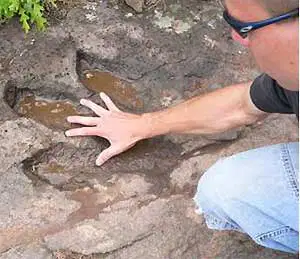
The preserved evidence of the activity of an organism is called a (a) fossil.
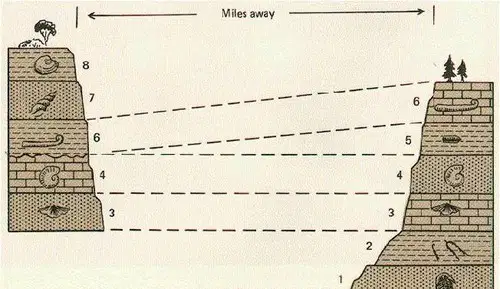
(a) is a method where geologists study rocks and fossils from separate locations.
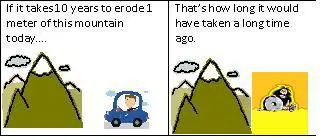
The idea that geological processes occur slowly and steadily over time is called (a) .

