
Font size
 Worksheets
Seasons and Tides
Total questions: 10
Worksheet time: 5mins

The diagram shows Earth at four positions in its orbit around the Sun. Which statement correctly describes the seasons in the Northern Hemisphere at these positions?
Position 2 is summer, Position 4 is winter
Position 2 is spring, Position 4 is fall
Position 2 is fall, Position 4 is spring
Position 2 is winter, Position 4 is summer

Based on the diagram, what type of tide occurs when these celestial bodies are positioned as shown?
A. A spring tide occurs when the Earth, Moon, and Sun are aligned, as shown in the diagram.
B. A neap tide occurs when the Earth, Moon, and Sun are aligned, as shown in the diagram.
C. A regular tide occurs when the Earth, Moon, and Sun are aligned, as shown in the diagram.
D. No special tide occurs when the Earth, Moon, and Sun are aligned, as shown in the diagram.

Based on this image, which statement is correct?
A. It is winter in the Northern Hemisphere and summer in the Southern Hemisphere.
B. It is summer in the Northern Hemisphere and winter in the Southern Hemisphere.
C. It is spring in both the Northern and Southern Hemispheres.
D. The amount of daylight is equal in both hemispheres.

A student in New York (41°N latitude) wonders why they need heavier clothing in December but lighter clothing in June. Which statement best explains the need for different clothing in December versus June in the Northern Hemisphere?
The Earth is farther from the Sun in December and closer in June.
The Northern Hemisphere receives more direct sunlight in June due to Earth's tilt.
The Earth's rotation is slower in December, causing longer, colder nights.
The Sun produces more energy in June than in December.

A student creates a model of Earth using a globe with a light source representing the sun. When modeling summer in Australia, which direction should the Earth's axis tilt relative to the light source?
The Southern Hemisphere should tilt away from the light
The Southern Hemisphere should tilt toward the light
The axis should be vertical with no tilt
The axis should point directly at the light

A student creates a model of Earth using a globe with a light source representing the sun. What would happen in the model if the axis direction kept changing?
It would show correct seasonal changes
It would show incorrect seasonal patterns
It would show only summer conditions
It would show only winter conditions
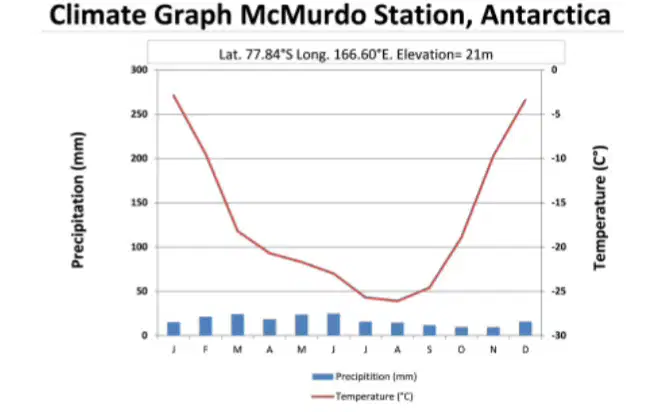
A scientist studying climate patterns notices seasonal changes at McMurdo Station, Antarctica. Examine the climate graph provided. Which two statements correctly explain the seasonal changes observed at McMurdo Station? Select two correct answers.
The station experiences its warmest temperatures during the months of December and January.
Precipitation remains relatively constant throughout the year, with slight increases in summer.
The coldest temperatures occur during the Southern Hemisphere's winter months (June-August).
Temperature variations throughout the year are minimal, staying within a 5°C range.
The station receives the most precipitation during the coldest months of the year.

Which combination of factors creates the strongest tides experienced by the fishermen?
New moon phase and the Moon at its closest point to Earth
Full moon phase and the Moon at its farthest point from Earth
First quarter moon phase and the Moon at its average distance from Earth
Third quarter moon phase and the Moon at its closest point to Earth
Harbor managers adjust shipping schedules based on predicted tidal patterns. They notice that ships
have more clearance under a bridge than they expected during neap tides. Which statement best explains why the water level might be lower than anticipated during a neap tide?
Neap tides cause low tides to be lower than usual.
The Moon's gravity is weaker during the first and third quarter phases.
The Sun's gravitational pull is opposing the Moon's pull more strongly than usual
Neap tides have a smaller tidal range, which can result in lower high tides.
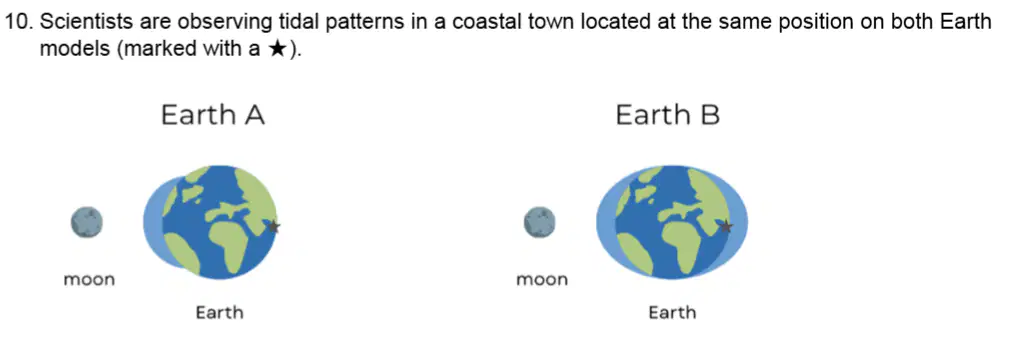
As each Earth completes one full 24-hour rotation, which statement BEST explains why model B more accurately represents the daily tidal patterns this coastal town would experience?
Model A would predict one high tide per day when the town faces the Moon, while model B correctly predicts two high tides per day—one when the town passes through each bulge.
Model A would predict constant sea levels throughout the day, while model B correctly predicts two high tides (when the town passes through each bulge) and two low tides (when the town is between bulges) per day.
Model A would predict higher tides only during full moons, while model B correctly predicts daily tidal cycles regardless of the Moon's phase.
Model A would predict tides caused only by the Sun's gravity, while model B correctly shows that the Moon is the only significant influence on daily tides.

