
 Worksheets
Adding & Removing Heat - SC.7.P.11.1
Total questions: 10
Worksheet time: 5mins
Name
Class
Date
1.
(SC.7.P.11.1) Temperature changes may result from adding or removing heat from a system. Which of the following does temperature measure?
a)
the energy transferred when an object changes state
b)
the average kinetic energy of the particles that make up the object
c)
the state of matter that makes up the object
d)
the electrical energy that is present in the object
2.
(SC.7.P.11.1) Adding or removing heat from a system may result in a temperature change. Which temperature change would indicate that energy as heat was transferred out of a system?
a)
The temperature increased by 5 °C.
b)
The temperature increased from 30 °C to 40 °C.
c)
The temperature dropped by 1 °C.
d)
The temperature remained unchanged.
3.

(SC.7.P.11.1) Specific heat is the amount of energy needed to change the temperature of 1 kilogram (kg) of a substance by 1 °C. The unit of energy for this change is called the joule (J). The table below lists the specific heat in J/kg•°C of four different substances.
Which of the following shows the correct order of substances from least to most energy required to change the temperature of the substances listed in the table above?
a)
aluminum --> copper --> gold --> water
b)
copper --> water --> aluminum --> gold
c)
gold --> copper --> aluminum --> water
d)
water --> aluminum --> copper --> gold
4.
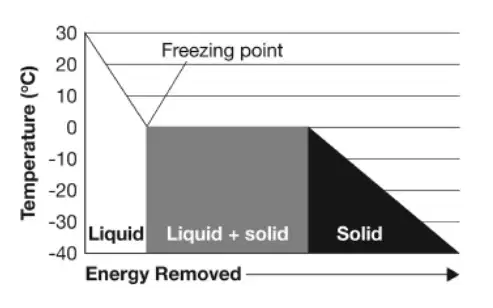
(SC.7.P.11.1) The graph below illustrates the changes in state of water at various temperatures over a period of time. Which of the following statements best summarizes the information shown on the above graph?
a)
Water changes from a gas to a liquid at 0 ºC.
b)
Water boils at 30º C.
c)
The temperature of water remains constant as energy is removed.
d)
Water changes from a liquid to a solid at 0 ºC.
5.
(SC.7.P.11.1) If the temperature of an object is 25 °C, which of the following temperatures would indicate the most heat was removed from this object?
a)
10 °C
b)
40 °C
c)
20 °C
d)
30 °C
6.
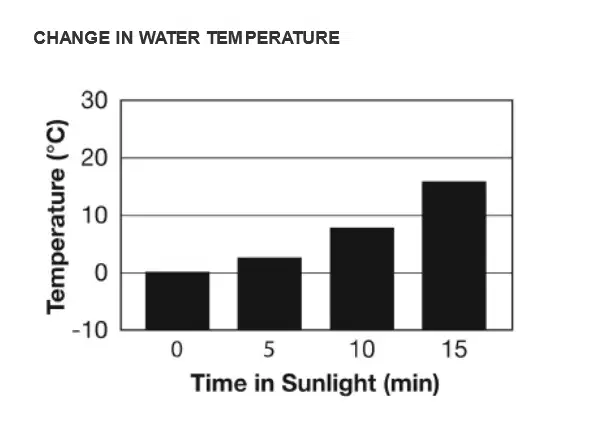
(SC.7.P.11.1) Alejandra performed an experiment where she placed a beaker of ice water in sunlight and measured the temperature over a period of 15 minutes. She prepared the bar graph shown below to illustrate the results of her experiment. What can Alejandra’s conclude from her experiment?
a)
The ice water released energy as heat.
b)
The sunlight transferred energy as heat to the ice water.
c)
The water froze.
d)
The water boiled.
7.
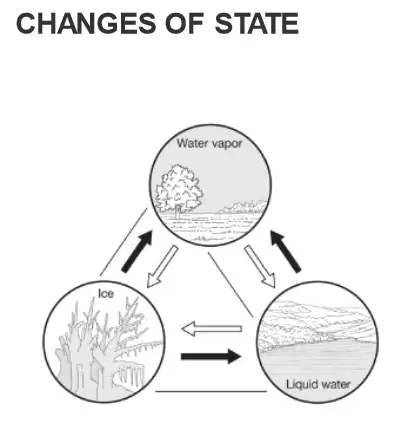
(SC.7.P.11.1) Look closely at the illustration below of the three states of water. Which of the following labels should be added to all of the black arrows in the above illustration? Choose the Best Answer.
a)
temperature increases
b)
temperature decreases
c)
heat added
d)
heat removed
8.
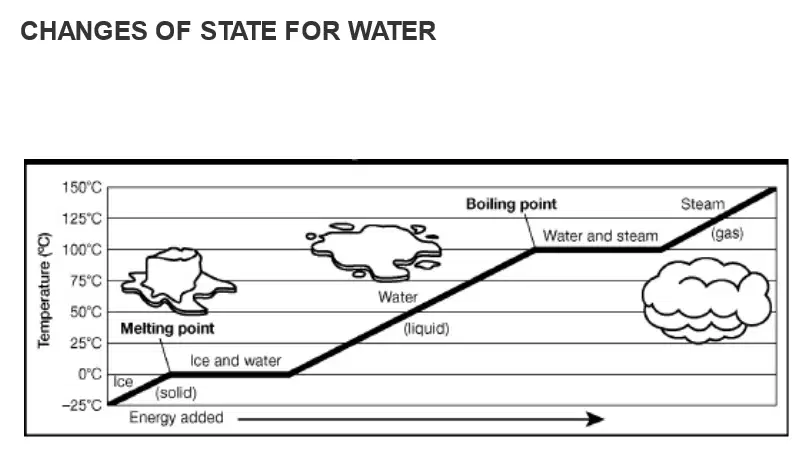
(SC.7.P.11.1) The graph below shows the changes of state for water. The x-axis of this graph is labeled “Energy added.” Which of the following units could represent the x-axis?
a)
seconds
b)
millimeters
c)
degreees Celsius
d)
Joules
9.
(SC.7.P.11.1) As energy is added or removed from a system, a change in temperature may result. Which of the following is the best explanation for the type of energy transfer that may occur between objects at different temperatures?
a)
Electrical energy will be transferred between objects at different temperatures.
b)
Heat energy will be transferred between objects at different temperatures.
c)
Light energy will be transferred between objects at different temperatures.
d)
Sound energy will be transferred between objects at different temperatures.
10.
(SC.7.P.11.1) A change of state may happen when energy as heat is transferred to or from a substance. Which change of state could occur as energy is added to a substance?
a)
gas --> solid
b)
liquid --> solid
c)
gas --> liquid
d)
liquid --> gas
100 %

