wayground logo

Free Printable Worksheets

NEW

Font size

S
M
L
XL
Worksheets

Unit 9 Electricity Review

Total questions: 28

Worksheet time: 33mins

Name
Class
Date
1.
A pathway for electricity to travel is called___________
a)
current
b)
static electrcity
c)
circuit
d)
circle
2.
A continuous flow of electricity is called_____________
a)
series
b)
circuit
c)
static
d)
current
3.
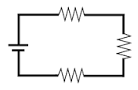
What kind of circuit is this?
a)
series
b)
parallel
4.
In a parallel circuit if one light bulb goes OUT; then they ALL go out. TRUE OR FALSE?
a)
TRUE
b)
FALSE
5.
What is a switch's function in a circuit?
a)
to make the current hotter or colder
b)
turn on and off the flow of current
c)
the pathway that current flows
d)
to add more power to the circuit
6.

How is a conductor different from an insulator?

a)

In a conductor, electric current can flow freely; in an insulator, it cannot flow freely

b)

In a conductor, electric current cannot flow freely; in an insulator, it can flow freely

c)

Conductors have magnetic fields; insulators do not have magnetic fields

d)

Conductors do not have magnetic fields; insulators do have magnetic fields

7.

What is a circuit?

a)

an unbroken loop of conductive material through which electrons flow continuously

b)

the same as an insulator

c)

a broken loop of conductive material through which electrons flow continuously

8.

What is electricity?

a)

the flow of electric charge

b)

the flow of negative electric charge

c)

the orbit of electrons around a nucleus

d)

the flow of positive electric charge

9.

Where is the resistor located on this diagram?

a)

A

b)

C

c)

D

d)

B

10.
Choose the correct sentence.
a)
This circuit will work because it is an open circuit.
b)
This circuit will work because it is a closed circuit.
c)
This circuit will NOT work because it is an open circuit.
d)
This circuit will NOT work because it is a closed circuit.
11.

A Charging system producing 14.5 Volts with a current flow of 43.5 Amps, what is the circuit resistance?

a)

58 Ohms

b)

0.33 Ohms

c)

13 Ohms

d)

1 Ohms

12.
The plastic covering is there to:
a)
Provide a conductor for electrical energy to flow.
b)
Provide an insulator so that electrical energy will not pass outside of the wires.
c)
Provide a conductor so that electrical energy can NOT flow.
d)
Provide an insulator so that electrical energy can flow.
13.

If you build up a positive charge on your body and touch a metal doorknob you may receive a "shock". What really happened?

a)

Electrons flowed from you to the doorknob.

b)

Electrons flowed from the doorknob to you.

c)

Protons flowed from you to the doorknob.

d)

Electrons from the air around you cancelled out the positive charge.

14.

When charging by INDUCTION: the two objects involved DO NOT touch.

a)

TRUE

b)

FALSE

15.

Will the balloons ATTRACT or REPEL each other?

a)
b)
16.

Will the balloons ATTRACT or REPEL each other?

a)
b)
17.
An example of a conductor is :
a)
a glass paperweight
b)
a plastic cap
c)
a metal screw
d)
a wooden handle
18.
An example of an insulator is:
a)
iron
b)
silver
c)
copper wire
d)
rubber
19.
All wires used in electric circuits should be covered with:
a)
a colored material.
b)
a conducting material.
c)
an insulating material.
d)
none of these.
20.

Are electrons moving or not moving in the circuit?

a)

moving

b)

not moving

21.

Electrons return to a battery at the ___ terminal.

a)

postive

b)

negative

22.
What type of circuit is pictured?
a)
series
b)
parallel
23.
What kind of circuit is this?
a)
Series
b)
Consecutive
c)
Parallel
d)
Training
24.
A circuit made of wires, a lamp, a switch, and a cell is shown at the right. What change is needed for the lamp to glow? 
a)
The switch needs to be opened.
b)
The switch needs to be closed.
c)
The cell needs an insulator.
d)
The wire needs to be connected to the bottom of the cell.
25.

What is the total resistance of this circuit?

a)

65.4 Ω

b)

85.9 Ω

c)

400 Ω

d)

150 Ω

26.

At which point is the electric field the strongest

a)

A

b)

B

c)

C

d)

D

27.

Based on the arrangement of the electric field lines in the diagram, what are the charges?

a)

both charges are the same

b)

the charges are opposite

c)

they are neutral; no charge

28.

Which diagram correctly shows the electric field around a negative charge?

a)

A

b)

B

c)

they are both positive