
 Worksheets
BPMN
Total questions: 35
Worksheet time: 21mins
What does the acronym BPM mean?
A. Business Process Modeling
B. Business Process Manufacturing
C. Business Process Management
D. Business Process Maintenance
BPM focuses on:
A. The clients
B. The processes
C. The managers
D. The procedures
How are roles or positions represented in a diagram?
A. In the pool
B. In the lanes
C. In the Task
D. At the floodgates
What does BPMN stand for?
A. Business Product Management Notation
B. Business Process Management Notation
C. Business Parallel Model Newest
D. Board Production Main Notation
What is BPMN?
A. a notational model for business process diagrams
B. a Business Process Management Methodology
C. a business process automation tool
D. a business process analysis technique
What are the basic elements of a BPMN?
A. Flowcharts, Process and Event Diagrams
B. Events, Gates and Activities
C. Decisions, Recursion, Tasks
D. Stakeholders, Project Manager, Consultor
What are the three types of flows in BPMN?
A. task flow, message flow and decision flow
B. activity flow, event flow and decision flow
C. sequence flow, message flow and association flow
D. task flow, event flow and decision flow
Describes how a single business entity carries out the process, responding to a single coordination perspective.
A. Orchestration
B. Choreography
C. Collaboration
Describes a process with two or more participants.
A. Orchestration
B. Choreography
C. Collaboration
Describes the interaction between participants in a process, defining expected behavior. Interactions correspond to the communication through which participants exchange messages.
A. Orchestration
B. Choreography
C. Collaboration
BPMN: It is a graphic notation that allows you to logically visualize the steps of a procedure, where there is a predetermined and structured sequence for the execution of tasks.
A. True
B. False
In BPMN notation, the inputs and outputs of a process can include information such as documents, data in systems, and physical elements.
A. True
B. False
BPMN notation is rich in representation elements, yet it does not allow modeling complex processes.
A. True
B. False

In BPMN, what does the following symbol represent?
A. Association Flow
B. Message flow
C. Sequence Flow
D. Outflow

In BPMN, what does color represent in a symbol?
A. A traffic sign
B. A meeting point
C. A checkpoint
D. A danger sign
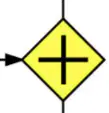
What does this symbol represent?
A. Exclusive Gateway
B. Parallel Gateway
C. Complex Gateway
D. Inclusive Gateway
What is a start event in BPMN?
A. an event that initiates a business process
B. an event that occurs during a business process
C. an event that marks the end of a business process
D. an event that represents a user action
What is a gateway in BPMN?
A. an element that defines the beginning of a business process
B. an element that defines the end of a business process
C. an element that defines the sequence flow of the business process
D. an element that represents a decision in the business process
What is a task in BPMN?
A. an activity that must be performed by a user or system
B. an event that marks the beginning of a business process
C. an event that represents a decision
D. an activity that is performed automatically by the system
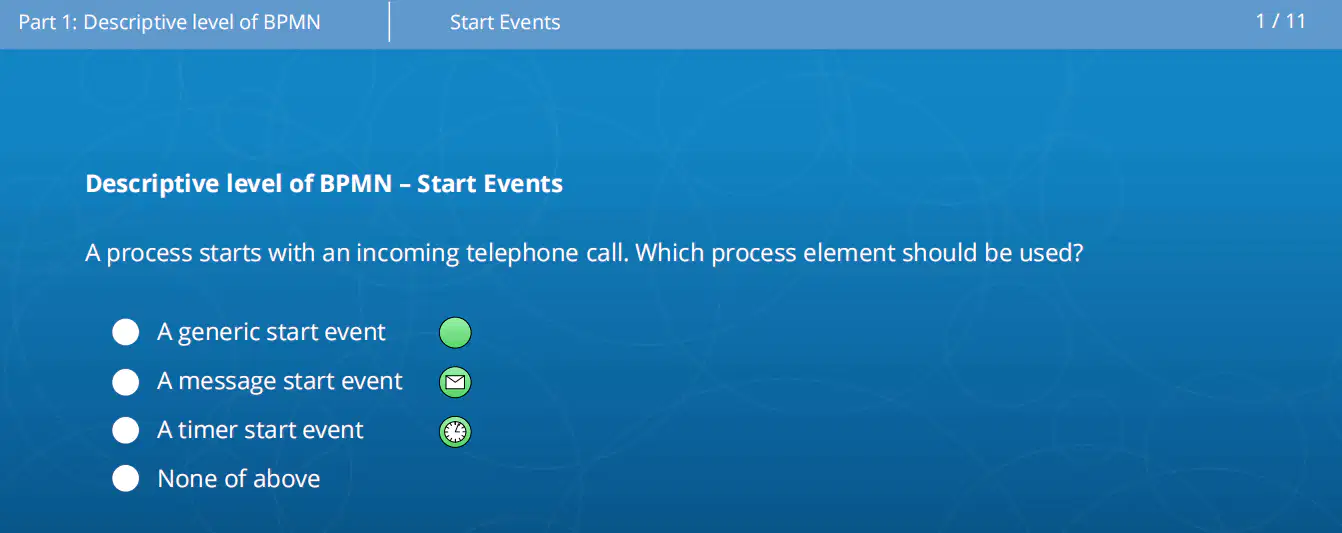
A process starts with an incoming telephone call. Which process element should be used?
A. a generic start event
B. a message start event
C. a timer start event
D. none of above
A process can have ...
A. Excatly one start event
B. Several start events
C. No start events
D. All of the above
A process might have ...
A. Exactly one end event
B. Several end events
C. No end events
D. All of the above
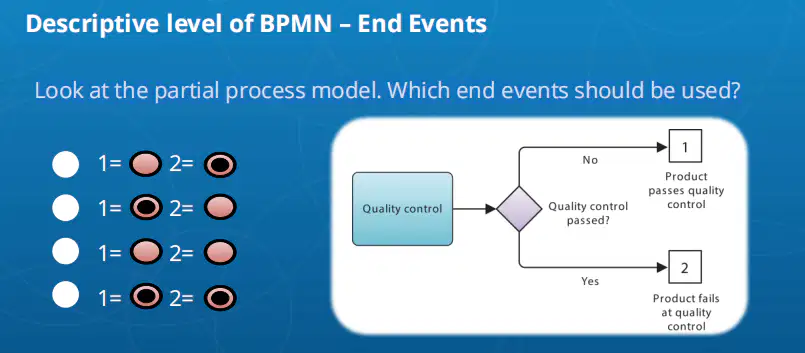
Look at the partial process model. Which end events should be used?
A
B
C
D
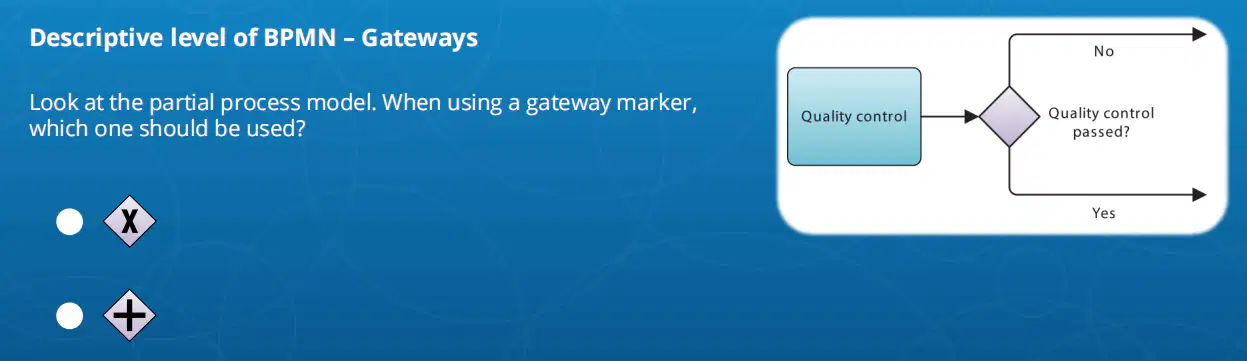
Look at the partial process model. When using a gateway marker,
which one should be used?
A
B
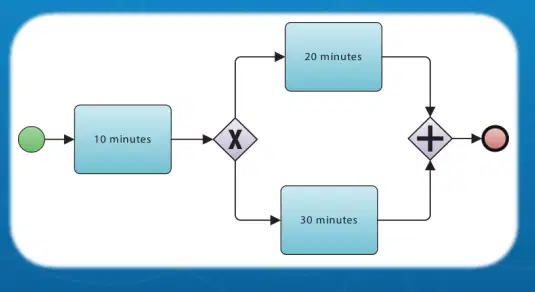
How long does it take to finish this process?
A. 30 minutes
B. 40 minutes
C. 60 minutes
D. Never
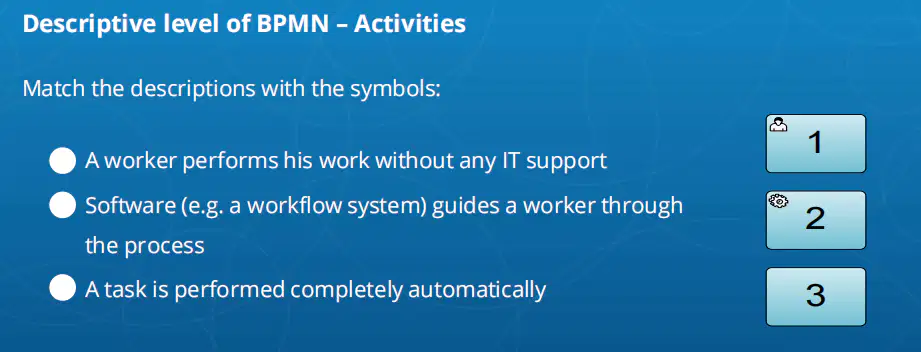
Match the descriptions with the symbols:
A. 3 - 2 - 1
B. 1 - 3 - 2
C. 2 - 1 - 3
D. 3 - 1 - 2
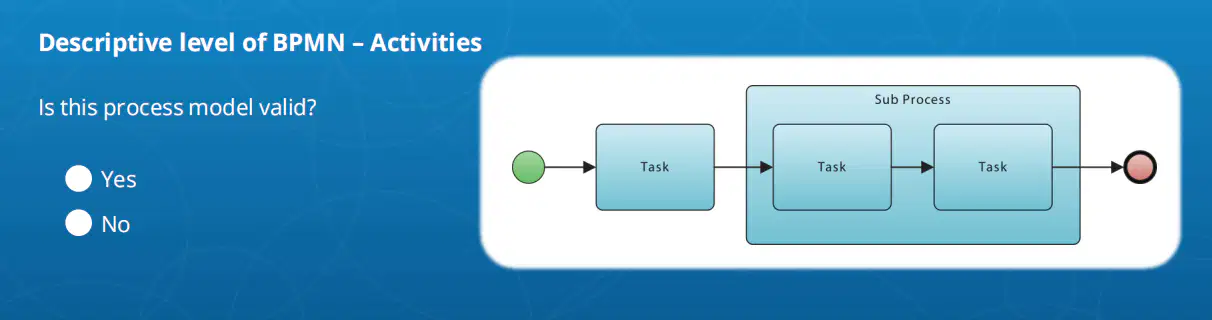
Is this process model valid?
A. Yes
B. No
A Pool might contain:
A. No processes
B. One process
C. Several processes
Descriptive level of BPMN – Pools and Lanes
Two companies collaborate to achieve a common goal. In this case,
a process model should consist of:
A. Two Lanes
B. Two Pools
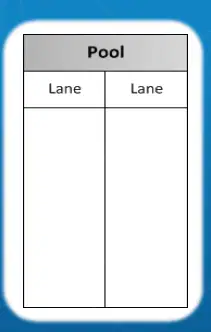
Descriptive level of BPMN – Pools and Lanes
Lanes can be nested: True or False?
A. True
B. False

Which of the following process tracks fit the process model?
A. i-A-B-o1
B. i-A-C-B-o1
C. i-D-E-o2
D. i-A-D-E-o2
Which gateway can be used to model the following situation:
During a shared apartment meeting, the roommates vote on whether to purchase a faster internet connection. If three-quarters of the roommates agree, the faster connection is booked.

A

B

C

D
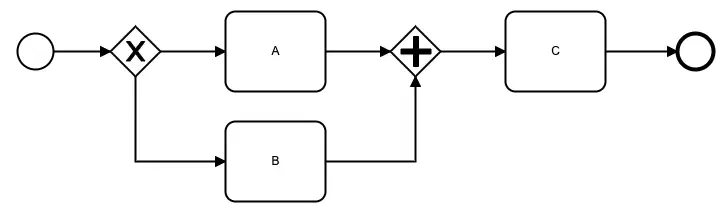
How often is activity C executed in the process model shown?
A. Not once
B. Once
C. Twice
D. As often as you like
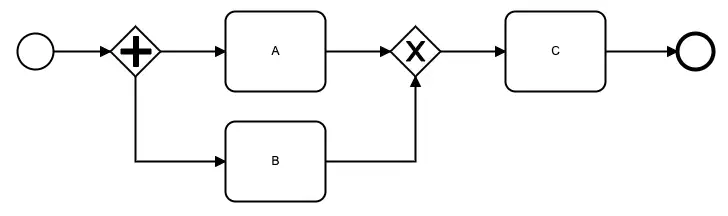
How often is activity C executed in the process model shown?
A. Not once
B. Once
C. Twice
D. As often as you like
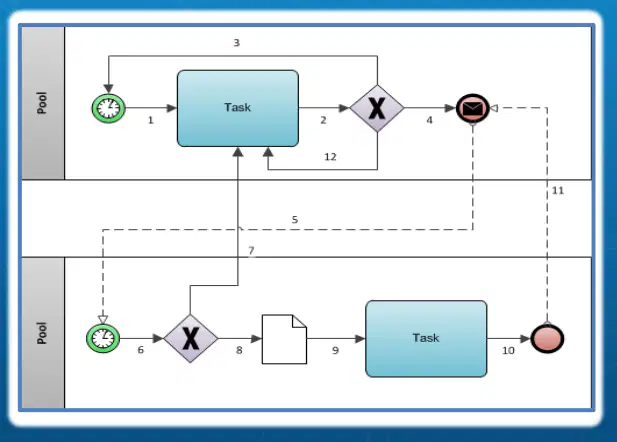
Descriptive process model.
Which connections in this process model are used
incorrectly and why?

