
 Worksheets
Unit 11 Quiz: Governments
Total questions: 19
Worksheet time: 10mins
Name
Class
Date
1.
What do an autocracy and oligarchy have in common?
a)
The head of state is chosen by Parliament.
b)
Their citizens decide public issues for themselves.
c)
The majority of citizens have little or no control over government.
d)
Political power is exercised by representatives elected by the people.
2.
Which statement applies to all types of monarchies?
a)
The monarch inherits his/her power
b)
They combine the executive and legislative branches
c)
Their ruler holds absolute power, unlimited by Parliaments or constitutions
d)
The monarch's power, whether total or limited, is established in a written constitution
3.
What is one advantage of the American constitutional republic over autocratic nations in safeguarding individual liberties?
a)
Its national government has unlimited power over its citizens.
b)
The conduct of its government officials is limited by the rule of law.
c)
It places power in a single person without any checks and balances.
d)
It gives local authorities final authority over the national government.
4.
Which type of economic system provides the most economic freedom and has historically provided high standards of living?
a)
Socialism
b)
Capitalism
c)
Totalilarian
d)
Communism
5.
How do communist economies determine what goods and services to provide to their citizens?
a)
Central planners set quotas for the state-owned farms and factories.
b)
Private businesses decide what to produce based on consumer demand.
c)
Private citizens determine their own needs and produce for themselves.
d)
State-owned industries determine some production while private businesses produce goods based on consumer demand.
6.
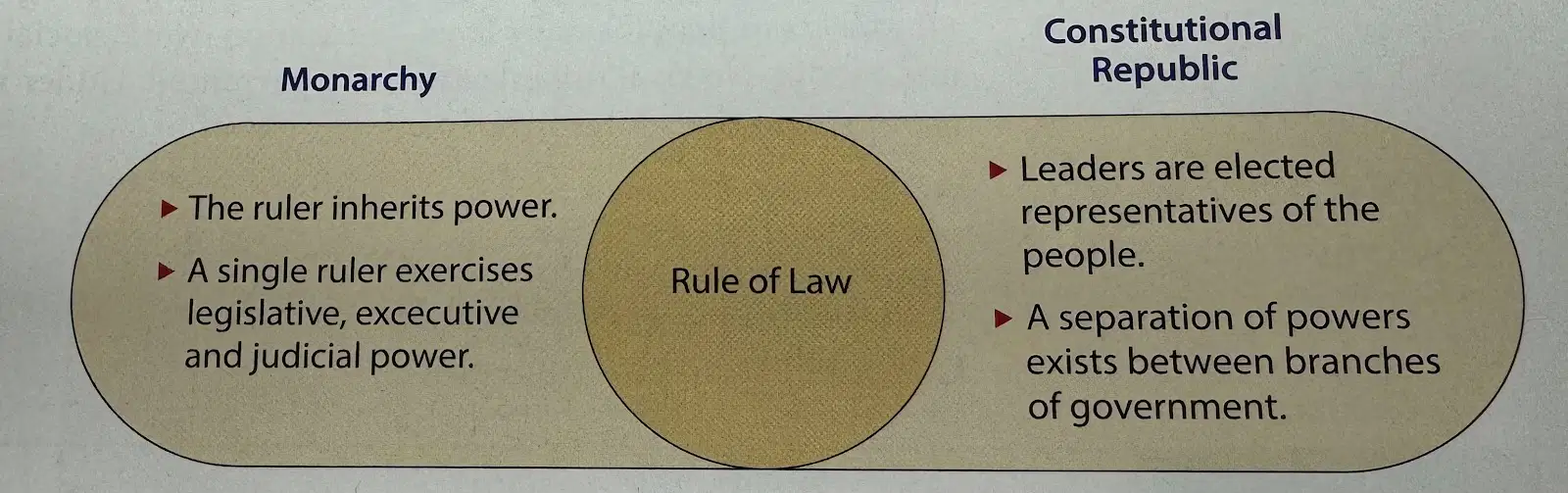
What would be considered an advantage of the government on the right (constitutional republic)?
a)
There are fewer disagreements over public policy.
b)
It is able to act more quickly over public policy.
c)
It provides better safeguards for protecting individual liberities.
d)
Members of the government are able to meet with foreign officials.
7.
Which statement is true of a federal but not of a unitary system of government?
a)
Its local governments are extensions of the central government.
b)
Its local governments cannot be abolished by the central government.
c)
Its central government usually appoints the leaders of local governments.
d)
Its central government delegates responsibilities to local governments to carry out.
8.
The excerpt below is from "The Form of Islamic Government" by Ayatollah Khomeini, Supreme Leader of Iran
The fundamental difference between Islamic government, on the one hand and constitutional monarchy and republics, on the other, is this: whereas the representatives of the people or the monarch in such regimes engage in legislation, in Islam the legislative power and competence to establish laws belong exclusively to God Almighty.
Based on this excerpt, which form of government would Ayatollah Khomeini have preferred?
a)
Oligarchy
b)
Autocracy
c)
Theorcracy
d)
Democracy
9.
John lives in the country of Devonia. Devonia has an absolute leader in charge of its government. This leader holds unlimited power. She can imprison or even execute citizens at will. She has opened special internment camps, where she sends critics of her government. The government controls all aspects of people's daily lives -- education, work, social organizations, and media. No rival organizations are permitted. Under which form of government does John live?
a)
Monarchy
b)
Oligarchy
c)
Constitutional Republic
d)
Totalitarian Government
10.
What is an advantage of the federal system of government in balancing local sovereignty with national unity?
a)
In this system, local governments can leave the nation at any time because they are sovereign.
b)
In this system, national unity is secure because the national government exercises complete control over local governments.
c)
In this system, freedom is protected because local governments have sovereignty over the national government in all matters.
d)
In this system, the national government is strong enough to protect the nation but local governments prevent it from becoming authoritarian.
11.
Why did the authors of the Constitution create a federal system of government rather than a unitary system?
a)
They did not trust the state governments.
b)
They feared a central government that was too powerful.
c)
They wanted to limit the role of the people in government.
d)
They had seen how inefficient a weak central government was under the Articles of Confederation.
12.
Which statement identifies an advantage of capitalism over government-controlled economic systems in raising standards of living?
a)
Central planners identify where economic needs are greatest.
b)
The profit incentive spurs producers to develop new technologies.
c)
Government leaders punish critics who challenge economic policies.
d)
Workers have no reason to work hard since their jobs are guaranteed
13.

Which list correctly identifies the three type of governments in the diagram below?
a)
1. Unitary; 2. Federal; 3. Confederal
b)
1. Federal; 2. Confederal; 3. Unitary
c)
1. Monarchical; 2. Autocratic; 3. Theocratic
d)
1. Confederal; 2. Democratic; 3. Monarchical
14.
What do socialist and communist economic systems have in common?
a)
They often resulted in brutal dictatorship and economic stagnation.
b)
They believed that the ideal society was one in which the government abolished all forms of private property.
c)
They both promoted a violent social revolution in which workers would take control of the government.
d)
They believed that government should provide services to the community to raise the average standard of living.
15.
Which form of government gives the most power to ordinary citizens?
a)
Autocracy
b)
Oligarchy
c)
Theocracy
d)
Democracy
16.
Which statement best describes a socialist economy?
a)
Private businesses provide all goods and services.
b)
Taxes are low, but government services are extremely limited.
c)
The government owns several basic industries and provides many services at no cost.
d)
Private property is abolished and all goods and services are provided to citizens by the government.
17.
The excerpt below comes from the writings of Jacques Bénigne Bossuet, a French bishop in the early 1700's.
Rulers act as the ministers of God and as his lieutenants on earth. It is through them that God exercises his empire...It appears from all this that the person of the king is sacred, and that to attack him in any way is sacrilege...
Based on the this excerpt, which form of government would Bishop Bossuet most likely favor?
a)
Oligarchy
b)
Democracy
c)
Monarchy
d)
Confederation
18.
The list below describes the characteristics of an economic system:
1- People can own private property
2- Producers can make whatever they want
3- Consumers can buy whatever they want
4- Producers act to make a profit
What is an important consequence of this type of economic system?
a)
Many people enjoy economic freedom and high standards of living.
b)
Living standards drop when the country falls behind in its use of technology.
c)
People are helped by the government, which provides many free public services.
d)
Government leaders take over all farms and industries to provide greater equality.
19.
Which statement identifies an advantage of the federal system of government in resisting authoritarianism?
a)
Local authorities possess greater power than the central government.
b)
Local authorities have the right to secede from the nation at any time.
c)
Local authorities have enough independent power to resist the rise of an overpowering central government.
d)
The central government cannot become too strong because it is a weak association of stronger local governments.
100 %

