
 Worksheets
STEMSCOPES - Force and Motion
Total questions: 34
Worksheet time: 18mins
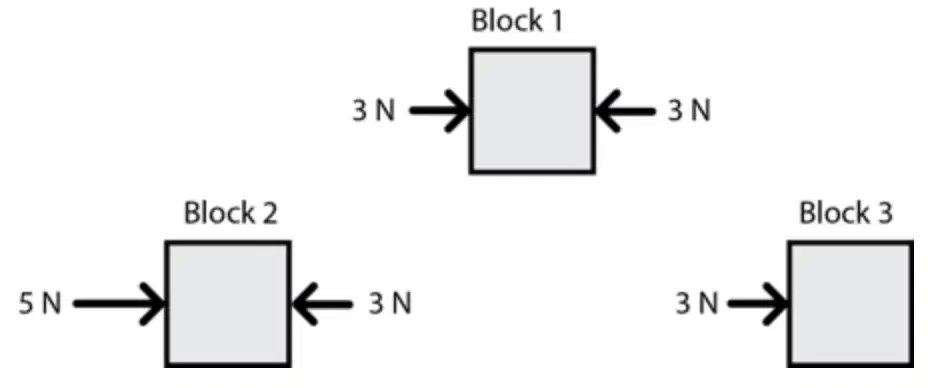
The illustration shows the forces in Newtons (N) acting on three different blocks.
Which blocks will experience a change in motion, or acceleration?
Blocks 1 and 2
Blocks 2 and 3
Blocks 1 and 3
Blocks 1, 2, and 3
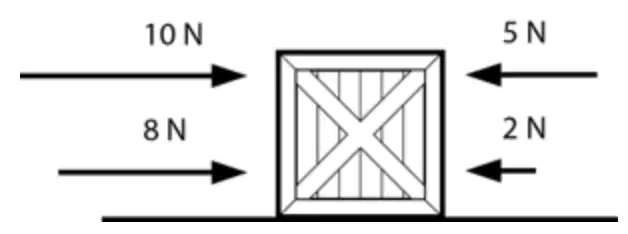
The illustration shows all the forces in Newtons (N) acting on a box.
The sum of all the forces acting on the box results in a force actingon the box–
to the right with a strength of 11 Newtons
to the left with a strength of 7 Newtons
to the right with a strength of 25 Newtons
to the left with a strength of 6 Newtons

Students are investigating how mass affects the force needed to move an object. They attached a wooden block to a spring scale and placed a 10 g mass on top of the block and pulled it 50 cm across the table.
Which of the following changes to their setup would result in a larger force reading on the spring scale?
Sliding the block 60 cm
Attaching a larger spring scale
Using a 20 g mass
Using a circular piece of wood
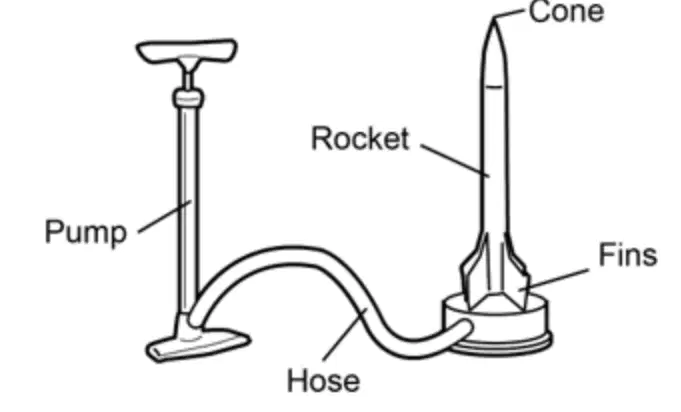
Students are using an air rocket to investigate the relationship between force and an object’s motion. Students pump air into the rocket, then release the rocket, and the compressed air pushes the rocket upward.
In order to vary the amount of force acting on the rocket, which of the following should the students change in each trial?
The length of the hose attached to the pump
The distance traveled by the rocket
The amount of air pumped into the rocket
The height of the rocket from fins to cone
Which investigation will best test the effects of gravity on moving objects?
a ball slowing down on a flat surface
a bicycle speeding up on a flat surface
balloons floating upward from the same height
pencils falling from the same height
A man is pushing a ball up a hill. If the man stops pushing the ball and steps out of the way, what will most likely happen to the ball?
It will continue to roll up the hill.
It will roll down the hill.
It will stop on the hill.
It will roll to the side toward the man.
Which best describes the role friction plays in the operation of a car?
Friction makes the car go faster.
Friction keeps the car from stopping.
Friction helps the car to slow down and stop.
Friction turns the car in a new direction.
Marcy let a bowling ball and kick ball outside on a windy day. Which best explains why the kick ball moved but the bowling ball did not?
The kick ball has less mass so it was easier to move.
The force of gravity acting on the bowing ball is greater.
The mass of the kick ball is greater so it is easier to move.
The force of gravity acting on the kick ball is greater.
A helicopter traveled 200 miles in one hour. During the next hour, it traveled abother 200 miles. Which best describes the average speed of the helicopter during the second hour?
about the same as the first hour
slower than the first hour
exactly the same as the first hour
faster than the first hour
A news truck traveled 60 miles in one hour on Thursday and 240 miles in four hours on Friday. Which best describes the average speed of the truck? (speed = distance ÷ time)
The truck drove more slowly on Thursday.
The truck drove mor slowly on Friday.
The truck drove the same speed on both days.
There is not enough information to determine the speed.
In a game of tug of war, team one pulls to the right with a force of 500 Newtons and team two pulls to the left with a force of 800 Newtons. What is the net force?
300 N to the right
300 N to the left
1300 N to the right
1300 N to the left
Is it possible an object to move at constant speed without a force pulling or pushing it?
No, a force is needed to keep an object moving at constant speed, but it doesn't have to be a constant force.
Yes, an object will move at constant speed as long as the force inside the object doesn't run out.
No, a constant force is needed to keep an object moving at constant speed.
Yes, an object will move at constant speed unless a force acts to change its motion.
A magnetic toy train is moved away from a magnet that cannot move. What happens to the potential energy in the system of magnets during the movement?
The potential energy increases because the train moves against the magnetic force.
The potential energy does not change because magnets in the system do not change.
The potential energy decreases because the train moves in the same direction as the magnetic force.
The train does not have any potential energy, it should only change its kinetic energy.
A spaceship is traveling through space. Suddenly, its speed increases. What can you say about the kinetic energy of the spaceship?
There is no way to know what happened to the kinetic energy.
The kinetic energy remains the same because speed and kinetic energy are not related.
The kinetic energy increases as its speed increases.
There is no kinetic energy, and we should be measuring its potential energy.
A person pushes against a wall with 15N of force. The wall doesn't move. The wall exerts how much force on the student?
greater than 15N
0N
15N
less than 15N
There is a book sitting at rest on a chair. Which of the following statements are true?
The chair exerts no force on the book.
The book exerts no force on the chair.
There are many forces acting on the book, but they balance each other out.
all of these
Three people can move a piano easier than two people. This demonstrates which of Newton's Laws of Motion?
Newton's 3rd Law (Action Forces & Reaction Forces)
Newton's 2nd Law (F = m x a)
Newton's 1st Law (Inertia)
none of the above are the correct law to describe this situtation
What is the speed of an object in a given direction?
motion
speed
velocity
force
A push or a pull that can change the motion of an object
mass
force
direction
motion
The sum of all the forces acting on an object
mass
motion
net force
force
A change in motion caused by an unbalanced force acting on an object; can include increasing speed, decreasing speed, or changing direction
speed
acceleration
velocity
motion
A change in an object's motion is caused by
acceletation
balanced forces
velocity
unbalanced forces
What happens when two forces act in the same direction?
their strengths are added
the stronger one wins
their sum divided by the two is the total force
they cancel each other out
Which of the following objects has the least acceleration?
a full shopping cart pushed with a hard force
an empty shopping cart pushed with a light force
a full shopping cart pushed with a light force
an empty shopping cart pushed with a hard force


Which of Newton's laws is represented by this image?
Newton's 1st Law
Newton's 2nd Law
Newton's 3rd Law

In which section does the car have the greatest acceleration?
from C to D
from B to C
from A to B
from D to E
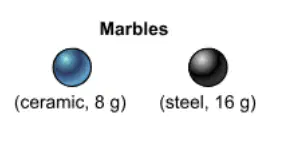
Which marble will have more kinetic energy?
They have the same amount
ceramic
steel
not enough information

What would cause the person on the left to change position?
It is impossible to change.
The force applied by the two people on the right would have to be greater than 200N.
The person on the left would need to turn around.
The force applied by the two people on the right would have to be less than 200N.
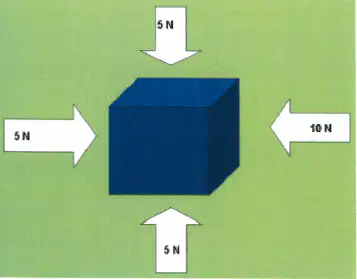
In what direction will the box move?
left
up
down
right
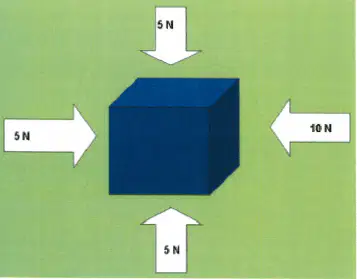
What is the net force acting on the box?
0N
25N
5N
15N

What is the net force on the box shown in the picture?
10N to the left
10N to the right
50N to the right
60N to the left
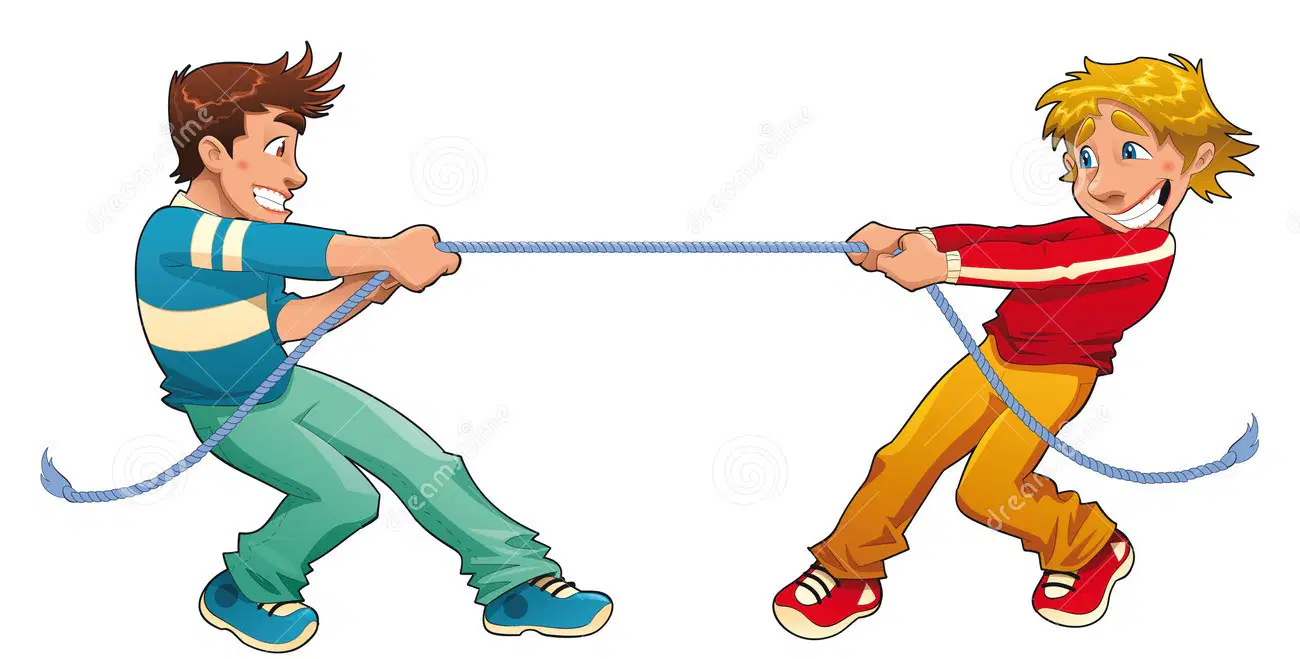
If these boys are pulling with the same amount of force, what will happen?
The boy on the right will win.
Both will fall down.
They will not move at all.
The boy on the left will win.

This graph shows the motion of an object. Which best describes the motion of the object?
It is sitting still.
It travels at constant speed and suddenly stops.
It continually increases its speed.
It is moving at a constant speed.

