
 Worksheets
G5-S2-Final- term Review
Total questions: 171
Worksheet time: 1hrs 26mins
When we throw anything in air it always falls down because of _____
Friction
Gravity
Solid
motion

Forces can be applied in different directions.
TRUE
FALSE

A ____________ is a push or a pull on an object.
friction
force
magnet
gravity
Force can make things -
move
change
stop
All of them
Friction always (a) down a moving object.
(a) always acts in the direction opposite to the direction in which the object is moving or trying to move.
which of these is an effect of force?(tick mark the correct answers)
force can start a motion
force can stop a motion
force can change the direction of motion
force can change the shape of an object
force can change the speed a moving object

A spring scale measures _______.
inertia
force
friction
Forces are measured in units called ________
Newtons (N)
grams (g)
pounds (lb)
centimeters (cm)
Which of the following images shows a pull?


A force can make a moving body move faster
true
false
True or false: An object resting on the ground can move without force.
True
False
Which type of surface would create the least friction?
concrete
glass
rubber
sandpaper

At the start of a football game, a footballer kicks a ball placed in the middle of the field to move the ball.
What is the effect of force on the object?
Change the direction of a moving object
Make a moving object stop
Make a moving object move slower
Make a stationary object move
What type of force causes a sky diver to fall towards the ground?
friction
gravity
magnetism
applied force

in the given figure force is
changing the direction of motion
changing the shape
stopping a moving object
none of the above
which of the following is not an effect of force:
to move a body from rest
to stop a moving body
to change the colour of an object
to change the shape of a body

4. Which effect of force does the picture below explain?
Force can change the shape of objects.
Force can make a stationary object move.
Force will stop a moving object.

10.3
11.5
13
103

5
5.0
0.5
2.5

3
0.3
0.15
0.4

without friction, an object in motion would never stop
true
false
you can walk because there is friction between your __________ and ______________
ground and air
feet and ground
feet and air
air and ground


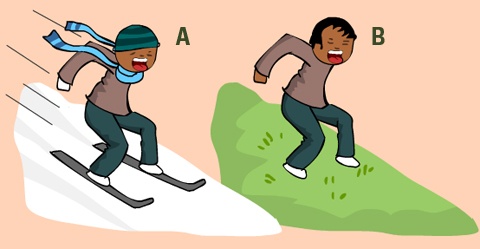
What type of friction will you have when two objects slide against each other?
Sliding
Rolling
Static
Fluid
What type of friction will you see when two objects roll across each other?
Static
Sliding
Fluid
Rolling

What type of friction will slow down the rolling soccer ball?
Fluid
Sliding
Rolling
Static
The weakest type of friction that occurs between solid surfaces is _____ friction.
sliding friction
rolling friction
static friction
None of the above

Water is the only liquid objects can either float or sink in.
True
False

Would this object float or sink?
Float
Sink
which of these is made to sink?


What happens to an object when the gravitational force is stronger than the buoyant force?
sinks
floats
Not sure

When part or all of a material is above the surface of a liquid.
properties
sink
float
materials

What is this force called?
Drag
Lift
Gravity
A pencil falls off of a desk. What moves the pencil toward the floor?
mass
friction
gravity
speed
Glass is an example of an elastic material.
True
False
Something that is elastic springs back after being stretched.
True
False
How does heat move?
From cooler objects to warmer objects.
From warmer objects to cooler objects
From metal objects to nonmetal objects
Very quickly in all directions
What is heat?
The temperature of hot objects
The energy transferred between hot objects
The fire hot objects give off.
All of the above
What does friction produce?
heat
light
sound
gravity
An instrument used to measure heat is called...
Celsius
Machine
Thermometer
Scale
When you rub your hands together quickly, you can feel warmth between your hands. Which statement explains why rubbing your hands together produces warmth?
This action causes increased blood circulation.
This action causes mechanical energy.
This action captures heat from the environment.
This action produces heat through friction.
The biggest source of heat for our planet is the _____.
Earth
Fire
Moon
Sun

Which example creates heat through electricity
Hair dryer
The Sun's rays
breaks on a bicycle
burning coal

You are going camping. What will keep you warm at night?
The sun
The moon
The campfire
S'mores
True or False
Fire is an example of burning
True
False
What is heat in Science?
Energy that moves from warmer objects to cooler objects.
How warm something is.
Energy that allows us to see.
32 degrees Celsius.
Which of these did NOT use heat energy?
cooking food
warming up a room
bouncing a ball
having a hot shower
What tool can be used to measure how hot or cold something is?
clock
ruler
thermometer
Which of these images are examples of kinetic heat sources?


Which of these images are examples of electrical heat sources?


Which of these images are examples of chemical heat sources?


......is a bad conductor of heat
copper
iron
plastic
Aluminium
Materials that conduct heat are called.........
Heat conductors
Heat insulators
Aluminium is used in making .......
Handles of kettles
cooking pots and kettles
Heavy blankets
........is used in making the insulating glass windows.
Plastic
Air
Iron
No correct answer
we wear woolen clothes in winter to..........
keep the weather warm
keep the body warm
conduct the heat
The handle of electric iron is made of .......
Iron
Aluminium
Plastic
Heat is used in our daily life in ........
Cooking
Heating water
Warming the house
All of them
Heat transfer through touching
convection
conduction
radiation
Heat transfer through waves
convection
conduction
radiation

What heat transfer is this?
convection
conduction
radiation

What heat transfer is this?
convection
conduction
radiation

What heat transfer is this?
convection
conduction
radiation
True or False: Warm air sinks.
yes, it does
no, it rises
True or False: Cold air sinks.
yes, it does
no, it rises
When you heat up an object, the particles in the object move _________.
faster
the same speed
slower
Hot chocolate is stirred with a spoon and the spoon gets hot.
Conduction
Convection
Radiation
Temperature
The sun warms your skin on a cold day.
Conduction
Convection
Radiation
Temperature
Hot air balloon rises.
Conduction
Convection
Radiation
Adventure
The air near the ceiling in a room is warmer that the air near the floor.
Conduction
Convection
Radiation
Electricity
The sidewalk burns your bare feet in the summer time.
Conduction
Convection
Radiation
Transformation
Heat transfer through liquid and gases
Conduction
Convection
Radiation
Temperature
When two objects are in physical contact with each other
Conduction
Convection
Radiation
Friction
A shirt warmed when it touches a hot iron
Conduction
Convection
Radiation
Laundry
力
A pull or push from one object to another
(a)
有弹性的
Something can be stretched and returned to its original form or size.
(a)
图表
A visualisation of data and information
(a)
弹簧测力计
A tool used to measure forces.
(a)
牛顿
A physicist who discovered the laws of motion and force. Also the name of a unit of force.
(a)
重力
The force that pulls things downwards on the earth.
(a)
滑动摩擦力
The force of two surfaces shifting against each other. .
(a)
滚动摩擦力
Resistance(阻碍) to rotation.
(a)
浮力
The force that lifts objects in a liquid or gas.
(a)
漂浮
When the object lies on or just below the surface of a liquid
(a)
下沉
When an object cannot stay on the surface of a liquid and goes down into the liquid.
(a)
1.热:A form of energy that causes temperature
rises.
(a)
2.能量 :
Makes thing happen or move
(a)
3.热源Where heat comes from
.
(a)
4.动能The energy of motion.
(a)
5.导热性能:The efficiency of a material to transfer heat.
(a)
6.热的良导体:A material conducts heat easily.
(a)
7.热的绝缘体:A material conducts heat poorly.
(a)
8.热传导:Heat transfer within or between solid objects (e.g., spoon in hot water
(a)
9.热对流:Heat transfer through liquids or gases, causing warmer parts to rise and cooler parts to sink (e.g., boiling water)
(a)
10.热辐射Heat transfer through infrared waves (e.g., warmth from the Sun)
(a)

What is the function (purpose) of a pelican's beak ? Hint: Think of Finding Nemo
To eat flowers
To eat seeds and nuts
To catch and eat fish
To tear apart its prey

What is the function (purpose) of a short beak? Hint: Their beaks are small and strong. So they need to eat something small.
To open nuts and seeds
To tear apart meat
To help it fly
To eat nectar from flowers

What is the function (purpose) of a long think beak? Hint: Their beaks are very thin and long, so it is able to get into small places.
To open nuts and seeds
To eat nectar from flowers
To help grab large prey
To help it tear apart its prey


Why do the spines on a cactus MOST LIKELY discourage animals from eating it?
The spines are sharp and pointy, so they may hurt the animals.
The spines contain toxins that will make the animals itch.
The animals are afraid of the color of the spines.
The spines contain water and the animals do not like to drink water.
1.- The life of a plant starts from a.......
A) flower
B) root
C) seed
10.- What are the conditions that plants need to germinate?
A) water, warmth, air
B) water, sunlight, air
C) water, sunlight, carbon dioxide

Photosynthesis happens at root level.
True
False
Germination means . . . . . .
seeds growing into flowers
why seeds move from place to place
how seeds stick in the ground
when a seed begins to grow
One important thing plants/trees give us is?
life
oxygen
shade on hot days
carbon dioxide

The _____ stage in a plant's life cycle happens after germination when the young plant grows.
seedling
adult
roots
flower
In a controlled experiment . . .
all variables are constant except the one you are testing
more than one variable can be tested at a time
data is not collected
the hypothesis is always supported
Experiment: How does the flavor of ice cream affect the speed of melting?
The speed at which the ice cream melts is the ___________ variable.
independent
dependent
What is the primary purpose of a plant's leaves?
To attract pollinators
To store water
To anchor the plant in the soil
To absorb sunlight for photosynthesis
Which part of the plant is responsible for transporting water and nutrients from the roots to the leaves?
Stem
Roots
Leaves
Flowers
What do plants primarily use sunlight for?
To grow taller
To produce food through photosynthesis
To attract pollinators
To absorb water
In the food chain "sun → plant → herbivore → carnivore," which organism is the primary consumer?
Carnivore
Herbivore
Sun
Plant
How do some plants adapt to survive in dry environments?
By growing larger leaves
By developing deep roots
By producing more flowers
By increasing their height
What adaptation allows a hummingbird to feed on nectar from flowers?
Wide wings for gliding
Strong legs for jumping
Sharp claws for grasping
Long, slender beak
Which part of the plant is primarily responsible for photosynthesis?
Leaves
Flowers
Stem
Roots
Which of the following adaptations helps plants survive in dry environments?
Deep roots
Large leaves
Bright flowers
Thick bark
In a scientific experiment, what is the purpose of a control group?
To test the effect of the independent variable
To provide a standard for comparison
To ensure the experiment is fair
To increase the number of trials

