
 Worksheets
ch 14.1-14.5
Total questions: 125
Worksheet time: 1hrs 3mins
Real GDP is most commonly used to monitor short-run changes in
the price index from the preceding period.
economic activity.
the income distribution over time.
the rate at which a person can trade the currency of one country for the currency of another.
During expansions
sales and profits fall.
sales and profits rise.
sales rise, but profits fall.
sales fall, but profits rise.
Most macroeconomic variables that measure some type of income, spending, or production fluctuate far apart from each other.
True
False
Which of the following is NOT correct?
Short-run fluctuations in economic activity can happen in developed countries such as Canada.
During economic contractions most firms experience dwindling profits.
When real GDP expands, the rate of unemployment rises.
Recessions come at irregular intervals and are almost impossible to predict.
Which of the following macroeconomic variables is a small part of real GDP, yet accounts for a large share of the fluctuation in real GDP?
investment
unemployment
auto sales
consumer spending
Recessions occur at ________ intervals and are ________ to predict with much accuracy.
irregular; quite possible
regular; quite possible
regular; almost impossible
irregular; almost impossible
Which of the following occurs during a recession?
an increase in unemployment and a decrease in real output and real income
an increase in unemployment and an increase in real output and real income
a decrease in unemployment and an increase in real output and real income
a decrease in unemployment and a decrease in real output and real income
Which of the following is correct?
Economic fluctuations are easily predicted by competent economists.
Sometimes recessions are close together.
Recessions have never occurred very close together.
Spending, income, and production do not fluctuate closely with real GDP.
The recessions associated with the business cycle come at irregular intervals.
True
False
When output rises, unemployment also rises
True
False
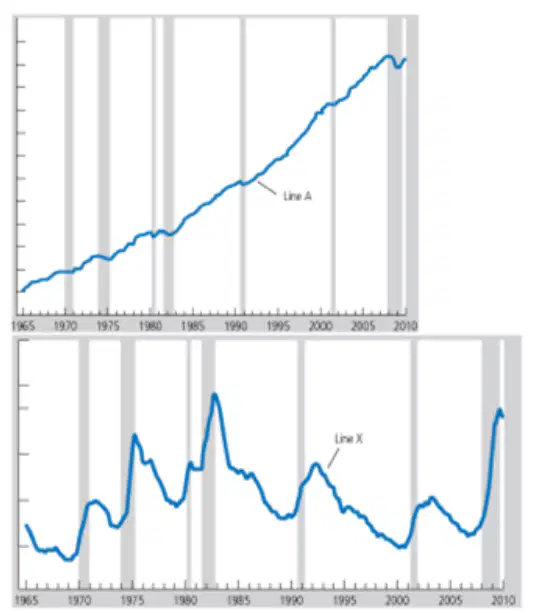
Unemployment is represented by
Line A only
both Line A and Line X
neither Line A nor Line A
Line X only
Like real GDP, investment fluctuates, but it fluctuates ________ real GDP.
much less than
much more than
slightly less than
the same amount as
During a recession, unemployment typically
rises
falls slightly
falls substantially
does not change
As recessions begin, employment
and income both rise.
rises and income falls.
falls and income rises.
and income both fall
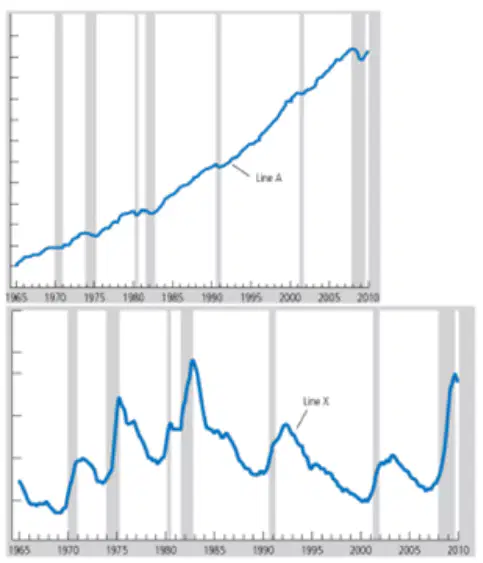
Real GDP is represented by
Line X only
both Line A and Line X
neither Line A nor Line X
Line A only
When output rises, unemployment
rises by a large amount.
remains unchanged.
rises by a small amount.
falls
The decline in investment spending accounts for how much of the decline in output during a recession?
2/3
1/3
2/7
1/7
Which of the following rises during expansions?
employment but not consumer spending
neither employment nor consumer spending
both employment and consumer spending
consumer spending but not employment
During recessions, changes in investment spending are the biggest contributor to changes in
personal income.
retail sales.
real GDP.
consumer spending.
Because some economists do not understand what things change GDP, they cannot predict recessions with a fair amount of accuracy.
True
False
Unemployment
decreases as production falls.
falls when households save a larger fraction of their income.
rises during expansions.
moves in the opposite direction as real GDP.
Recessions occur at regular intervals and are possible to predict with much accuracy.
True
False
Which of the following rise during a recession?
both losses and unemployment
losses but not unemployment
unemployment but not losses
profit and private investment
The quantity of domestically produced goods and services that households, firms, the government, and customers abroad want to buy at each price level is shown on the
market-demand curve.
aggregate-supply curve.
aggregate-demand curve.
aggregate-goods curve.
Which of the following would be included in aggregate demand?
the quantity of services that firms sell
the quantity of goods that firms produce
firms' purchases of newly produced machinery
the government's tax collections
Which classical economist observed that, when the money supply expanded after gold discoveries, it took some time for prices to rise, and in the meantime, the economy enjoyed higher employment and production?
Joan Robinson
David Ricardo
Adam Smith
David Hume
When analyzing the economy as a whole, ________ substitution from one market to another is impossible.
externality
aggregate
microeconomic
macroeconomic
We need to study a model in which real and nominal variables interact in order to understand how the economy works
in the short run but not the long run.
in both the short run and the long run.
in the long run but not the short run.
in the medium run.
When comparing the slopes of the aggregate-demand and aggregate-supply curves to the slopes of demand and supply curves for specific goods and services, the explanations are
the same for all the curves.
the same for the demand curves but not the supply curves.
the same for the supply curves but not the demand curves.
quite different for the aggregate curves from the specific market curves.
Which of the following adjusts to bring aggregate demand and aggregate supply into balance?
the price level but not the quantity of output
both the price level and the quantity of output
variables other than the price level and the quantity of output
the quantity of output but not the price level
We depart from the assumptions of classical economics when we focus on the relationship between the quantity of output and the ________ level.
price
retail sales
real GDP
unemployment
The vertical axis of the aggregate demand and aggregate supply graph has the
output of services.
price level.
real GDP.
output of goods.
According to classical macroeconomic theory, the price level, but not real GDP, is affected by changes in the
labour supply.
aggregate supply.
supply schedule
money supply.
The belief by most economists that real and nominal variables are essentially determined separately in the long run is characteristic of the ________ model.
classical
aggregate supply
Keynesian
aggregate demand
In the model of aggregate demand and aggregate supply, the GDP deflator measures the
average price level.
amount of real output.
nominal interest rate.
price of oil.
An increase in the money supply causes output to rise in the short run.
True
False
The separation of real and nominal variables is referred to as the classical
diseconomy
dichotomy
discount
determnant
Although wages, incomes, and interest rates are most often discussed in real terms, what matters most are their nominal values.
True
False
Most economists believe that real and nominal variables are highly intertwined and that money can temporarily move real GDP away from its persistent trend in
the long run but not in the short run.
the short run but not in the long run.
the medium long run.
the very long run.
The aggregate-demand curve shows the quantity of goods and services that firms choose to produce and sell at each price level.
True
False
The quantity of goods and services that firms produce and sell at each price level is shown on the
market-supply curve.
aggregate-supply curve.
aggregate-demand curve.
aggregate-services curve.
The best description of the economy in the long run comes from which macroeconomic theory?
aggregate demand
aggregate supply
Keynesian
classical
According to classical macroeconomic theory, nominal variables, but not real variables, are affected by changes in the
labour supply.
aggregate supply.
money supply.
supply schedule.
The horizontal axis of the aggregate demand and aggregate supply graph has the
unemployment rate.
output of goods and services.
price level as measured by the GDP deflator.
price level as measured by the CPI.
Most economists believe that money neutrality holds in
the short run
the long run
the short run but not in the long run
both the short run and the long run
According to the classical model, both prices and nominal income would double if the quantity of money
remained constant
halved
tripled
doubled
The classical view that money does not matter is sometimes described by the saying, "Money is a
mask."
smoke screen."
veil."
camouflage."
Most economists believe that classical theory describes the world in the long run but not in the short run.
True
False
Which of the following will make people buy less?
Wealth and interest rates rise.
Wealth falls and interest rates fall.
Wealth rises and interest rates fall.
Wealth falls and interest rates rise.
A decrease in the price level makes consumers feel wealthier, so they purchase more. This logic helps explain why the aggregate-demand curve
is vertical.
is horizontal.
slopes upward.
slopes downward.
The Central Bank of Wiknam decreases the money supply at the same time the Parliament of Wiknam repeals a new investment tax credit. Which of these policies shifts aggregate demand to the left?
the money supply decrease but not the investment tax credit repeal
the investment tax credit repeal but not the money supply decrease
neither the investment tax credit repeal nor the money supply decrease
both the money supply decrease and the investment tax credit repeal
Purchases by which of the following contributes to the aggregate demand?
households and businesses only
governments and net exports only
households, governments, and net exports only
households, businesses, governments, and net exports
From 2001 to 2005 there was a dramatic change in the price of houses. This change made people feel wealthier and shifted aggregate demand right. The price of houses must have
fallen
risen
been volatile
remained constant
The aggregate-demand curve shows that an increase in the price level
decreases the dollar value of goods and services demanded in the economy.
decreases the real value of goods and services demanded in the economy.
increases the dollar value of goods and services demanded in the economy.
increases the real value of goods and services demanded in the economy.
People hold less money and lend more and the interest rate falls when the price level
remains constant
increases by more than 30 percent
decreases
increases by less than 30 percent
Aggregate demand shifts to the left if the money supply decreases.
True
False
Tax increases shift aggregate demand
right as do increases in government spending.
right while increases in government spending shift aggregate demand left
left as do increases in government spending.
left while increases in government spending shift aggregate demand right.
Suppose a change in the stock market makes people feel wealthier, increases consumption, and shifts the aggregate-demand curve right. The change in the stock market must have been
a decrease in stock prices.
an increase in stock prices.
no change in stock prices.
The stock market has no effect on wealth and consumption.
When the government spends less, the initial effect is that
aggregate demand shifts right.
aggregate supply shifts right.
aggregate demand shifts left.
aggregate supply shifts left
When the price level rises
firms will want to spend less on new business buildings and business equipment, and households will want to spend less building new homes.
the interest falls because people will want to hold less money and so buy more bonds.
the interest rate falls because people will want to hold more money and so sell bonds.
firms will want to spend more on new business buildings and business equipment, and households will want to spend more building new homes.
Which of the following would NOT explain why the aggregate demand curve slopes downward?
A lower price level reduces the interest rate, which encourages greater spending on investment goods.
A higher price level increases real wealth, which stimulates spending on consumption.
A higher price level lowers the real value of money and makes consumers poorer, which in turn encourages them to spend less.
A lower price level causes Canadian interest rates to fall, the real value of the dollar to decline in foreign exchange markets, and Canadian net exports to rise.
In the context of the aggregate-demand curve, when the price level increases, households increase their holdings of money, interest rates increase, and spending on investment goods decreases because of the ________ effect.
wealth
exchange-rate
interest-rate
net-export
Which term best describes an increase in the spending of households and businesses resulting from the increased purchasing power of a constant supply of money as the price level declines?
inflationary tradeoff
multiplier
wealth effect
nominal-income effect
People will want to buy fewer bonds and the interest rate will rise, as the price level
falls by less than 50 percent.
falls by more than 50 percent.
rises.
remains constant.
If the price level rises, the real value of a dollar
rises, so people will want to buy more.
falls, so people will want to buy less.
rises, so people will want to buy less.
falls, so people will want to buy more.
If the interest rate rises and the supply of dollars in the market for foreign currency exchange shifts left, then the price must have
remained constant.
dropped by less 10 percent.
dropped by more than 90 percent.
risen.
Real wealth falls, interest rates rise, and the dollar appreciates as the price level
remains constant.
rises.
falls slightly.
falls substantially.
Which of the following shift aggregate demand left?
Net exports rise for some reason other than a price change, and government purchases rise.
Net exports rise for some reason other than a price change, and taxes increase.
Net exports fall for some reason other than a price change, and taxes fall.
Net exports fall for some reason other than a price change, and government purchases fall.
Which of the following shift aggregate demand right?
a decrease in taxes and at a given price level consumers feel less wealthy
a decrease in taxes and at a given price level consumers feel more wealthy
an increase in taxes and at a given price level consumers feel more wealthy
an increase in taxes and at a given price level consumers feel less wealthy
Gross domestic product is the same as the sum of consumption, investment, government purchases, and net exports.
True
False
If businesses in general decide that they have underbuilt and so now have too little capital, their response to this would initially shift
aggregate demand left.
aggregate supply right.
aggregate demand right.
aggregate supply left.
Which of the following increases in response to the interest-rate effect from a decrease in the price level?
consumption but not investment
investment but not consumption
both investment and consumption
net exports
The logic of the wealth effect begins with a change in the price level changing the interest rate.
True
False
An increase in natural resources would
increase long-run aggregate supply.
decrease long-run aggregate supply.
have no impact on long-run aggregate supply.
decrease aggregate demand.
A vertical long-run aggregate-supply curve represents
the classical dichotomy but not monetary neutrality.
neither the classical dichotomy nor monetary neutrality.
monetary neutrality but not the classical dichotomy.
both the classical dichotomy and monetary neutrality.
If there is a natural disaster, the long-run aggregate-supply curve shifts
left
right
either vertically or horizontally
upward
Which curve is shifted by an improvement in technology?
only the aggregate demand
both the aggregate demand and the aggregate supply
only the short-run aggregate supply
both the short-run and the long-run aggregate supply
An improvement in technology would cause the long-run aggregate-supply curve to shift
downward.
right.
either vertically or horizontally.
left.
A government regulation that prevents using a current technology raises the price level.
True
False
If the money supply rises by 5 percent and people were expecting it to rise by 2 percent, then some firms have
higher than desired prices, which increases their sales.
higher than desired prices, which depresses their sales.
lower than desired prices, which depresses their sales.
lower than desired prices, which increases their sales.
Which of the following shifts short-run aggregate supply right?
an increase in the minimum wage
an decrease in immigration from abroad
an increase in the price of oil
a decrease in the expected price level
Which of the following would make the price level increase and real GDP decrease?
Long-run aggregate supply shifts left.
Long-run aggregate supply shifts right.
Aggregate demand shifts right.
Aggregate demand shifts left.
An upward-sloping short-run aggregate-supply curve is represented by which of the following equations?
Quantity of output supplied = Natural level of output – a(Actual price level – Expected price level)
Quantity of output supplied = a(Natural level of output) + (Actual price level – Expected price level)
Quantity of output supplied = Natural level of output + a(Actual price level – Expected price level)
Quantity of output supplied = Natural level of output + a(Actual price level + Expected price level)
Imagine a hypothetical world in which, over the last 50 years, both real GDP and prices have trended downward in most countries. Continuing falls in the level of real GDP and the price level can be explained by
continuing losses in technological ability alone.
continuing losses in technological ability and continuing decreases in the money supply.
continuing decreases in the money supply along.
neither technological ability nor changes in the money supply.
If wages are sticky, then a smaller than expected increase in the price level
raises the real costs of production, so the short-run aggregate supply curve shifts left.
reduces the real costs of production, so the short-run aggregate supply curve shifts right.
raises the real costs of production, so the aggregate quantity of goods and services declines.
reduces the real costs of production, so the aggregate quantity of goods and services rises.
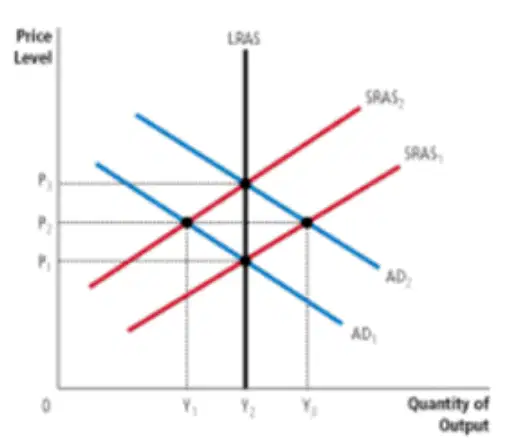
Y2 represents the
equilibrium price level.
maximum amount of short-run aggregate supply.
natural rate of unemployment.
natural level of output.
A change in weather could
shift the long-run aggregate-supply curve.
cause a left-to-right movement along the long-run aggregate-supply curve.
cause a right-to-left movement along the long-run aggregate-supply curve.
not change the long-run aggregate-supply curve.
The long-run aggregate supply curve shifts left if
emigration abroad increases but not if important technology is outlawed.
important technology is outlawed but not if emigration abroad increases.
either emigration abroad increases or important technology is outlawed.
either emigration abroad decreases or technology improves.
The idea that nominal wages are slow to adjust to changing economic conditions can explain the ________ slope of the short-run aggregate-supply curve.
upward
vertical
downward
horizontal
Other things the same, if the price level is higher than expected, then some firms believe that the relative price of what they produce has
decreased, so they increase production.
decreased, so they decrease production.
increased, so they increase production.
increased, so they decrease production.
The misperceptions theory of the short-run aggregate supply curve says that the quantity of output supplied will decrease if the price level
increases by less than expected so that firms believe the relative price of their output has increased.
increases by more than expected so that firms believe the relative price of their output has increased.
increases by more than expected so that firms believe the relative price of their output has decreased.
increases by less than expected so that firms believe the relative price of their output has decreased.
An increase in the capital stock shifts
short-run aggregate supply right but does not shift long-run aggregate supply.
long-run aggregate supply right but does not shift short-run aggregate supply.
both short-run and long-run aggregate supply right.
short-run aggregate supply left and long-run aggregate supply right.
Because the price level does not affect the long-run determinants of real GDP, the long-run aggregate-supply is upward sloping.
True
False
A decrease in a supply of oil could
increase long-run aggregate supply.
decrease long-run aggregate supply.
have no impact on long-run aggregate supply.
decrease aggregate demand.
When the price level rises less than expected, a firm with a sticky price will sell its output at a price that is
more than the firm desires and decrease its production
less than the firm desires and increase its production.
less than the firm desires and decrease its production.
more than the firm desires and increase its production.
Continued losses in technological ability and continued decreases in the money supply would unambiguously lead to
declining real GDP only
declining prices only.
declining prices and declining real GDP.
neither declining prices nor declining real GDP.
A change in weather patterns that makes farming more difficult would
decrease long-run aggregate supply.
increase long-run aggregate supply.
increase long-run aggregate supply.
have no impact on long-run aggregate supply.
If not all prices adjust instantly to changing economic circumstances, an unexpected fall in the price level leaves some firms with higher-than-desired prices, and these higher-than-desired prices depress sales and induce firms to ________ the quantity of goods and services they produce.
increase substantially
make no changes to
increase slightly
reduce
The sticky-wage theory of the short-run aggregate supply curve says that when the price level is higher than expected,
relative to prices wages are higher and employment rises.
relative to prices wages are higher and employment falls.
relative to prices wages are lower and employment falls.
relative to prices wages are lower and employment rises.
Imagine two economies that are identical except that, for a long time, economy A has had a money supply of $1000 billion while economy B has had a money supply of $1500 billion. It follows that
real GDP and the price level are higher in country B.
real GDP, but not the price level, is higher in country B.
neither the price level nor real GDP is higher in country B.
the price level, but not real GDP is higher in country B.
Which of the following shifts the short-run but not the long-run aggregate-supply curve left?
a decrease in how much people want to consume
an appreciation of the dollar
an increase in the expected price level
a decrease in the expected price level
When production costs fall,
the short-run aggregate-supply curve shifts to the left.
the aggregate-demand curve shifts to the right.
the aggregate-demand curve shifts to the left.
the short-run aggregate-supply curve shifts to the right.
The long-run effect of a decrease in household consumption is to lower
both real output and the price level.
the price level and leave real output unchanged.
real output and raise the price level.
real output and leave the price level unchanged.
Suppose the economy is in long-run equilibrium. If the government decreases its expenditures, eventually the decrease in aggregate demand causes price expectations to
rise. This rise in price expectations shifts the short-run aggregate-supply curve to the right.
fall. This fall in price expectations shifts the short-run aggregate-supply curve to the right.
rise. This rise in price expectations shifts the short-run aggregate-supply curve to the left.
fall. This fall in price expectations shifts the short-run aggregate-supply curve to the left.
Which of the following shifts short-run aggregate supply right?
an increase in the actual price level
a decrease in price expectations
a decrease in the money supply
an increase in the price of oil
Suppose that there is a decrease in the costs of production that shifts the short-run aggregate-supply curve right. If there is no policy response, then eventually
because unemployment is low, wages will be bid up and short-run aggregate supply will shift right.
because unemployment is high, wages will be bid up and short-run aggregate supply will shift right.
because unemployment is low, wages will be bid up and short-run aggregate supply will shift left.
because unemployment is high, wages will be bid down and short-run aggregate supply will shift right.
If aggregate demand and aggregate supply both shift left, we can be sure that the price level is higher in the short run.
True
False
If the economy is initially at long-run equilibrium and aggregate demand expands, then in the long run the price level
is the same and output is lower than in the original long-run equilibrium.
and output are lower than in the original long-run equilibrium.
and output are higher than in the original long-run equilibrium.
is higher and output is the same as the original long-run equilibrium.
When prices and unemployment rise, such an event is sometimes called
depreciation.
expansion.
expansion.
stagflation.
Which of the following would decrease the price level?
a decrease in the money supply
an increase in the expected price level
a decrease in taxes
an increase in the natural rate of unemployment

If the economy starts at Y, then W represents
inflation.
a recession.
an expansion.
long-run equilibrium.
Stagflation results from continued decreases in aggregate supply.
True
False
Fluctuations in real GDP are caused
only by changes in aggregate demand.
only by changes in aggregate supply.
neither by changes in aggregate demand nor changes in aggregate supply.
by changes in aggregate demand and/or changes in aggregate supply.
Suppose the economy is in long-run equilibrium. In a short span of time, there is a large emigration of skilled workers, a major depletion of oil fields, and a major new regulation limiting electricity production. In the short run, we would expect
the price level to fall and real GDP to rise.
the price level to rise and real GDP to fall.
the price level and real GDP both to stay the same.
the price level and real GDP both to rise.
In the short run a decrease in the costs of production makes
output and prices rise.
output rise and prices fall.
output fall and prices rise.
output and prices fall.
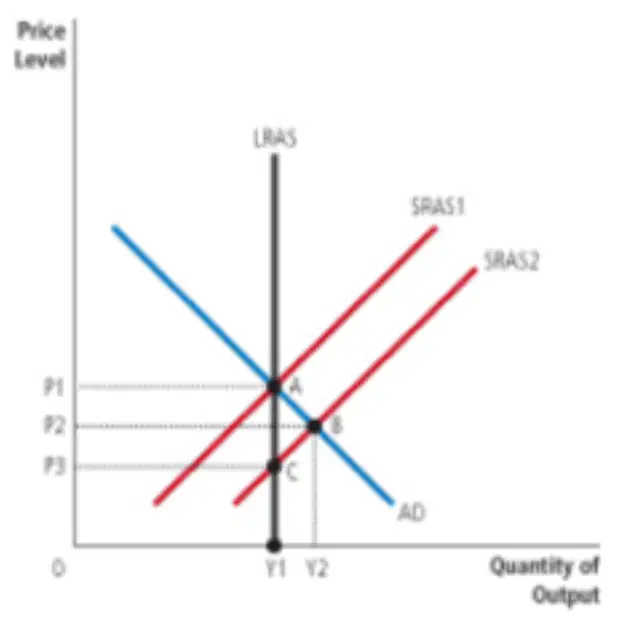
The shift of the short-run aggregate-supply curve from SRAS1 to SRAS2
causes the economy to experience a decrease in the unemployment rate.
could be caused by an increase in the expected price level.
could be caused by an outbreak of war in the Middle East.
causes the economy to experience stagflation.
Suppose the economy is in long-run equilibrium. If there is a decrease in the supply of labour as well as a decrease in the money supply, then we would expect that in the short run,
real GDP will rise, and the price level might rise, fall, or stay the same.
the price level will rise, and real GDP might rise, fall, or stay the same.
real GDP will fall, and the price level might rise, fall, or stay the same.
the price level will fall, and real GDP might rise, fall, or stay the same.
An increase in the availability of an important major resource such as oil shifts
aggregate supply right.
aggregate supply left.
aggregate demand right.
aggregate demand left.
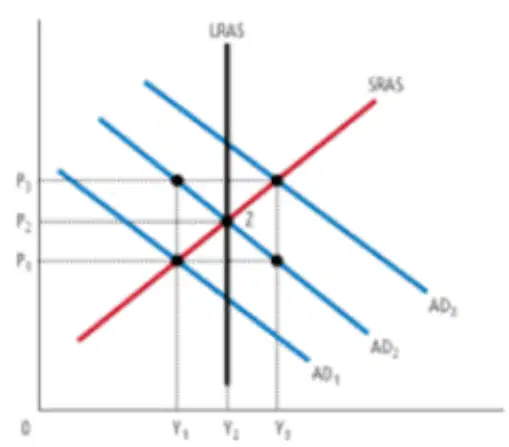
A move by the economy from Z to P3 and Y1 would be consistent with
depreciation.
stagflation.
inflation.
expansion.
If the government institutes an investment tax credit and decreases income taxes,
real GDP rises, and the price level could rise, fall, or stay the same.
real GDP falls, and the price level could rise, fall, or stay the same.
real GDP and the price level rise.
real GDP and the price level fall.
Increased optimism about the future leads to falling prices and falling unemployment in the short run.
True
False
Which of the following would cause prices and real GDP to fall in the short run?
Short-run aggregate supply shifts right.
Short-run aggregate supply shifts left.
Aggregate demand shifts left.
Aggregate demand shifts right.
Which effect is likely to occur in Canada when the price of oil increases?
recessions only
little effect on the business cycle
change in the economy due principally to changing aggregate demand
both inflation and recession
How does the aggregate-demand curve shift when increased uncertainty and pessimism about the future of the economy lead firms to desire less investment spending, which shifts the aggregate-demand curve to the left?
The curve shifts to the right.
The curve does not shift at all.
The curve shifts to the left.
The curve first shifts to the right and then shifts to the left.
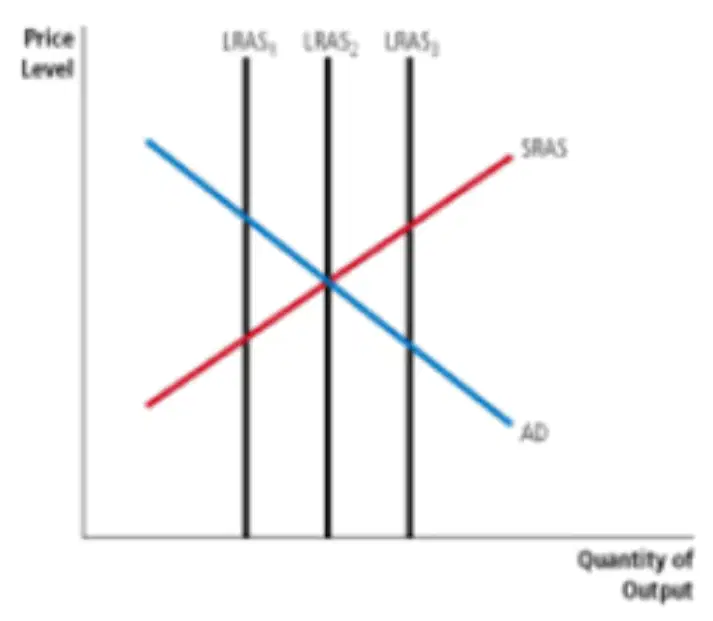
Which of the long-run aggregate-supply curves is consistent with long-run equilibrium?
both LRAS2 and LRAS3
LRAS1
LRAS3
LRAS2

