
 Worksheets
DP SEHS A.2.3 Energy systems 2 (with HL)
Total questions: 22
Worksheet time: 11mins
Which energy system is primarily used during maximal exercise intensity for longer than 10 seconds?
Fatty acids (aerobic)
Carbohydrates (aerobic)
PCr (anaerobic)
Carbohydrates (anaerobic)
What is the main reason for the passive recovery period?
To increase speed
To allow rest
To measure heart rate
To change direction
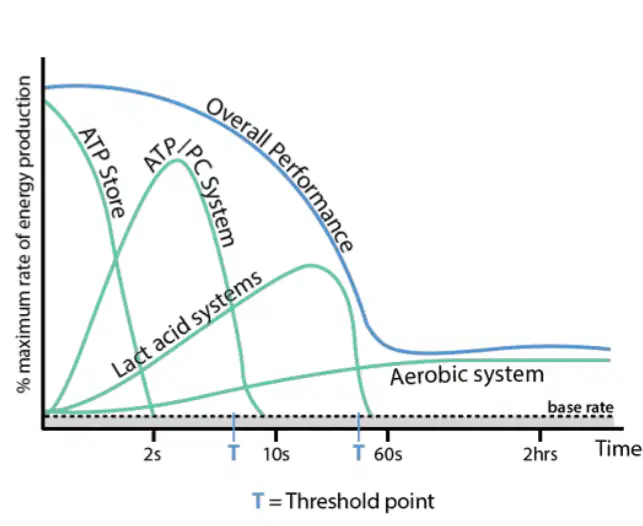
What is the significance of the threshold point (T) in the diagram?
It marks the start of exercise
It indicates a change in energy system dominance
It shows the end of exercise
It marks the peak of energy production

What does PCr stand for in the context of the diagram?
Phosphocreatine
Protein creatine
Phosphate creatine
Phospholipid creatine
What is the significance of VO2max in endurance?
It is unrelated to endurance
It is a key factor in endurance
It decreases endurance
It measures muscle strength
Which of the following is an example of a central circulatory factor affecting VO2max?
Maximal cardiac output
Skeletal muscle strength
Lung capacity
Bone density
Which of the following statements is true about VO2max?
It can be improved by training.
It is solely determined by genetic factors.
It is unaffected by cardiovascular capacity.
It is not related to endurance performance.
How can VO2max be improved?
Through training
By increasing age
By reducing physical activity
By avoiding exercise
What is the unit for reporting absolute VO2max?
Liters per minute (lmin-1)
Milliliters per kilogram per minute (ml kg-1 min-1)
Liters per hour (lh-1)
Milliliters per minute (mlmin-1)
What factors are considered when using the relative V02max value?
Age and gender
Mass and size, muscle mass, heart size, blood volume
Diet and hydration
Training frequency
Why might a less massive athlete have a higher relative V02max value?
They have more muscle mass
They are more fit
They train more frequently
They have a larger heart size

What is the typical relative VO₂ max range for professional team sport athletes who are biological males?
40-45 ml kg⁻¹ min⁻¹
45-55 ml kg⁻¹ min⁻¹
50-60 ml kg⁻¹ min⁻¹
>65 ml kg⁻¹ min⁻¹

What is the typical relative VO₂ max range for untrained but healthy biological females?
35-40 ml kg⁻¹ min⁻¹
40-45 ml kg⁻¹ min⁻¹
45-55 ml kg⁻¹ min⁻¹
50-60 ml kg⁻¹ min⁻¹
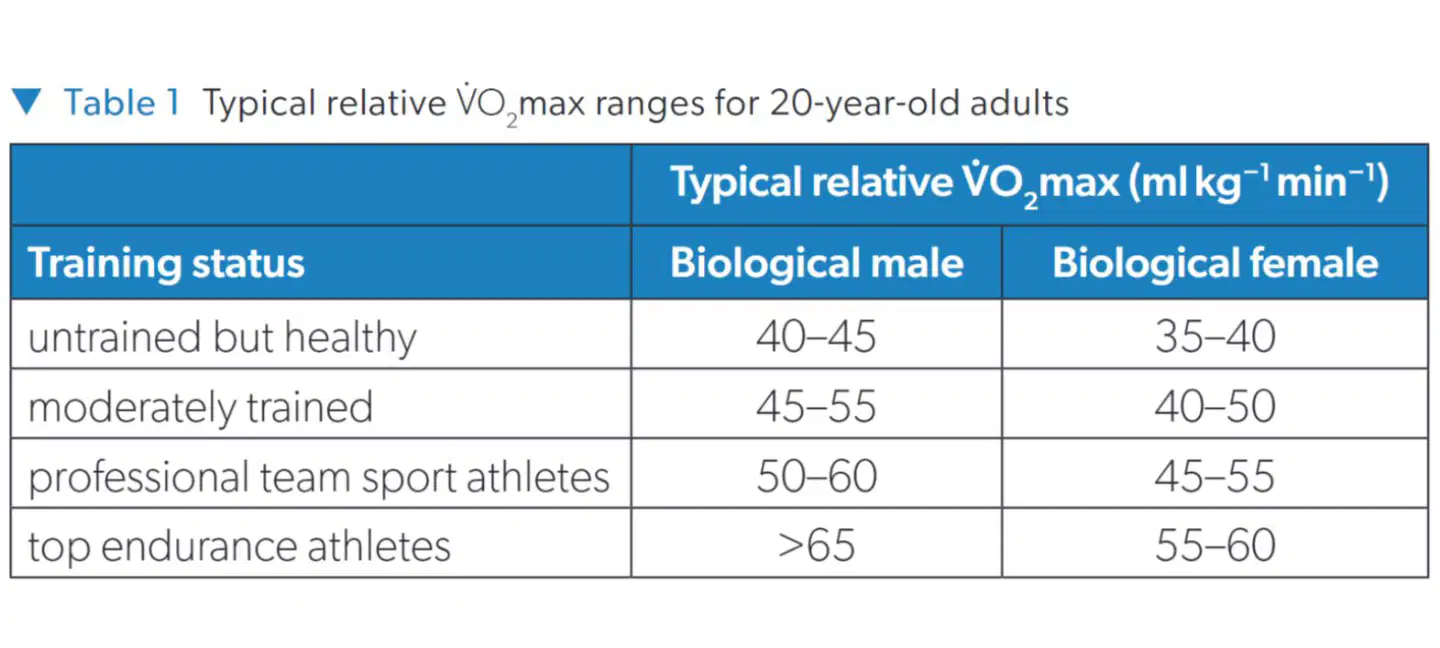
What is the typical relative VO₂ max range for moderately trained biological males?
35-40 ml kg⁻¹ min⁻¹
40-45 ml kg⁻¹ min⁻¹
45-55 ml kg⁻¹ min⁻¹
50-60 ml kg⁻¹ min⁻¹
What is the relationship between exercise intensity and the lactate inflection point?
Higher intensity lowers the lactate inflection point.
Higher intensity raises the lactate inflection point.
Intensity has no effect on the lactate inflection point.
Intensity only affects the lactate inflection point in cold conditions.
What physiological adaptation occurs with regular aerobic training?
Improved lung capacity
Reduced blood volume
Decreased heart rate
Increased muscle mass
Which of the following factors can negatively impact VO2max?
Regular exercise
Healthy diet
High altitude
Consistent training
What is the primary benefit of interval training for aerobic capacity?
Increased muscle endurance
Improved cardiovascular efficiency
Enhanced flexibility
Greater fat loss
Which of the following is a common method to assess VO2max?
Step test
Body composition analysis
Flexibility test
Blood pressure measurement
What role does lactate play during high-intensity exercise?
It indicates muscle fatigue
It enhances oxygen delivery
It serves as a primary energy source
It is a waste product only
What is the primary factor that determines an individual's VO2max?
Body composition
Genetics
Age
Training history
How does altitude affect VO2max during exercise?
It increases VO2max
It only affects trained athletes
It decreases VO2max
It has no effect

