
 Worksheets
BIOSPRINT CHAPTER 5-6
Total questions: 23
Worksheet time: 19mins
The main organic product formed during photosynthesis, used as an energy source by the plant, is (a) .
A student places a plant in a sealed container with CO₂ and water. After several hours under light, tests show that sugar levels in the plant have increased. What is the main product responsible for this?
Oxygen
Water
Glucose
Carbon dioxide
During aerobic respiration, pyruvate enters the mitochondrion and is converted into acetyl-CoA, releasing CO₂ and NADH.
Where does this reaction occur?
Cytoplasm
Matrix of mitochondria
Inner mitochondrial membrane
Cristae
Sort the processes based on where they occur in the mitochondrion:
Cytoplasm
Glycolysis
Mitochondrial matrix
Pyruvate oxidation
Mitochondrial matrix
Krebs Cycle
Inner mitochondrial membrane
Electron transport chain
Which of the following correctly compares fermentation and aerobic respiration?
Both processes involve the electron transport chain
Fermentation uses NADH to reduce pyruvate, not to fuel the ETC
Fermentation produces more ATP than aerobic respiration
NADH is regenerated into NAD⁺ by donating electrons to oxygen in fermentation
A yeast cell is placed in an anaerobic environment. Glycolysis produces pyruvate and NADH. Without oxygen available, what happens to the NADH?
It donates electrons to the ETC in the inner membrane
It is stored for later use
It donates electrons to pyruvate to regenerate NAD⁺
It is broken down into ATP
The products of the Krebs cycle include
ATP
NADH
FADH2
CO2
Which of the following correctly explains why C₄ plants are more efficient than C₃ plants in hot, dry conditions?
Rubisco in C₄ plants binds CO₂ more effectively
PEP carboxylase in C₄ plants has a higher affinity for CO₂ and does not bind O₂
C₄ plants only use light-dependent reactions
PEP carboxylase fixes O₂ in bundle sheath cells
In hot, dry climates, C₄ plants use (a) instead of rubisco to fix CO₂ in mesophyll cells, minimizing photorespiration.
A poison prevents protons from accumulating in the intermembrane space of mitochondria. What would most likely happen as a result?
Electrons stop flowing in the ETC
ATP synthase will stop producing ATP
NADH will stop donating electrons
Oxygen will no longer be needed
Chemiosmosis occurs as protons pump/transport from the mitochondrial matrix into the intermembrane space.
True
False
During chemiosmosis, protons move from the (a)
into the (b) through ATP synthase.
Which of the following is true about glycolysis?
It occurs only when oxygen is present
It takes place inside the mitochondria
It requires oxygen to produce pyruvate
It can occur without oxygen
Why do plants use cyclic photophosphorylation instead of non-cyclic sometimes?
To make NADPH only
To balance the ATP:NADPH ratio by producing ATP only
To release oxygen when water is not available
To split water molecules
During the Calvin cycle, the enzyme Rubisco catalyzes the fixation of carbon dioxide to RuBP, producing [ (a) ] as the first stable product.
What happens to the concentration of 3-phosphoglycerate in the Calvin cycle during the light-independent reactions?
It decreases as it is converted into glucose.
It increases due to the attachment of CO₂ to RuBP
It remains unchanged as it is recycled.
It decreases due to the formation of RuBP.
A researcher isolates thylakoid membranes from plant chloroplasts and exposes them to light energy while measuring oxygen levels. After a few minutes, they observe oxygen is being produced, but no ATP or NADPH is formed.
Further analysis reveals that the electron transport chain is blocked before Photosystem I (PSI).
Based on the passage, which of the following is the MOST likely cause of this issue?
Water is not being split at PSII, preventing electron flow.
NADP⁺ is not available, preventing ATP synthesis.
Plastoquinone (PQ) is blocked, preventing electrons from reaching PSI.
The proton gradient is too strong, stopping ATP synthase activity.
Label
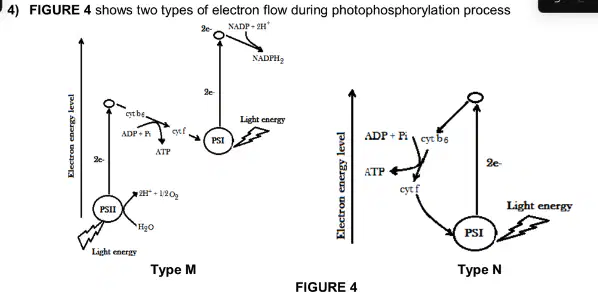
Which of the following describes Type M and Type N from the diagram?
Type M is cyclic and Type N is non-cyclic
Type M is non-cyclic and Type N is cyclic
Type M and Type N both represent non-cyclic photophosphorylation
Type M and Type N both represent cyclic photophosphorylation
What is the substrate involved in Type M and Type N photophosphorylation?
NADPH
ADP and Pi
H₂O
Glucose
What is the role of light in the photophosphorylation process?
Photolysis of water
To excited electrons/photoactivation
To reduce NADP⁺ to NADPH
What are the conditions for Type M and Type N to occur?
Type M requires light and water, while Type N requires only light
Type M requires light only, while Type N requires light and water
ToBoth require only light
Both require light and water
Photophosphorylation occurs in the (a) membrane of the chloroplast.

