
 Worksheets
Energy
Total questions: 30
Worksheet time: 15mins
Name
Class
Date
1.
A person is riding a bicycle and wants to know how much energy they have. They weigh the bike and it weighs 13 kg. They then use a radar detector to determine that it was moving at a speed of 3 m/s. What is the kinetic energy of the bike?
a)
39J
b)
117J
c)
19.5J
d)
15.5J
e)
58.5J
2.
The main difference between kinetic energy and potential energy is that:
a)
although both energies involve motion, only kinetic involves position.
b)
kinetic energy involves position and potential energy involves motion.
c)
although both energies involve position, only potential involves motion.
d)
kinetic energy involves motion and potential energy involves position.
3.

A ball rolls off of a table and drops bouncing a few times before coming to a rest. Throughout this process the balls energy continuously gets converted between kinetic and potential energy. At what location does the ball have the most gravitational potential energy?
a)
A
b)
B
c)
C
d)
D
e)
E
4.

A ball rolls off of a table and drops bouncing a few times before coming to a rest. Throughout this process the balls energy continuously gets converted between kinetic and potential energy. At what location does the ball have the least gravitational potential energy?
a)
C
b)
A
c)
B
d)
D
e)
E
5.

Compare the gravitational potential energy of the ball at locations B and E, it is the same at both locations because
a)
the height is the same
b)
the kinetic energy has increased
c)
the ball is traveling at the same velocity
d)
the potential energy has decreased
6.
The energy of motion is called?
a)
Thermal energy
b)
kinetic energy
c)
work
d)
potential energy
7.
Which of the following is not a type of potential energy?
a)
elastic
b)
gravitational
c)
kinetic
d)
chemical
8.
The sum of kinetic and potential energy within a system is called
a)
thermal energy
b)
chemical energy
c)
electrical energy
d)
mechanical energy
9.
Which of the following energy forms is involved in winding the spring of a wind up car?
a)
elastic potential energy
b)
gravitational potential energy
c)
non-mechanical energy
d)
electrical energy
10.
A person is getting ready to boil some pasta. They fill a pan with water and put it on the stove. The stove is turned on and as the temperature of the water rises what form of energy also increases ________.
a)
mass of the object
b)
thermal energy of the object
c)
potential energy of the object
d)
Specific heat of the object
11.
Matter is needed to transfer thermal energy by ________.
a)
Conduction
b)
Convection
c)
Radiation
d)
Both conduction and convection
e)
Conduction, convection, and radiation
12.
A sky diver jumps out of a plane with a variety of motion sensors. Prior to jumping they find their mass is 72.0 kg. What is the kinetic energy if they are falling at a terminal velocity of 79.0 m/s?
a)
2,844 J
b)
5,688 J
c)
11,376 J
d)
224,676 J
13.
Why is the gravitational potential energy of an object 1 meter above the moon’s surface less than its potential energy 1 meter above Earth’s surface?
a)
A) The object’s mass is less on the moon.
b)
B) The object’s weight is more on the moon.
c)
C) The object’s acceleration due to gravity is less on the moon.
d)
D) Both A and C
14.
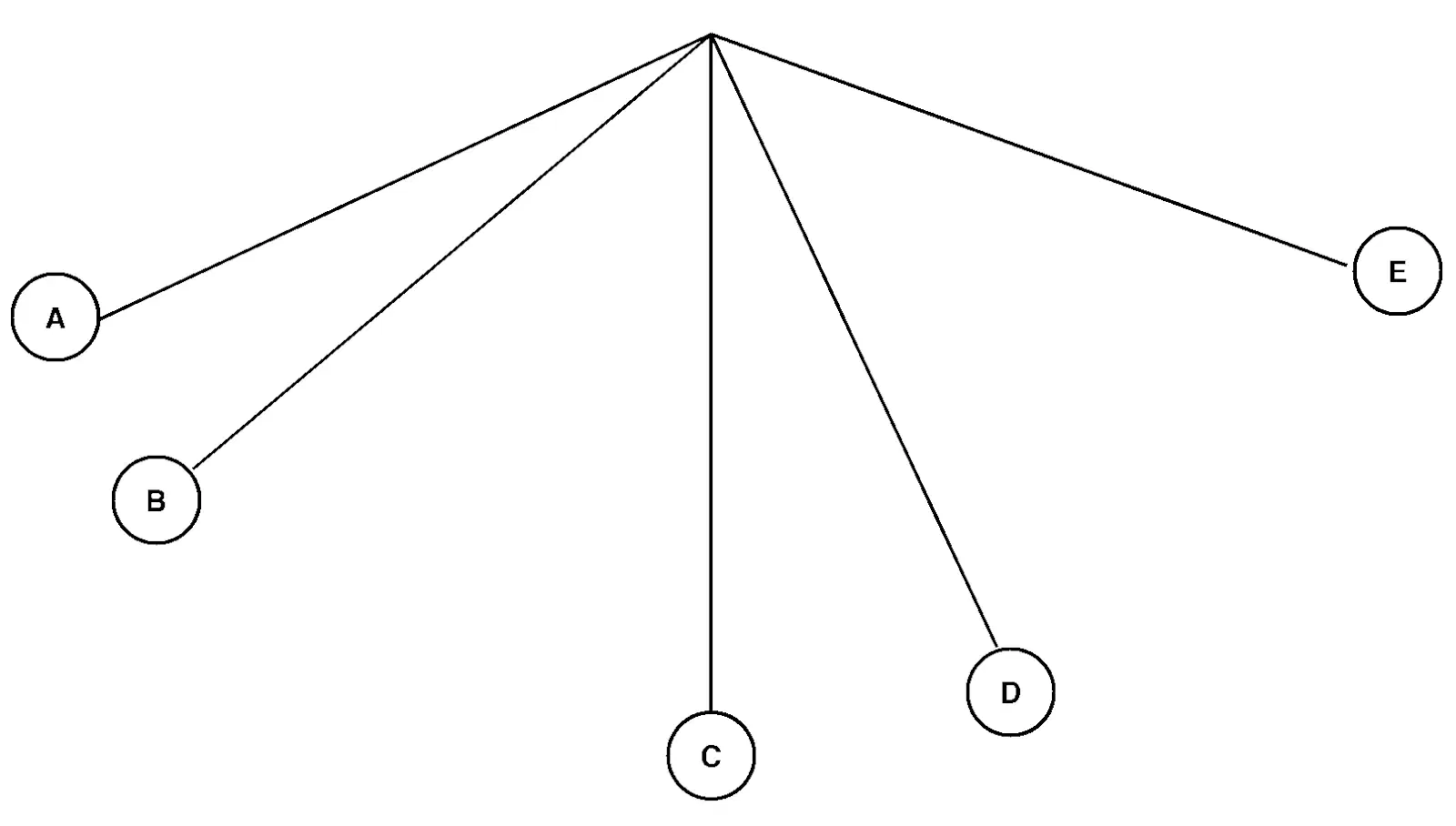
A student ties a weight to the end of a string to create a pendulum. They then swing the weight and make observations. At what point would the potential energy of the pendulum in the picture be the greatest?
a)
A
b)
B
c)
C
d)
D
15.
What is the average kinetic energy of the particles in that object?
a)
mass
b)
specific heat
c)
temperature
d)
conductivity
16.
A student notices that when two objects are placed in contact with one another the heat of both objects will eventually become the same. Heat is the transfer of the thermal energy because of a _____ difference.
a)
conduction
b)
specific heat
c)
radiation
d)
temperature
17.
The transfer of energy as waves moving through space is called ______.
a)
conduction
b)
specific heat
c)
radiation
d)
convection
18.
Which of the following is a renewable source of energy?
a)
Wood
b)
Geothermal
c)
Coal
d)
Petroleum
19.
Which of the following is a non-renewable source of energy?
a)
solar
b)
biofuel
c)
oil
d)
wind
20.
What type of energy do humans get from food?
a)
nuclear
b)
renewable
c)
electrical
d)
chemical
21.
A roller coaster car that weighs 200kg is sitting at the top of a peak. This peak is 500 m high. What is the potential energy of the car?
a)
0.4J
b)
205J
c)
100000J
d)
980000J
22.
A baby sitting 20 meters high on a hill, weighs 6 N. What is the energy of the baby?
a)
1176J
b)
120J
c)
196J
d)
980000J
23.
The potential energy of a 40 kg cannon ball is 14000 J. How high was the cannon ball to have this much potential energy?
a)
36 meters
b)
5,488,000 meters
c)
6,000,000 meters
d)
35.7 meters
24.
A truck is traveling at 50m/s. The truck weighs 5000 kg. What is the energy of the truck?
a)
6250000J
b)
125000J
c)
100J
d)
250000J
25.
How much energy must be absorbed by water with a mass of 0.5 kg in order to raise the temperature from 30 degrees to 65 degrees? Water has a specific heat of 4,190 J/kg.
a)
70,000J
b)
73,535J
c)
73,325J
d)
250,000J
26.
How much heat is need to warm 0.052 kg of gold from 30 degrees to 120 degrees? Gold has a specific heat of 136 J/kg.
a)
737J
b)
650J
c)
637J
d)
627J
27.
If it takes 820J of heat to warm a sample of zinc from 0 to 50 degrees. what would be the mass of the zinc? Zinc has a specific heat of 380 J/kg.
a)
0.043
b)
15,580,000
c)
0.045
d)
15,600,000
28.
Two objects were lifted by a machine. One object had a mass of 4 kilograms, and was lifted at a speed of 2 m/s. The other had a mass of 6 kg, and was lifted at a rate of 3 m/s. What is the energy of the two objects?
a)
4J, 18J
b)
8J, 27J
c)
10J, 30J
d)
12J, 34J
29.
Two objects were lifted by a machine. One object had a mass of 4 kilograms, and was lifted at a speed of 2 m/s. The other had a mass of 6 kg, and was lifted at a rate of 3 m/s. Which object had more potential energy when it was lifted to a height of 10 meters?
a)
Object one had more potential energy
b)
Object two had more potential energy
c)
Object one and two had the same potential energy
30.
Heat flows spontaneously from hot objects to cold objects.
a)
True
b)
False
100 %

