
 Worksheets
Electrostatics & Magnetics Mini Test
Total questions: 30
Worksheet time: 16mins
In a loop circuit, the total voltage drop across three resistors is 20 V. If the battery supplies 18 V, is there a problem with this circuit? Explain using Kirchhoff's Voltage Law.
Yes, there is a problem because the total voltage drop should equal the battery voltage according to Kirchhoff's Voltage Law.
No, there is no problem because the total voltage drop can be greater than the battery voltage.
Yes, there is a problem because the total voltage drop should be less than the battery voltage.
No, there is no problem because Kirchhoff's Voltage Law does not apply here.
In a circuit, 5 A and 7 A are entering a junction, while one branch leaves the junction with 8 A. What is the remaining current flowing out of the junction?
4 A
2 A
5 A
6 A
At a junction in a circuit, the currents flowing into the junction are 3 A and 2 A. The current flowing out of the junction is 4 A. What is the unknown current flowing out of the junction?
1 A
2 A
3 A
0 A
A junction has 10 A flowing into it from one branch. Two currents leave the junction, 4 A and 3 A. What is the current in the remaining branch?
3 A
2 A
5 A
6 A
In a simple loop circuit, there are two resistors with voltage drops of 5 V and 7 V, and the total voltage from the battery is 12 V. Does this circuit follow Kirchhoff's Voltage Law?
Yes, because the sum of voltage drops equals the total voltage.
No, because the sum of voltage drops does not equal the total voltage.
Yes, because the voltage drops are less than the total voltage.
No, because the voltage drops are greater than the total voltage.
A loop in a circuit has a 12 V battery and three resistors with voltage drops of 3 V, 4 V, and an unknown voltage. What is the unknown voltage drop across the third resistor to satisfy Kirchhoff’s Voltage Law? KVL states that the sum of the voltage drops equals the total voltage.
5 V
2 V
6 V
7 V
In a closed-loop circuit, the voltage drops across three resistors are 2 V, 6 V, and 5 V. The total voltage supplied by the battery is 15 V. Verify if Kirchhoff's Voltage Law holds in this circuit.
Yes, Kirchhoff's Voltage Law holds.
No, Kirchhoff's Voltage Law does not hold.
A loop has two resistors with voltage drops of 4 V and 6 V, and an unknown third voltage drop. The battery supplies 14 V. Calculate the unknown voltage drop.
4 V
2 V
8 V
10 V
What is the formula for calculating resistance using Ohm's Law?
R = V/I
R = I/V
R = V*I
R = I*V
If the current (I) is 4A and the resistance (R) is 3Ω, what is the voltage (V)?
12V
6V
9V
15V
In Ohm's Law, I stands for:
Current
Voltage
Resistance
Power
What happens to the current if the voltage doubles and the resistance remains the same?
It doubles
It halves
It remains the same
It quadruples
The unit of resistance is:
Ohm (Ω)
Volt (V)
Ampere (A)
Watt (W)
A circuit has a resistance of 15Ω and is powered by a 30V supply. How much current flows through it?
2A
1A
0.5A
3A
If a device has a resistance of 10Ω and it's used with a current of 2A, what's the voltage across it?
20V
10V
5V
15V
Which component in an electrical circuit opposes the flow of current?
Resistor
Capacitor
Inductor
Transformer
This is the region of the magnet where the magnetic force is strongest.
Poles
Equator
Center
Edge
If a magnet is broken in half, what would be the result?
Two magnets would be formed.
The magnet would lose its magnetism.
The magnet would explode.
The magnet would turn into dust.
Opposite poles....
Attract
Repel
Neutralize
Ignore
Can magnets interact with objects even when they are not in direct contact?
Yes
No, they need to touch
Only if the objects are metal
Only in a vacuum
What is a magnet?
An object that produces a magnetic field.
A device that stores electrical energy.
A tool used for cutting materials.
A type of battery used in electronics.
Electric fields are usually created when _____ are transferred between objects.
electrons
protons
neutrons
photons
Where an electric charge experiences a force, there is an...
electric field
magnetic field
gravitational field
nuclear field
Static Charge
buildup of excessive electric charge in an object
flow of electric current through a conductor
magnetic field around a magnet
chemical reaction in a battery
Electricity
a form of energy that is produced when electrons move from one place to another
a type of liquid fuel used in cars
a form of energy stored in food
a type of gas used for cooking
As two charges get closer together
the electric force increases
the electric force decreases
the electric force remains constant
the electric force becomes zero
How do objects get charged?
Objects can lose or gain electrons
Objects can change color
Objects can change shape
Objects can change temperature
A static charge on an object will create...
an electric field
a magnetic field
a gravitational field
a nuclear field
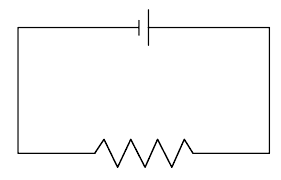
This circuit has a 24 volt battery and the resistor is 8 ohms. How many amps are running through the circuit?
3 Amps
192 Amps
2 Amps
4 Amps


