Wayground logo

Free Printable Worksheets

Font size

S
M
L
XL
Worksheets

CH 22 Section 1: The Italian Renaissance

Total questions: 22

Worksheet time: 12mins

Name
Class
Date
1.

What was the main focus of the humanism movement?

a)

Obeying the authority of the king

b)

Exploring a new understanding of the individual

c)

Fighting wars for territory

d)

Building large cathedrals

2.

Which Italian city was most influential during the Renaissance?

a)

Florence

b)

Milan

c)

Rome

d)

Venice

3.

What technique did Renaissance artists develop to show depth and distance?

a)

Fresco

b)

Mosaic

c)

Perspective

d)

Sculpting

4.

What did Renaissance writers start using instead of Latin?

a)

Greek

b)

Spanish

c)

French

d)

Vernacular

5.

Which family was known for their political power and patronage in Florence?

a)

Sforza

b)

Gonzaga

c)

Medici

d)

Borgia

6.

What did Filippo Brunelleschi design for the cathedral of Florence?

a)

A self-supporting dome

b)

A stained glass window

c)

A marble altar

d)

A bell tower

7.

What was the Renaissance period known for?

a)

A movement of great creativity in arts and thinking

b)

A decline in trade

c)

The fall of the Roman Empire

d)

The rise of feudalism

8.
Which of the following is associated with Humanism?
a)
the ideas of the middle ages
b)
the ideas of Greece & Rome
c)
the ideas of ancient China
d)
the ideas of ancient India
9.
What is the artistic technique that is used to show depth and distance on a flat surface?
a)
realism
b)
perspective
c)
idealism
d)
distancism
10.

What group developed great wealth and became patrons of the arts?

a)

The Church

b)

Kings/Queens

c)

Merchant Class

d)

Peasant communities

11.

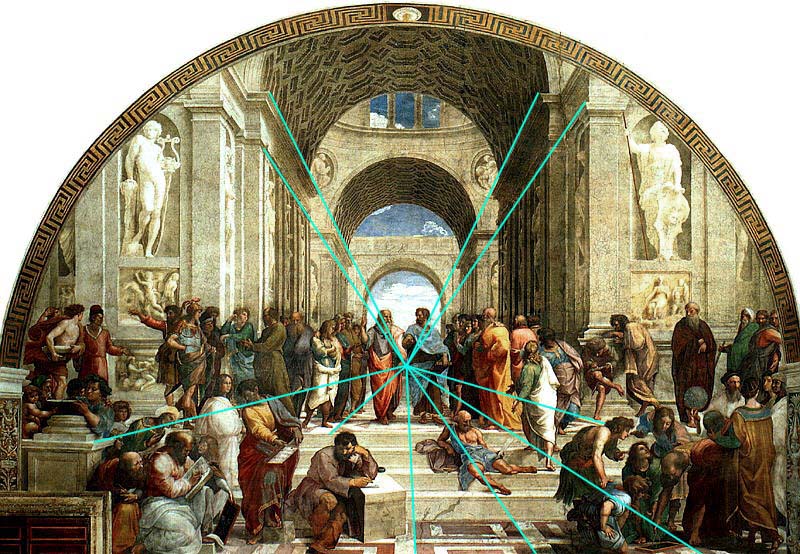
What group of people were shown in Raphael's School of Athens?

a)
Renaissance artists and musicians
b)
Modern scientists and inventors
c)
Ancient philosophers and scholars, including Plato and Aristotle.
d)
Medieval knights and warriors
12.

What new subjects did Italian Renaissance artists depict?

a)

Historical battles from ancient wars

b)

Secular Subjects: Classical mythology, portraits, landscapes, and everyday life.

c)
Abstract concepts
d)
Religious rituals
13.

What is the definition of Renaissance Man?

a)
An individual with a single area of expertise.
b)
A person who only excels in the arts.
c)

A person who is good at multiple disciplines.

d)
Someone who avoids learning new skills.
14.

Which artist painted the ceiling of the Sistine Chapel?

a)
Raphael
b)
Leonardo da Vinci
c)
Donatello
d)
Michelangelo
15.

What is the definition of classical?

a)
Classical refers to modern trends in art and music.
b)
Classical is a term used for contemporary styles.
c)
Classical denotes a focus on futuristic innovations.
d)

Classical refers to Ancient Greek and Roman teachings

16.

What is the definition of Renaissance?

a)
A scientific revolution in the 18th century.
b)
A period of decline in European art and culture.
c)
A cultural movement in Europe from the 14th to the 17th century marked by a revival of classical learning and art.
d)
A movement focused solely on religious reform.
17.

Who were the Borgia Family?

a)
A medieval military order
b)

The Borgia Family was a powerful Italian noble family from Rome during the Renaissance, known for their political influence and connections to the Catholic Church.

c)
A famous Italian artist known for his paintings
d)
A family of famous scientists in the Renaissance
18.

What is the definition of secular?

a)
Not connected to religion or spiritual matters.
b)
Related to a specific religion
c)
Involving spiritual beliefs
d)
Connected to religious practices
19.

What is the definition of vernacular?

a)
The language or dialect spoken by the ordinary people in a particular region.
b)
A type of ancient script used in religious texts.
c)
A dialect that is only spoken by the elite class.
d)
A formal language used in literature and academia.
20.

What is the definition of patrons?

a)
Patrons are critics of artists or organizations.
b)
Patrons are individuals who create art.
c)
Patrons are people who attend events without supporting them.
d)
Patrons are supporters or sponsors of artists or organizations.
21.

What famous painting did Leonardo da Vinci paint?

a)
The Scream
b)
Mona Lisa
c)
Starry Night
d)
The Last Supper
22.

Who were the Medici family?

a)
A famous artist from the Renaissance
b)
A political party in modern Italy
c)
A noble family from ancient Rome
d)
The Medici family were a wealthy and influential family in Renaissance Florence, known for their banking and patronage of the arts.