
 Worksheets
Unit 8 Test Practice: Rational Functions
Total questions: 149
Worksheet time: 10hrs 18mins

(0, -1)
(0, 0)
(0, 4)

(-1, 0)
(0, 0)
(4, 0)

Find the vertical asymptote of the rational function.
f(x)=3x−2x2−2x−8
none
Find the x-intercept(s) of the function.
f(x)=x−64x−12
(3,0)
none


What is the x-value in the coordinate of the hole?
2
2 and 3
-3
3
How do you find the y-intercept?
replace all x-values with 0
replace all y-values with 0
set denominator equal to 0
compare the degrees of the numerator and denominator
How do you find the x-intercept?
replace all x-values with 0
replace the y-value with 0 or make the numerator equal 0
set denominator equal to 0
compare the degrees of the numerator and denominator
How do you determine the Horizontal Asymptote?
replace all x-values with 0
replace the y-value with 0 or make the numerator equal 0
set denominator equal to 0
compare the degrees of the numerator and denominator
How do you know if a factor in the denominator is a hole instead of a V.A. ?
It cancels out
it equals 0
you set the numerator equal to 0
you compare the degrees
When finding the horizontal asymptote, if the numerator degree is greater than the denominator degree, the answer is...
y = 0
none
y =a / b
When finding the H.A., if the numerator degree is equal to the denominator degree, the answer is...
y = 0
none
y =a / b
Solve the inverse variation equation: y=x8 for x when y = 4
1
2
3
4
Apply inverse variation to a real-life scenario: If the speed of a car is inversely proportional to the time taken to reach the destination, and a car traveling at 60 mph reaches the destination in 4 hours, how long will it take for a car traveling at 80 mph to reach the same destination?
2 hours
3 hours
4 hours
5 hours
y = 400/x
If 3 people can complete the project in 7 days, how long will it take 5 people?
If y = 150 when x = 2, find y when x = 25.

What is the x-intercept?
(0, 0)
(4, 0)
(5, 0)
(-5, 0)

(2/3, 0)
(4, 0)
(-2, 0)
(-8, 0)
(1, 0)
(-4, 0)
(2, 0)


Simplify.
1/(n-7)
n-7
(n-6)/(n-7)
n-6

Simplify the rational function
1/(x + 5)
1/(x - 5)
(x - 5)(x + 5)
(x - 5)/[(x - 5)(x + 5)]

Simplify.
4x³/(x+2)
4x³/(x+10)
2x³/(5x+1)
2x³/(x+5)


Find the coordinates of the hole.
(-3, -3)
(-3, 3)
(3, -3)
(3, 3)

Is there a hole or a vertical asymptote?
A hole when x = 2
A vertical asymptote at x = 2
there is no hole or vertical asymptote

Match the graph to the correct rational equation below.
f(x)=x2/(x2+x-12)
f(x)=4x2/(x2-x-12)
f(x)=(2x2-2)/2x2
f(x)=x/(x2+x-12)

What is the end behavior as x approaches negative infinity?
y approaches negative infinity
y approaches positive infinity
y approaches 1
y approaches 2

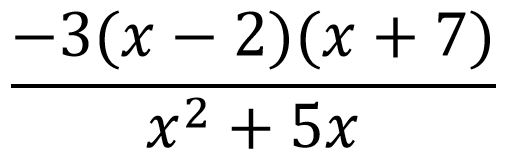

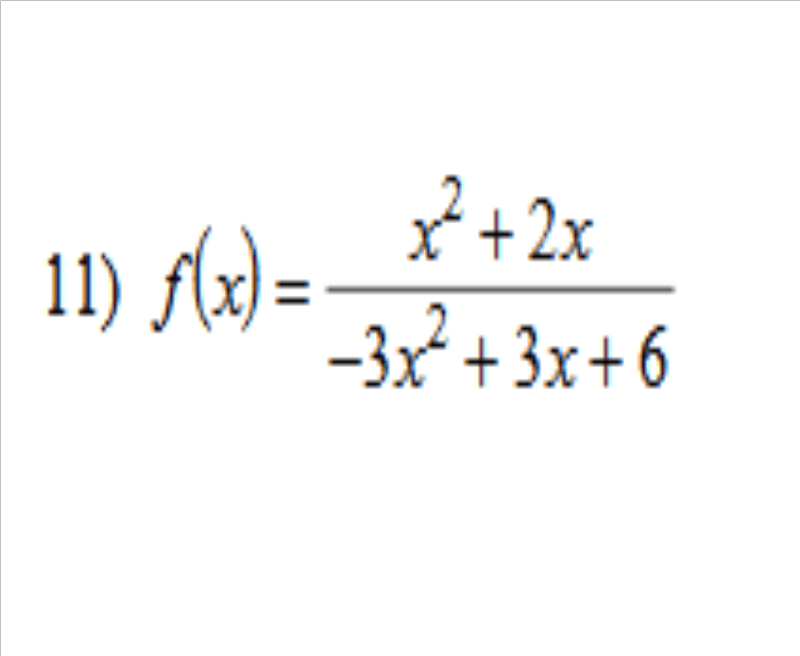


(-3, 1/2)
(3, 1/8)
(5, 1/8)
(-5, 1/2)
What creates a hole in the graph of a rational function?
Crossing the x-axis
An absence of dirt.
Crossing a vertical asymptote.
A factor that cancels out.
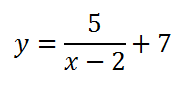


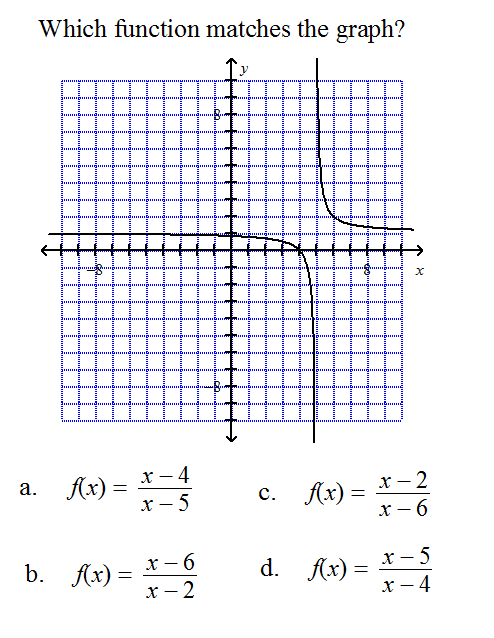
What is the equation of the rational function graphed?


Simplify: x2−49x2+6x−7
x+7x−1
x+7x+1
x−7x−1
x−7x+1
Simplify: x2+3x−18x2+6x
x+3x
x−3x
x−3x+6
x+6x
Simplify: x2−4x2+7x+10
x+2x−5
x−2x−5
x+2x+5
x−2x+5
Simplify: x2−6x+5x2−25
x−1x+5
x−1x−5
x+1x+5
x+1x−5
Simplify: x2+4xx2+7x+12
x+4x+3
xx−3
xx+3
x2x+3
Simplify: x2−81x2−4x−45
x−9x+5
x+9x+5
x−9x−5
x+9x−5

Simplify the rational expression
A
B
C
D

Simplify the rational expression
A
B
C
D

Simplify the rational expression
A
B
C
D

Simplify the rational expression
A
B
C
D

Simplify the rational expression
A
B
C
D

Simplify the rational expression
A
B
C
D

Simplify the rational expression
A
B
C
D

Simplify the rational expression
A
B
C
D

Simplify the rational expression
A
B
C
D

Simplify the rational expression
A
B
C
D

Multiply and Simplify
4(x+3)/(x+2),
(x+2)/4(x+1)
(x+2)/4(x+3),
4(x+1)/(x+2),

Divide the Rational Expression
A
B
C
D

Simplify.
A
B
C
D

Multiply the Rational Expression
A.
B.
C.
D.

Divide
1/6
x+10/ 6x+60
x+8/ 6x+60
(x+10)(x+8)/ 6x+60

Divide the Rational Expression
A
B
C
D
Multiply the Rational Expression
A.
B.
C.
D.

Multiply the Rational Expression
A
B
C
D


SIMPLIFY
A
B
C
D

Simplify the expression.


Simplify the expression.


Simplify the expression.


Simplify the expression.


Solve for x
1/3
-5.5
5.5
2.5

Solve for x
4
2
-2
-4


Solve.
x = 5
x = -3
x = 3
x = -5

Solve.
x = 4.5
x = -4.5
x = 3
x = -3


3/5
3/4
1/4
4/5

2
1
-1
-4

Solve!
(a)

Solve by using the LCD.
(a)


Find the vertical asymptote(s).
x = 3 and x = -7
x = 3
x = -7
x = -4
Suppose you translate the graph of y=x3 so that the new graph has asymptotes at x= -5 and y=14. What is the equation for the new graph?
y=x−53−14
y=x+53+14
y=x−143−5
y=x+143+5

What is the HORIZONTAL asymptote of this function? (click on the graph to enlarge)
x=1
x=-3
y=1
y= -3

Write the equation for the graph.
y=x+31
y=x−31
y=x1+3
y=x1−3

What's the vertical asymptote of the function?
x = 4
x = 16
x = 4 , x = -4
No vertical asymptote

Choose the best equation for the graph.


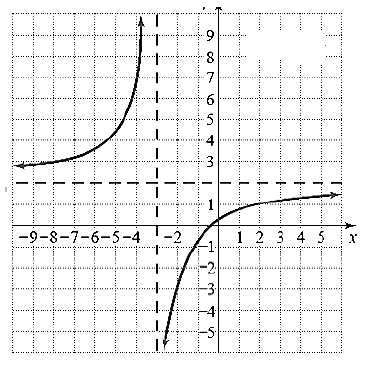
Which of the following represents the graph below?
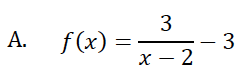
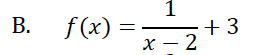
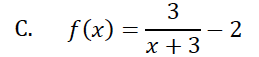
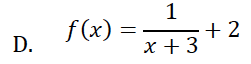
Graph the function.
f(x)=x−4−x+1


What is the horizontal asymptote of the function y=2x−75x+2 ?
y=0
y=5/2
y=2
y=7


Simplify
(x-9)
x−91
(x+9)
x+91

Simplify
a
b
c
d

simplify
A
B
C
D
Write the given statement in a mathematical equation.
Interest (I) varies jointly as the principal (P) amount deposited, and the rate (r) and time (t) of the deposit.
I = kPrt
P = kIrt
T = kPIt
r = kPIt
Simplify: k2−45k+21
5k−2
5k+2
k−25
k−2
Simplify: k2+7k+127k2k+31
k + 3
k - 10
3k−5
7k2k+4
Simplify: x+645x
5(x+6)4x
20x(x+6)
20x(x+6)
20xx+6
Simplify: 9k2+2k−355k25k3−25k2
k−74k2
k+79
49
1
x+6x2−1x+6x2−x−2
−x−3
x2+1x2−x−2
(x−1)(x+1)x−2
x−1x−2

Solve.
x = 5
x = -3
x = 3
x = -5

Simplify
1
-1
Can't be simplified
0
Solve the equation for x.
7
6
14
0

Describe all transformations from the parent function g(x)=x1 to f(x).
Shift right 5 and shift up 7
Shift left 7 and shift up 5
Reflect over the x-axis, shift up 7
Shift left 5 and shift up 7
1−x2x+x23
x2−2xx3+3
x−2x(x+3)
x−2x+3
x−2x(x3+3)
If z varies inversely with the square of t, and z = 5 when t = 3, find z when t = 6
If A varies jointly with B and C, and A = 12 when B = 2 and C = 3, find A when B = 4 and C = 5.

What's the vertical asymptote of the function?
x = -4, x = 1
x = 4, x = -1
x = -4, x = -1
x = 4, x = 1
The horizontal asymptote equals zero when:
the degree of the numerator and denominator are equal
the degree of the numerator is less than the degree of the denominator
the degree of the numerator is greater than the degree of the denominator
the numerator equals zero

Find the horizontal asymptote:
y = 0
y = 1
None
y = 3/2
Identify the type of discontinuity at x=3 for the function f(x)=x−3x2−9 .
Hole
Vertical Asymptote
Domain
Range

Select all the following statements that are true.
Vertical asymptote at x=1
Vertical asymptote at x=0
No vertical asymptote
Hole at (-1, 0)
Hole at (1, -1)

Which is the graph of the rational equation:


Solve for x:
x−16=x−24+x+12
1
2
-1
No Solution

