
 Worksheets
Unit 4 Reivew- The Growth of Empires
Total questions: 80
Worksheet time: 2hrs 30mins

Romans were well known for constructing arches as part of their buildings. What is the name wedge-shaped stone in the middle of the arch?
dome
pyramid
keystone
cornerstone
Who was the first official emperor of the Roman Empire?
Julius Caesar
Augustus Caesar
Marc Antony
Aristotle
Who was Augustus Caesar's grand-uncle (and also his adopted father)?
Julius Caesar
Hadrian
Marc Antony
Alexander the Great
TRUE or FALSE: After King Alaric and the Visigoths attacked Rome, the entire Roman Empire to the West fell.
True
False
Which of the following correctly describes the Pax Romana period? Select the THREE correct answers.
It was aka the Golden Age of Rome
Citizens had more rights and felt secure
It was a time of war and fighting
The Roman Empire was beginning to fall
It was a time of peace and prosperity
What were factors that led to the fall of the Roman Empire? Select the THREE correct answers.
the Romans were no longer enslaving people
Roman armies had become too large
many barbarian tribes wanted to destroy Rome
there were not enough resources to make repairs
they did not have honest emperors
Rome used ________ to bring clean water to homes.
baths
bridges
sewers
aqueducts

Use the source to help you answer the question.
How were Roman roads were built to last for centuries? Select the THREE correct answers.
The mixture of clay and sand helped the roads be more durable
Romans used the best supplies for their roads
They built the roads without a foundation
Drainage systems were installed
The roads were built in layers to make them stronger and more durable

Use the source to help you answer the question.
Which people were considered the wealthy upper-class of Roman society?
Merchants

Use the source to help you answer the question. Which people were considered the working class of Roman society?
Slaves
Patricians
Before the Emperors, the Roman government was called a __________.
aristocracy
monarchy
dictatorship
republic (democracy)
How did Octavian become the sole ruler of Rome?
He defeated the armies of Brutus, Cassius, Antonius, and other senators.
He was elected by the people.
He inherited the throne from his father, Julius Caesar.
He defeated the Athenian and Spartan armies.
How did Augustus want people to see him as a ruler?
As a humble leader
As a powerful conqueror
As a wealthy king
As a wise philosopher
What changes did Augustus make to Rome and its government?
He reorganized the military and tax system.
He built a new palace for himself.
He banned all public gatherings.
He reduced the size of the empire.
What was the Pax Romana?
A time of peace during the rule of Augustus
A new type of Roman army
A famous Roman festival during the rule of Augustus.
A Roman law about trade
In what directions did Rome grow the most after Julius Caesar's death?
North and east
South and west
Only north
Only east
What natural feature protected the northeastern borders of the Roman Empire in Europe?
The Alps
The Rhine River
The Mediterranean Sea
The Danube River
Why were improvements in roads, bridges, and other forms of transportation important for the Roman Empire?
For trading with other countries quickly
For moving military supplies and troops quickly
For building more cities
For exploring and conquering new lands
What was the purpose of structures like the one in the image?
To bring clean water to distant parts of the Roman Empire.
To serve as a bridge for transportation and travel.
To act as a defensive wall from invaders.
To provide shelter for travelers.
How did Diocletian change the Roman Empire?
He divided the Roman Empire into eastern and western halves.
He expanded the empire to new territories.
He abolished the Senate.
He moved the capital to Byzantium.
What challenges did the Roman Empire face?
The size of the empire, corruption, and fights for political power.
Lack of resources, poor leadership, and natural disasters.
Frequent invasions, economic prosperity, and peace.
Overpopulation, technological advancements, and cultural unity.
Where did Constantine move the capital of the Roman Empire, and why was it necessary?
Byzantium because Rome was no longer a well-organized center of power.
Alexandria because it was closer to trade routes than Rome was.
Athens because of its cultural significance.
Carthage because of its strategic location.
Why were Christians persecuted under the Roman Empire?
Because of their religious beliefs.
Because they were wealthy.
Because they were soldiers.
Because they were from another country.
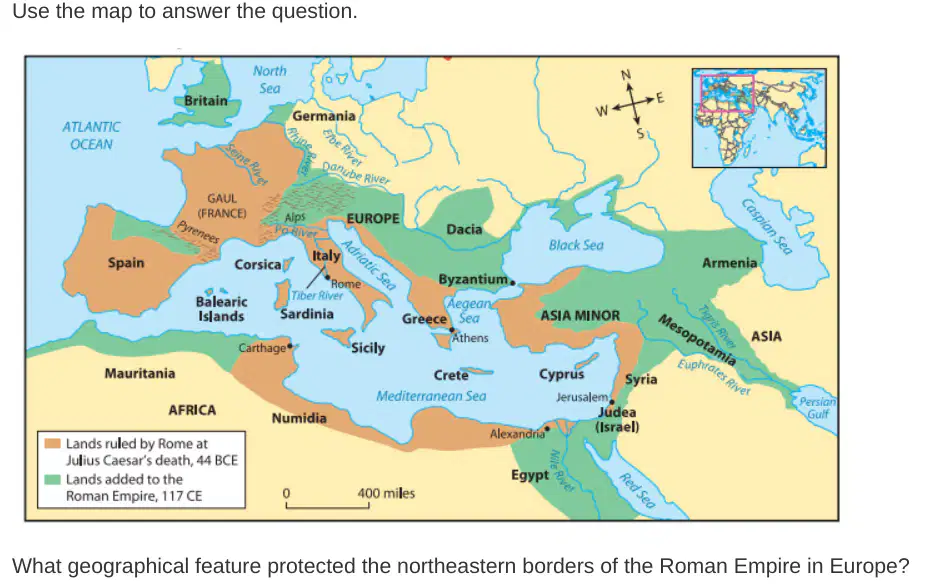
Use the map to answer the question.
What geographical feature protected the northeastern borders of the Roman Empire in Europe?
the Nile River
the Pyrenees
the Black Sea
the Rhine River
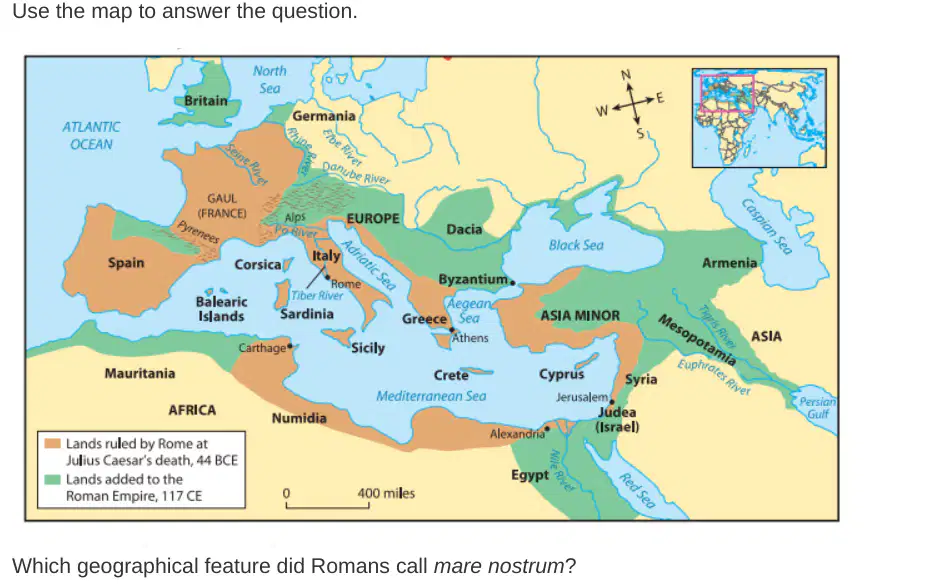
Use the map to answer the question.
Which geographical feature did Romans call mare nostrum?
the Black Sea
the Adriatic Sea
the Aegean Sea
the Mediterranean Sea
Why is Augustus Caesar considered one of Rome’s greatest leaders?
Responses
He made Christianity a legal religion.
He expanded the empire by conquering Gaul.
He improved safety measures and built new buildings and aqueducts in Rome.
He divided the empire into eastern and western parts.
What was the Pax Romana?
Responses
a Roman name for aqueducts
the highest rank in the Roman army
a long period of peace in the empire
words placed on buildings in the empire
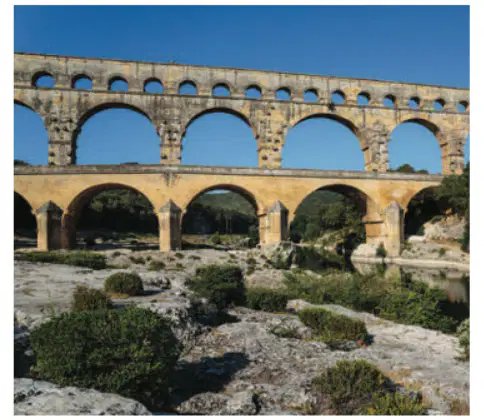
Use the image to answer the question.
What was the purpose of structures like this one?
to serve as places of worship
to guard against outside attacks
to bring fresh water to Roman cities
to show where Roman cities’ borders ended
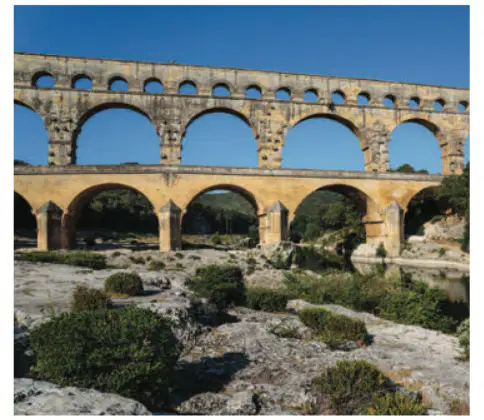
Use the image to answer the question.
What purpose did the arches in this structure serve?
They provided support to the structure.
They were entirely used for decoration.
They allowed defenders to shoot at enemies.
They gave a window to the world of the gods.
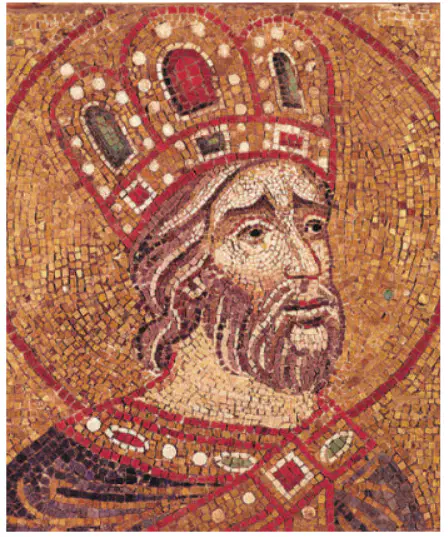
Use the image to answer the question.
What is this emperor famous for?
being the last emperor
dividing the empire
persecuting Christians
converting to Christianity
What was Byzantium renamed?
Constantinople
Nicaea
Rome
Judea
What did Emperor Justinian do?
He wrote a code of laws.
He renamed the capital.
He expanded the army.
He split the empire.

Use the image to answer the following question.
What is this emperor famous for? Select the two correct answers.
writing the Aeneid
setting up a treasury
giving power to Antonius
surrendering to his enemies
expanding Rome’s borders
Why was it so hard to unify China under the Qin Dynasty?
the dynasty was weak
the Chinese did not want to be unified
the Chinese had different writing, money, and measurements
they were too busy fighting off invaders
What was the major benefit of the Grand Canal?
it was easier to transport food
it was easier to get water
the river stopped flooding
it kept out invaders
True or False: After the Qin unified China, all of the Chinese spoke the same language.
True
False
The Silk Road is ______________
made of silk
a trade route for many goods
only one road
a water route between Asia and North America
Why did the Chinese prefer to travel by boat?
it was faster and easier after they invented the compass
the roads were too dangerous to travel
silk was too heavy to carry over land
they wanted to avoid going through Persian territory
Which of the following was NOT something traded on the Silk Road?
Silk and Horses
Religion and Beliefs
Ideas and Technology
Papyrus and Hieroglyphics
Why was the Great Wall built?
to keep out invaders
to serve as a punishment for criminals
to attract tourists
to hold back flood waters
Who generally DID NOT work on the Great Wall?
Qin Shi Huangdi's son
slaves
criminals
wealthy people
Which achievement of the Chinese made it easier to send messages to each other?
paper
woodblock printing
magnetic compass
porcelain
Which achievement of the Chinese was like the first copy machine?
paper
woodblock printing
magnetic compass
porcelain
Which achievement of the Chinese made it easier to travel?
paper
woodblock printing
magnetic compass
porcelain
Which achievement of the Chinese was wanted by other civilizations?
paper
woodblock printing
magnetic compass
porcelain
Who was ruled by emperors?
Imperial China
Greece
Ancient Egypt
United States
Who was ruled by pharaohs?
Greece
United States
Ancient Egypt
Imperial China
The Nile river started their civilization
Imperial China
Greece
United States
Ancient Egypt
the place where an emperor was buried with terracotta soldiers
Imperial China
Greece
United States
Ancient Egypt
Where were Pharaohs are buried in pyramids?
Imperial China
United States
Ancient Egypt
Greece
What desert made daily life harder for Imperial China
Australian desert
Artic desert
Gobi desert
Sahara desert
What were the silk roads?
Was the tallest mountain in China
Was used to trade goods, philosophies, religion, and languages
Largest river in Egypt
Largest river in China
The yellow river was the start of their civilization
Imperial China
United States
Ancient Egypt
Greece
What was the importance of Chinese traditions?
Shows how they honored the pharaohs
Shows the importance of honoring ancestors and family
Shows the importance of trading goods
Shows how kids should listen to their parents
What is confucianism?
Believed in goodness of humanity, following rules, and fair leadership
Believed in worshiping many gods, everything is one, and Chi energy in the body
Built monasteries and monuments in honor of this religion
What is Buddhism
Belief in goodness of humanity, following rules, and fair leadership
Built monasteries and monuments in honor of this religion
Believed in worshiping many gods, everything is one, and Chi energy in the body
What is Taoism
Believed in worshiping many gods, everything is one, and Chi energy in the body
Built monasteries and monuments in honor of this religion
Belief in goodness of humanity, following rules, and fair leadership
Majority of the people were peasants or poor
Ancient Egypt
United States
Imperial China
Greece
The printing of books was important because it helped spread ideas and information more rapidly.
TRUE
FALSE
Suppose four Chinese emperors are in the same dynasty. Which statement would be true about them?
They were born in the same region.
They use the same style of government
They belong to the same political party
They are all members of the same family.
a ceramic made of fine clay baked at very high temperatures
porcelain
novel
steppe
census
to bring together in one unit; to join; to make into one group
unify
convert
method
neo-Confucianism
Nomadic peoples from the north of China who were really good at fighting and riding horseback
Mongols
Koreans
Japanese
Russians
How did the Silk Roads connect different parts of Afro-Eurasia?
How did the Silk Roads affect life in Imperial China?
The Silk Roads facilitated the exchange of goods, ideas, cultures, and religious.
Who built the first Great Wall?
What was the significance of the Great Wall of China?
___________ were people who moved from one place to another.
Nomads
Cinfucius
Asia
Yellow river
Invaders were kept out of China by the ___________ which spanned some 4,000 miles.
silk
Great Wall
dragons
cycle of the moon

