
 Worksheets
EOC Review
Total questions: 41
Worksheet time: 28mins
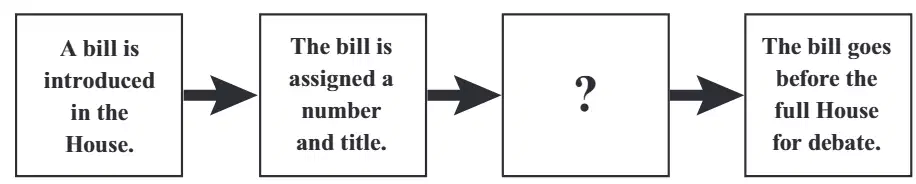
The flow chart below shows part of the process in which a bill becomes a state law. Which action completes the flow chart?
The bill is sent to committee for study.
The bill is sent to the governor for support.
The bill is published in newspapers for comment.
The bill is reviewed by a judge for constitutionality.
Which is one constitutional requirement to be eligible to be elected as President of the United States?
a resident for at least 20 years
previous government service
a member of a political party
at least 35 years of age

How does this U.S. Supreme Court decision protect individual rights?
It provides defendants a jury of their peers.
It allows lawyers to call witnesses for defendants.
It allows defendants to set aside fines they cannot pay.
It provides defendants legal representation if they cannot afford it.
Which statement describes separation of powers?
Civil servants are not subject to political pressure.
Presidential power is not subject to congressional oversight.
Civilian authorities have control over the branches of the military.
Political authority is divided among the branches of the government.

According to the excerpt, which problem did the Articles of Confederation create?
a lack of checks on legislative powers
a lack of powers given to state legislatures
the lack of authority to enforce congressional acts
the lack of authority to apportion congressional districts

When it was first ratified, which group of people did this amendment address?
Chinese immigrants
Mexican immigrants
Asian-American men
African-American men
Which statement describes the intent of checks and balances?
The government receives revenue from the people.
The government receives authority from the people.
No branch of government can become too powerful.
No branch of government can apply concurrent powers.
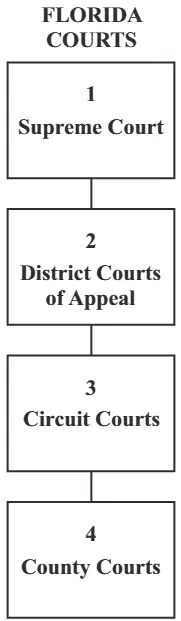
The diagram below illustrates the structure of courts of Florida. Which numbered court has only original jurisdiction?
1
2
3
4
What was the main reason President Harry S. Truman went to the United Nations in response to the Communist invasion of South Korea in 1950?
to advance U.S. political goals in the United Nations
to justify U.S. economic support for the United Nations
to seek international support for the defense of South Korea
to ask troops to prevent a political overthrow of South Korea
What role does the Cabinet serve at the federal level?
It advises the president on national issues and assists in operating the government.
It works with the political party in power to ensure members support the president’s agenda.
It works with the major news organizations to ensure public support for upcoming legislation.
It advises government leaders on procedural matters and assists in the passage of legislation.
Which statement describes a difference between the duties of state and federal governments?
The federal government builds roads.
The federal government mints coins.
State governments establish courts.
State governments levy taxes.

How did King George III respond to the action described in the excerpt?
A) He approved the colonists’ decision to use a trade boycott.
B) He supported the election of colonial representatives to Parliament.
C) He ignored the colonists’ demands for change in government policy.
D) He repealed the law declaring Parliament could pass laws for the colonies.
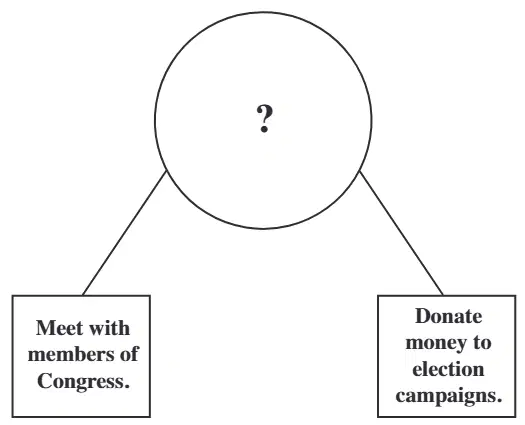
The diagram below shows some activities in the political process. Which title completes the diagram?
Ways that Corporations Influence Consumers
Ways that Citizens Support Personal Businesses
Ways that Interest Groups Influence Lawmakers
Ways that Public Officials Support Government Reforms
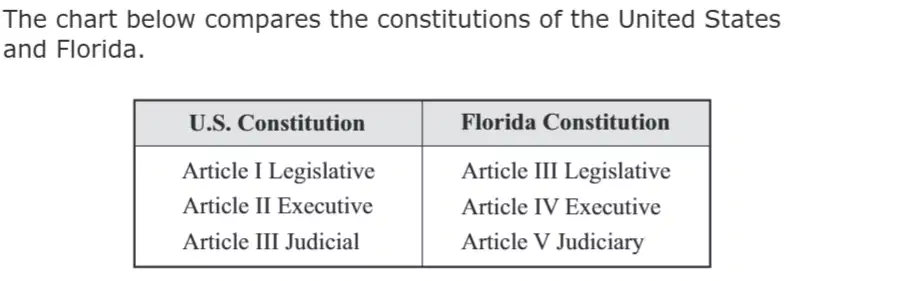
What do these two constitutions have in common?
They both include the sharing of powers.
They both include the separation of powers.
They both are examples of government processes.
They both are examples of government regulations.

The excerpt below was published in 1788. In the . . . republic of America, the power surrendered by the people is first divided between two distinct governments . . . The different governments will control each other, at the same time that each will be controlled by itself. Which principle of government is described in this excerpt?
direct democracy
judicial review
rule of law
federalism
Which action did the U.S. government take to help make the world a safer place to live?
It helped found the North American Free Trade Agreement (NAFTA) in 1994.
It withdrew from the International Red Cross in 1863.
It helped found the United Nations (UN) in 1945.
It withdrew from the European Union in 1993.
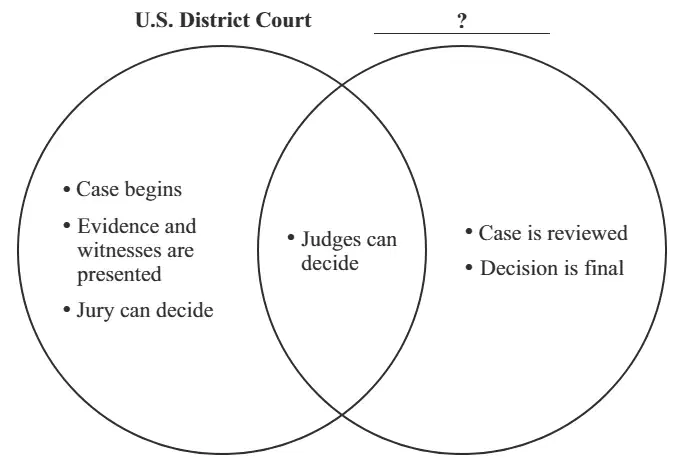
The Venn diagram below compares two types of federal courts. Which federal court replaces the question mark?
U.S. Bankruptcy Court
U.S. Territorial Court
U.S. Supreme Court
U.S. Tax Court
What was the significance of Thomas Paine’s pamphlet Common Sense?
It was a published document outlining personal rights in Great Britain.
It was an influential work calling for independence from Great Britain.
It was a popular almanac instructing colonial farmers.
It was a written framework of colonial government.
The list of questions below is used to determine whether a candidate meets the constitutional requirements to run for a seat in the U.S. House of Representatives. - What is the candidate’s age? - How long has the candidate been a U.S. citizen? - ? Which question completes this list?
Which state is the candidate a resident of?
Does the candidate have a college degree?
Does the candidate have a political background?
Which branch of the U.S. Armed Forces is the candidate a veteran of?
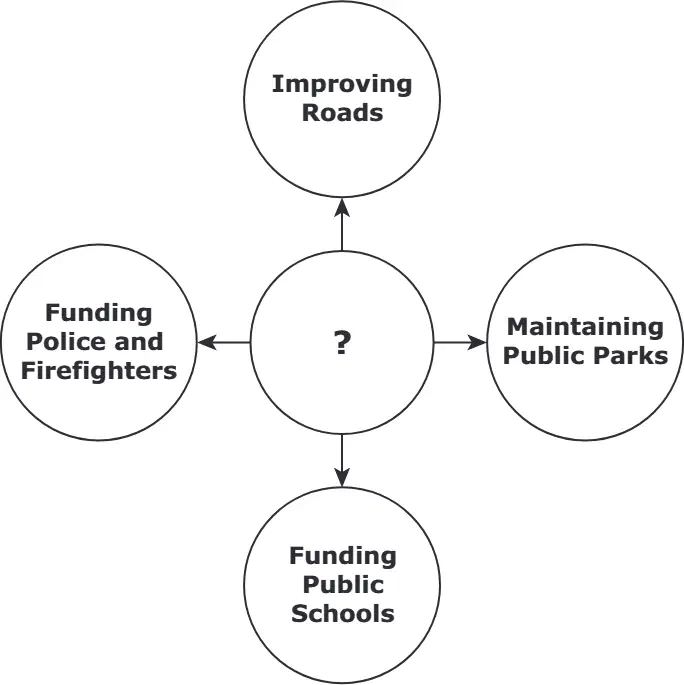
The diagram below shows outcomes of a civic obligation. Which title describes the civic obligation that would result in these outcomes?
Responsibility of Government to Enforce Laws
Role of Voting in Controlling Government
Role of Taxation in Providing Services
Importance of Education in Society

The list below describes types of local governments. The U.S. Census Bureau reported that in 2012 there were 89,004 local governments in the United States. Local governments included the following: - 3,031 counties - 19,522 municipalities - 16,364 townships - 37,203 special districts - 12,884 independent school districts. Which generalization can be made about governments in the United States based on this list?
Local governments collect more taxes than the federal government does.
Local governments serve fewer people than the federal government does.
The federal government has many more full-time employees than local governments do.
The federal government has less direct interaction with the people than local governments do.

The diagram below describes a political process. A vacancy occurs for the position of Secretary of Commerce. The president nominates an individual to serve. ? Which statement completes the diagram?
The Senate votes to confirm or deny the appointment.
The federal courts vote to confirm or deny the appointment.
The state governors vote to confirm or deny the appointment.
The House of Representatives votes to confirm or deny the appointment.
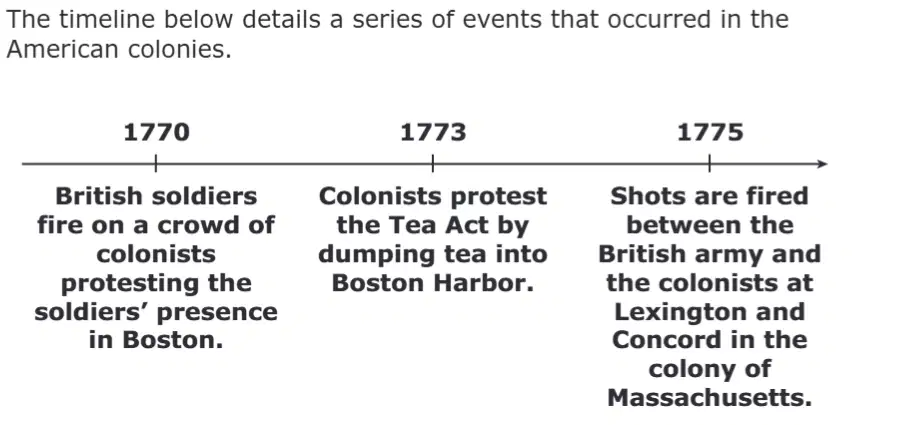
Based on this timeline, which conclusion can be drawn about English policies for colonial rule?
A) English policies attempted to provoke the colonists into a war against the king.
B) English policies compelled the colonists to acknowledge the sovereignty of the king.
C) English policies were unable to address the economic downturn experienced by the colonies.
D) English policies were unable to peacefully resolve the growing political tensions in the colonies.
Which situation is an example of double jeopardy?
A) A person is put on trial without a lawyer and found guilty.
B) A person is found guilty after a trial and convicted of multiple crimes.
C) A person is found guilty after a trial and receives an unreasonable sentence.
D) A person is put on trial and found guilty of a crime for which he or she has already been tried.
How does a federal system of government differ from a unitary system?
The central government passes laws in a federal system.
States hold some government powers in a federal system.
The central government collects taxes in a federal system.
Voters elect some government leaders in a federal system.
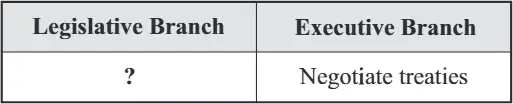
The chart below shows functions of the legislative and executive branches in foreign policy. Which function completes the chart?
Coin money
Declare war
Regulate pollution
Punish counterfeiters
Why are people required to pass a U.S. citizenship test as part of the naturalization process?
to create a safer society
to create a healthier society
to encourage a more informed citizenry
to encourage a more privileged citizenry
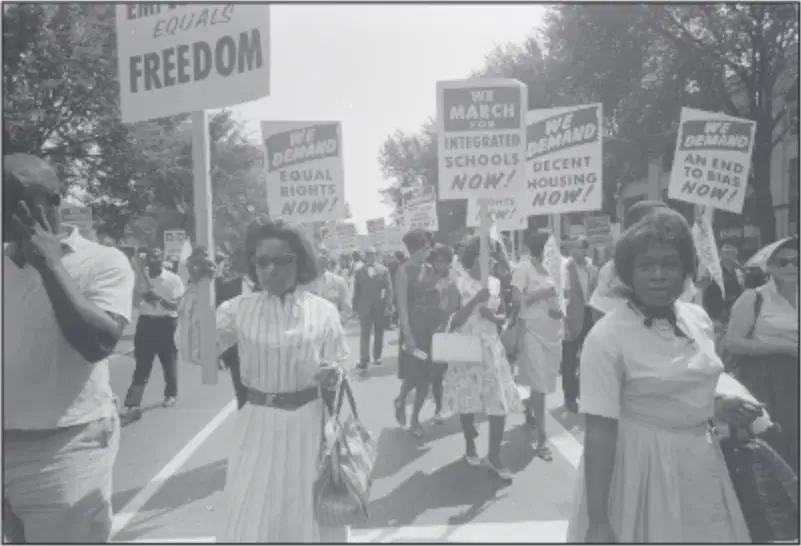
The photograph below was taken during the March on Washington for Jobs and Freedom in 1963. Based on this photograph, which generalization can be made about how participating in this type of activity influences government?
Participation demonstrates public concerns to elected officials.
Participation restricts civil rights through organized assemblies.
Participation discourages multiple perspectives about pending legislation.
Participation increases money spent on advertising during election campaigns.
Examine the impact of media, individuals, and interest groups on monitoring and influencing government.
Media, individuals, and interest groups have no impact on government.
Media, individuals, and interest groups play a crucial role in monitoring and influencing government.
Only media influences government, not individuals or interest groups.
Interest groups are the sole influencers of government.
What happens to a bill if the President SIGNS it?
it becomes a Law
It is rejected
Which is not a formal requirement for presidential candidates?
Must have a background in politics
Must be at least 35 years old
Must have lived in the U.S. for 14 years
Must be a natural born citizen
Separation of (a) -power is separated between the (b) branches. Checks and (c) -each branch has (d) over the other (e) branches. Individual Rights - basic liberties of citizens are protected.
Match the following
Article 1- Legislative
House of Representatives and Senate
Aticle 2- Executive
President
Aricle 3- Judicial
Supreme Court
Separation of Powers
divide power in 3 branches, Montesquieu
Which function of the Constitution of the United States prevents any one branch from gaining too much power?
Rule of law
Representative Government
Separation of Powers
Checks and Balances
Which of the following best explains the executive branch’s influence on the U.S. Judiciary?
Federal judges are impeached by the House of Representatives.
The President appoints federal judges to be confirmed by the Senate.
A federal judge is appointed by a joint resolution of Congress.
The Department of Justice selects federal judges.

Which Supreme Court case established JUDICIAL REVIEW?
McCullough v. Maryland
Marbury v. Madison
Gibbons v. Ogden
Baker v. Carr

Basic principle of the Constitution: Power is shared between federal, state, and local government.
popular sovereignty
checks and balances
federalism
individual rights
The (a) amendment says all (b) not given to the (c) government are left for the (d) thus creating the system of (e)
Match the following
13
outlaws slavery
14
natural born rights/states treat fairly
15
black men's suffrage
16
taxes
17
most votes becomes senator
Which Amendment gave women the right to vote?
23rd
18th
21st
19th

