
Font size
 Worksheets
sCIENCE REVIEW
Total questions: 100
Worksheet time: 2hrs 26mins
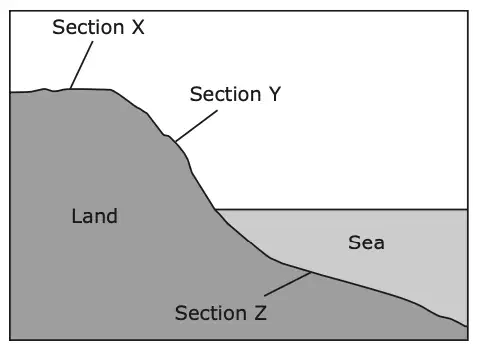
A diagram of different sections of land is shown. Which action is most likely happening in Section Y in the diagram?
Wind and rain compacting rock into larger pieces
Water carrying rocky material to a new location
Chemicals in water gluing sediments to each other
Pressure causing layers of sediment to form over time

A student uses the setup shown to investigate ways to speed up evaporation. Which forms of energy are being compared in the student’s investigation?
Light energy and electrical energy
Mechanical energy and electrical energy
Light energy and thermal energy
Mechanical energy and thermal energy
A student plans to make a chart that describes each process in the water cycle. Which sentence should the student use to describe the process of condensation?
Water flows downhill.
Liquid water turns into water vapor.
Polar ice turns into liquid water.
Water vapor collects to form droplets.

A student makes the model shown with objects representing the sun, Earth, and the moon to use in a class demonstration. Which action should the student do with the objects to demonstrate a complete day-night cycle of Earth?
Move the moon around Earth once
Spin the sun in a circle once
Move Earth around the sun once
Spin Earth in a circle once

Two box turtles live in an area in a zoo’s reptile house. Zoo visitors made a list of observations of the turtles. The list is shown. Which observations best describe how box turtles interact with living parts of their environment?
Observation 4 and observation 6
Observation 2 and observation 5
Observation 1 and observation 5
Observation 3 and observation 4
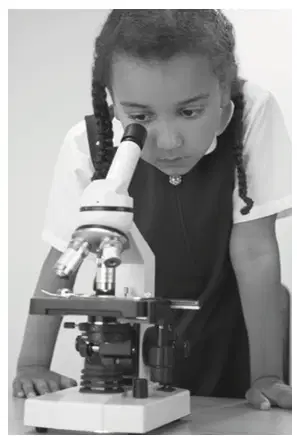
The student is observing part of a plant with a microscope. Which statement describes a behavior of light in the microscope?
Light travels through the microscope lens without changing direction.
Moving in straight lines causes light to increase in brightness.
Light refracts through the lens of the microscope.
Moving in straight lines keeps light from reflecting.

Students conduct an investigation with breakfast cereal. The first four steps of the students’ investigation are in the table shown. The students are trying to determine the presence of which substance in the cereal?
Sugar
Iron
Salt
Water
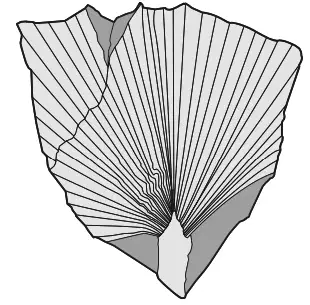
Scientists have uncovered palm plant fossils in Alaska, the northern-most state of the United States. Modern-day palm plants grow in tropical climates. A picture of a palm fossil that measures almost one meter across is shown. This discovery suggests to scientists that this area in Alaska once was —
covered with an ocean
warmer than it is now
populated by polar bears
changed by earthquakes
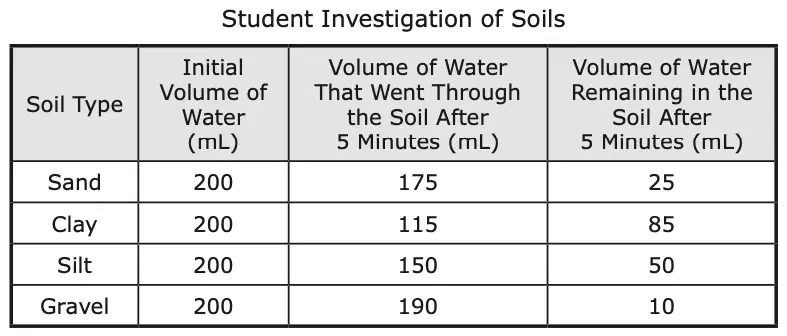
A group of students wants to build a desert garden at school. They need soil that allows water to drain away easily for the desert plants in this garden. The students test different soils to determine how much water passes through and how much water remains in each soil as shown in the table. Based on the table, which types of soils are best to use to build the garden?
Clay and sand
Sand and gravel
Gravel and silt
Silt and clay

Students build a balloon-rocket car using a balloon, a straw, a water bottle, and some tape. When the straw is released by a student, the air from the balloon comes out. A diagram of the car is shown. Which statement best describes the motion of the car when the straw is released?
The car will move away from the wall in the same direction as the air that is leaving the balloon.
The car will move toward the wall because of the force of the air from the straw.
The car will move fast because the straw gets light as the air is released.
The car will not move because the air escapes from the balloon.
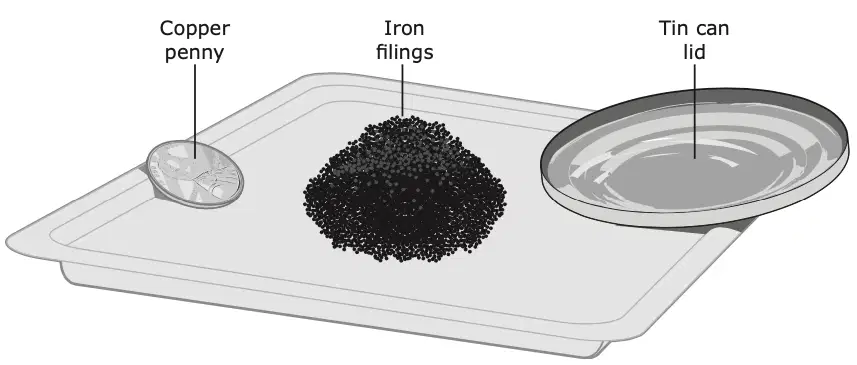
Students observe some objects on a lab tray. The students will classify the objects based on physical properties common to all of the objects. Based on their common properties, how should these objects be classified?
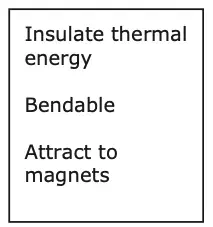
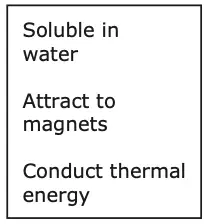
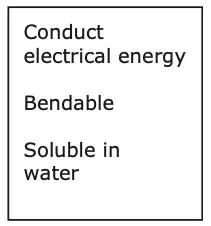

Which of these devices is the only one NOT designed to produce both sound and light energy?


What most likely happened to the dead plants and animals?
They were eaten by scavengers.
G They became fossil fuels.
H They were washed away by water
J They became an underground aquifer.

Based on this information, what is most likely an advantage of the bony fish tail fin over the shark tail fin?
A It is easier for a bony fish to change direction quickly since muscles control the movement of the tail fin.
B The bones in the tail fin help a bony fish sink to lower depths in the water when searching for food.
C The flexible tail fin is fanned by the water, so a bony fish uses less energy to swim.
D The thin spines of the tail fin prevent a bony fish from being seen by larger predator fish.

What property of soils is the student most likely examining with this procedure?
F The differences in texture between wet and dry soils
G How well different soils retain water
H How much water is needed to dissolve different soils
J The amount of time it takes different soils to dry

Based on their properties, which of the objects is most likely a metal?
A Object , because it is a solid that is less dense than water
B Object 2, because all metals float in water
C Object 2, because metals conduct thermal energy and electricity
D Object1, because it can be used to provide insulation for thermal energy
6 Which of these describes one or more living organisms that depend on another living organism to survive?
F Bacteria living in the mouth of a horse
G Ivy plants growing up a fence to obtain more sunlight
H Mold living on a hard, rocky surface
J An angelfish releasing carbon dioxide into pond water

What is the athlete demonstrating in the picture?
A Doing work by pushing the ball and changing its motion and position
B Changing the position but not the motion of the ball
C Doing work by pulling the racquet and changing the ball’s position but not its motion
D Changing the position and motion of the ball without doing any work

Which statement correctly describes the transfer of energy in a food chain in this wetland?
F Energy is transferred from hawks to shrews to grasshoppers to marsh grasses.
G Energy is transferred from marsh grasses to crickets to hawks to frogs.
H Energy is transferred from grasshoppers to crickets to frogs to hawks.
J Energy is transferred from cattails to crickets to shrews to hawks.
9 A group of students is performing an investigation to measure how much liquid water is produced from a 10 L sample of snow. What must occur in order for the students to perform this investigation?
A The sample must be kept in a freezer.
B The temperature of the sample must change.
C The investigation must be performed outside.
D The physical state of the sample must remain the same.
10 A bright-red male cardinal comes to a school bird feeder every morning. Like other cardinals, this bird makes a sharp chirping sound as it hops around the bird feeder.
Which of these is a learned behavior of this bird?
F Having red feathers
G Eating seeds during the day
H Coming to the bird feeder each morning
J Making a chirping sound
11 One type of fuel was used for thousands of years before other fuels were commonly used. Which fuel is an alternative resource that was most likely the first fuel used by humans?
A Coal
B Natural gas
C Petroleum
D Wood

Which property of light are the students observing in this situation?
F Light can be refracted and separated into different colors as it moves from air to a different medium.
G Light is refracted as it moves from one medium to another medium.
H Light travels in a straight line and can be reflected off the surface of water.
J Light is absorbed by water and reflected off glass.

This valley was most likely formed by —
A a rapid series of earthquakes
B volcanic activity
C a flood with rapidly moving water
D the movement of a glacier

Which organisms have a life cycle that is most like that of abalones?
F Humans
G Frogs
H Birds
J Snakes

A LEDs 1, 3, and 4 only
B LEDs 1, 2, 3, and 4
C LEDs 3 and 4 only
D LEDs 1, 3, 4, and 5


Based on the diagram, which statement best compares the life cycles of these two types of organisms?
A Young ladybird beetles take many years to develop into adults. Young grasshoppers develop into adults quickly.
B Young grasshoppers live in a habitat that is different from that of adults. Young ladybird beetles live in the same habitat as adults.
C Young grasshoppers undergo incomplete metamorphosis to become adults. Young ladybird beetles undergo complete metamorphosis to become adults.
D Young ladybird beetles have a nymph stage before becoming adults. Young grasshoppers are larvae before becoming adults.
The Grand Canyon is more than 400 km long and in some places almost 2 km deep. Which model best represents the main process that formed the Grand Canyon?


A Conduct five trials, using a different scale to pull each block of wood
B Conduct five trials, pulling a different side of each block each time
C Conduct five trials, using a different table for each trial
D Conduct five trials, pulling each block of wood in the same way for each trial

F The pan-like shape of the giant water lily leaves helps them catch rainwater. The slim shape of the mesquite leaves helps them avoid sunlight.
G The broad shape of the giant water lily leaves helps them stay on the water surface.The slim shape of the mesquite leaves helps them prevent water loss.
H The pan-like shape of the giant water lily leaves helps them attract small fish. The slim shape of the mesquite leaves helps them avoid herbivores.
J The broad shape of the giant water lily leaves helps them attract aquatic birds. The slim shape of the mesquite leaves helps them attract pollinators.

A Student 1 only
B Students 2 and 4 only
C Student 2 only
D Students 1 and 3 only
22 A family takes a group picture in a park where bluebonnets are blooming. The family notices that some of the blooms are white and others are blue.
The color of the blooms is most likely determined by —
F air temperature
G the age of the plant
H the types of consumers that eat the plant
J inheritance from parent plants
23 A beaker with 115 mL of solution has a temperature of 21°C. The solution contains 5 g of salt and 115 mL of water. Students added two ice cubes to the solution and stirred the solution with a stirring rod.
Which properties of the solution changed as the ice cubes melted?
A The color and physical state of the solution
B The temperature, mass, and volume of the solution
C The volume, temperature, and mass of the salt in the solution
D The physical state and temperature of the solution

F travels in straight lines and reflects from the surface of the mirror
G refracts in the glass of the mirror and is spread out all over the room
H enters the mirror and changes direction when it is refracted by the back of the mirror
J travels through air and does not change its direction in air
25 A science class has an aquarium in which fish and aquatic plants are growing. How is carbon dioxide directly involved in the survival of organisms in the aquarium?
A The fish must absorb carbon dioxide through their gills for energy.
B Both the plants and the fish need carbon dioxide to make their own nutrients.
C The plants need carbon dioxide to make sugar.
D The plants release carbon dioxide into the water to control the water temperature.
26 A family was vacationing in the mountains in a cabin that had no electrical power. They needed boiling water in order to prepare dried soup mix.
With no electrical energy available, which method would most likely provide enough thermal energy to quickly heat the water to boiling?
F Using a microwave oven to heat water in a glass jar for 3 minutes
G Shaking the water in a closed, insulated plastic bottle for 3 minutes
H Shining a battery-powered flashlight on a metal container of water for 10 minutes
J Placing a metal pot of water over glowing charcoal in an outdoor grill for 10 minutes

A Two
B Three
C Four
D Five

F Heat from the sun warms the ocean, causing water to evaporate. The water vapor then condenses to form a cumulonimbus cloud.
G Heat from the sun causes clouds in the area to gather over the ocean and form one large cumulonimbus cloud.
G Heat from the sun causes clouds in the area togather over the ocean and form one large cumulonimbus cloud.
J Light from the sun causes ocean water to reflect water vapor into the air and gather over the ocean into a cumulonimbus cloud.

A Stir the liquids, let them settle, and then identify the bottom layer as water
B Drop a piece of ice into the graduated cylinder, let the ice settle, and then identify the layer just above the ice as water
C Add water to the graduated cylinder, let the mixture settle, and then identify the layer that increases in volume as water
D Carefully pour each layer into separate plastic containers, place the containers in a freezer, and then identify the liquid that takes the longest to freeze as water


A Open the switch and then connect the two wires that are attached to the wood block
B Switch the positions of the two wires that are connected to the battery and then open the switch
C Move the switch closer in the circuit to the battery
D Connect the two wires that are attached to the woodblock
32 Aquatic plants have adaptations that help them live in water. For example, the structures needed for making food are located on the tops of floating plant leaves.This adaptation helps the plants —
F absorb sunlight
G stay anchored
H avoid predators
J capture fish

A Biofuel
B Hydroelectric
C Geothermal
D Solar

F Dry, rocky mountains
G Forests of pine trees
H Tall, spiny cacti
J Lakes and rivers

A Salt and water
B Gravel and water
C Shampoo and water
D Sugar and water
36 Which statement best describes the processes of weathering and erosion?
F Weathering and erosion are directly responsible for the breakdown of any type ofrock into smaller particles and the carrying away of the loose sediments.
G Weathering and erosion are directly responsible for depositing loose sediments on the bottom of the ocean, forming layers of sediment.
H Weathering and erosion are directly responsible for the amount of water in a river that transports sediments to the sea.
J Weathering and erosion are directly responsible for the transportation, deposition, and compaction of loose sediments on the seafloor.
A student makes a terrarium containing plants and a lizard. Lizards are cold -blooded animals which means that their body temperature varies with the temperature of the environment. Because of this they cannot live in extreme hot or cold weather environments. The student place the terrarium on a windowsill so that the sun will shine on the lizard. Which of these could the student use with the terrarium that would help the lizard survive the night?
A lamp, because it is difficult to see in the dark.
A lamp, because the air temperature is cooler at night.
A thermometer, to record the temperature at night.
a thermometer, because the moon light can reflect from e plants.

The weather map shown can be used to predict the weather. Which city MOST LIKELY to experience clouds and storms in the next few days?
Denver, because when we look at the map it says it has a warm front coming
Dallas, because it has a low pressure moving in
Dallas, because it is cold now
Denver, because the city is near an area of low pressure and a cold front moving toward it.
To study the water cycle, student ad ice cubes to a glass of water. Ten mins later they observed the glass. On the outside of the glass, students wee drops of water. Which statement explains the students' observation
water vapor has become liquid water
solid water has become liquid water
Liquid water has become water vapor
Solid water has become solid water
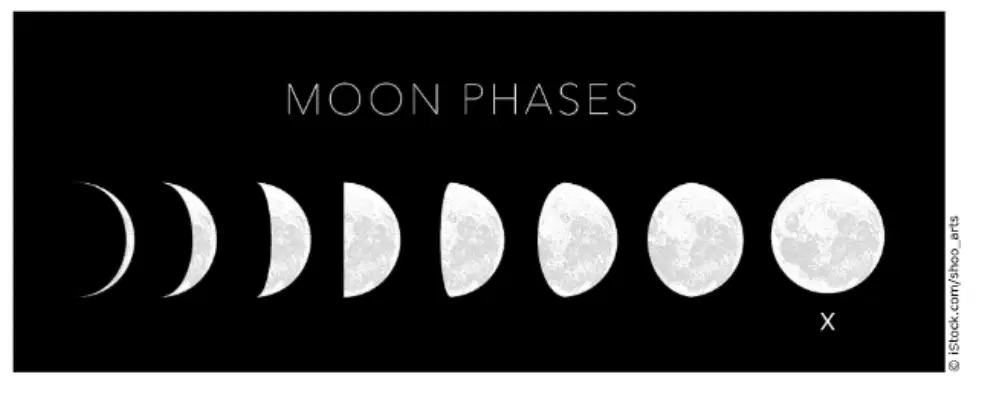
The diagram of some lunar phases is shown. Based on the diagram, which lunar phase will occur directly after X?


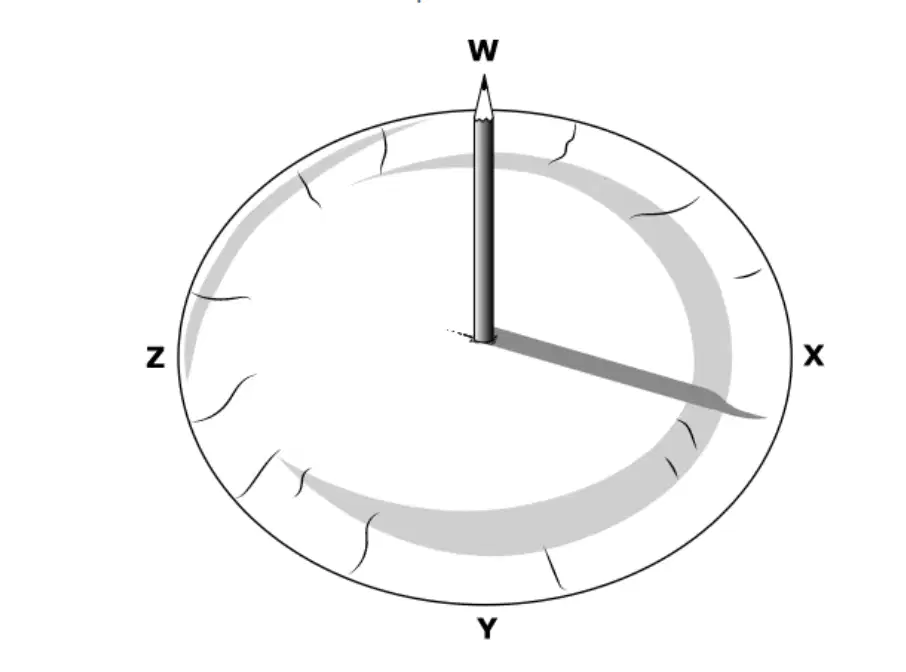
A student make a sundial. The student takes a picture of the sundial at 3:30 pm. Based on the student's sundial, which letter is closest to the position of the sun when the picture was taken?
W
X
Y
Z

The table list some traits of three plants. ALL the plants listed in the tavle are MOST LIKELY adapted to which enviroment?
swamp
artic
desert
forest
Which sentences describes the interaction of a white-tailed deer with both living and nonliving parts of its ecosystem?
The white-tailed deer hides behind a rock and uses the heart from the the sun to stay warm
The white-tailed deer protects its fawn from predator and shows the fawn how to find food
the white-tailed deer rubs its antlers on a tree and eats leaves from the tree.
the white-tailed deer eats grass and drink water from a pond
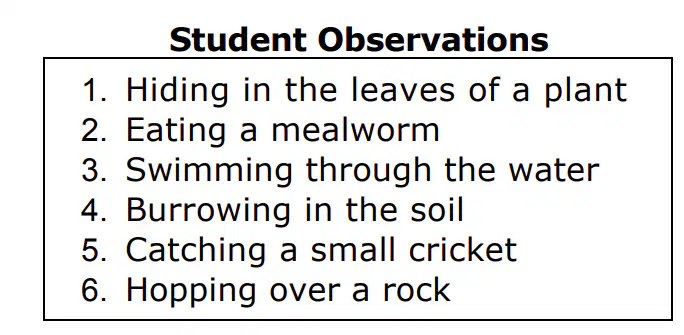
Mrs. Moreno uses an aquarium to make a habitat for a frog. A list of students observation of the frog is shown. Which student observation show the frog interacting with nonliving elements in its environment.
1 and 4
3 and 6
2 and 5
6 and 1
Axis deer are invasive species of deer found in Texas. Axis deer eat grasses, flowers, and shrubs. Their diet are often the same as those of other animals native to Texas. Based on this information, how do axis deer most likely affect Texas ecosystem?
they cause populations to native plants to incerease
they overgraze the land, which causes soil erosion to increase.
They cause the predators of native animas to move to a new location
they increase the availability of food
Resercher fround seashells fossils, including those from mollusks and coral, in a rock formation high in the rocky mountains. Which statement BEST explains why seashell fossils can be found on some mountains?
the rocks formed under water
rivers carried the rocks up the mountains
the area was a sand dune that hardened as it was covered by water
the mountains split to form canyons that contained organism with shells.
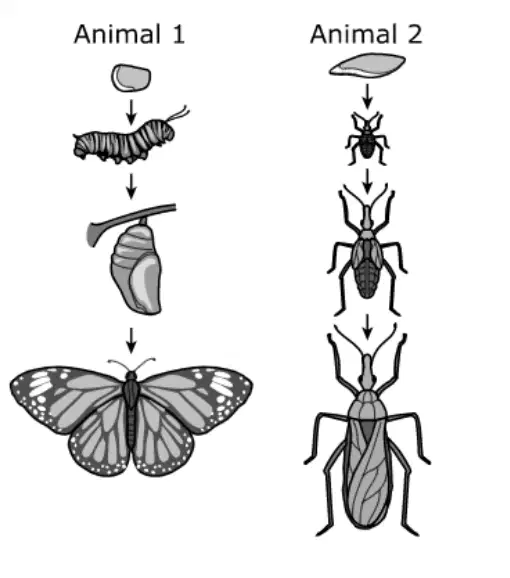
the life stages of two animals are shown. Which statement BEST describes a stage in the animals developmnet?
Animal 1 changes form to become an adult
both animals look like the adult while growing
animal 2 reaches adulthood in a shorter period of time
both animals have young that live in similar habitat.

the table shows characteristics of two different types of birds that live in similar forest environments. which statement explains an advantage of a bone in the macaw's tongue that the tongue that the hornbill does NOT need?
It helps macaws catch and chew small mammals and crustaceans.
it helps macaws break open and eat tropical fruits and nuts
it helps macaws make large holes in tress to reach insects to eat
it helps macaws swallow whole prey
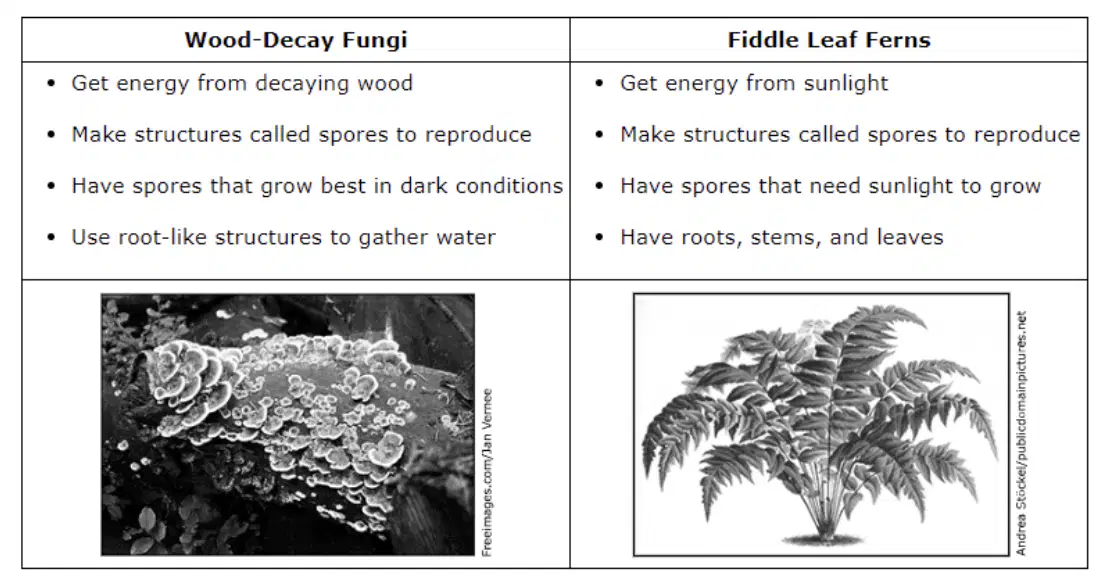
The tallest trees in a rainforest are removed for lumber. this increases the moun of light on the forest floor. the table shows information about fungi and ferns that grow on the forest floor. which tatment explains why one organims is better adapted to the removal of the tall trees?
the fungi are better adapted becuse they have spores that grow better in the dark
the ferns are better adapted because they have strong root systems.
the fungi are better adapted because they can get energy from decaying trees.
the ferns are better adapted because they get energy from the sun
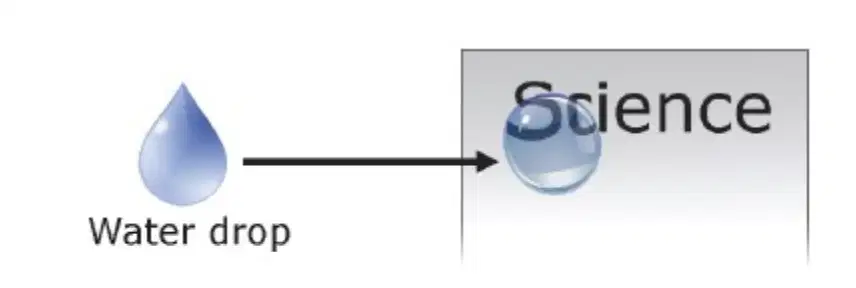
Julian was reading outside when a drop of water landed on his book. The letters of the book’s title look bigger through the drop of water because the drop of water —
refracts light
absorbs light
reflects light
blocks light
Which statement best describes what happens when water and lemon juice are combined?
A mixture is made because lemon juice is more dense than water.
A solution is made because lemon juice is less dense than water.
A mixture is made because lemon juice is not soluble in water.
A solution is made because lemon juice is soluble in water.

Students conducted an investigation to determine which substances maintain their physical properties when combined with other substances.
The substances maintained their physical properties in —
Test 1 and Test 2
Test 2 and Test 3
Test 2 and Test 4
Test 3 and Test 4
Which illustration shows a closed circuit?


While visiting the beach, Evelyn collected sand and water in a bottle. She shook the bottle for several seconds and then left it upright until the next day. Considering the density of sand, which picture correctly shows how the bottle will look the next day?


A fifth grade student designed an experiment to test the effect that friction has on a ball. The diagram shows how far the same ball travels when it is released from the top of a ramp on three different surfaces: glass, wood, and sand. Based on the diagram, which statement correctly explains the results of the experiment?
The glass surface had the least friction because the ball traveled the farthest distance.
The wood surface had no friction because the ball traveled half the distance.
The sand surface had the least friction because the ball traveled the shortest distance.
Each surface had the same amount of friction.
Which are the steps that formed the oil and natural gas?
lava created heat and pressure over millions of years which formed oil and natural gas
What items use electrical energy to produce BOTH light and sound energy. Select THREE correct responses.
fan
Computer
Alarm clock
TV
In which stage of the water cycle does liquid water change into water vapor?
Condensation
Precipitation
Freezing
Evaporation
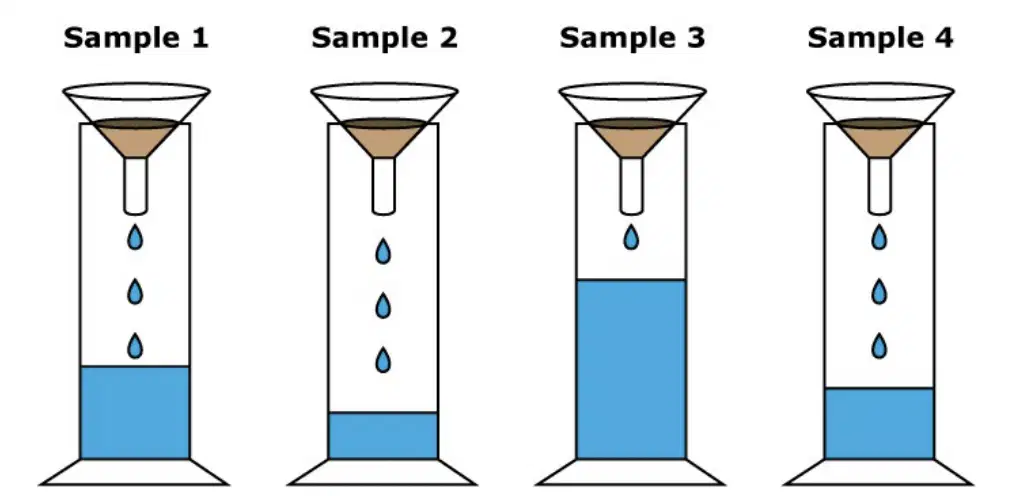
Four samples of different soils are placed in a funnel. The same amount of water is poured over each sample. Miguel needs to put the samples in order based on their ability to retain water the least amount of water to the most amount of water?
Sample 2
Sample 4
Sample 1
Sample 3
Sample 3
Sample 1
Sample 4
Sample 2
sample 1
sample 2
sample 3
sample 4
sample 2
sample 4
sample 3
sample 1
The kinds of data that reflect climate are different from the conditions described in weather data. Which of the following is a description of climate?
Today it is hot and sunny in Phoenix, Arizona.
Summers are usually mild in Lansing, Michigan.
Last week it rained every day in San Antonio, Texas.

The table shows some weather data collected over a five-day period. What pattern over the five days can be observed in the collected data?
There was more rain on the warmer days.
There were fewer clouds as the week went on.
Rain came along with lower temperatures.
Weather and climate data are different. Which of the following is a description of weather data?
The average daytime high in the Amazon is 25C.
Temperatures in the Arctic are usually below freezing.
It rained two inches in Miami, Florida on May 5th.

The map shows the weather for Texas on Monday, October 15, 2012. Before the front passed through Houston on Sunday, the high temperature was 14C. Which of the following is the most reasonable prediction for the high temperature on Monday, after the front has passed?
8°c
14°c
20°c
Climate data is not the same as weather data. Which of the following is a description of climate data?
New York had a record rainfall on Wednesday.
The coast of Antarctica has very short summers.
Winds are currently from the south in Ann Arbor, Michigan.
Most evaportation in the water cycle happens from oceans. This is because oceans-
expose the most water to the Suns energy
contains water with salt dissolved in it
have currents that constantly mix them
Suns heat causes which of the following movements of water in the water cycle?
Rivers flowing down mountains
Evaporation from oceans
Precipitation form clouds

The diagram shows the water cycle.Which labeled part shows precipitation?
A
B
C

Students are conducting an investigation using four bowls containing water and salt to represent the ocean.Where did the most evaporation occur?
Sunny window sill
Outside in shade
Outside in direct sunlight

Students built a model of the water cycle by putting water in the bottom of a plastic bottle and then shining a lamp on it. What part of the model represents the Sun’s energy?
Lamp shining on bottle
Tiny droplets forming at top of bottle
Drops running down the side of bottle
Day and night on the Earth are caused by -
the orbit of the Moon around the Earth
the rotation of the Sun on it axis
the rotation of the Earth on its axis
Which of the following occurs on a daily basis?
The Earth rotates once on its axis
The Earth revolves once around the Sun
The Moon rotates once on its axis

A student observed the Sun throughout the day over the neighbor’s house. The change the student observed is caused by -
orbit of Earth around the Sun
rotation of Earth on its axis
orbit of the Sun through space

The diagram here illustrates Earth rotating as well as the Sun’s light illuminating Earth. According to the diagram above, which point on Earth is about to experience sunset?
A
B
C
About how many hours are there between one sunrise and the next?
8
12
24
Which of the following is a characteristic of both the Earth and the Moon?
Atmosphere containing oxygen
Rocky surface covered with landforms
Flowing water in oceans and rivers
The Sun and the Earth share some similarities, including their –
size
shape
temperature
Among the Earth, Sun, and Moon, what makes the Earth unique? Only the Earth –
can generate energy
can generate energy
contains water in liquid form
What characteristic do the Earth and Moon share that makes them different from the Sun?
Spherical shape
Rotate on an axis
Rocky crust and surface

A student created a diagram to compare the characteristics of the Earth and the Moon. Which of the following characteristics could be placed in the center part of the diagram?
Orbits another object
Strong gravitational pull
Rotates every 24 hours
A student recorded the time it took for all the water in a puddle on a sidewalk to evaporate after a rain. Which kind of energy causes water to evaporate?
Light energy from streetlights
Sound energy from passing cars
Thermal energy from the environment
Mechanical energy from nearby streets
Earth continuously rotates on its axis while also moving in an orbit. About how much time does it take for Earth to make one complete rotation on its axis?
24 hours
30 days
60 minutes
365 days
For a class demonstration a student turned off the lights in the classroom. The student then shined light from a flashlight through a hole in a piece of cardboard. The class saw the narrow beam of light continue until another student placed a mirror in the light’s path. The light did not continue past the mirror because —
light cannot travel very far
the mirror absorbed all the light
the light was refracted back to the light source
light travels in a straight line and cannot go around objects

A table of different properties of four samples of matter is shown.
Which conclusion can be made about the samples based on the table?
Sample 1 is made of plastic.
Sample 2 is made of metal.
Sample 3 is attracted to magnets.
Sample 4 is less dense than water.

A wagon is pushed and begins to move. As the wagon moves, it slows and comes to a stop. The wagon and the direction it is pushed are shown. What force causes the wagon to stop?
The force of gravity which is acting in the same direction as the arrow
The force of friction which is acting in the same direction as the arrow
The force of gravity which is acting in the opposite direction of the arrow
The force of friction which is acting in the opposite direction of the arrow

Students made a chart classifying animal behaviors. Which animal behavior is NOT correctly classified?
Bear looking for food in a trash can
Owl being active at night
Dog coming when its name is called
Squirrel getting seeds from a bird feeder
Canyons and mesas are two landforms found in the western part of the United States. Which statement best describes how canyons and mesas are similar?
Both were formed by slow-moving glaciers.
Both were formed by erosion by wind and water.
Both were part of a mountain that was weathered by ice.
Both were part of a desert that was reshaped by a flood.

A student wants to make a change to the circuit shown below so that when Switch 1 is open and Switch 2 is closed, only one light will be on in the circuit.
Which diagram shows how the student should change the circuit?


Students researching the relationships between some organisms in the Lavaca Bay ecosystem in Texas made this partial food web.
Which of these lists contains only organisms that receive some of their energy directly from other organisms that produce their own food?
Bald eagles and spotted sandpipers
Swamp rabbits, hermit crabs, and swamp sparrows
Phytoplankton, hermit crabs, and blue crabs
Wiregrass, clover grass, and phytoplankton

A science class is observing a pet turtle in a small plastic pool. The students turn on a portable camping lamp that is clamped on to a counter next to the pool.
Which kind of energy is used by the portable lamp to produce light?
Mechanical energy, because the lamp is clamped on to the counte
Thermal energy, because the lamp increases the temperature of the water
Electrical energy, because the lamp is battery-operated
Sound energy, because the lamp vibrates when clicked on

