Worksheets
GMAS Review-Unit 3-Waves
Total questions: 50
Worksheet time: 36mins

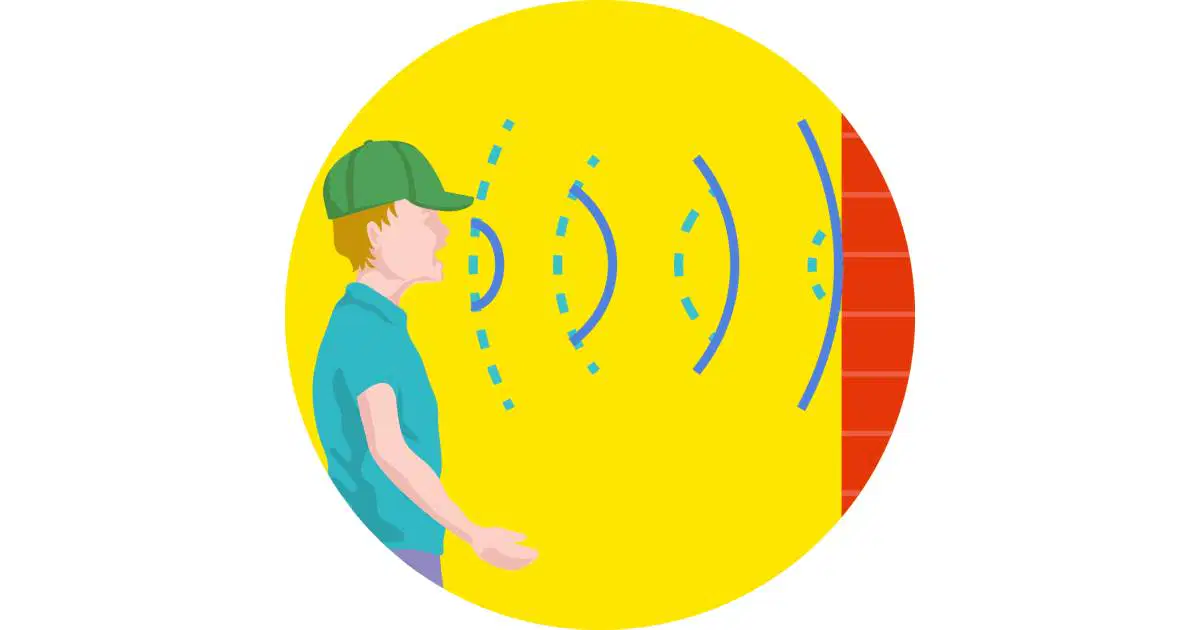
An echo is created from what wave behavior?
reflection
refraction
diffraction
absorption
In which medium will sound travel fastest?
salt water
fresh water
metal
air
To what is amplitude related?
the loudness of a sound
the amount of energy carried by a wave
both of these

This bicycle appears red because _?_
Density of Various Materials
Substance Density (gram per cubic centimeter)
Ice 0.897
Glass 2.6
Sapphire 3.99
The data in the table show the densities of different materials. Predict which property of a wave will be most impacted by the different densities shown in the table.
the speed
the amplitude
the wavelength
the distance from the sound source

Rectangles 1-5 are color gradients from white (first rectangle) to black (fifth rectangle). Which rectangle would absorb the most light?
rectangle 1
rectangle2
rectangle 3
rectangle 4
rectangle 5
Waves are rhythmic disturbances that carry ______through matter or space without transferring matter
Which statement is true for both electromagnetic waves and sound waves? Choose 2 answers.
Both carry energy.
Both are longitudinal waves.
Both are transverse waves.
Both can refract.
Both need a medium to travel through.

Sound waves require a solid, liquid, or gas to travel through because sound waves need
a vacuum to travel through
a specific temperature in order to be heard
molecules to bump into each other
to be under constant pressure
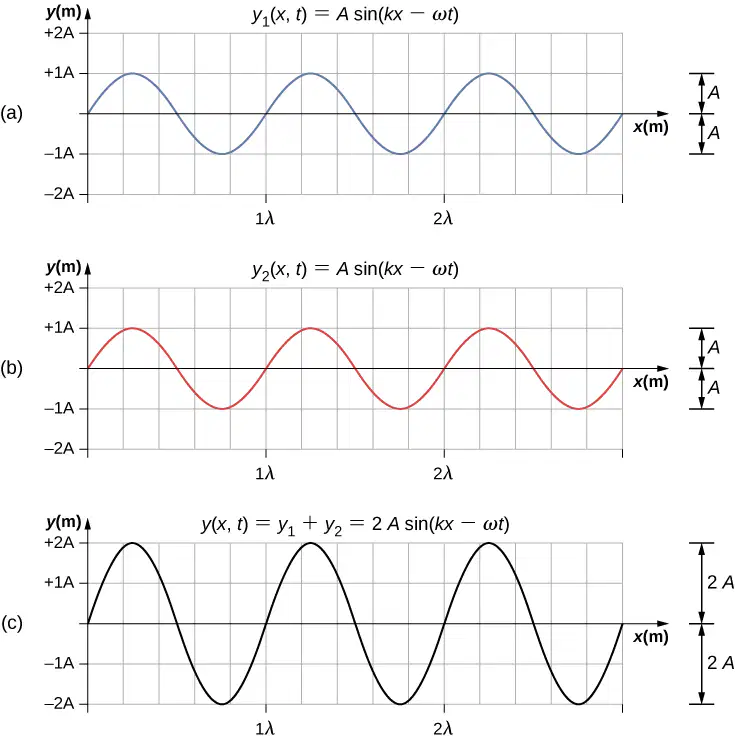
Choose the statement that is true about Wave B (red) and Wave C (black)
Wave B has twice the energy because it has a frequency twice as large.
Wave B has twice the energy because it has an amplitude twice as large.
Wave C has twice the energy because it has an amplitude twice as large.
Waves B and C gave the same energy because they have the same amplitude.

Which type of interaction is this?
reflection
refraction
diffraction
interference
If you were to hit a steel railroad track with a hammer, which bar graph below would represent the speed sound in the track versus the air?

Transverse

Longitudinal


Which wave behavior shown represents diffraction?
A.
B.
C.
D.

Which part of the diagram represents the path of a reflected light ray?
A.
B.
Light Bulb
Air


What is the value of X?
incident ray
reflected ray
45°
cannot be determined
In longitudinal waves, how is the displacement of the medium oriented relative to the wave's propagation?
Perpendicular
Parallel
At a 45-degree angle
In a random direction
A sound wave is an example of a _____ wave.
longitudinal
compressional
transverse
longitudinal & compressional
transverse & longitudinal
The visible light spectrum ranges between ____ and ____ waves.
television; radio
ultraviolet; gamma
infrared ; ultraviolet
radar ; X-rays
In which medium will sound travel fastest?
salt water
fresh water
metal
air

Which one refracts & diverges light rays?
A
B

Which one refracts and converges light rays?
A
B

Which one is used to correct nearsighted vision?
A
B

Which one is used to correct farsighted vision?
A
B

In which direction is frequency increasing?
from visible light ot microwaves
from ultraviolet to infrared
from radio waves to gamma rays
from gamma rays to radio waves

How would the model be different for a sound wave that is being transmitted through the same substance?
The wavy arrows representing sound waves would have a smaller wavelength.
The wavy arrows representing sound waves would go in the opposite direction.
The atoms in the model would move parallel to the direction of the incoming wave.
The atoms in the model would move perpendicular to the direction of the incoming wave.

The BEST question for the student to ask to determine whether the electromagnetic wave modeled will cause damage to the retina is ?
What is the vertical distance between point X and point Y on the model?
What is the vertical distance between point W and point Z on the model?
What is the horizontal distance between point W and point Z on the model?
What is the horizontal distance between point X and point Z on the model?

Which material will a sound wave MOST LIKELY travel at the GREATEST speed?
Material W
Material X
Material Y
Material Z
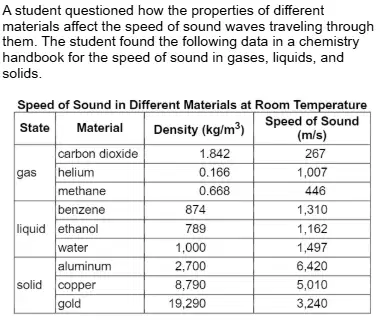
Which 2 predictions can be made based on the data shown in the table?
The speed of sound generally increases as it moves from gases to liquids to solids.
The speed of sound generally increases as it moves from solids to liquids to gases.
As the density of liquids and solids increases, the speed of sound generally increases.
As the density of gases and liquids increases, the speed of sound generally decreases.
As the density of solids and gases increases, the speed of sound generally decreases.
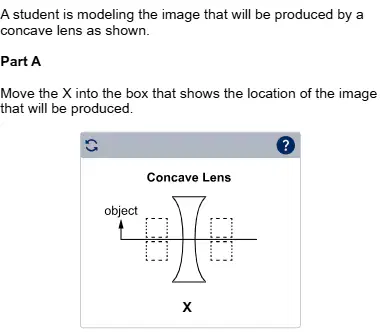
There are 4 boxes where the X can be placed. Where would the location of the X be placed to show where the image will be produced?
Box at the top left before the lens
Box at the bottom left before the lens
Box at the top right after the lens
Box at the bottom right after the lens
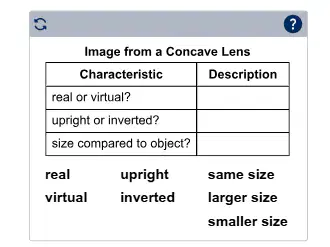
Which sequences of answers would answer the Description column from top to bottom?
real
inverted
larger size
virtual
upright
smaller size
real
upright
larger size
virtual
inverted
smaller size

These are 3 wave model diagrams. What would be the correct sequence of wave behaviors from left to right?
reflection
refraction
diffraction
refraction
diffraction
absorption
absorption
reflection
refraction
diffraction
refraction
reflection

Which wave model diagram would produce an echo?
1st diagram
2nd diagram
3rd diagram
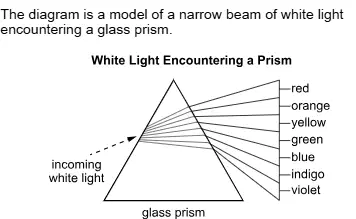
When white light enters and leaves the prism, its path is changed because the light is _?_ at the boundary between the glass and the air.
absorbed
diffracted
reflected
refracted
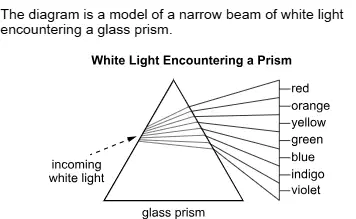
Prisms bend or refract white light, producing the colors of the rainbow we can see. The different colors are seen because each color of light that emerges from the prism has a different _?_.
amplitude
intensity
speed
wavelength

Which diagram below shows the student's correctly completed model?


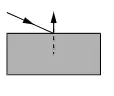
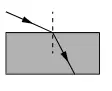

Which TWO questions should the student ask about each wave to help identify the types of waves shown in the model?
Can the wave affect life on Earth?
Does the wave have a repeating pattern?
Is the wave a transverse or a longitudinal wave?
Is energy carried through the wave as it travels?
Does the wave need to travel through a medium?
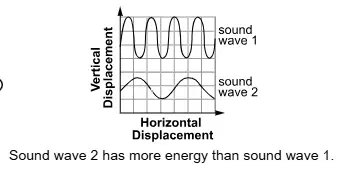
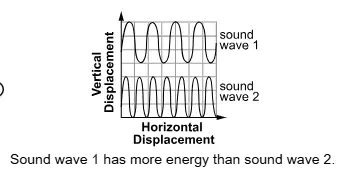
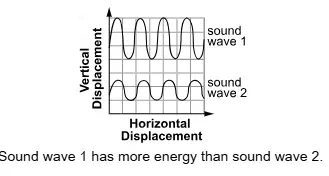
A student is modeling two different sound waves. The student determines that sound wave 2 has only half the amplitude of sound wave 1. Which model shows this difference in amplitude and describes how the energy of each wave is affected by this difference?