
Font size
 Worksheets
AWS Cloud Practitioner (CLF-CO2) (DataCamp - Quizzes)
Total questions: 75
Worksheet time: 43mins
Cloud computing is becoming increasingly important in today's world, helping businesses, governments, and individuals have quick access to virtual goods and services.
How does cloud computing create value in our daily lives?
It provides quick access to digital services.
It allows users to avoid data privacy concerns.
It completely removes the need for all on-premise infrastructure.
It ensures offline access to virtual resources.

Four companies are growing rapidly and need a scalable cloud solution to handle fluctuating demand. Each company has different needs. Your task is to determine which one would benefit the most from a highly scalable cloud infrastructure.
Which one would benefit the most from a highly scalable cloud infrastructure?
ShopEase
Streamly
MediSecure
CodeSync
Ever wonder how new apps, websites, and online companies are popping up daily? Cloud computing is the answer.
People are able to quickly start businesses, sell goods, and services from all over the world nearly instantly.
Which cloud computing advantage helps to best aid in this first-to-market success?
Scalability
Cost
Speed
Security
TechWorks Inc. is a growing e-commerce company that experiences major traffic spikes during holiday sales. Their on-premise servers struggle to handle sudden surges, leading to slow website performance and frustrated customers. They are considering switching to cloud computing to take advantage of scalability, reliability, and cost savings.
Which cloud computing benefit would best help TechWorks Inc. manage its fluctuating demand?
On-premise data replication, reducing downtime but keeping infrastructure costs high.
Manual scaling, requiring IT staff to adjust resources as needed.
Fixed infrastructure, ensuring consistent server performance year-round.
Virtualization, allowing better resource efficiency and cost savings.
Josh manages a team of developers who build custom applications. Instead of upgrading physical servers and equipment, Josh wants to provide his team with a scalable cloud-based solution that offers infrastructure, storage, and networking but still allows the team full control over building and managing applications.
Which cloud service model would best meet Josh’s needs?
PaaS
SaaS
IaaS
FaaS

Jorge is looking for a company to help manage their business operations with minimal setup and maintenance. They want a solution that provides ready-to-use software to handle inventory, orders, and payments without the need to build or manage any custom infrastructure.
Which company would best meet Jorge’s needs for a SaaS solution?
CodeFlow Inc.
DataWare Corp.
TrackIt Solutions
QuickPay Services
In terms of cloud deployment models, the private model and the public model are on the opposite ends of the spectrum. Therefore, it's crucial to understand the difference between the two. If you know the strengths and drawbacks of each, then you can better decide on the best deployment model for a given use-case, even if it's something in between like the hybrid, community, or multicloud model!
Which of the following is classified as Private Model?
Can get direct access to all the data centers.
Provides an organization with exclusive use of infrastructure.
In cloud bursting, overflow traffic is sent to this model.
Usually has the least upfront time investment.
In terms of cloud deployment models, the private model and the public model are on the opposite ends of the spectrum. Therefore, it's crucial to understand the difference between the two. If you know the strengths and drawbacks of each, then you can better decide on the best deployment model for a given use-case, even if it's something in between like the hybrid, community, or multicloud model!
Which of the following is classified as Public Model?
Can get direct access to all the data centers.
Provides an organization with exclusive use of infrastructure.
In cloud bursting, overflow traffic is sent to this model.
Usually has the least upfront time investment.
Below are four statements each describing a deployment model and a use-case.
Select the statement that does not describe an appropriate use-case for a given model.
Community model: Three different university hospitals have partnered on a research study requiring sensitive patient data.
Public model: A young startup wants to get their app live right away at the lowest cost possible and with the ability to scale.
Hybrid model: Different government agencies need access to tax data.
Multicloud model: A freelance data scientist needs to use services from different cloud providers depending on their clients' needs.
GDPR has regulations on how long data can be stored. Below is an excerpt from the European Commission describing this regulation:
Data must be stored for the shortest time possible. That period should take into account the reasons why your company/organization needs to process the data, as well as any legal obligations to keep the data for a fixed period of time (for example national labour, tax or anti-fraud laws requiring you to keep personal data about your employees for a defined period, product warranty duration, etc.).
Your company/organization should establish time limits to erase or review the data stored.
How could this rule affect a company using cloud computing?
If copies of European user data exist on multiple data centers, including disaster recovery backups, companies need to have a robust protocol for making sure every copy is deleted once the time limit elapses.
Companies could store European user data outside of European Union borders to avoid having to delete data.
Any hardware in data centers holding data that needs to be deleted will have to be physically destroyed, thereby increasing maintenance and hardware costs.
In the video, we saw a list of data protection regulations around the world. To understand these regulations properly, you need to understand personal data. As a reminder, this is how GDPR defines personal data:
Personal data is any information that relates to an identified or identifiable living individual. Different pieces of information, which collected together can lead to the identification of a particular person, also constitute personal data.
Decide whether each type of data cannot be labelled as personal data.

In 2017, Microsoft released a "Cloud Skills Report" where they surveyed 250 technical leaders in the UK who are actively involved in recruitment and technical evaluation.
Below is a plot from the report which splits responses between medium sized organizations (250-999 employees) and large-sized organizations (1000+ employees):
What does this plot indicate about cloud skills?
More than 80% of respondents believe that the right cloud skills will be important or critical to their organization's digital transformation.
Many organizations don't realize the importance of cloud skills yet.
Organizations are struggling to fill their cloud skills gap.
The rise of cloud computing has brought on a new wave of technology roles. In this exercise, each responsibility belongs to a role.
Select all statements that matches Cloud Architect.
Solutions architect of the cloud.
Design cloud infrastructure based on business requirements.
Ensure reliability, availability, and scalability through automation.
Maintain infrastructure through code.
Ensure data privacy of users and the organization is protected.
The rise of cloud computing has brought on a new wave of technology roles. In this exercise, each responsibility belongs to a role.
Select all statements that matches Security Engineer.
Solutions architect of the cloud.
Spec out technical security requirements based on regulations and business requirements.
Ensure reliability, availability, and scalability through automation.
Maintain infrastructure through code.
Ensure data privacy of users and the organization is protected.
The rise of cloud computing has brought on a new wave of technology roles. In this exercise, each responsibility belongs to a role.
Select all statements that matches DevOps Engineer.
Solutions architect of the cloud.
Spec out technical security requirements based on regulations and business requirements.
Ensure reliability, availability, and scalability through automation.
Maintain infrastructure through code.
Ensure data privacy of users and the organization is protected.
Which three cloud services make up the big three?
Amazon Web Services
Oracle Cloud
Microsoft Azure
IBM Cloud
Google Cloud
Cloud vendor lock-in is a situation in which a customer using a cloud service cannot easily transition to a competitor's product or service.
What are things a company can do to avoid vendor lock-in?
Implement a multi-cloud and/or hybrid cloud strategy.
Invest in open standards and technologies.
Don't sign long-term contracts and negotiate flexibility into contracts.
All of the above are good strategies for avoiding vendor lock-in.
You have been introduced to a range of key cloud services offered by AWS to enterprises and professionals.
Which of the following is Not a cloud service offered by AWS?
Simple Storage Service (S3)
Kinesis
BigQuery
Redshift
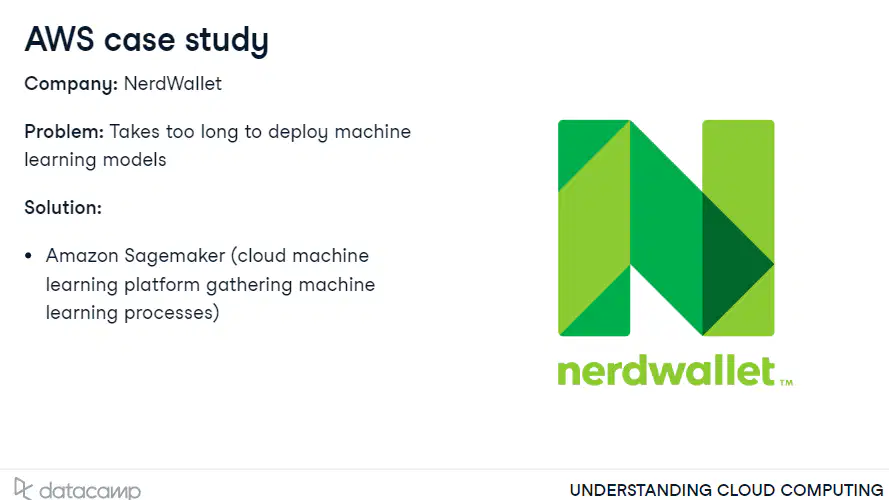
What was the outcome of NerdWallet's move to Amazon SageMaker?
It now costs them more to train machine learning models.
Models now take days to train instead of months.
Customer data is now much more secure.
Microsoft Azure offers customers more than 200 products and services across different areas of interest, such as security, migration, and Internet of Things. We have covered some of the key cloud services.
But which services would you need for your Data Science and Analytics tasks? Select all that apply.
Azure Machine Learning
Azure Stream Analytics
Azure Data Lake
Azure SQL Database
Microsoft Azure offers customers more than 200 products and services across different areas of interest, such as security, migration, and Internet of Things. We have covered some of the key cloud services.
But which services would you use for Data Storage? Select all that apply.
Azure Machine Learning
Azure Stream Analytics
Azure Data Lake
Azure SQL Database
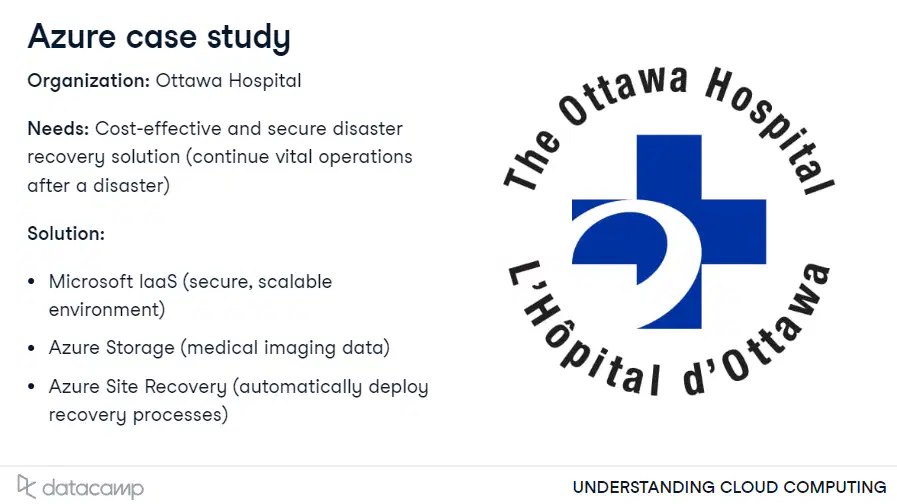
Why did Ottawa Hospital decide to use Microsoft Azure Site Recovery?
They wanted to decrease the time it takes for image recognition models to identify tumors on medical imaging.
They wanted to decrease storage costs.
They needed a reliable solution to protect their data and essential operations during a disaster.
Canadian regulations required them to move their data to the cloud.
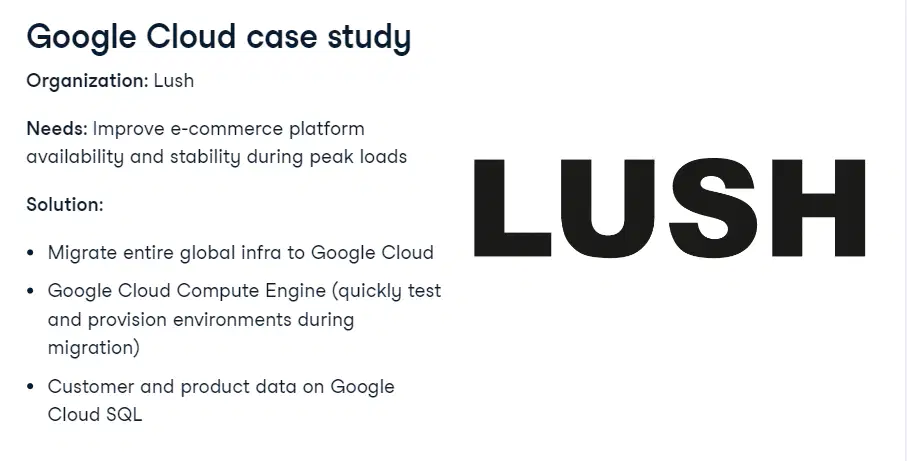
The international cosmetics company Lush migrated their entire infrastructure to Google Cloud.
What was the expected outcome?
Lush wanted to build a recommendation engine to help buyers choose the right product based on their previous purchases, allergies, etc.
Lush wanted to reduce packaging by becoming an online-only retailer.
Lush wanted to improve the scalability and availability of their e-commerce platform when traffic increases.
You've learned about the services offered by the three cloud infrastructure market leaders. Let's see how well you understand their positioning.
Classify statements that are true.
Microsoft Azure provides integration with other Microsoft products such as the Office Suite or SQL Server.
Amazon Web Services offers a breadth of cloud solutions for a lot of different areas.
Compute Engine, Big Query, Blob Storage, and SageMaker are all AWS Services.
Microsoft was the first mover on the cloud infrastructure market.
Google Cloud has a service to allow customers to manage and deploy workloads.
Throughout this chapter, you looked into the cloud infrastructure services offered by Amazon, Microsoft, and Google.
Let's see how well you understand their respective solutions.
Select all services that classify as file storage.
Amazon S3
Amazon EC2
Azure Virtual Machines
Amazon Redshift
Azure file storage
Throughout this chapter, you looked into the cloud infrastructure services offered by Amazon, Microsoft, and Google.
Let's see how well you understand their respective solutions.
Select all services that classify as computation.
Google BigQuery
Amazon EC2
Azure Virtual Machines
Amazon Redshift
Azure file storage
Throughout this chapter, you looked into the cloud infrastructure services offered by Amazon, Microsoft, and Google.
Let's see how well you understand their respective solutions.
Select all services that classify as databases solutions.
Google BigQuery
Amazon EC2
Azure Virtual Machines
Amazon Redshift
Azure file storage
Using the AWS Management Console and navigating to the Dashboard section of EC2 service, under the Resources widget, there are multiple services available.
Which service is not included in the list?
Key Pairs
Elastic IPs
Instances
AWS Billing
You work for a startup that is rapidly expanding its services globally. The company is considering migrating to the AWS Cloud to support this growth. You are tasked with classifying key benefits of AWS to help the team understand why this move could be advantageous.
Classify which statements fall under Cost Efficiency.
Lower upfront costs.
High Availability across multiple regions.
Global network of data centers.
Pay-as-you-go pricing
Elasticity to scale up or down.
You work for a startup that is rapidly expanding its services globally. The company is considering migrating to the AWS Cloud to support this growth. You are tasked with classifying key benefits of AWS to help the team understand why this move could be advantageous.
Classify which statements fall under Operational Flexibility.
Lower upfront costs.
High Availability across multiple regions.
Global network of data centers.
Pay-as-you-go pricing
Elasticity to scale up or down.
Which of the following services help you estimate costs and plan budgets?
S3
Billing and Cost Management
CloudFront
Which of the following best describes the "Pay for what you use" benefit of AWS?
You prepay for a fixed number of resources each month
You are charged based on your estimated usage for the year
You pay only for the individual services you consume, without long-term contracts
You pay a flat fee regardless of usage
Which of the following are benefits of economies of scale in AWS? (Select TWO)
Higher costs due to global distribution
Access to lower prices as usage increases
Shared infrastructure leading to cost savings
The need to build your own data center
How does AWS help eliminate guessing capacity needs?
It automatically charges you for the maximum possible capacity
It offers predictive analytics to help estimate resource usage
It allows you to provision resources as needed and scale up or down
It enforces a fixed resource allocation plan
Which of the following are advantages of AWS in terms of increased agility and speed? (Select TWO)
Launching new applications takes weeks to months
Rapid provisioning of resources speeds up innovation
Changes in infrastructure require extensive manual setup
Developers can experiment and iterate faster
Which AWS benefit is being used when a company quickly expands its application to users in Europe and Asia within hours?
Pay-as-you-go pricing
Increased agility and speed
Save money on datacenter
Go global in minutes
Which AWS Well-Architected Framework pillar focuses on protecting systems, information, and assets while delivering business value?
Operational Excellence
Reliability
Security
Performance Efficiency
Your company is planning to migrate a mission-critical application to AWS. The application must ensure data protection and compliance with regulations, maintain high availability, and optimize costs.
Select each statement that demonstrates whether it's a top-priority, or secondary priority in this scenario.
Reliability
Operational Excellence
Performance Efficiency
Security
Cost Optimization
Which AWS Well-Architected pillar focuses on protecting data, systems, and assets through risk assessments and mitigation strategies?
Cost Optimization
Operational Excellence
Security
Reliability
Which of the following are best practices under the Cost Optimization pillar? (Select TWO)
Right-sizing resources
Using Spot Instances where appropriate
Encrypting data at rest
Deploying across multiple Availability Zones
Which pillar of the Well-Architected Framework encourages experimenting with new types of instances and using serverless architectures?
Reliability
Performance Efficiency
Security
Operational Excellence
Which principles are associated with the Operational Excellence pillar? (Select TWO)
Perform operations as code
Make frequent, small, reversible changes
Always use the most powerful hardware
Avoid documenting operational procedures
Which AWS Well-Architected pillar is concerned with minimizing environmental impacts and improving long-term efficiency?
Cost Optimization
Operational Excellence
Reliability
Sustainability
Which practices help achieve Reliability in an AWS environment? (Select TWO)
Implementing automated recovery from failure
Keeping all infrastructure in a single AZ
Using AWS Auto Scaling and health checks
Manually deploying updates to avoid automation
Which of the following most aligns with the Sustainability pillar of the AWS Well-Architected Framework?
Increase performance by running the largest instance types
Optimize workloads to reduce total energy consumption
Encrypt all data to ensure compliance
Launch services only in your local Region
Which of the following actions align with the Performance Efficiency pillar? (Select TWO)
Using caching mechanisms such as Amazon CloudFront or ElastiCache
Avoiding automation
Adopting serverless technologies like AWS Lambda
Hard-coding resource limits
What is the primary goal of the Operational Excellence pillar?
Lowering costs through optimal resource usage
Running and monitoring systems to deliver business value and improve processes
Ensuring data is encrypted
Providing high availability through multi-region deployments
Which of the following reflect the goals of the Security pillar? (Select TWO)
Enable traceability using CloudTrail and CloudWatch
Apply least privilege access control
Replicate resources across multiple regions
Use the largest EC2 instances to prevent breaches
Your organization is preparing for cloud migration, and it's essential to classify strategies based on their alignment with the AWS Cloud Adoption Framework (AWS CAF). Your task is to evaluate different approaches and determine which align with AWS CAF principles.
You are presented with four different scenarios. Classify which are aligned with AWS CAF.
Leadership decides to use AWS CAF to guide the migration, starting with a detailed assessment across governance, people, and technology, followed by targeted training programs to upskill the team.
The organization decides to engage a third-party consultant for cloud migration, using AWS CAF as a guideline while ensuring internal teams are deeply involved in key decisions and processes.
The organization conducts an assessment of its existing IT infrastructure and decides to prioritize migrating applications that are easiest to move, with a plan to revisit more complex applications later.
The IT team focuses on redesigning key applications using cloud-native services and plans to manage governance and compliance after the migration is complete.
What is one of the primary benefits of using AWS Migration Hub in a cloud migration project?
It automatically moves data from on-premise systems to AWS.
It sets up AWS Snowball jobs for data transfer.
It tracks the status of migrations across multiple AWS services.
It calculates the cost of migration services.
Which of the following domains are part of the People perspective of the AWS Cloud Adoption Framework? (Select TWO)
Cloud Financial Management
Cloud Fluency
Platform Engineering
Change Acceleration
Which AWS CAF perspective primarily helps in defining and managing business strategies, driving innovation, and realizing financial benefits from data?
Platform
People
Business
Governance
Which of the following are benefits of adopting AWS CAF and implementing its guidance successfully? (Select TWO)
Reducing Risks
Increasing Revenue and Operational Efficiency
Lock-in to a single cloud provider
Replacing all traditional IT roles
Which AWS CAF perspective includes domains like Program & Project Management, Cloud Financial Management, and Data Governance?
Platform
Governance
Security
Operations
Which tools or services can support migration strategies aligned with AWS CAF principles? (Select TWO)
AWS Database Migration Service (DMS)
AWS Snowball
Amazon CloudFront
AWS Amplify

Your company owns several SQL Server licenses that are still valid and have active Software Assurance. Management wants to minimize costs during the migration to AWS, especially in terms of software licensing. The IT team is also exploring the benefits of leveraging flexibility and scalability of AWS.
What is the best licensing strategy for this scenario?
Included Licenses
Bring Your Own License (BYOL)
Subscription-Based Licensing
Pay-Per-Use Licensing
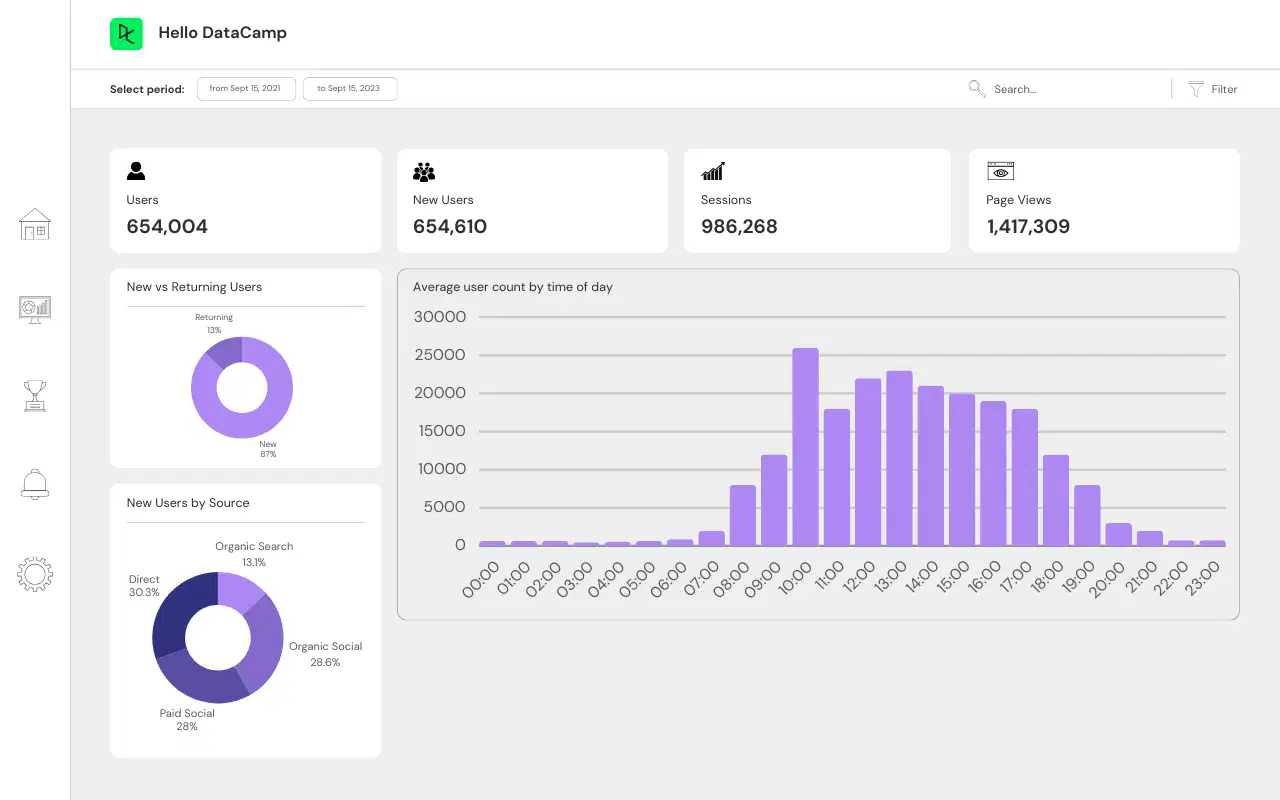
Your company has moved a web application to AWS. Here is a sample dashboard displaying the various levels of traffic throughout the day with peak usage during business hours and minimal usage overnight.
Which approach should you take to ensure cost efficiency through right-sizing?
Use fixed-size instances to handle peak traffic at all times.
Use auto-scaling to adjust the number and size of instances based on traffic patterns.
Use the largest instance available to avoid performance issues.
Use multiple small instances without considering traffic patterns.
Which of the following best describes the primary financial benefit of cloud computing under the concept of Cloud Economics?
Always having reserved infrastructure ready for future growth
Owning physical hardware to avoid rental fees
Paying only for what you use and reducing fixed IT costs
Setting a fixed monthly fee for all resources regardless of usage
Which of the following actions are aligned with right-sizing cloud resources? (Select TWO)
Adjusting instance sizes to match actual application usage
Monitoring workloads to optimize resource allocation
Overprovisioning infrastructure for rare traffic spikes
Committing to the largest instance types to prevent underperformance
In Cloud Economics, how are fixed costs different from variable costs?
Fixed costs change frequently, while variable costs stay constant
Fixed costs involve ongoing payments regardless of usage, while variable costs scale with demand
Fixed costs are always cheaper than variable costs
Variable costs require hardware ownership
What are key advantages of "Bring Your Own Licenses (BYOL)" on AWS? (Select TWO)
Reducing costs by using existing software investments
Avoiding the need to purchase new licenses when migrating
Enabling license-free environments
Replacing cloud-native tools with manual configuration
Which AWS services support the automation and cost efficiency principles of Cloud Economics? (Select TWO)
AWS Lambda (for serverless, pay-per-execution compute)
AWS RDS (managed database service that automates setup and scaling)
Amazon EC2 with manually installed software
AWS CloudFront for edge caching only
You are working as a network engineer for a mid-sized company that is migrating its on-premises data center to AWS. The company needs to securely connect its on-premises network to AWS. Additionally, they have mission-critical applications that demand a high-bandwidth, low-latency connection to ensure fast and reliable data transfer. Security and performance are the top priorities for this connection.
Which connectivity option should the company choose to securely connect its on-premises network to AWS?
AWS VPN
AWS Direct Connect
Public Internet
You are a cloud architect at a company that is expanding its cloud infrastructure. Your team has been tasked with deploying, managing, and monitoring various AWS resources, ranging from EC2 instances to S3 buckets. However, with so many tools available—APIs, SDKs, the AWS Management Console, and Infrastructure as code (IaC)—your team needs to decide which tool to use for each specific task.
Classify the statements that best matches AWS Management Console approach.
Quickly deploy a single EC2 instance for testing purposes.
Integrating AWS services with a third-party application.
Creating a Lambda function that triggers on S3 uploads.
Monitoring and visualizing the health of multiple AWS services.
Automatically scaling an application based on traffic.
You are a cloud architect at a company that is expanding its cloud infrastructure. Your team has been tasked with deploying, managing, and monitoring various AWS resources, ranging from EC2 instances to S3 buckets. However, with so many tools available—APIs, SDKs, the AWS Management Console, and Infrastructure as code (IaC)—your team needs to decide which tool to use for each specific task.
Classify the statements that best matches Programmatic Access approach.
Quickly deploy a single EC2 instance for testing purposes.
Integrating AWS services with a third-party application.
Creating a Lambda function that triggers on S3 uploads.
Monitoring and visualizing the health of multiple AWS services.
Automatically scaling an application based on traffic.

You are tasked with designing a highly available web application that serves global users. The application must minimize downtime and deliver content with low latency. Which approach best meets these requirements?
Deploy the application in a single AWS Region with resources spread across multiple Availability Zones.
Deploy the application only in edge locations around the world, without using AWS Regions or Availability Zones.
Deploy the application across multiple AWS Regions and use edge locations for content delivery.
In AWS CloudFront, which option would be least effective for a truly global audience that requires low latency?
Use All Edge Locations
Use only North America and Europe
Use North America, Europe, Asia, Middle East, and Africa
You are a solutions architect tasked with optimizing the infrastructure for various workloads in a cloud environment. Your goal is to determine whether a server-based or serverless approach is best suited for each scenario. Understanding when to use a server-based architecture versus serverless architecture is crucial for balancing performance, scalability, and cost-efficiency.
Classify each workload by selecting the most appropriate option: Server-based.
A long-running background processing job that requires full control over the underlying environment.
A high-performance database requiring fine-tuned configuration for a large, consistent workload.
A small event-driven function that runs in response to specific triggers, such as an image upload.
A legacy enterprise application that needs to be migrated to the cloud and requires persistent server instances.
A simple, stateless function that needs to be executed based on a schedule (e.g., cron jobs).
You are a solutions architect tasked with optimizing the infrastructure for various workloads in a cloud environment. Your goal is to determine whether a server-based or serverless approach is best suited for each scenario. Understanding when to use a server-based architecture versus serverless architecture is crucial for balancing performance, scalability, and cost-efficiency.
Classify each workload by selecting the most appropriate option: Serverless.
A long-running background processing job that requires full control over the underlying environment.
A high-performance database requiring fine-tuned configuration for a large, consistent workload.
A small event-driven function that runs in response to specific triggers, such as an image upload.
A legacy enterprise application that needs to be migrated to the cloud and requires persistent server instances.
A simple, stateless function that needs to be executed based on a schedule (e.g., cron jobs).
What is a key feature of AWS Lambda when it comes to scaling and managing serverless functions?
The function must be manually started every time it's needed.
You must configure the underlying servers for the function to run.
The function can only be triggered from the AWS Management Console.
The function automatically scales based on the number of incoming requests.
In this exercise, you will explore different types of databases offered by AWS. Understanding when to use relational databases, NoSQL databases, and memory-based databases is crucial for efficiently managing and querying various types of data.
Classify use cases into the appropriate database category: Relational Databases.
E-commerce transactions: High volume of structured data requiring complex queries.
Product catalog: Unstructured or semi-structured data that can scale easily.
Leaderboard data for a gaming app: Data that needs to be frequently updated and accessed in real-time.
Customer orders: Structured data requiring high availability.
Chat application messages: Real-time data requiring quick access and updates.
In this exercise, you will explore different types of databases offered by AWS. Understanding when to use relational databases, NoSQL databases, and memory-based databases is crucial for efficiently managing and querying various types of data.
Classify use cases into the appropriate database category: NoSQL Databases.
E-commerce transactions: High volume of structured data requiring complex queries.
Product catalog: Unstructured or semi-structured data that can scale easily.
Leaderboard data for a gaming app: Data that needs to be frequently updated and accessed in real-time.
Customer orders: Structured data requiring high availability.
Chat application messages: Real-time data requiring quick access and updates.
In this exercise, you will explore different types of databases offered by AWS. Understanding when to use relational databases, NoSQL databases, and memory-based databases is crucial for efficiently managing and querying various types of data.
Classify use cases into the appropriate database category: Memory-Based Databases.
E-commerce transactions: High volume of structured data requiring complex queries.
Product catalog: Unstructured or semi-structured data that can scale easily.
Leaderboard data for a gaming app: Data that needs to be frequently updated and accessed in real-time.
Customer orders: Structured data requiring high availability.
User-Session data: Data that needs to be accessed and updated frequently with low latency.
Your company needs to deploy a structured database for a new application. The database should be easy to manage and scale without worrying about the underlying infrastructure. Additionally, the application requires high availability and automatic backups. Which database solution should you choose?
EC2-hosted database
Amazon S3
Amazon RDS
DynamoDB

You are a Solutions Architect for a company transitioning its on-premises archival data storage to Amazon S3. The company stores a large volume of financial records that are rarely accessed but must be retained for regulatory purposes. When access is required, the data should be available within a few hours. The company is looking to minimize storage costs while ensuring that the data is highly durable and can be retrieved when needed.
Which Amazon S3 storage class would you recommend for storing these rarely accessed financial records to minimize cost while ensuring durability and retrieval within a few hours?
S3 Standard
S3 Standard-IA
S3 One Zone-IA
S3 Glacier

