
 Worksheets
Ultimate Math G7 Q4 Exam
Total questions: 213
Worksheet time: 3hrs 41mins
_____ is a branch of Mathematics that involves expressions with variables.
Algebra
algebraic expression
constants
variables
An _____ is a meaningful combination of numbers, letters, and arithmetic operations.
Algebra
algebraic expression
constants
variables
The numbers in an algebraic expression are called _____ while the letters are called _____.
In "x + 7", x is the _____, and 7 is the _____.
Algebra
algebraic expression
constants
variables
x + 7
sum
difference
product
quotient
x -3y
sum
difference
product
quotient
5(-7)
sum
difference
product
quotient
7/b-3
sum
difference
product
quotient
0, 1, 2, 3, 4, 5, 6, 7, 8, 9
Numerals
Letters or variables to represent unknown numbers
variable
replacement set
constant
x, y, z, a, b, ∅, ∆
Numerals
Letters or variables to represent unknown numbers
variable
replacement set
constant
A _____ is a symbol that represents any number from a given replacement set.
Numerals
Letters or variables to represent unknown numbers
variable
replacement set
constant
The t is the set of values of the variable
Numerals
Letters or variables to represent unknown numbers
variable
replacement set
constant
A _____ is a symbol that has exactly one number in its replacement set. Any numeral is a _____, such as 7, 4, and 11. Pi (𝜋) is also a _____. If m has a replacement set of {9}, then m is a _____.
Numerals
Letters or variables to represent unknown numbers
variable
replacement set
constant
There are many ways to express the addition, subtraction, multiplication, or division of algebraic expressions.
(a)
the sum of m and 8
(a)
10 added to c
(a)
7 plus a
(a)
5 more than t
(a)
q increased by p
(a)
11 greater than n
(a)
exceeds r by 20
(a)
the difference of 8 and m
(a)
10 subtracted from c
(a)
7 minus a
(a)
5 less than t
(a)
t decreased by p
(a)
9 take away d
(a)
18 reduced by n
(a)
• The multiplication sign (_) is seldom used in algebra since it could be mistaken for the letter x. Thus, if we wish to express the idea of eight times the number, we can do this in any of the following ways: 8 • n or 8(n) or 8n
(a)
For two numbers, parentheses are often preferred over a raised dot, which may be mistaken for a decimal. Thus, 8 × 4 is expressed as :
(a)
The division symbol (÷) is rarely used in algebra. More often, we use the fraction bar. Thus for a ÷ b, we write (a)
a^n, read as “a (a) to the n,” means a is multiplied by itself n times.
equals; is equal to; is
=
>
<
≠
is greater than; is more than
=
>
<
≠
is less than
=
>
<
≠
is not equal to
=
>
<
≠
is greater than or equal to
≥
≤
is less than or equal to
≥
≤
( ) as in 3(4x – y)
Parenthesis
Brackets
Braces
Bar
[ ] as in 4 – [3 + (x – 5)]
Parenthesis
Brackets
Braces
Bar
{ } as in x – {5 + [y – (3 + x)]}
Parenthesis
Brackets
Braces
Bar
_____ as in the fraction
4-7x
_____
y
Parenthesis
Brackets
Braces
Bar
11 – {12 – [4 – (8 + 9)] – 13}
(a)
7 + 11/4 + 7
(a)
a statement containing one or more terms connected by plus or minus signs
Algebraic expression
Constant
Factors
Literal factor
Algebraic term
a number, letter, or symbol whose value is fixed.
Algebraic expression
Constant
Factors
Literal factor
Algebraic term
the numbers and symbols in a product
Algebraic expression
Constant
Factors
Literal factor
Algebraic term
a letter used as a factor
Algebraic expression
Constant
Factors
Literal factor
Algebraic term
either a single number, a letter, or a product of several numbers or letters
Algebraic expression
Constant
Factors
Literal factor
Algebraic term
the number in an algebraic term
Numerical coefficient
Literal coefficient
Exponent
Base
a letter used to represent a number
Numerical coefficient
Literal coefficient
Exponent
Base
– a small number written to the right of and slightly above another number or letter to indicate how many times the latter is used as a factor.
Numerical coefficient
Literal coefficient
Exponent
Base
a number or letter to which an exponent refers
Numerical coefficient
Literal coefficient
Exponent
Base
the product of a number used two or more times as a factor
Power
Similar terms
– algebraic terms that have the same literal factors and in which each letter has the same exponent in all of the terms.
Power
Similar terms
Consider the algebraic expression: 7x^3 - 2y^2 + 14
1. How many terms are there?
(a)
Consider the algebraic expression: 7x^3 - 2y^2 + 14
2. What are the terms?
(a)
Consider the algebraic expression: 7x^3 - 2y^2 + 14
3. What is the constant term?
(a)
Consider the algebraic expression: 7x^3 - 2y^2 + 14
4. What is the literal coefficient of the first term?
(a)
Consider the algebraic expression: 7x^3 - 2y^2 + 14
5. What is the numerical coefficient of the second term?
(a)
A (a) is an algebraic expression that represents the sum of one or more terms containing whole number exponents on the variables.
For Example: 8ab^2c, 4x + 3, 5x^2 - 3x + 4, 5x + 2y - 3z
A polynomial with one term is called a _____.
monomial
binomial
trinomial
A polynomial with two terms is called a _____.
monomial
binomial
trinomial
A polynomial with three terms is called a _____.
monomial
binomial
trinomial
Look for plus or minus signs separating the terms. (Although we defined a polynomial as a sum of one or more terms, any one of those could be a negative term.)
First
Second
Third
Make sure that there are no variables in the denominator of any of the terms, nor any variable under the radical sign (√).
First
Second
Third
Count the number of terms and name the expressions accordingly.
First
Second
Third
x^2
Monomial
Binomial
Trinomial
x^2 + 2x + 1
Monomial
Binomial
Trinomial
2a^2b^3c
Monomial
Binomial
Trinomial
-p - 7
Monomial
Binomial
Trinomial
We can also classify polynomials using their degree. The _____ in one variable is the number of times that the variables occur as a factor in the monomial.
Term: Degree
-5a^3: 3
degree of a monomial
greatest
degree of a term
degree of a polynomial
lowest
The _____ with more than one variable is the total number of times its variable occur as factors.
Term: Degree
-5ab^2c^3:
1 + 2 + 3 = 6
degree of a monomial
greatest
degree of a term
degree of a polynomial
lowest
The degree of a polynomial is the _____ of the degrees of its terms.
For example, in the polynomial: a^2b + a^2b^2 - ab:
Term: Degree
a^2b: 2 + 1 = 3
a^2b^2: 2 + 2 =4
ab: 1 + 1 = 2
Thus, the degree of a2b + a2b 2 – ab is 4.
degree of a monomial
greatest
degree of a term
degree of a polynomial
lowest
The _____ that has only one variable is the exponent of that variable.
degree of a monomial
greatest
degree of a term
degree of a polynomial
lowest
The _____ that has only one variable is the highest power appearing in any of the terms.
degree of a monomial
greatest
degree of a term
degree of a polynomial
lowest
The _____ that has more than one variable is the sum of the exponents of the variables.
degree of a term
degree of a polynomial
The _____ in more than one variable is the highest sum of the exponents of the variables in any of the terms.
degree of a term
degree of a polynomial
Identify the degree of each polynomial.
10
(a)
Identify the degree of each polynomial.
x^2 + 1
(a)
Identify the degree of each polynomial.
2abc
(a)
Identify the degree of each polynomial.
-5x^2y^3 - 6xy + 3
(a)
5x^10y^5
(a)
Combing like terms, such as 3x and 2x, involves an important property of numbers called the _____. The _____ works in two directions:
1. To multiply 3 and (4+2) , apply the Distributive Property of Multiplication over Addition. 3(4+2) = 3 • 4 + 3•2 = 18
2. When used in reverse order, a common factor can be removed from the terms. 3 • 4 + 3 • 2 = 3(4 + 2) = 18
Distributive Property
Associative property
Commutative property
1. 7a^2 - 4a - 8a^2 -3a
(a)
2. 3x + x(5 - x) - 8x
(a)
6 − 4(5 − 8x)
(a)
7 + 4b^2 - 3 - 2b^2
(a)
-10k(-6k + 7) +8k
(a)
_____ - If two quantities are equal, then one quantity can be replaced by the other. In symbols: For all numbers a and b, if a = b, then a may be replaced by b.
Substitution Property of Equality
Substitution Property of Inequality
Substitution Property of Diversity
Substitution Property of Equity
When numbers are substituted for variable in a polynomial, the polynomial becomes a numerical value. Finding this value is called (a) .
There are at least two steps involved in evaluating an algebraic expression:
1. Replacing the variable by the given number value (substitution).
2. Performing the indicated arithmetic following the order of operations.
Recall that when dealing with the order of operations, we follow the GEMDAS Rule.
First, simplify expressions within _____.
grouping symbols
powers
products
quotients
Recall that when dealing with the order of operations, we follow the GEMDAS Rule.
Then, simplify t
grouping symbols
powers
products
quotients
Recall that when dealing with the order of operations, we follow the GEMDAS Rule.
Then simplify _____ and _____ in order from left to right
grouping symbols
powers
products
quotients
Recall that when dealing with the order of operations, we follow the GEMDAS Rule.
Then simplify _____ and _____ in order from left to right
(a)
Evaluate the polynomial 2𝑥^3 - 3x – 4 when:
x = -1
(a)
Evaluate the polynomial 2𝑥^3 - 3x – 4 when:
x = 0
(a)
Evaluate the polynomial 2𝑥^3 - 3x – 4 when:
x = 3
(a)
Evaluate each expression using the values a = 5, b = 8, and c = –3.
5a – 9
(a)
Evaluate each expression using the values a = 5, b = 8, and c = –3.
4b^2 + 2c
(a)
Evaluate each expression using the values a = 5, b = 8, and c = –3.
a + b/5c
(a)
Evaluate the expression 𝐛^𝟐 − 4ac for the given values of a, b, and c.
1. a = 1; b = −2; c = 3
(a)
Evaluate the expression 𝐛^𝟐 − 4ac for the given values of a, b, and c.
2. a = -3; b = 5; c = −2
(a)
Evaluate the expression 𝐛^𝟐 − 4ac for the given values of a, b, and c.
3. a = 0.4; b = −0.5; c = −6
(a)
It is a mathematical statement that shows two numbers or two expressions are equal.
In the equation x + 4 = 15, the expression x + 4 is called the left-hand side, and 15 is called the right-hand side of the equation.
Equations
Linear Equations
Root or solution
Equivalent equations
Identity
These equations may involve a polynomial in one variable of degree one. These equations may have one solution, no solution, or an infinite number of solutions. Example: 32 = t − 15 This equation has exactly one solution.
Equations
Linear Equations
Root or solution
Equivalent equations
Identity
any value of the variable that makes the equation a true statement.
Equations
Linear Equations
Root or solution
Equivalent equations
Identity
are equations that have the same solution. Example: x – 5 = 6 and x = 11 x = 6 + 5 x = 11
Equations
Linear Equations
Root or solution
Equivalent equations
Identity
an equation that is satisfied by every number for which both sides are defined. This type of equation has infinitely many solutions.
Examples:
x + x = 2x
If x = 1, then 1 + 1 = 2(1)
2 = 2
If x = 2, then 2 + 2 = 2(2)
4 = 4
2nd Example:
5(x + 3) = 5x + 15
If x = 1, then 5(1 + 3) = 5(1) + 15
5(4) = 5 + 15
20 = 20
If x = 2, then 5(2 + 3) = 5(2) + 15
5(5) = 10 + 15
25 = 25
Equations
Linear Equations
Root or solution
Equivalent equations
Identity
an equation that has no solution.
Example:
x = x + 1 If x = 1, then 1 = 1 + 1
1 ≠ 2.
2nd Example:
x – x = 1
0 ≠ 1
∴ No solution
Inconsistent equation
Conditional equation
an equation that has at least one solution but is not an identity.
Example:
2x - 4 = 0
2x/2 = 4/2
x = 2
Inconsistent equation
Conditional equation
5x – 11 = 29; where X = 8
Is the given number a solution of the equation?
Yes
No
x/9 = 6; where X = 63
Is the given number a solution of the equation?
Yes
No
x – 7 = 5
inconsistent
conditional
identity
1/2x = 5
inconsistent
conditional
identity
6 - 2x = 2(-x + 3)
inconsistent
conditional
identity
5 - x = 0
inconsistent
conditional
identity
x - 3 = 4 + x
inconsistent
conditional
identity
The cost of a computer set with a printer is Php 38,495. This amount is Php 9,790 more than the cost without a printer. Find the cost of the computer set without the printer.
(a)
The difference of a number and twelve is twenty. Find the number.
(a)
Six times the difference between a number and four equals thirty. Find the number.
(a)
One half of a number is eight. Determine the number.
(a)
The sum of two times a number and 20 is twelve. Determine the number.
(a)
_____ are rules that allow you to balance, manipulate, and solve equations. A more convenient way of solving equations is through the application of the _____ of equality.
Properties
APE
SPE
MPE
DPE
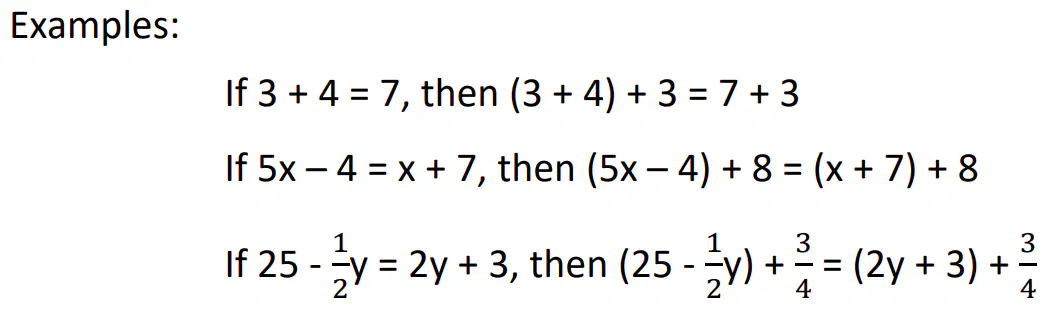
Let x, y, and z be real numbers. If x = y, then x + z = y + z. Adding the same quantity to both sides of an equation results to equal quantities.
Properties
APE
SPE
MPE
DPE
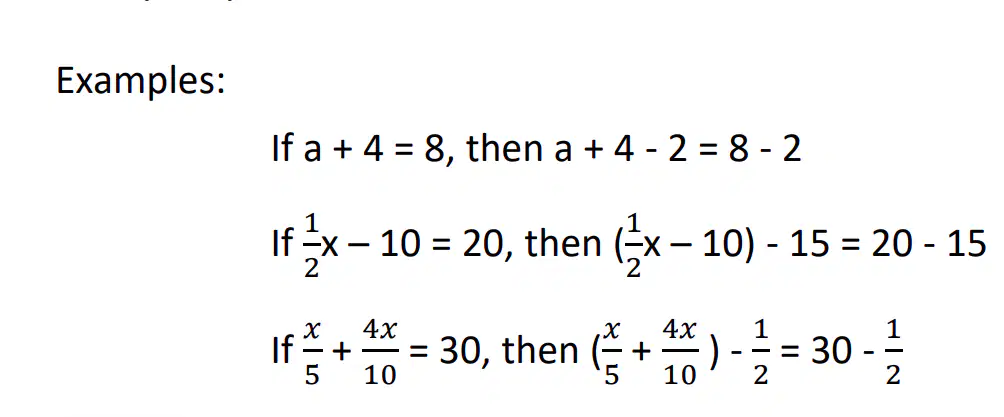
Let x, y, and z be real numbers. If x = y, then x - z = y - z. Subtracting the same quantity to both sides of an equation results to equal quantities.
Properties
APE
SPE
MPE
DPE
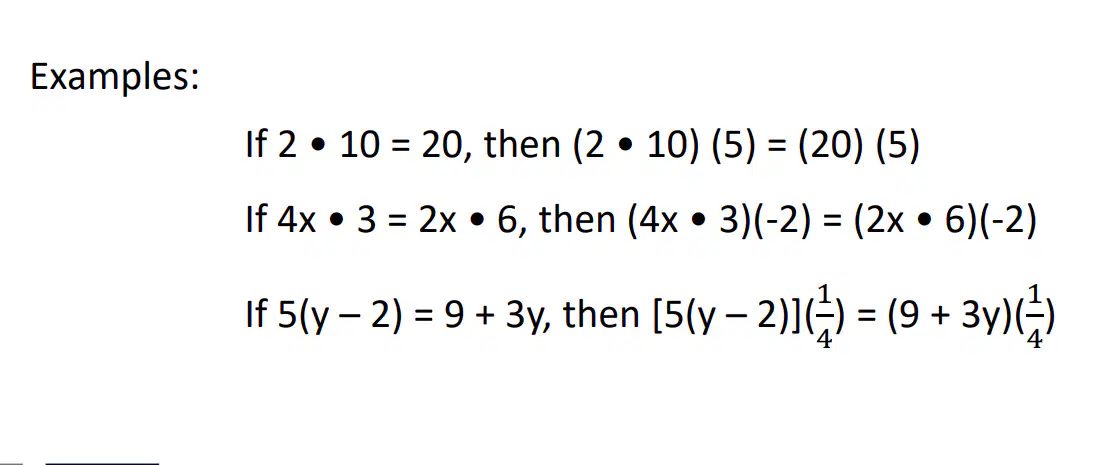
Let x, y, and z be real numbers. If x = y, then xz = yz. Both sides of the equation may be multiplied by equals.
Properties
APE
SPE
MPE
DPE
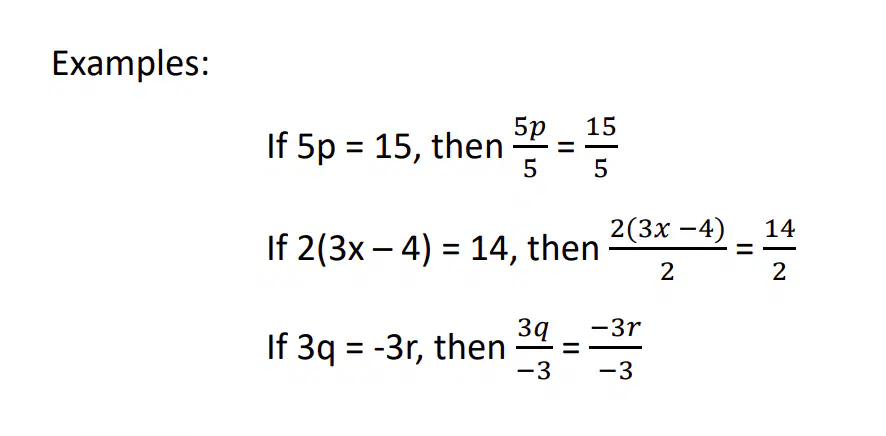
Let x, y, and z be real numbers. If x = y and z ≠ 0, then x/z = y/z.
Both sides of the equation may be divided by the same nonzero real number
Properties
APE
SPE
MPE
DPE
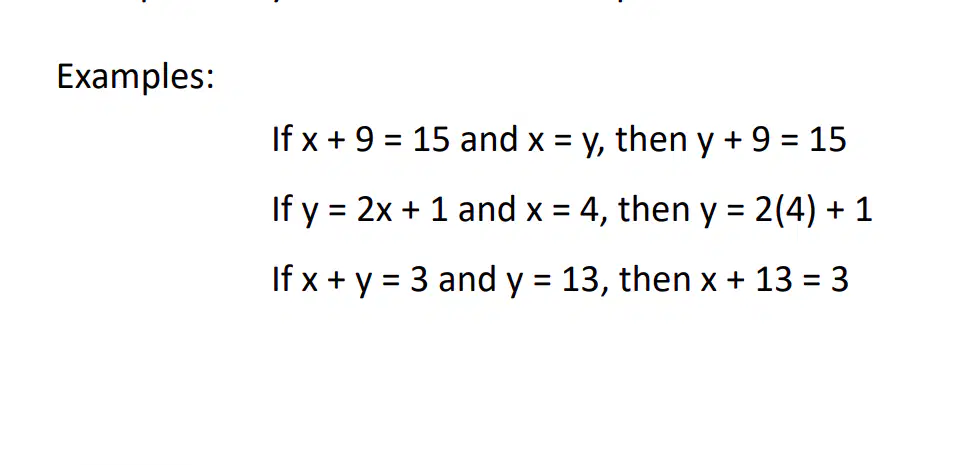
Let x, y, and z be real numbers. If x + y = z and x = y, then y + y = z or x + x = z. Equals may be substituted for equals.
Substitution Law
Reflexive Property
Symmetric Property
Transitive Property (TPE)
Additive Identity
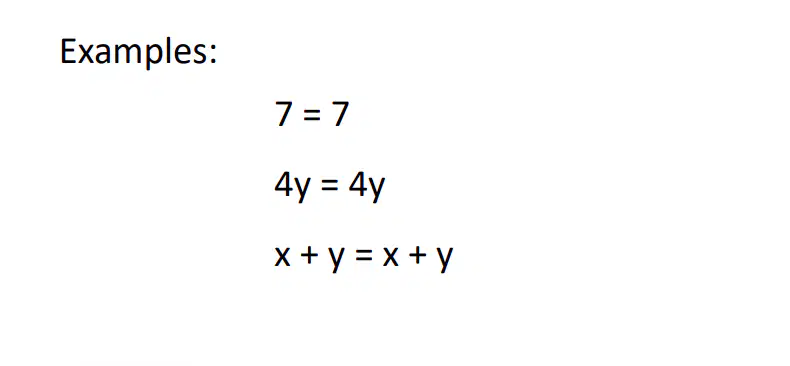
For any real value of x, y, and z: x = x, y = y, and z = z. Any number or expression is equal to itself.
Substitution Law
Reflexive Property
Symmetric Property
Transitive Property (TPE)
Additive Identity
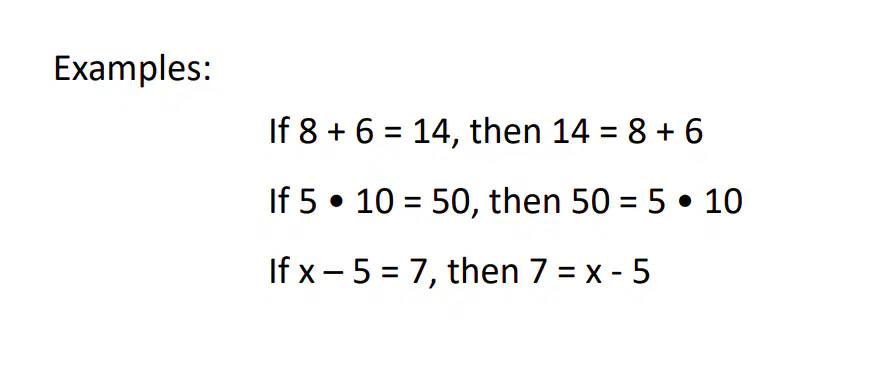
For any real value of x, y, and z: If x = y, then y = x. The expressions on both sides of an equation may be interchanged.
Substitution Law
Reflexive Property
Symmetric Property
Transitive Property (TPE)
Additive Identity
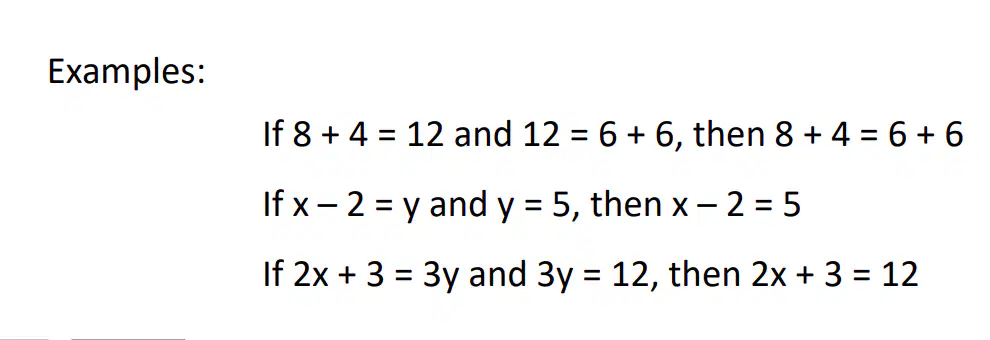
For any real value of x, y, and z: If x = y and y = z, then x = z. If two quantities are both equal to a third quantity, then they are equal to each other.
Substitution Law
Reflexive Property
Symmetric Property
Transitive Property (TPE)
Additive Identity
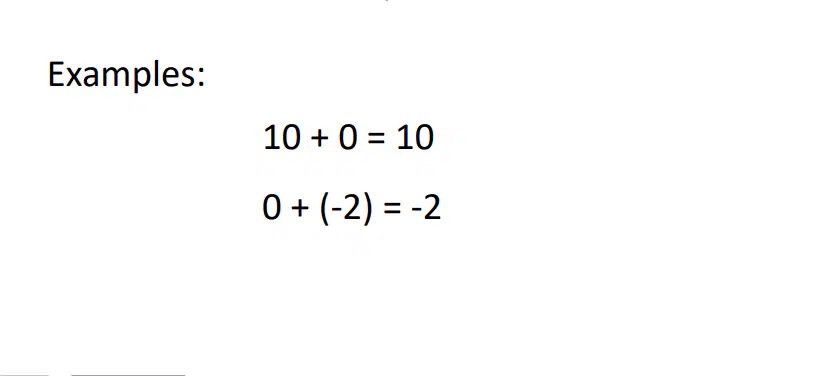
For any real value of x, y, and z: For any number x, x + 0 = 0 + x = x If 0 is added to any number x, then the sum is x.
Substitution Law
Reflexive Property
Symmetric Property
Transitive Property (TPE)
Additive Identity
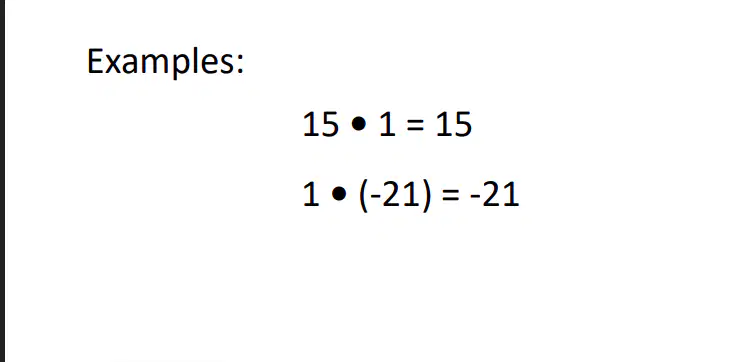
For any real value of x, y, and z: For any number x, x • 1 = 1 • x = x If x is multiplied by 1, then the product is x.
Multiplicative Identity
Multiplicative Property of Zero
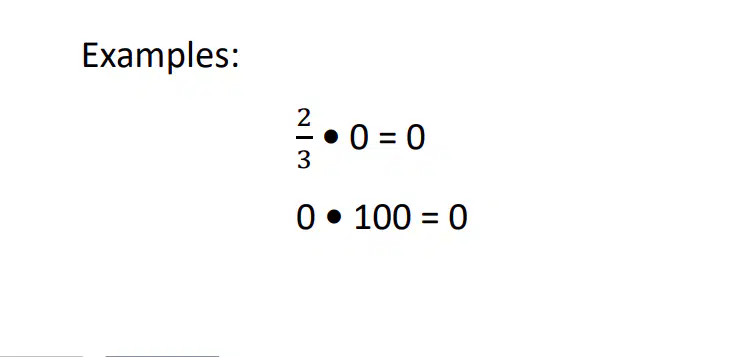
For any real value of x, y, and z: For any number x, x • 0 = 0 • x = 0 If 0 is a factor, then the product is zero.
Multiplicative Identity
Multiplicative Property of Zero
If x/5 = 3, then 2x = 30
(a)
x = 7 and y = 7, then x =y.
(a)
If m + n = 2, then 2 = m + n.
(a)
If a + 3 = b, then a = b – 3
(a)
(xy) • 1 = xy
(a)
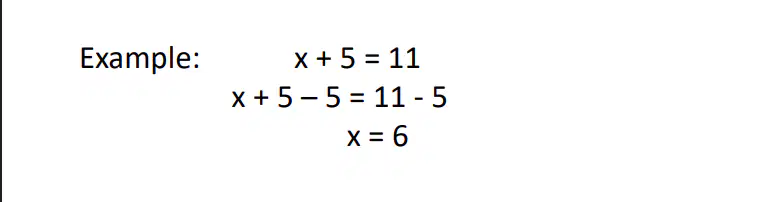
It can be solved by subtracting the same number from each side of the equation so that the variable is isolated on one side of the equation.
Addition Equation
Subtraction Equation
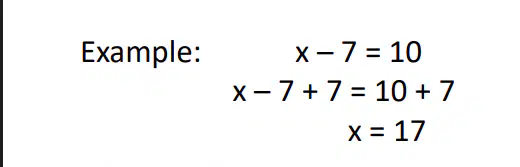
It can be solved by adding the same number on each side of the equation.
Addition Equation
Subtraction Equation
36 = x + 12
(a)
2y = 12y + 10
(a)
20 = m – 15.5
(a)
4 – n = 13
(a)
7x = 84
(a)
n/5 = 9
(a)
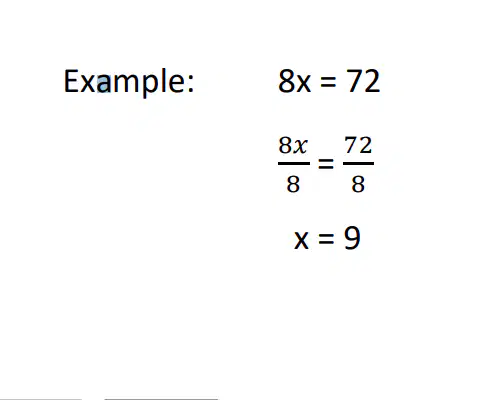
It can solve a multiplication equation by dividing.
Multiplication Equation
Division Equation
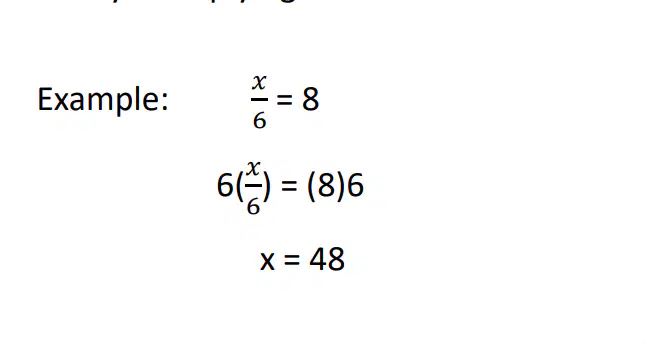
It can solve a division equation by multiplying.
Multiplication Equation
Division Equation
-22 = 11y
(a)
1/8 = x/5
(a)
n/15 = 1/3
(a)
2.5m = 50
(a)
y/4 + 9 = -5
(a)
x/6 + 1/3 = 1/2
(a)
4/7x = -20
(a)
Equations and formulas involving several variables are sometimes called (a) . Example: A formula for finding the perimeter of a basketball court is given by:
P = 2l + 2w
where P = perimeter, l = length, and w = width
To make l the subject of the formula, simply manipulate the formula in the same way as an equation, remembering that letters are now being used instead of numbers.
1. P = 2l + 2w
2. P - 2w = 2l Subtract 2w form both sides
3. P-2w/2 = L or L = P-2w/2 Divide both sides by 2
4. P/2 - w = l
Make p the subject of each formula.
xp = mb
(a)
Make p the subject of each formula.
x = n - m/p
(a)
A _____ is a meaningful collection of things.
set
element or a member of a set
Experiment
Outcome
Sample space
An _____ is a thing that belongs to the set. For any two sets A and B, if every element of set A is also an element of set B, then set A is a subset of B.
set
element or a member of a set
Experiment
Outcome
Sample space
a process that has several distinct possible outcomes in which the result cannot be predicted with certainty.
set
element or a member of a set
Experiment
Outcome
Sample space
any possible result of an experiment
set
element or a member of a set
Experiment
Outcome
Sample space
the set of all possible outcomes of an experiment
set
element or a member of a set
Experiment
Outcome
Sample space
In both cases, we see that the _____ we want takes place if the outcome of the experiment is an element of the subsets of the sample space. This subset of a sample space is called an _____.
event
The Union of Two Events
The Intersection of Two Events
The Complement of an Event
An _____ is a subset of the sample space.
event
The Union of Two Events
The Intersection of Two Events
The Complement of an Event
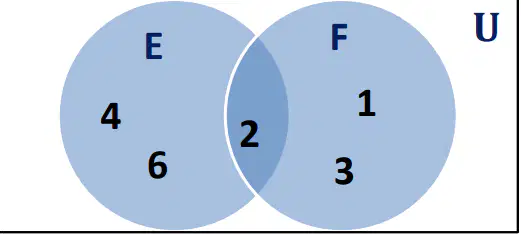
_____ is all outcomes in either or both events. _____, E and F, is denoted by E ∪ F. It is read as “E union F.”
For example: E = {2, 4, 6} and F = {1, 2, 3}
E ∪ F = {1, 2, 3, 4, 6}
event
The Union of Two Events
The Intersection of Two Events
The Complement of an Event
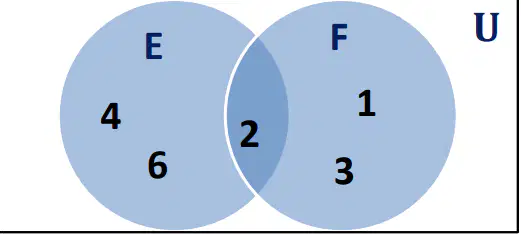
_____ is only those events common to both. _____, E and F, is denoted by E ∩ F. It is read as “E intersection F.”
For example: E = {2, 4, 6} and F = {1, 2, 3}
E ∩ F = {2}
event
The Union of Two Events
The Intersection of Two Events
The Complement of an Event
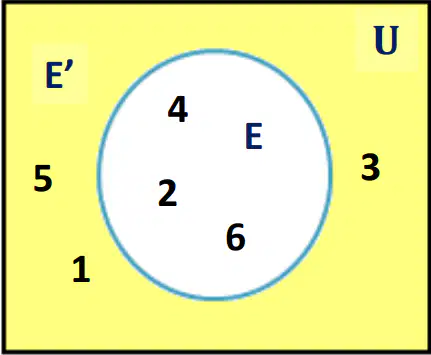
The _____ is the set of elements not in E that are in the sample space, S. _____ E is denoted by E’. It is read as “complement of E” or “E prime.”
For example: E’ = {1, 3, 5}
event
The Union of Two Events
The Intersection of Two Events
The Complement of an Event
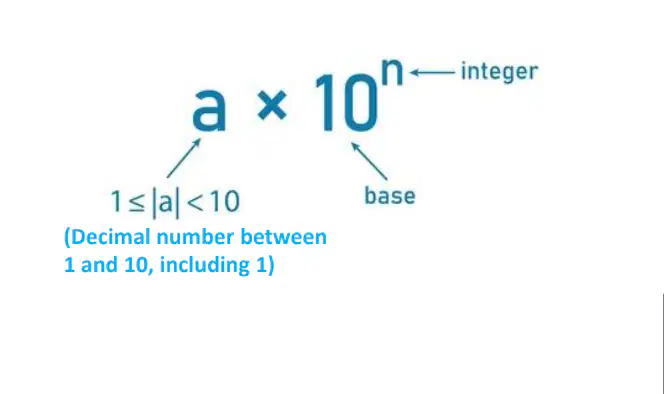
A number expressed in the form a × 10^𝑛 , where a is the base which is a decimal number with 1 ≤ |a|< 10, and n is an integer exponent.
Scientific notation is based on powers of 10. Numbers written in scientific notation have two parts:
(a)
Is it in Scientific Notation? Answer Yes or No.
4.35 x 10^6
(a)
Is it in Scientific Notation? Answer Yes or No.
43.5 x 10^6
(a)
Is it in Scientific Notation? Answer Yes or No.
0.435 x 10^6
(a)
Changing Decimal Notations to Scientific Notations:
Type First, Second, Third, and Fourth
Place the decimal point after the first nonzero digit.
(a)
Changing Decimal Notations to Scientific Notations:
Type First, Second, Third, and Fourth
Count the number of places the decimal point is moved, and use that number as the number exponent.
(a)
Changing Decimal Notations to Scientific Notations:
Type First, Second, Third, and Fourth
If the original number is greater than 10, the exponent is positive. If the original number is between 1 and 10, the exponent is zero.
(a)
Changing Decimal Notations to Scientific Notations:
Type First, Second, Third, and Fourth
If the original number is between 0 and 1, the exponent is negative.
(a)
To change from scientific notation with a positive integer exponent to standard notation, move the decimal point to the right, the number of places indicated by the exponent.
7.7 x 10^9 = 7,700,000,000
Changing Scientific Notations (Positive Exponents) to Standard Form
Changing Scientific Notations (Negative Exponents) to Standard Form
To write a number expressed in scientific notation with a negative exponent in standard form, move the decimal point to the left, the same number of places as the absolute value of the exponent.
8.6 x 10^-9 = 0.0000000086
Changing Scientific Notations (Positive Exponents) to Standard Form
Changing Scientific Notations (Negative Exponents) to Standard Form
Write each in scientific notation:
650 000
(a)
Write each in scientific notation:
82 700 000
(a)
Write each in scientific notation:
0.00000002
(a)
Write each in scientific notation:
0.000451
(a)
Write each number in standard form:
5 × 10^8
(a)
Write each number in standard form:
0.12 × 10^5
(a)
Write each number in standard form:
24 × 10^−6
(a)
Write each number in standard form:
1.39 × 10^−2
(a)
Steps for Addition and Subtraction of Numbers Written in Scientific Notation:
Rewrite the number with the smaller exponent so that its exponent is the same as the other.
(a)
Steps for Addition and Subtraction of Numbers Written in Scientific Notation:
Add or subtract the decimal numbers. The power of 10 will not change.
(a)
Steps for Addition and Subtraction of Numbers Written in Scientific Notation:
Rewrite the number in scientific notation.
(a)
Calculate the sum or difference:
(4.8 × 10^7 ) + (6.1 × 10^7 )
(a)
Calculate the sum or difference:
(2.52 × 10^4 ) + (3.4 × 10^5 )
(a)
Calculate the sum or difference:
(6.11 × 10^−4 ) - (2.8 × 10^−5 )
(a)
Steps in Multiplication and Division of Numbers Written in Scientific Notation:
Multiply/Divide the decimal numbers.
(a)
Steps in Multiplication and Division of Numbers Written in Scientific Notation:
Multiply/Divide the powers of 10.
(a)
Steps in Multiplication and Division of Numbers Written in Scientific Notation:
Convert the answer to scientific notation if necessary.
(a)
(4 × 10^−5 ) × (3 × 10^−4 )
(a)
(3.9 × 10^6 ) × (2.2 × 10^5 )
(a)
2 x 10^8/4 x 10^2
(a)
(5.4 × 10^7 ) - (3.1 × 10^6 )
(a)
(4.23 × 10^−5 ) + (2.15 × 10^−6 )
(a)
(7 × 10^−6 ) × (8 × 10^−2 )
(a)
3 x 10^10/8 x 10^5
(a)
All nonzero digits are significant.
235 has three significant digits: 2, 3, and 5.
1 487 692 has seven significant digits.
TRUE
FALSE
All zeros located between nonzero digits are significant digits.
205 has three significant digits: 2, 0, and 5.
4 005 has four significant digits.
TRUE
FALSE
Not All digits of the first factor when a number is expressed in scientific notation.
8.43 × 10⁷ has three significant digits.
2.050 × 10⁻³ has four significant digits.
TRUE
FALSE
Underscored or specified zeros of a whole number ending in zeros.
27 000 has two significant digits: 2 and 7.
27 000 has four significant digits: 2, 7, 0, and 0.
TRUE
FALSE
Zeros at the end of a whole number (unless specified to be significant)..
2 000 has one significant digit: 2.
3 040 has three significant digits: 3, 0, and 4.
TRUE
FALSE
Zeros following the decimal point in a number between 0 and 1.
0.005 has one significant digit: 5.
0.0005 has one significant digit: 5.
TRUE
FALSE
When approximate quantities are added or subtracted, the result will only have as many decimal places as the quantity with the least number of decimal places.
Addition and Subtraction for Approximate Numbers
Multiplication and Division Rule for Approximate Numbers
When approximate quantities are multiplied or divided, the result will only have as many significant figures as the quantity with the least number of significant figures.
Addition and Subtraction for Approximate Numbers
Multiplication and Division Rule for Approximate Numbers
The three sides of a triangular lot are measured to be approximately 33.4 ft., 14.2 ft., and 27.73 ft. long. Find the approximate perimeter of the lot.
(a)
Find the approximate product of 4.7201 and 7.00.
(a)

