wayground logo

Free Printable Worksheets

Font size

S
M
L
XL
Worksheets

Unit 8 Test Review

Total questions: 88

Worksheet time: 6hrs 6mins
Name
Class
Date
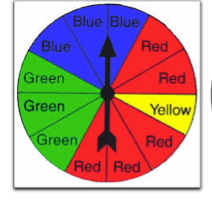
1.
What is the probability of spinning green?
a)
0
b)
1/4
c)
1/2
d)
3/4
2.
The letters that form the word ALGEBRA are placed in a bowl. What is the probability of choosing a letter other than “A”? 
a)
2/7
b)
5/49
c)
5/7
d)
10/49
3.

If you choose from the following M & M colors, what is the probability that you choose blue?

5 green

6 yellow

8 blue

7 brown

a)

1/4

b)

4/13

c)

8/25

d)

1/3

4.

Ryan has 4 rap songs, 11 pop songs, 8 country songs, and 2 rock songs. What is the probability of Ryan picking a rock song or a pop song?

a)

2/25

b)

13/25

c)

11/25

d)

22/25

5.

Suppose there are 200 students in the cafeteria during lunch. How many students would you expect to choose pizza as their favorite cafeteria food?

a)

90

b)

104

c)

18

d)

72

6.
If a dice is rolled 300 times, how many times would you predict a roll of a 1 or a 6?
a)
50
b)
100
c)
150
d)
75
7.
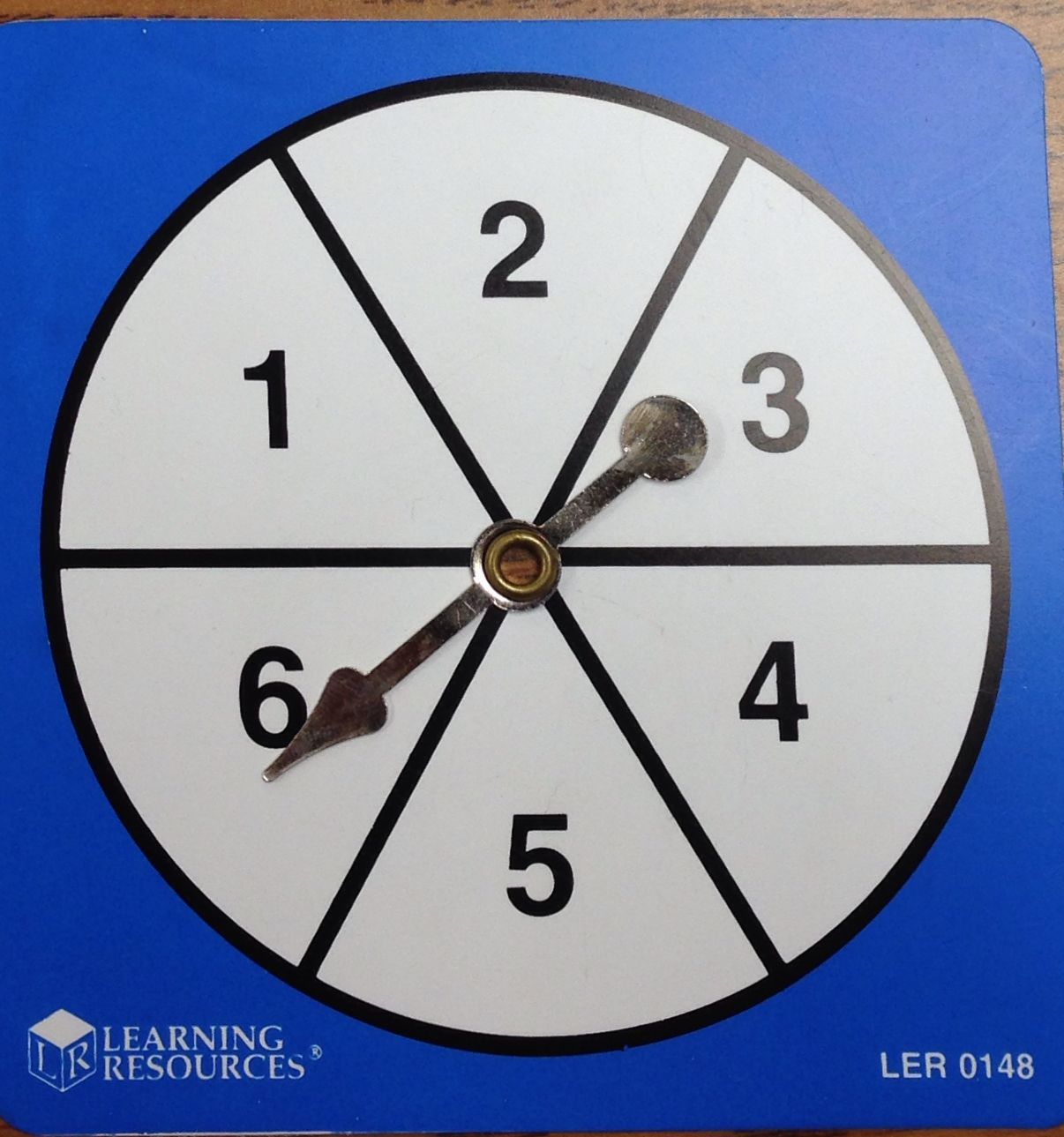
If you spin the spinner 90 times, how many times should the number 3 be selected?
a)
9
b)
15
c)
16
d)
30
8.

Bailey tossed a coin 10 times. The results were 7 heads and 3 tails.


What is the experimental probability of tossing tails?

a)

1/3

b)

3/10

c)

3/7

d)

1/2

9.

Use the spinner to find the probability.

P(not D) =

a)

5

b)

5/6

c)

0.63

d)

1/6

10.

A veterinarian has the animals listed in the table below staying at the hospital. Find the probabilities of what animal the veterinarian will care for next:

P(cat or reptile) =

a)

11/24

b)

5/11

c)

1/2

d)

10/22

11.
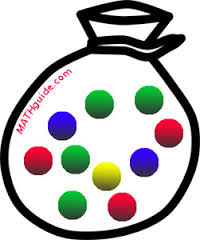
A bag has 3 red marbles, 2 blue and 4 yellow. What is the theoretical probability of pulling a red?
a)
3/10
b)
3/9
c)
1/9
d)
1/3
12.
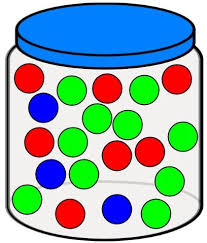
A jar contains 2 pink, 6 red, and 4 blue marbles. If you pick one marble without looking, what is the probability that the marble you pick will be red or blue?
a)
5/6
b)
1/2
c)
1/3
d)
1/6
13.
The following M & M colors are in the bowl:
4 yellow, 6 orange, 3 green, 5 blue, 2 brown.
What is the probability of selecting a brown candy?
a)
2/18
b)
1/9
c)
2/20
d)
1/10
14.

Kevin is making an omelet. There are 7 types of meat and 2 types of cheese to choose from. How many different omelets can Kevin make using exactly one of each item?

a)

7

b)

14

c)

9

d)

24

15.
The probability of it raining today is 30%.  What is the probability that it will NOT rain?
a)
30%
b)
70%
c)
100%
d)
0%
16.
What is the probability of pulling a red marble out of a jar of marbles that have 10 green marbles, 7 red marbles and 3 blue marbles?
a)
1/7
b)
7/20
c)
7/10
d)
3/10
17.
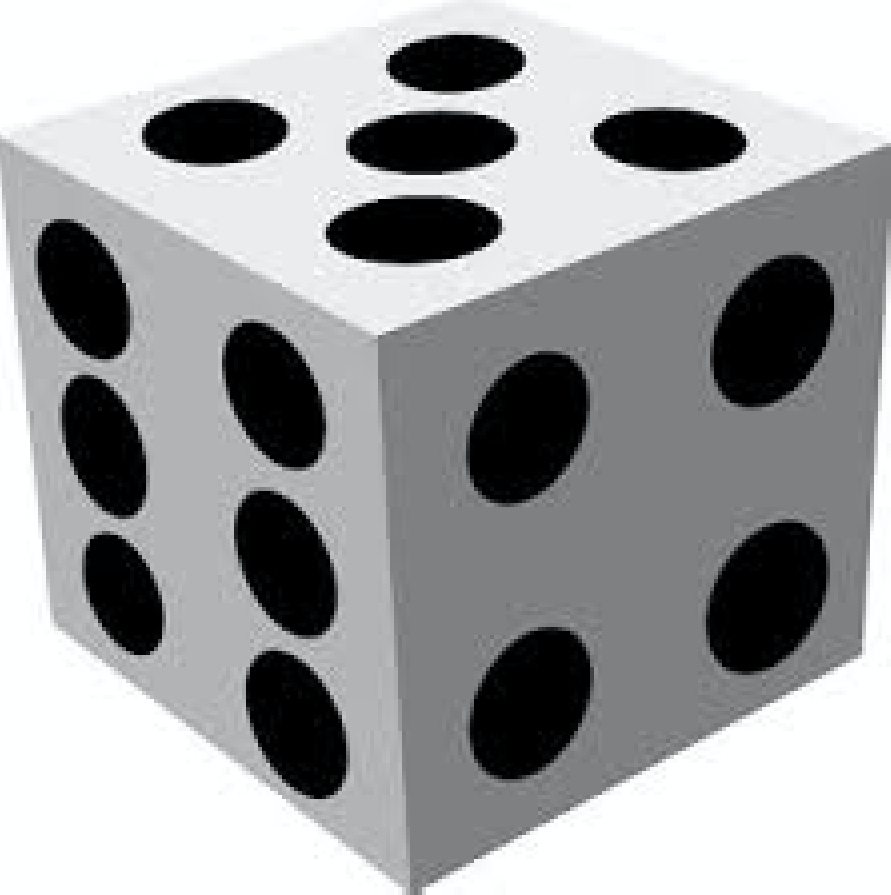
If you were to roll the die one time what is the probability of it landing on a 2?
a)
2 out of 6
b)
2 out of 2
c)
1 out of 6
d)
1 out of 1
18.
Ben has a basket of 5 red balls, 3 yellow balls, and 2 green balls. What is the probability that the probability he randomly chooses will be red?
a)
1/2
b)
1/5
c)
1/10
d)
5/8
19.
A bag of marbles has 8 red marbles and 6 purple marbles. Jennifer will randomly select 1 marble from the bag. What is the probability that she will select a purple marble?
a)
6/8
b)
3/4
c)
6/14
d)
3/7
20.
Look at the dartboard. 
A boy is playing darts with his friends. What is the probability that his dart will land in an unshaded square?
a)
12/25
b)
13/25
c)
10/25
d)
11/25
21.
What is an outcome?
a)
The result of an experiment
b)
The chance or likelihood of an event
c)
A fraction, decimal, or a percent
d)
An activity that gives various results
22.

What is the P( not purple) on this spinner?

a)

2/5

b)

1/5

c)

4/5

d)

3/5

23.

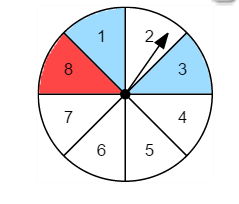
What is the probability of spinning an even number?

a)

16 2/3%

b)

33 1/3%

c)

50%

d)

75%

24.
Find the probability of rolling a 7 on a single die.
a)
1/6
b)
7/6
c)
0
d)
7/7
25.
What is the probability of spinning green?
a)
0
b)
1/4
c)
1/2
d)
3/4
26.
What is the probability of spinning red?
a)
0
b)
5/12
c)
1/2
d)
3/4
27.
What is the probability of spinning green or blue?
a)
0
b)
5/12
c)
1/2
d)
3/4
28.
How do you write 0.02 as a percent?
a)
20%
b)
200%
c)
2%
d)
.02%
29.
The letters that form the word ALGEBRA are placed in a bowl. What is the probability of choosing a letter other than “A”? 
a)
2/7
b)
5/49
c)
5/7
d)
10/49
30.
The letters that form the word MATHEMATICS are placed in a bowl. What is the probability of choosing a letter that is a vowel?
a)
8/121
b)
4/11
c)
2/11
d)
4/121
31.
A set of all possible outcomes is known as - 
a)
a list
b)
a complement
c)
a sample space
d)
an event
32.
You pick a marble from this bag.
What is the probability you will choose either a black or white marble?
a)
3/5
b)
9/100
c)
1/10
d)
2/5
33.
You roll two die.
What is the probability you will roll a 4, then roll a number less than 3?
a)
1/36
b)
1/18
c)
1/9
d)
1/6
34.

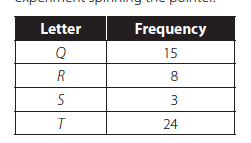
Find the relative frequency of spinning Letter Q.

a)

15/15

b)

3/10

c)

3/50

d)

7/10

35.
You flip a nickel three times.
Find the probability that all flips will land on tails.
a)
1/2
b)
1/4
c)
1/6
d)
1/8
36.

A bag has 3 red marbles, 2 blue and 4 green and 1 yellow. What is the theoretical probability of pulling a red?

a)

3/10

b)

3/9

c)

1/9

d)

1/3

37.

Use the tree diagram to find the probability of tossing a head first and then a tail when a coin is tossed twice.

a)

1

b)

1/2

c)

1/4

d)

1/3

38.
Experimental Probability is:
a)
What Will happen 
b)
What actually happens
c)
What should happen
d)
What I think Happens
39.
Probability can be written as ...
a)
a fraction
b)
a decimal
c)
a percent
d)
all of the above
40.
Theoretical Probability is?
a)
What Should happen
b)
What does happen
c)
What Will Happen
d)
What I want to Happen
41.
A jar contains 2 pink, 6 red, and 4 blue marbles. If you pick one marble without looking, what is the probability that the marble you pick will be red or blue?
a)
5/6
b)
1/2
c)
1/3
d)
1/6
42.
A likely chance event is closer to what number?
a)
0
b)
1
c)
.5
d)
100
43.
An unlikely chance event is closer to what number?
a)
0
b)
1
c)
2
d)
3
44.

A piggy bank contains 4 quarters, 18 dimes, 10 nickels, and 8 pennies. A coin is chosen at random, not replaced, then another is chosen. Find each probability.


P (penny, then dime).

a)

1/8

b)

9/100

c)

6/65

d)

17/195

45.

Find the probability of each set of independent events.


drawing a black checker from a bag of 6 black checkers and 4 red checkers, replacing it, and drawing another black checker.

a)

2/3

b)

9/25

c)

2/5

d)

3/5

46.

Find the probability of each set of independent events.


rolling a six on the first roll of a 1-6 number cube and rolling an odd number on the second roll of the same cube.

a)

1/12

b)

1/6

c)

1/8

d)

1/2

47.

Find the probability of each set of independent events.


flipping a tail on a coin and spinning a 5 on a spinner with sections of equal area numbered 1-5.

a)

1/2

b)

1/7

c)

1/5

d)

1/10

48.

A standard die is rolled twice. Find each probability.


P (prime, then 6)

a)

1/2

b)

2/3

c)

1/9

d)

1/12

49.
The spinner is divided into eight equal parts. Find the theoretical probability of landing on the given section of the spinner.P(white)=
a)
1/8
b)
5/8
c)
7/8
d)
3/7
50.
If you choose from the following M & M colors, what is the probability that you choose blue?
5 green
6 yellow
8 blue
7 brown
a)
8/26
b)
4/13
c)
8/25
d)
1/3
51.
A number cube is rolled twice. What is the probability of getting a 6 on the first roll, then a number less than 5 on the second roll? 
a)
2/3
b)
5/36
c)
1/9
d)
1/36
52.

Kaylee has 1 red, 3 blue, 2 brown, 5 black, 1 purple, and 4 pairs of pink flip-flops in her closet. Assuming she always replaces them, what is the probability that she will choose a blue pair on Monday and a pink pair on Tuesday?

a)

3/8

b)

4/75

c)

3/64

d)

15/32

53.
A chorus has 50 girls and 35 boys. If two are chosen at random to sing a duet, what is the probability that both will be boys? 
a)
1/6
b)
7/17
c)
3/8
d)
13/25
54.
Victor picks a card at random. Without putting the first card back, he picks a second card at random.
a)
Dependent
b)
Independent
55.
Clara picks a marble at random, puts it back, and then picks another marble at random.
a)
Dependent
b)
Independent
56.
A store sells shirts that are either small, medium, or large. The colors are either red, blue, green, or white. What is the probability someone will select a large green shirt?
a)
1/3
b)
1/7
c)
1/9
d)
1/12
57.
You pick a marble from this bag.
What is the probability you will choose either a black or white marble?
a)
3/5
b)
9/100
c)
1/10
d)
2/5
58.
P(not A) = 
*Remember to simplify.*
a)
6/8
b)
3/4
c)
2/8
d)
1/4
59.
A bag has 3 red marbles, 2 blue and 4 yellow. What is the theoretical probability of pulling a red?
a)
3/10
b)
3/9
c)
1/9
d)
1/3
60.
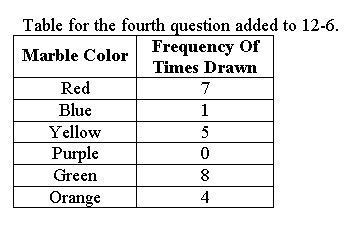
Based on the chart, what is the experimental probability of pulling a green marble?
a)
1/8
b)
8/25
c)
8/100
d)
7/8
61.
The spinner is divided into eight equal parts. Find the theoretical probability of landing on the given section of the spinner.P(white)=
a)
1/8
b)
5/8
c)
7/8
d)
3/7
62.
Andrew picks one marble at a time from a box and replaces it. He repeats this process 25 times and records the results in the table. Based on the table, which color marble has an experimental probability of 1/5?
a)
Yellow
b)
Red
c)
Blue
d)
Green
63.
If you choose from the following M & M colors, what is the probability that you choose blue?
5 green
6 yellow
8 blue
7 brown
a)
8/26
b)
4/13
c)
8/25
d)
1/3
64.
Find the probability of rolling a 7 on a single die.
a)
1/6
b)
7/6
c)
0
d)
7/7
65.
Robin has five different pairs of shoes that match with 6 different pairs of socks.  How many shoes-and-socks combinations can she make if she selects one pair of shoes and one pair of socks?
a)
1
b)
30
c)
5!
d)
6!
66.
Find the probability that a randomly chosen point in the figure lies in the shaded region.
a)
94.8%
b)
80%
c)
60%
d)
45.6%
67.
If a stone is dropped at random on the arrangement of tiles shown, what is the probability the stone lands on a black tile?
a)
5/9
b)
4/9
c)
1/2
d)
1/9
68.
Find the probability that the spinner lands on Bonus Card when spun.
a)
.44
b)
.22
c)
.14
d)
.17
69.
The extent to which something is likely to occur is known as - 
a)
sample space
b)
an event
c)
probability
d)
data
70.
The likelihood that a single, specific event will occur is called - 
a)
sample space
b)
compound probability
c)
a complement
d)
simple probability
71.
The likelihood of two or more related events occurring is called - 
a)
compound probability
b)
theoretical probability
c)
simple probability
d)
experimental probability
72.
The number of ways an event can occur divided by the total number of outcomes is known as - 
a)
an event complement
b)
experimental probability
c)
an event
d)
theoretical probability
73.
The ratio of the number of times an event occurred compared to the total number of trials conducted is known as - 
a)
theoretical probability
b)
experimental probability
c)
simple probability
d)
compound probability
74.
A set of all possible outcomes is known as - 
a)
a list
b)
a complement
c)
a sample space
d)
an event
75.
How do we determine which event is most likely to occur?
a)
The event has the closest improper fraction to 1
b)
The event has the closest proper fraction to 1/2
c)
The event has the closest proper fraction to 0
d)
The event has the closest proper fraction to 1
76.
In probability theory, the sum of an event (A) occurring and the same event NOT occurring (not A) is always - 
a)
0
b)
based on the sample space
c)
variable
d)
1
77.
Which of the following expressions would be used to calculate the complement of an event occurring?
a)
P(event) - 1
b)
P(event 1) x    P(event 2)
c)
P(event)/possible outcomes
d)
1 - P(event)
78.
P(A) + P(not A) = 1
a)
True
b)
False
79.
Which of the following expressions can be used to calculate the probability of two related events occurring?
a)
P(event) x 2
b)
P(event 1) +   P(event 2)
c)
P(event 1) x     P(event 2)
d)
P(event 1 + 2)
80.
The likelihood that an event will NOT occur is known as its - 
a)
complement
b)
sample space
c)
opposite
d)
trial
81.
If a coin is tossed 3 times, how many possible outcomes are in the sample space?
a)
6
b)
8
c)
3
d)
It depends
82.
Which of the following methods is NOT a good tool for determining sample space?
a)
tree diagrams
b)
area models
c)
organized lists
d)
guess and check
83.
A measurement of the likelihood of an event or events occurring on a scale of 0 to 1 is called - 
a)
data
b)
luck
c)
probability
d)
trials
84.
In compound probability, if one event does not affect the other event or events, it is referred to as - 
a)
theoretical probability
b)
independent probability
c)
experimental probability
d)
dependent probability
85.
In compound probability, if one event affects another event we call it - 
a)
independent probability
b)
experimental probability
c)
simple probability
d)
dependent probability
86.
When collected data is used to express probability, we call it - 
a)
theoretical probability
b)
experimental probability
c)
simple probability
d)
compound probability
87.
The probability of an event occurring, P(A), can be expressed as a fraction, decimal, or percent.
a)
True
b)
False
88.
The more number of trials conducted in an experiment and the more data collected, the closer an event's experimental probability will align with its theoretical probability.
a)
True
b)
False