
 Worksheets
11 - Risks, communication with Agile
Total questions: 27
Worksheet time: 19mins
Risk Identification is the process of which of the following?
Quantifying the impact to the project of a potential risk event
Determining and documenting potential risk events on the project
Assigning a probability that a particular risk event will occur
Defining the action to take in response to a risk event
Once risks have been identified and analyzed, this tool helps you determine an overall risk score.
Probability and impact matrix
Risk list
Risk register
Risk template
All of the following are strategies for dealing with negative risks, except for which one?
Accept
Transfer
Share
Mitigate
All of the following are strategies for dealing with positive risks, except for which one?
Transfer
Exploit
Enhance
Share
What strategy suites for dealing with positive risks?
Accept
Transfer
Avoid
Mitigate
Which of these statements describe risks?
Our most senior web developer will be available to work on this project.
The electrical capacity at the site of the project event may not be adequate.
The project ’ s due date is June 27.
There ’ s a potential for server administrator to receive a promotion during the course of this project.
A document you use to capture all known risks is called:
Risk Log
Risk Register
Risk List
Risk Diary
On a Friday evening John (your best engineer in the team) comes to you and says he quits. You have two weeks to find a substitution. What would reduce the chances of such an event? Why?
Regular one-on-ones with John
Comprehensive professional development plan
The highest salary in the team
More responsibility
A process that involves prioritizing risks for further action or analysis by assessing the impact and the probability of occurrence is called:
Risk Analysis
Risk Brainstorming
Risk Retrospective
Risk Investigation
When do you perform Risk Identification?
At the beginning of a project.
During project planning.
During the whole lifetime of a project.
During project execution.
As a part of your project, you need to organize a conference. You learn that in the place that you rented there's a 70% chance of a tropical storm on the selected dates. How should you handle such risk?
Change the location of the conference - Avoid
Buy insurance to cover possible damage.
Book another place nearby to mitigate the risk of the first location unavailable due to the storm.
Inform all participants of the possible storm.
Who should be involved in Risk Management activities?
Only Project Team.
Only Project Manager.
As many stakeholders as practical.
All stakeholders except clients.
You are on the call with clients. They say the vendor team they hired to create designs is behind schedule. What should you do?
State that your project is also behind the schedule because of it.
Log the risk into Risk Register to assess impact.
Do nothing. It's not your problem.
Contact the vendor to help them out.
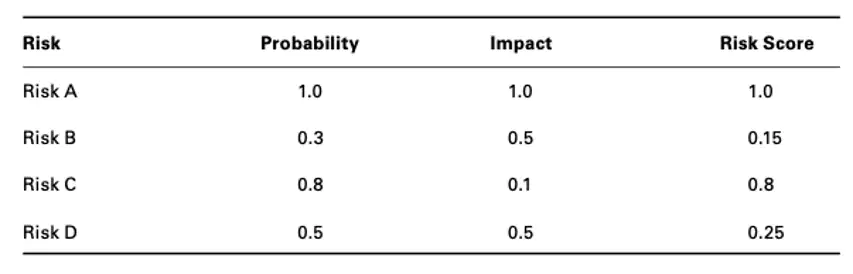
You have risk analysis results in the table. If you need to select only one risk to monitor, what it would be?
A
B
C
D
Why should you spend time developing a solid communications plan? Choose three.
To keep team members informed of project progress
To keep stakeholders updated on your progress
To keep vendors informed
To set stakeholder expectations
To set aside time for your own needs
This person is responsible for understanding the information correctly and making certain they ’ ve received all the information.
Sender
Messenger
Project manager
Receiver
Communications Planning is the process of which of the following?
Scheduling a regular meeting for the project team
Developing a distribution list for the stakeholders
Identifying the people or groups that need information on your project
Creating a template to report project status
What influences communication? Choose as many as apply.
Knowledge of subject
Culture influences
Emotions and attitude
Language
Communication and listening skills
What is critical communication skill?
Listening
Speaking
Writing
Presenting
What are communication types?
Verbal
Printed
Digital
Written
Is it true, that interactions with project team involve only formal communication that includes project kickoff meetings, team status meetings, written status reports, team building sessions, and other planned sessions with team?
No
Yes
Is it important to understand stakeholders expectations and concers regrading the project?
Yes
No
What is the meeting minutes?
It is an exact recording of everything that has happened in the meeting.
It is a detailed plan of the meeting.
It is a protocol of the meeting with actions assigned and decisions made.
What is a meeting agenda?
It is an exact recording of everything that has happened in the meeting.
It is a detailed plan of the meeting.
It is a protocol of the meeting with actions assigned and decisions made.
What are the main parts of the communication plan?
Format and method of transmission
Accountability for delivering
Who needs information
Types of information
All above
(a) meeting - to launch a project of an important portion
(b) meeting - to collect ideas
What is Sprint review meeting?
to inspect how the team worked and plan improvements
to define the Sprint Goal and select the Product Backlog items to be completed
to inspect progress, synchronize activities, and identify blockers
to present the completed increment of work to stakeholders and get feedback

