wayground logo

Free Printable Worksheets

NEW

Font size

S
M
L
XL
Worksheets

Natural Selection and Evolution

Total questions: 35

Worksheet time: 24mins

Name
Class
Date
1.

Change in characteristics of living things over time.

a)

Evolution

b)

Natural Selection

c)

Fitness

d)

Inheritance of Acquired Characteristics

e)

Mutation

2.

Organisms better fitted to the environment are more likely to survive and reproduce than organisms who aren’t fitted to the environment.

a)

Evolution

b)

Natural Selection

c)

Fitness

d)

Inheritance of Acquired Characteristics

e)

Mutation

3.

How adapted an organism is to its environment.

a)

Evolution

b)

Natural Selection

c)

Fitness

d)

Inheritance of Acquired Characteristics

e)

Mutation

4.
Bird's beaks evolve mainly due to the type of ___________________ available.
a)
food
b)
water
c)
shrubs
d)
mates
5.
If an organism can't adapt fast enough, this might happen.
a)
hibernate
b)
stay the same
c)
live longer
d)
become extinct
6.
Mutations are a change in what?
a)
DNA
b)
tRNA
c)
genotype
d)
phenotype
7.
What can happen to a species over time if some of the organisms have an advantage?
a)
The population will decrease
b)
The population will become extinct
c)
The population will slowly increase
8.
Survival of the Fittest and Evolution were proposed by what scientist?
a)
Charles Darwin
b)
Albert Einstein
c)
Steven Hawking
d)
Isaac Newton
9.
What is the advantage of having different shaped beaks?
a)
To look different from other species.
b)
To be able to eat the food readily available in the environment.
c)
To protect itself against predators.
d)
To protect itself against prey.
10.
Why do peppered moths tend to be the same color as the trees on which they live?
a)
The coloring goes along with tasting like the tree. 
b)
It keeps the moth the same temperature as the tree. 
c)
It makes the moths faster than the birds
d)
It makes the moths harder to see.
11.
Evolution works by 
a)
individuals changing to suit their environment
b)
Individuals learned new traits and pass them on
c)
sudden change in the environment cause a species change 
d)
small changes pass down through many generations
12.
The differences among a species, like different bird beaks, are called
a)
genes.
b)
variations.
c)
traits.
d)
theories.
13.
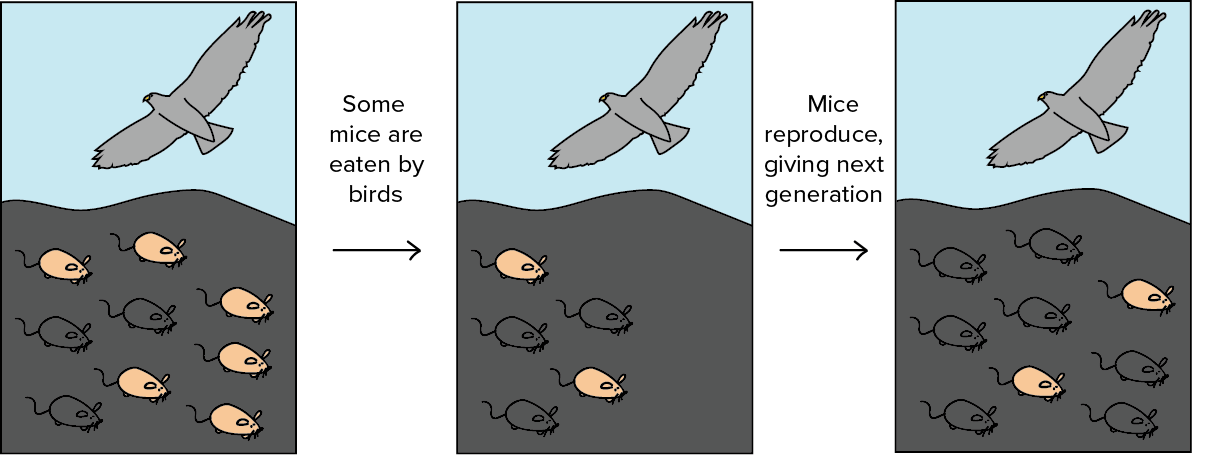
Why is the mouse population changing over time?
a)
The light mice can reproduce more successfully than the dark mice
b)
The hawks eat more dark mice than light mice because the dark mice taste better
c)
The hawks eat more light mice than dark mice because they can see the light mice more easily
d)
The hawks eat more dark mice than light mice because they can see the dark mice more easily
14.

Which is the sequence by which natural selection works?

a)

selection -> adaptation -> variation

b)

selection -> variation -> adaptation

c)

variation -> adaptation -> selection

d)

variation -> selection -> adaptation

15.

Which is the source of variation in a population of organisms?

a)

changes in environment

b)

changes in genes

c)

the interaction of genes with an environment

d)

the interaction of individuals with an environment

16.
Organisms with the most beneficial traits will survive.  This is commonly known as
a)
theory of evolution.
b)
variations.
c)
survival of the fittest.
d)
ecosystems.
17.
This scientist developed the theory of evolution as he studied the finches.
a)
Charles Darwin
b)
Isaac Newton
c)
Albert Einstein
d)
Marie Curie
18.
Behavioral changes of individuals of a species that allow for better survival. (Acquired traits)
a)
Variation
b)
Adaptation
c)
Behavior
d)
Environment
19.
Where the better adapted organisms survive to pass traits along to offspring.
a)
Evolution
b)
Natural Selection
c)
Extinction
d)
Artifical Selection
20.
Why are advantageous traits more likely to be passed onto offspring?
a)
Because they are more likely to survive and reproduce.
b)
Because they come from dominant alleles.
c)
Because they come from recessive alleles.
d)
Because the trait is an acquired phenotype.
21.
Do organisms "decide" to evolve and change?
a)
Yes, they know they need to change to survive 
b)
No, they change because of natural selection
22.

Gigantopithecus were very large primates that lived 500,000 years ago. Since none of these mammals are still today, they are said to be....

a)

Extinct

b)

Threatened

c)

Endangered

d)

Declining

23.
Which organisms are most likely to survive?
a)
the best adapted
b)
the fastest
c)
the strongest
d)
the most domesticated (tamed)
24.
Where the better adapted organisms survive to pass traits along to offspring.
a)
Evolution
b)
Natural Selection
c)
Extinction
d)
Artifical Selection
25.
Evolution is change in a population over time.
a)
True
b)
False
26.

What is the basis for all variation among organisms? (What causes all variation?)

a)

Mutation

b)

Genetic Drift

c)

Migration

d)

Inbreeding

27.
Whether or not a variation is an adaptation is dependent on the organism's
a)
Environment
b)
Genotype
c)
Phenotype
d)
Selection
28.
All rabbits living in a particular area would be an example of a(n)
a)
population
b)
species
c)
fossil
d)
individual organism
29.
The difference in the physical traits of an individual from those of other individuals in a group is called a(n)
a)
change
b)
adaption
c)
species
d)
variation
30.

Where do adaptations come from?

a)

The individual organism decides to adapt

b)

Mutations that give an organism an advantage in its environment

c)

Genetic recombination during meiosis

d)

Both mutations and genetic recombination are sources of adaptation

31.
The long and sharp beak of a woodpecker is an example of:
a)
Natural Selection
b)
Selective Breeding
32.

Why did the mouse population change over time?

a)

Their predators changed

b)

Their environment changed

c)

The number of offspring changed

d)

Their food source changed

33.

Why didn't the mouse populations change significantly in Location A?

a)

The environment stayed the same

b)

The predators stayed the same

c)

The food source changed

d)

The offspring changed

34.

Look at the table showing differences. Which organism is least related to humans?

a)

Chimpanzee

b)

Cow

c)

Fruit Fly

d)

Yeast

35.

Which type of mouse was able to best survive and reproduce in the white environment?

a)

White mouse

b)

Black mouse

c)

Both were equally able to survive and reproduce