
 Worksheets
5th Grade Science Review
Total questions: 140
Worksheet time: 7hrs 0mins
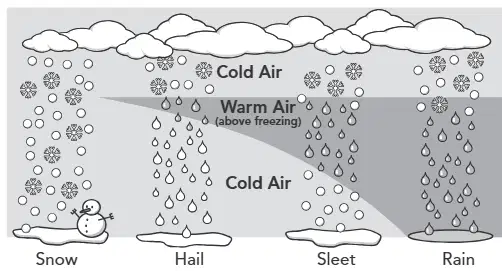
What season is it if it is sleeting outside?
Winter, because ice will only form when it is very cold outside.
Summer, because the ice is very small and must have melted.
Winter, because sleet is made from frozen rain.
Summer, because hail is made from particles carried by warm air.
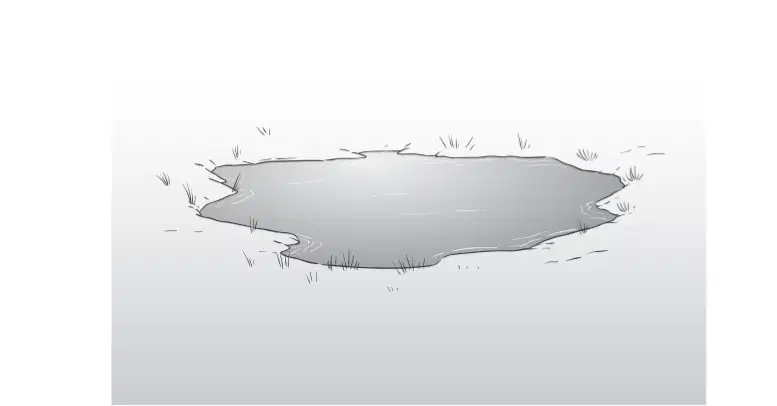
Water changes between states naturally throughout the water cycle. What is the next step the water in this image takes in the cycle?
Freezing into ice or evaporating into vapor.
Condensing into clouds or filtering into streams.
Flowing into runoff or melting into groundwater.
Precipitating into rain or running into the ocean.
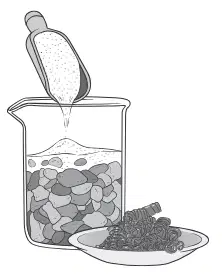
Which procedure could they use to separate the parts of this mixture?
Use water to dissolve both the salt and iron shavings, and use a sieve to separate the pebbles.
Add water and let it evaporate to remove the iron shavings, then use a filter to separate the pebbles and salt.
Add heat to the mixture to melt the salt, then use a magnet to separate the iron shavings from the pebbles.
Use a sieve to separate the pebbles and a magnet to separate the iron shavings from the salt.
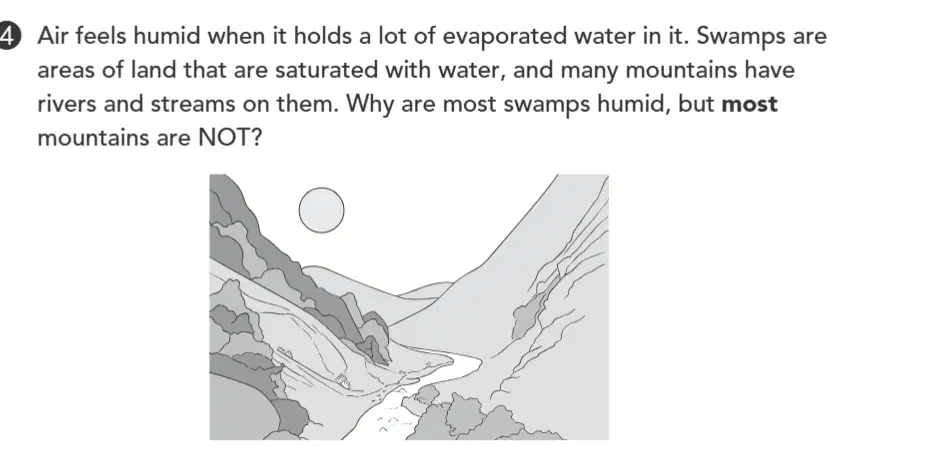
Why are most swamps humid, but most mountains are NOT?
Mountains are too dry, because their many tall trees block rainfall.
Mountains are too cool, because they are higher in elevation.
Mountains are too hot, because their soil retains warmth from the Sun.
Mountains are too windy, because they are taller than their surroundings.
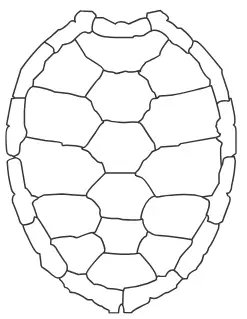
In what way is human skin similar to the structure of a turtle's carapace?
Both allow the animal to collect stimuli.
Both pump blood around the body.
Both offer protection to the animal.
Both digest food for energy.
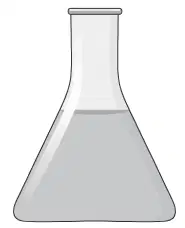
Chin’s teacher instructed students to observe the substance in the flask and write down their observations. Which of Chin’s observations could be used to show that the substance is a liquid?
has the same shape as the bottom of the flask
is the same color as the flask
has the same mass as the flask
expands to fill the volume of the flask
Chin’s teacher then asked students to design an experiment to test the properties of two new substances and then write a lab report about it. What information in Chin’s report will help other students get reliable results if they repeat the experiment?
a strong hypothesis
a blank table for data
a well-written conclusion
a detailed list of procedure steps
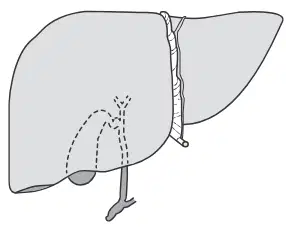
This organ is found in the human body and is responsible for producing an important enzyme. What is the function of that enzyme?
It breaks down starch in the mouth.
It digests proteins in the stomach.
It removes carbon dioxide from the blood.
It breaks apart fats in the small intestine.
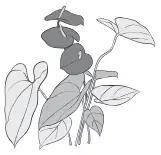
Which trait in the plant shown is best suited for a tropical environment?
It has very large leaves.
It has colorful flowers.
It has several thick stems.
It has a stilt, or prop, root system.
Two groups of kids are playing tug of war. Each team is pulling on the rope but the rope isn't moving. Which statement below best describes what is happening?
The forces acting on the rope are balanced.
The only force acting on the rope is gravity.
The rope is too thin to be acted on by forces.
The rope moves only when acted on by a pushing force.
In the turtle experiment, which is the control group?
The warm water, because it is the student’s hypothesis.
The cool water, because it would be the least expected result.
The room temperature water, because it is the average water temperature.
The empty tub, because it shows if the results are random.
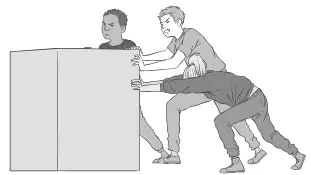
Based on the information, what conclusion can be drawn?
The box has a mass greater than the combined mass of the first two students pushing.
The forces acting on the box became unbalanced when the third student started pushing.
The only force acting on the box is the push applied by the students.
When the third student started to push the box’s mass decreased.
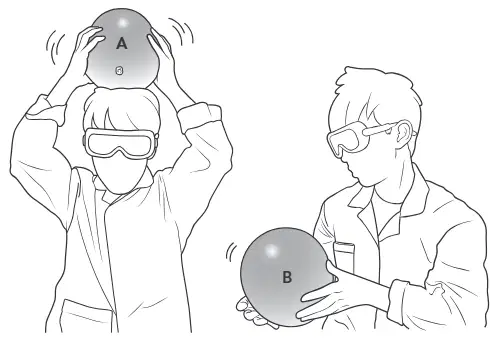
Two students begin an investigation by preparing two balloons. One student brings Balloon B close to Balloon A. The two balloons push apart. What conclusion can be drawn from this observation?
Both of these balloons have no electrical charge.
Balloon A is electrically-charged, while Balloon B has no charge.
Balloon A and Balloon B have opposite charges.
Balloon A and Balloon B have like charges.
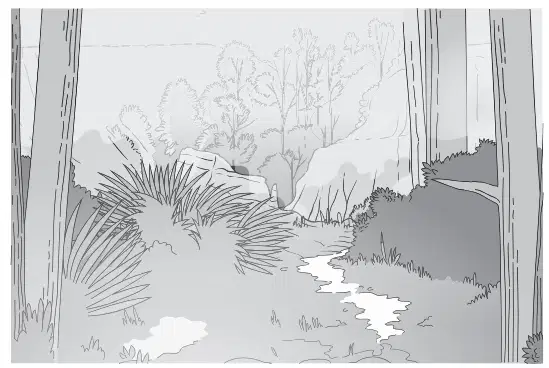
Fog, mist, rain, and hail are forms of weather having to do with water in the air. Which statement explains why the fog and mist shown in the art is more similar to rain than it is to hail?
Fog, mist, and rain are not considered precipitation, but hail is considered precipitation.
Fog, mist, and rain are considered precipitation, but hail is not considered precipitation.
Fog, mist, and rain are solid forms of weather, but hail is a liquid form of weather.
Fog, mist, and rain are liquid forms of weather, but hail is a solid form of weather.
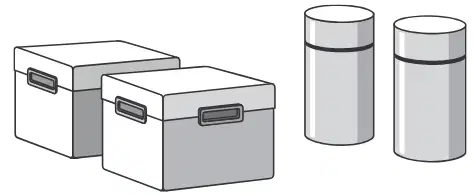
A student has samples of two materials, labeled A and B, in sealed containers. She plans to move the samples from the containers to the cylinders. If the samples are moved from the containers to the cylinders, the shape of Sample A changes, but the volumes of both samples stay the same. What best describes the states of the two samples?
Sample A is a liquid, and Sample B is a gas.
Sample A is a gas and Sample B is a solid.
Sample A is a solid, and Sample B is a liquid.
Sample A is a liquid, and Sample B is a solid.
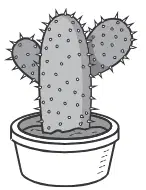
What conclusion can be made about the main adaptation shown by this organism?
It provides protection from predators.
It produces chemicals to ward off being eaten.
It allows the organism to run away from danger very quickly.
It produces a loud warning call when in danger.

A student investigates magnets. She places labels on two magnets to show their north and south poles. She places the magnets next to each other as shown and observes what happens. The student moves the north poles of the magnets toward one another. What will happen to the magnets as the poles get closer together?
The north poles will push away from one another.
The north poles will pull towards one another.
The north poles will neither pull towards nor push away from one another.
The magnetic force will be converted to electrical energy.
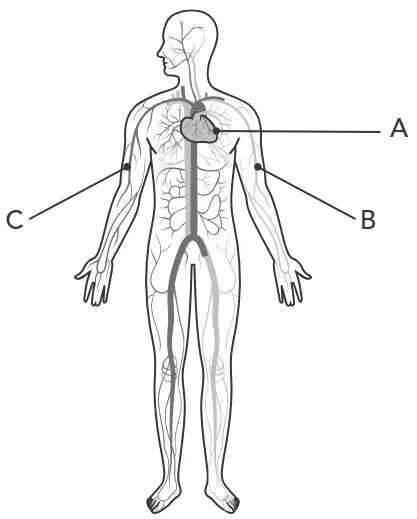
What is the most likely impact of damage to the organ labeled A?
Food will take much longer than normal to digest.
Parts of the body will have trouble sensing pain.
Gas exchange with the outside environment will be reduced.
Oxygen will have difficulty being transported to the rest of the body.
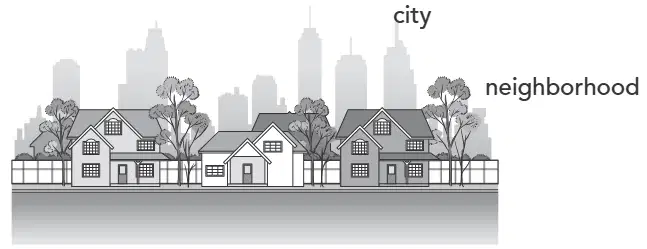
How does the warmer air in the settlement at the back affect the weather?
The warmer air prevents snow from falling.
The warmer air dries out the rain clouds.
The warmer air pushes down, creating fog.
The warmer air rises, causing additional rain.
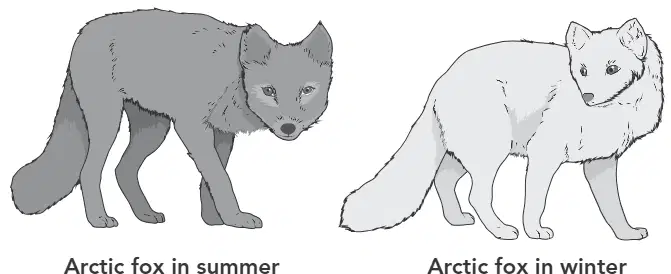
Jolene notices that foxes in Florida do not change color in the winter. Why do arctic foxes change fur color in the winter but Florida foxes do not?
White fur matches the snow during arctic winters, but Florida rarely gets snow.
White fur absorbs more heat during arctic winters, but Florida does not get cold.
White fur attracts mates during arctic winters, but foxes in Florida do not mate in winter.
White fur scares predators during arctic winters, but foxes in Florida do not hunt.

Based on the diagram, which best explains why it rains in Salta when the neighboring desert is so dry?
The chilled on-shore winds carry evaporated water to the east side of the mountains where it rains.
The cold current pushes the clouds over the mountain, and the rain falls on the east side of the mountains.
The high pressure forces the clouds into the Pacific Ocean causing rain on the east side of the mountains.
The chilled onshore winds cause snow on the west side of the mountains and rain on the east side.
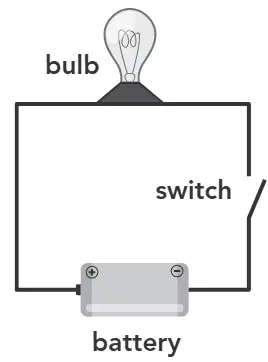
How will this circuit need to be changed so that currents can flow from the battery to light the bulb?
Add one more battery.
Increase the amount of wire used.
Close the switch.
Place the bulb closer to the battery.
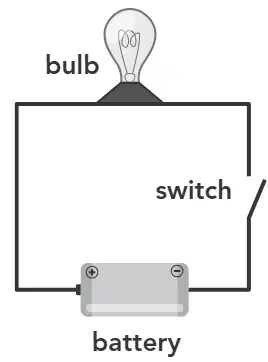
Students want to replace the material that connects the battery and the bulb in the circuit. Which material would be the best choice?
Copper, because it is a conductor.
String, because it is flexible.
Plastic, because it is an insulator.
Glass, because light energy can move through it.
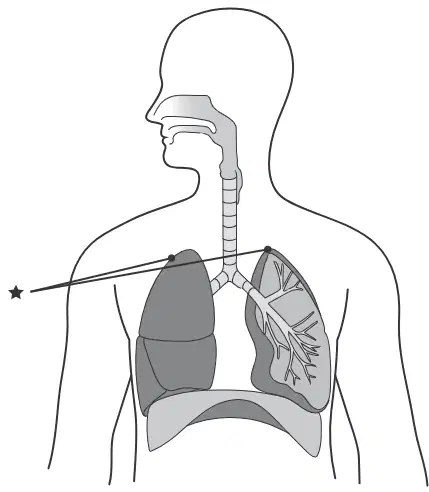
What is the primary function of the organ indicated by the star?
breaking down food for energy
exchanging gases with the environment
pumping blood to different organs
preventing diseases from spreading in the body
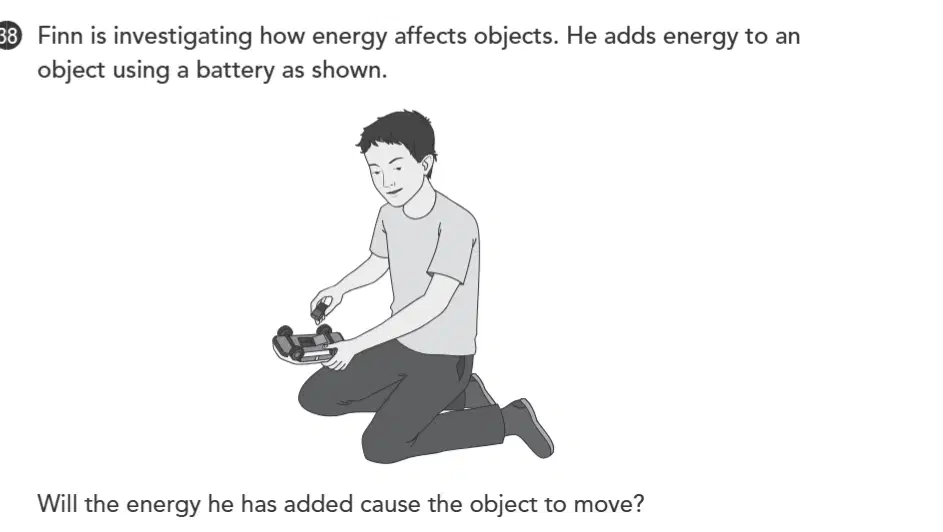
Will the energy Finn has added cause the object to move?
no, because the light energy from the battery will change its mass
no, because heat energy from the battery will change its temperature
yes, because the battery’s mechanical energy will make the motor run
yes, because the battery’s electrical energy will make its wheels turn
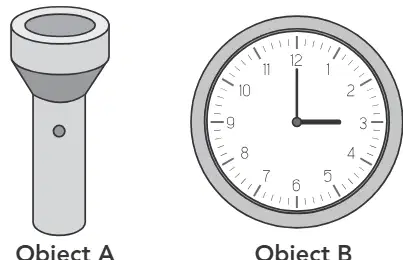
How can Bodhi show that electrical energy can be transformed into both light energy and the energy of motion?
use Object B to time how long Object A will stay lit
hold Object A in one hand and Object B in the other
remove the battery from Object A and use it to power Object B
shine Object A on Object B so that the light reflects onto the wall
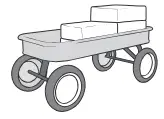
First, the students push the cart on the sidewalk. They use a meter stick to measure how far the cart moves. They bring the cart back to the starting point. They decide they want the cart to move farther the second time they push it. Which of these would NOT be a way to make the cart move farther?
Take some of the blocks out of the cart and push with the same force.
Take some of the blocks out of the cart and push with more force.
Keep the same number of blocks in the cart and push with more force.
Add some blocks to the wagon and push with the same force.
What change happens when the water reaches 100°C?
Liquid water changes to a solid.
Water vapor changes to a liquid.
Ice becomes a gas.
Liquid water becomes a gas.
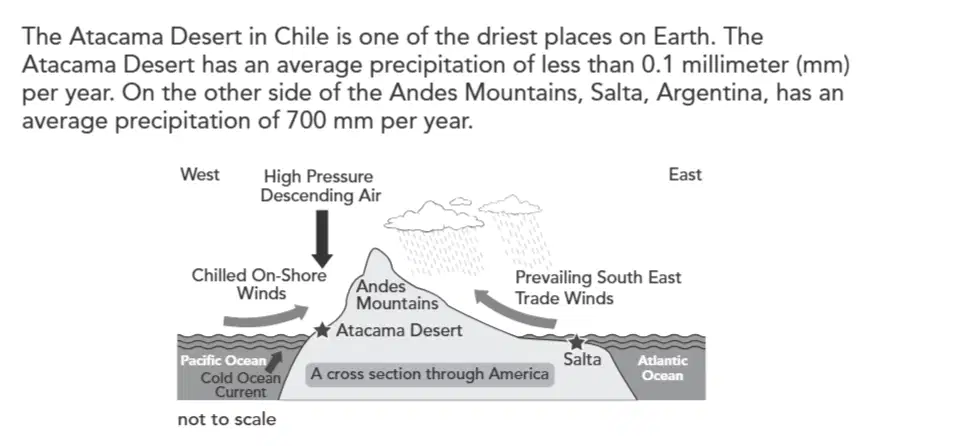
Which most likely describes the climate on the western side of the Andes mountains?
cool winters and warm summers
warm winters and hot summers
warm winters and cool summers
cold winters and cold summers
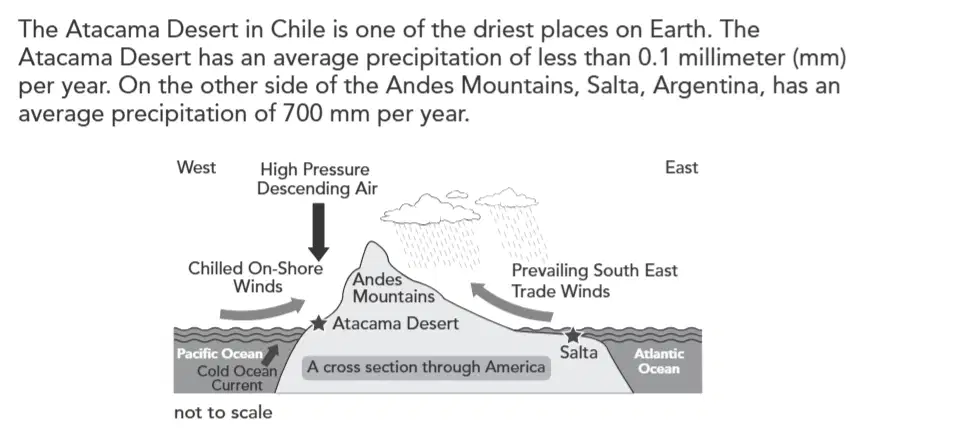
Although the Atacama Desert is one of the driest places on Earth, it does experience high humidity. What is the best explanation for this phenomenon?
After raining on the east side, the clouds create humid air on the west side.
Once the trade winds pass over the mountains, they create humid air.
The onshore winds push cool air over the hot desert, creating humid conditions.
Pressure near mountaintops pushes rainclouds down to form humid air.
What is the difference between asteroids and comets?
Asteroids are in orbit around the Sun.
Comets are slower than asteroids.
Asteroids are made of metals and rock.
Comets are smaller than asteroids.
The solar system body called 4 Vesta has a reflective rocky surface that can be visible to the human eye from Earth. It travels in an orbit around the Sun at a speed of 19 km/s and is 530,000 m in diameter. What is 4 Vesta?
Asteroid
Comet
Meteoroid
Moon
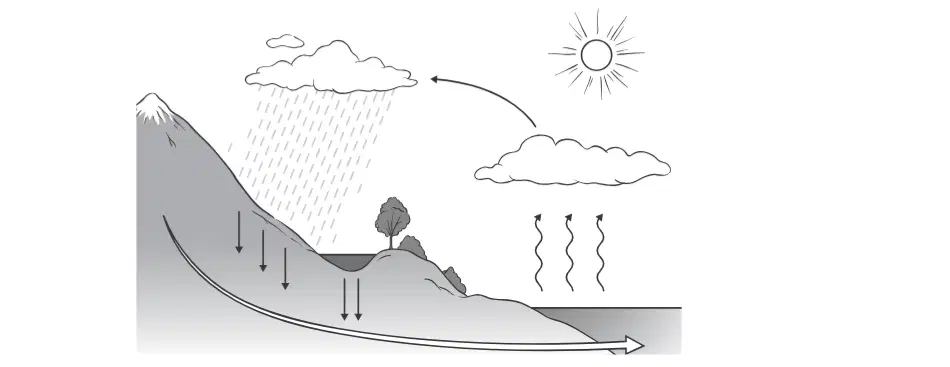
Based on the diagram, which statement best describes how fresh water sources on land such as ponds, streams, rivers, and lakes are created from ocean water?
Ocean water runs across the surface of the land and forms streams.
Wind carries evaporated ocean water over the land and it precipitates into lakes.
People collect ocean water, filter it to remove the salt, and create reservoirs.
Land soaks up ocean water and when it is saturated it forms ponds.
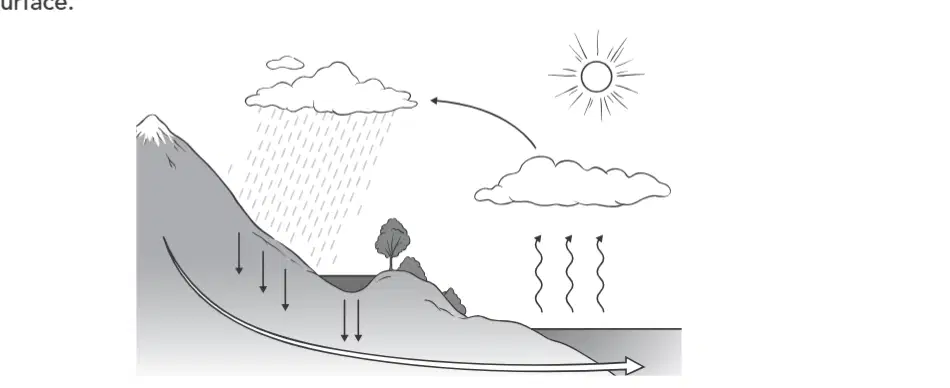
Which of these is an example of the role of condensation in the water cycle?
In the atmosphere, gaseous water vapor changes to liquid water.
Heavy water droplets fall from clouds.
Heat from sunlight causes liquid water to change to water vapor.
Water vapor is released to the air from the leaves of plants.
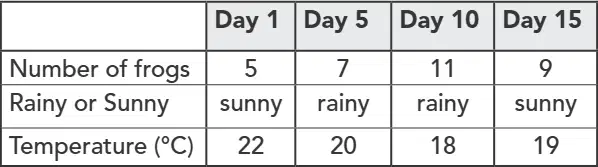
Frogs play an important role in the environment. A scientist wants to study what is causing the decline of frogs at the town’s pond and makes a chart. Which statement best explains if this is a scientific investigation?
It is a scientific investigation because many scientific investigations cannot follow the scientific method due to the subjects being studied.
It is not a scientific investigation because only scientific investigations that follow the scientific method precisely can be considered authentic.
It is not a scientific investigation because scientific investigations are never authentic, only scientific experiments are.
It is a scientific investigation because all scientific investigations and experiments are always considered authentic.
Isabella walked through a foggy forest and noticed her hair was damp. What phase changes happened as the water moved from the oceans to the forest to Isabella’s head?
It changed from gas to solid to liquid.
It changed from liquid to gas to solid.
It changed from solid to liquid to gas.
It changed from liquid to gas to liquid.
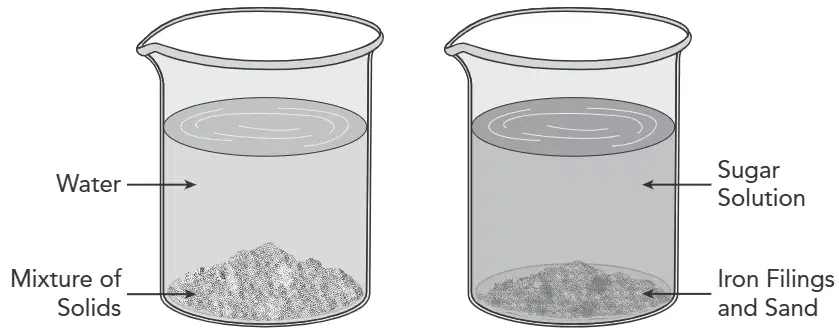
What would be the best method to remove the iron from the mixture?
Use a magnet to remove the filings.
Use tweezers to pick each filing out.
Let the water evaporate to leave the filings behind.
Pour the mixture through a strainer to remove the filings.
Next, Juanita carefully poured the liquid into another beaker through a filter placed in a funnel. What was the purpose of using the filter?
to remove the sugar from the water
to separate the sand from the mixture
to locate any iron filings that were missed
to find any particles of undissolved sugar
What is the main function of the roots in a plant?
To support the plant by holding it upright.
To produce food through photosynthesis.
To transport nutrients to the leaves.
To absorb water and nutrients from the soil.
Choose the third planet in the solar system.
Jupter
Neptune
Mars
Earth
Choose the largest planet in our solar system.
Jupiter
Neptune
Mercury
Earth
Name the star closest to Earth.
Polaris
Sun
Vega
Alpha Centauri
Katie’s class is studying galaxies. She is asked to describe a galaxy. Which statement is the BEST description of a galaxy?
gas, dust, planets and billions of stars
a star, planets that orbit the star, gas, and dust
a planet, moons that orbit the planet, gas, and dust
a group of planets, moons that orbit planets, gas, and dust
Gravity is a force that holds a galaxy together. Which of the following objects are NOT in the Milky Way galaxy?
The Sun
Pluto
The Andromeda Galaxy
Other stars
Planets are located at different distances from the Sun. Which two planets are closer to the Sun than Earth is?
Mars and Jupiter
Saturn and Neptune
Venus and Jupiter
Mercury and Venus
Which of the following statements correctly compares the inner planets of the Solar System to the outer planets?
The inner planets have rings, while the outer planets do not have rings.
The inner planets have few or no moons, while the outer planets have many moons.
The inner planets have longer year lengths, while the outer planets have shorter year lengths.
The inner planets are composed mostly of gas, while the outer planets are composed mostly of solids.

What is a graph that is used to show change over time?
line graph
bar graph
circle graph
diagram

Martha is growing plants in her science class. Which variable is her outcome variable?
The height of the plants (seedlings)
The amount of sunshine
The type of plant
The amount of water given per day

Martha is growing plants in her science class. Which variable is her independent variable? What did she change in her experiment?
The height of the plants (seedlings)
The type of plant
The amount of sunlight
The amount of water given per day

Gravity plays a major role in reshaping the surface of Earth through erosion. It pulls material downward after it has eroded from larger rock. Sometimes it causes erosion by itself. Which of the following results from erosion is due only to gravity?
a cave
a valley
a canyon
a landslide

What process is taking place in the diagram?
Temperature changes are causing the rock to weather.
Erosion is causing temperature changes in the rock.
Weathering is causing sedimentary rock to form.
Erosion is causing metamorphic rock to form.

A student reads through the chart to identify natural resources found in Florida. Which Florida natural resource is renewable?
oil
coal
wood
limestone

One of the most important reasons that people use Earth's resources is for energy. Which resource do you predict would take the longest amount of time to form?
sunlight
water
wood
coal

Astronomers have developed a scale to make it easier to compare the brightness of different stars. Susie is comparing two stars. Which of the following is the most likely reason for why one star appears brighter than the other?
The stars are made of different gases.
The stars release different amounts of light.
The stars are part of galaxies that are expanding.
The stars move different distances as they revolve.

Regina is going to dissolve a teaspoon of sugar in a cup of hot tea. What could Regina do to dissolve the sugar more quickly?
Add ice to the cup.
Stir the tea vigorously.
Add more sugar to the tea.
Put the tea and sugar in a larger cup.

A musician is playing a guitar. As he plucks the strings, he can feel the guitar vibrating. What type of energy causes this vibration?
heat
sound
electrical
chemical

All living things use energy. What kind of energy does a plant use to make its food?
electrical
light
magnetic
mechanical

Which of the following correctly shows the energy transformation that occurs in the circuit?
chemical to electrical
electrical to mechanical
electrical to mechanical to chemical
chemical to electrical to mechanical

A recycling station accidentally mixed together hundreds of glass jars with hundreds of steel cans. Which of the following is the easiest way to separate the cans from the jars?
Use acid to dissolve the cans and jars.
Sort the cans and jars by weight and shape.
Use a large magnet to separate the cans and jars
Heat the mixture of cans and jars until they melt.

Kevin is investigating different physical and chemical changes. He applies heat to an ice cube and observes the changes of state. In what order will the changes of state occur?
solid to liquid to solid
solid to liquid to gas
solid to gas to liquid
solid to gas to solid

A scientist wants to test how long it takes for fallen rainwater to evaporate. Where should the scientist perform the test?
at the coolest location to keep the water cool
at a location that can be easily observed and where water pools instead of flows down
at the location closest to a natural water source
at the mountain's steepest angle where water flows down quickly

Which property of C differs from A and B?
C has a definite color, while A and B are usually colorless
C has a definite shape, while A and B take the shape of their containers
C has a volume that can be measured, while A and B lack a definite volume
C has a mass of more than 50g, while A and B will always be less than that.

Kaylee observed two unknown plants. She recorded her observations of the plants in the table. In which group of plants would both of these plants be classified?
nonflowering plants with seeds
nonflowering plants with spores
flowering plants with wide leaves
flowering plants with narrow leaves
The moon seems to move across the sky once each night. Which of the following statements describes why this happens?
The moon revolves around Earth.
Earth revolves around the sun.
Earth rotates on its axis.
Earth's axis is tilted.
Slate is a kind of metamorphic rock. How does slate form?
from lava that cools and hardens
from magma that cools and hardens
from sediment that is pressed together over time
from other rock when heat and pressure cause changes
Which of the following best describes scientific investigations?
Scientific investigations are always controlled experiments.
Only trained scientists can carry out scientific investigations.
Scientific investigations always follow similar steps done in the same order.
The steps in a scientific investigation can vary but always include gathering evidence.
A closed circuit is a complete loop through which current flows. Which of the following lists the parts of a closed circuit?
wire, battery, bulb, closed switch
wire, battery bulb, open switch
battery, bulb, open switch
wire, bulb, closed switch

Earth moves in different ways. The picture shows Earth's motion. How long does it take Earth to make one complete trip from position 1 to position 4?
1 day
1 week
1 month
1 year
Kaylee observed two unknown plants. She recorded her observations of the plants in the table. In which group of plants would both of these plants be classified?
nonflowering plants with seeds
nonflowering plants with spores
flowering plants with wide leaves
flowering plants with narrow leaves
The moon seems to move across the sky once each night. Which of the following statements describes why this happens?
The moon revolves around Earth.
Earth revolves around the sun.
Earth rotates on its axis.
Earth's axis is tilted.
Slate is a kind of metamorphic rock. How does slate form?
from lava that cools and hardens
from magma that cools and hardens
from sediment that is pressed together over time
from other rock when heat and pressure cause changes
Which of the following best describes scientific investigations?
Scientific investigations are always controlled experiments.
Only trained scientists can carry out scientific investigations.
Scientific investigations always follow similar steps done in the same order.
The steps in a scientific investigation can vary but always include gathering evidence.
A closed circuit is a complete loop through which current flows. Which of the following lists the parts of a closed circuit?
wire, battery, bulb, closed switch
wire, battery bulb, open switch
battery, bulb, open switch
wire, bulb, closed switch
Earth moves in different ways. The picture shows Earth's motion. How long does it take Earth to make one complete trip from position 1 to position 4?
1 day
1 week
1 month
1 year
There are many different forms of energy. Which form of energy comes from a piano when someone plays it?
chemical energy
electrical energy
light energy
sound energy
The temperature of the air affects other weather conditions. Which of the following describes how temperature affects humidity?
Warmer air holds more water vapor than colder air.
Colder air holds more water vapor than warmer air.
Colder air is denser than warmer air.
Warmer air is less dense than colder air.
Jenna has two sealed shoe boxes. Inside one is a rock with more mass, and inside the other is a rock with less mass. Which of the following will most likely happen is she pushes the two boxes with the same amount of force?
The box with more mass will move faster and not as far.
The box with more mass will move faster and farther.
The box with less mass will move more slowly and farther.
The box with less mass will move faster and farther.
Box turtles have yellowish markings on their green shells. The colors and markings help the turtles blend in with the ground of a forest. Which of the following is NOT an adaptation like the turtles' markings?
a polar bear's thick layer of fat
an arctic fox's white fur
a giraffe's spotted coat
a toad's green skin

Birds that live in Florida's swamps often have long beaks and long legs. The shapes of the birds' beaks help them catch fish to eat. The long legs help the birds wade in the swamp water. The picture shows four birds. Which bird is best suited to catching fish in Florida's swamps?
goldfinch
pileated woodpecker
white ibis
mallard duck
A dog knows how to open a gate and to sit on command. Which of the following statements best describes these actions?
They are necessary for survival.
They are learned behaviors.
They are inherited traits.
They are instincts.
Plants, mica, limestone, and water are four things found in Florida. Which of the following describes something else these four things have in common?
They are all minerals.
They are all natural resources.
They are all renewable resources.
They are all nonrenewable resources.
Erin conducts an investigation about how maple trees make food. She makes observations of ten maple trees. Which of the following must Erin do to provide evidence of her results?
record her observations exactly
record her inferences in a data table
draw diagrams of the trees she observes
use a measuring tape to measure the trees
The brain is an important part of the human body. Which of the following has a role most similar to the brain of a human?
a roof covering and protecting a building
a computer controlling all parts of a factory
a filter removing solids at a water treatment plant
a conveyer belt moving boxes through a warehouse

Several groups of students investigated how mold grows. Each group placed a piece of bread in a plastic bag and put two drops of water on the bread. Then they kept the bread in a dark, warm place. Three days later, they observed the bread. The table below shows their observations. Which of the following best compares the students' observations?
All the groups made the same observations
All the groups but Ian's observed mold growth
All the groups but Jamal's group observed mold growth
Lee's and Rebecca's groups observed the most mold growth

Four students drew diagrams to show how some parts of our home galaxy are related. Which student drew a diagram that best shows how these parts of our home galaxy are related?
Aidan
Olivia
Grace
Diego
Needles are important parts of pine trees. Which of the following plant arts have the same functions as a pine tree's needles?
a squash plant's flowers
an orange tree's roots
a lemon tree's stems
an oak tree's leaves

In the water cycle, water is constantly moving and changing. Emma drew four pictures to show four steps in the water cycle. Then she wrote captions for her pictures describing the changes they show. In what order should Emma arrange her pictures to best represent the step in the water cycle?
S, Q, R, P
P, Q, R, S
S, R, Q, P
Q, S, R, P

In the water cycle, water moves along the land, atmosphere, and ocean. Which of the followin describes how water moves in picture R?
from the ocean to the atmosphere
from the atmosphere to the land
from the ocean to the land
from the land to the ocean

In picture S, which of the following physical changes occurs as a result of a change in temperature?
a change from a solid to a gas
a change from a liquid to a gas
a change from a gas to a solid
a change from a solid to a liquid

Which of the following describes the kind of change that occurs in picture Q?
the chemical change of rusting
the chemical change of burning
the physical change of condensing
the physical change of evaporating
Alex kicks a ball with a certain force. Then Lauren kicks the same ball with a larger force. Which of the following will most likely happen?
The ball will move faster and farther when Alex kicks it.
The ball will move more slowly and farther when Alex kicks it.
The ball will move faster and farther when Lauren kicks it.
The ball will move faster and not as far when Lauren kicks it.
Rainwater seeps into cracks in a rocks. Freezing and thawing of the rainwater in the rock can cause weathering. Which of the following describes how this process happens?
As water flows through the cracks, it picks up the rock and carries it downhill.
As sand in the water flows, it scrapes the rock and wears it away.
As ice flows in sheets, it picks up the rock and carries it away.
As ice expands, it pushes against the rock and splits it apart.
Organisms can change their environments in many ways. Which of the following is the best example of one kind of organism helping another by changing the environment?
Beavers use their teeth to cut down pine trees.
Kudzu vines grow quickly around beech trees.
Humans cause deforestation by clearing birch forests.
Earthworms add nutrients to soil that palm trees take in.
Andrea is conducting an investigation about animals. She will use a ruler to measure the length of the animals. Which of the following best describes why Andrea should write down her measurements in a data table as part of this investigation?
to help her use a ruler
to help her control variables
to help her organize her data
to help her plan the steps to follow
Animals and plants have parts that are similar in some ways and different in others. Which of the following best describes a difference between the nose of an animal and the leaves of a plant?
The animal's nose takes in air, and the plant's leaves do not.
The plant's leaves make food, and the animal's nose does not.
The animal's nose take in sunlight, and the plant's leaves do not.
The plant's leaves provide support, and the animals' nose does not.
The sun and Earth are two different objects in our solar system. Which of the following describes a difference between the sun and the Earth?
Earth is much larger than the sun.
Earth is much hotter than the sun.
Earth is much smaller than the sun.
Earth is much less rocky than the sun.

During an investigation, Isabella observes the moon's phase. She can see half of the lit side of the moon. She draws and labels this phase. Which of the following did she most likely draw?
New Moon
Crescent Moon
Quarter Moon
Full Moon
Animals in different places have different ways of surviving when seasons change. Which of the following animals is most likely to hibernate during winter?
a manatee along the Florida coast
a monarch butterfly in Mexico
a bat in a northern state
a black bear in Florida
Predators such as coyotes sometimes move to a new environment to find food. Which of the following best explains why skunks would be better able to survive than rabbits would if more coyotes moved to their forest?
Skunks have better camouflage for hiding.
Skunks can run much faster than rabbits.
Skunks can mimic poisonous animals.
Skunks can use smell for protection.
Cole conducted an investigation to find out how heat affects rusting. Which of the following events would provide the best evidence that Cole conducted a good scientific investigation?
Other people do different experiments and get the same results.
Other people repeat his experiment and get the same results.
He repeats his experiment and gets different results.
Other people read about his experiment and results.
Long ago, people observed a group of stars that formed a pattern in the sky. They imagined the pattern looked like a swan, so they gave it the name Cygnus (the Latin word for "swan"). Why does Cygnus seem to move across the night sky throughout the year?
because the stars revolve around the Earth
because Earth revolves around the sun
because the sun revolves around Earth
because Earth revolves around the stars
All living things need food to stay alive. Which of the following describes how a palm tree gets food?
It takes in sunlight, air, and water to make food.
It breaks down dead organisms to make food.
It eats other plants to get food.
It eats animals to get food.
Marcus made a list of the main parts that make up a galaxy. On the list, Marcus includes gases, water, and stars. What should he do to make his list correct?
He should add animals to the list.
He should replace water with dust.
He should replace stars with comets.
He should remove gases from the list.
Slash pine trees and rose bushes are two plants found in Florida. Which of the following best describes a difference between the life cycles of a slash pine tree and a rose bush?
A slash pine tree's life cycle includes a flower, and a rose bush's life cycle does not.
A slash pine tree's life cycle includes a cone, and a rose bush's life cycle does not.
A slash pine tree's life cycle includes a seed, and a rose bush's life cycle does not.
A rose bush's life cycle includes a seed, and a slash pine tree's life cycle does not.

The map shows the climate regions of North and South America. Which of the following describes Florida's climate?
warm temperate climate
tropical rainy climate
cool temperate climate
dry desert climate
John shared information with the class about a kind of energy that travels through space. Which of the following describes what he did?
made a model of light
made a model of sound
communicated about light
communicated about sound
Jorge eats an orange and an apple. Then he states that apples taste better than oranges. Which of the following describes Jorge's statement?
It is a fact because it is supported by observations.
It is an opinion because it is supported by observations.
It is an opinion because it can change from one person to the next.
It is an observation because it can change from one person to the next.

Four students took turns blowing on the same cardboard tube for 10 seconds. They measured the distance the tube rolled across the same flat surface during that time. The results are shown in the table. Which student provided the tube with the least amount of mechanical energy according to the data in the table?
Joe
Alexis
Makayla
Tim
Faith has a mixture of steel paper clips and tiny iron filings. Steel is made from different metals, including iron. Which of the following would be the best way for Faith to separate the parts of this mixture?
pick out the iron filings with tweezers
use a magnet to attract the iron filings
sort the mixture using a strainer with small holes
soak the mixture in water until the iron filings dissolve
Joshua and Devin are comparing and analyzing data from their toy car racing trials. When they ran the trials for car speed, what were Joshua and Devin measuring?
the distance each car moved
the amount of time each car moved
the distance each car moved in a certain amount of time
the direction each car moved in a certain amount of time
Grizzly bear cubs have brown fur like their parents' fur. Which kind of trait is the cubs' fur color?
learned behavior
inherited behavior
acquired physical characteristic
inherited physical characteristic

Benjamin wants to show what happens to water during condensation. He drew this picture to show this process. What should Benjamin do to make his picture correct?
not change his picture at all
replace the gas with solid ice
replace the liquid with solid ice
point the arrow toward the liquid
Courtney is planning an investigation to test her idea that cardinals make their nests in the same places that blue jays do. Which of the following explains why Courtney should make and record observations of the cardinals and blue jays herself?
so she can prove to others that she can make and record good observations
so her explanations will be supported by direct observations
so her observations will prove her original idea was correct
so she can form opinions about the birds during her test
The sun and Betelgeuse are both stars you can see from Earth. But the sun is much closer to Earth than Betelgeuse is. Which of the following describes a difference between how the two stars appear because of this difference in distance?
Betelgeuse looks rockier.
The sun looks larger and brighter.
The sun looks smaller and dimmer.
The sun looks as if it moves more slowly.
Sunlight travels from the air above a lake into the water below. Which of the following most likely happens when the sunlight passes from the air into the water?
The sunlight is absorbed.
The sunlight's path bends.
The sunlight's path remains straight.
The sunlight is bounced back into the air.

Energy can cause things to move. The picture shows strings that move when the appliance is turned on. Which of the following best explains why the strings tied to the appliance move?
Moving air has mechanical energy that can move things.
Electrical energy is the energy of moving electrical charges.
Moving water has mechanical energy that can move things.
Heat is produced when moving objects rub against one another.
Caroline and Allison asked the question, "How does the temperature of a metal affect how bendable it is?" Caroline conducted a controlled test with copper wire. Allison conducted a controlled test with steel wire. Which of the following should both of these scientific investigations include?
estimation rather than exact measurement
evidence that helps answer their question
opinions they formed separately
inferences they both agree on

Plants have many different parts with different jobs. the part of the plant pictured helps the plant reproduce. Which of the following is produced in the plant part shown?
cone
egg
root
stem

Energy can be changed from one form into another. The device pictured changes energy. Which energy change happens inside the device pictured?
Electrical energy is turned into heat energy.
Heat energy is turned into electrical energy.
Light energy is turned into electrical energy.
Electrical energy is turned into sound energy.

Ken tested four samples of matter to see if they were magnetic. Only 1 sample was attracted to a magnet. Sample 1 is most likely made of which of the following?
glass
iron
plastic
wood

Which of the following describes one thing that the four different samples have in common?
They are all solids.
They are all liquids.
They are all kinds of metal.
They are all kinds of plastic.

Which statement best describes one property of the samples?
Sample 1 takes up the greatest amount of space.
Sample 2 takes up the greatest amount of space.
Samples 3 and 4 take up the least amount of space.
All of the samples take up the same amount of space.

Ken wanted to find out if heat is conducted easily through each type of material. He placed the samples in hot water so that each sample was half covered by the water. Ken found out that sample 4 was most likely NOT made of which of the following?
wood
rubber
plastic
iron
Jada conducted research about beavers. She concluded that beavers can be destructive. Which of the following statements provides evidence to support Jada's conclusion?
The beaver is the largest rodent in North America.
A group of beavers can cut down many trees in a single night.
Beavers communicate with one another by slapping their tails on the water.
In the eighteenth and nineteenth centuries, tens of thousands of beavers were hunted for their fur.
Matthew uses many forms of energy each day. When does Matthew use chemical energy?
when he turns on a lamp to read a book
when he listens to a friend play the drums
when he uses a dishwasher to wash dishes
when he burns gasoline to run a lawn mower
A sample of the mineral alcite is white with breaks along a smooth surface. Which two properties of the mineral sample are described here?
color and luster
color and cleavage
luster and cleavage
streak color and hardness

Energy from the sun is passed from one living thing to another in the marsh food chain shown. Which of the following describes the transfer of energy from one consumer to another consumer in this food chain ?
from raccoon to frog
from frog to grasshopper
from grasshopper to frog
from grass to grasshopper
Which are two of Florida's renewable resources used to produce electricity?
limestone and silicon
wind and sunlight
oil and phosphate
fish and water
Suppose an unknown space body is revolving around the sun. The space body is small, rocky, and shaped like a loaf of bread. Based on this information about the space body, which of the following is most likely correct?
It is not a planet because it is not made mostly of gas.
It is not a planet because it is not shaped like a ball.
It is a planet because it revolves around the sun.
It is a planet because it is small and rocky.
Paige will conduct an experiment to find out how heat is transferred between two different metal objects. Which of the following should she do so that others can repeat her experiment?
record exactly what she does and observes
use common metals found in every home
build a model of her experiment setup
plan what she will do before starting
When Angel tries to lift his backpack filled with books, he finds it hard to do. Which force pulls down on the backpack when he tries to lift it?
magnetic force
electrical force
Angel's pull
gravity

Butterflies are one kind of insect found in Florida. The life cycle of a butterfly is pictured. Which stage of the life cycle is the larva?
stage 1
stage 2
stage 3
stage 4

The organisms shown live in different environments. They have been placed into two groups. Which of the following describes how these organisms have been grouped?
fish and mammals
insects and amphibians
vertebrates and invertebrates
scaled animals and feathered animals
Jose and Rachel are standing in front of the class. The teacher asks Jose to pretend he is Earth and Rachel to pretend she is the sun. Then the teacher asks them to model for the class how Earth rotates. Which of the following should they do?
Jose should walk from east to west while Rachel stands still.
Jose should walk around Rachel while Rachel stands still.
Rachel should walk around Jose while Jose stands still.
Jose should turn in place while Rachel stands still.

