
NEW
Font size
 Worksheets
PSYCH 614 Quiz 12
Total questions: 12
Worksheet time: 2hrs 0mins
1. You are running a multiple regression analysis to predict final grades in PSYCH 614 from previous statistics experience (a composite score from 5 continuously-rated items), class attendance (a count of the number of classes attended), and their interaction. Which predictors should you center?
class attendance
None of them
All of them
previous statistics experience
2. Holding all other factors constant, which of the following will increase statistical power?
Increasing measurement error
Studying a phenomenon with a smaller effect size
Changing the p-value cut-off from .01 to .05
Using a cross-sectional (vs. a repeated measures) design

3. Below is the equation for a multiple regression analysis you are conducting as part of your master's thesis. Your advisor asks you to add the interaction to the analysis. Which term accurately reflects the interaction?
b3X1,iX2,i
b4X1,iX2,i
b3X3,iX4,i
b4X3,iX4,i
4. You are interested in predicting whether a person will attempt robbery (1) or not (0) from their scores on a 10-point hunger inventory (with 1 = "satiated" and 10 = "never been hungrier"). You conducted a logistic regression and found that Exp(B) was 2.56. How should you interpret this?
If two people have hunger scores that differ by 1 unit, then the odds of the person with the higher hunger score attempting robbery are 2.56 times higher than for the other person.
25.6% of the variance in robbery attempts is explained by hunger.
If two people have hunger scores that differ by 1 unit, then the odds of the person with the higher hunger score attempting robbery are 2.56 times lower than for the other person.
2.56 times more people who attempted robbery scored highly on hunger.
5. You conducted a MANOVA to test whether year in college (i.e., first year, sophomore, junior, and senior) predicted quality of life, which was reflected by 5 different continuous outcome variables (GPA, hours per week of extracurricular activities, number of Twitter followers, degree of trust in friendships, and level of communication with family). The F-statistic associated with your Wilks' lambda was significant! What follow-up test(s) should you conduct to determine where the effect lies among the dependent variables?
Discriminant function analysis
5 univariate ANOVAs
Contrasts
a series of t-tests
6. TRUE or FALSE? In the same data set, the overall variance explained by the components of a principal component analysis will generally be less than that explained by the same number of factors in an exploratory factor analysis.
TRUE
FALSE
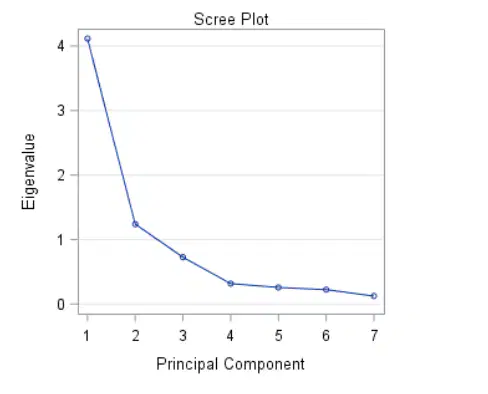
7. TRUE or FALSE? Kaiser's Criterion and the scree plot below suggest the same number of components should be extracted in a principal component analysis?
TRUE
FALSE
8a. What type of approach accurately characterizes Factor Analysis (i.e., based on variance related to both variables and people)?
Variable-Centered Analysis
Person-Specific Analysis
Person-Centered Analysis
None of the above
8b. What type of approach accurately characterizes P-technique (i.e., based on variance related to both variables and people)?
Variable-Centered Analysis
Person-Specific Analysis
Person-Centered Analysis
None of the above
8c. What type of approach accurately characterizes Cluster Analysis (i.e., based on variance related to both variables and people)?
Variable-Centered Analysis
Person-Specific Analysis
Person-Centered Analysis
None of the above
9. TRUE or FALSE? Person-specific analyses (of intra-individual variation) can be used when data violate the assumption of homogeneity across people or time.
TRUE
FALSE
10. You are interested in momentary fluctuations in stress and cognition for students transitioning to graduate school. Over the summer, you enroll 50 first year graduate students in your study. Every 12 hours (at 9AM and 9PM each day) for the first month of the Fall semester, they provide you with a 1 (lowest ever) to 10 (highest ever) rating of their current perceived stress, and they complete a 5-minute cognitive battery consisting of working memory, perceptual speed, and verbal fluency domains (each with their own score, with high scores reflecting better performance). Which of the following analytic methods would be suitable for a person-oriented analysis of these data to examine the inter-relations among stress and the 3 cognitive domains?
P-technique
Multilevel models
GIMME
All of the above

