
NEW
Font size
 Worksheets
Unit 5 Formative Assessment
Total questions: 15
Worksheet time: 14mins
If the enthalpy change (ΔH) is negative the reaction is ____.
Calculate 35C in Kelvin
308 K
-238 K
238 K
238 K

Durning a state change the temperature of a substance_________.


Calculate the enthalpy change for the reaction
-120 kJ/mol
120 kJ/mol
-1020 kJ/mol
1020 kJ/mol
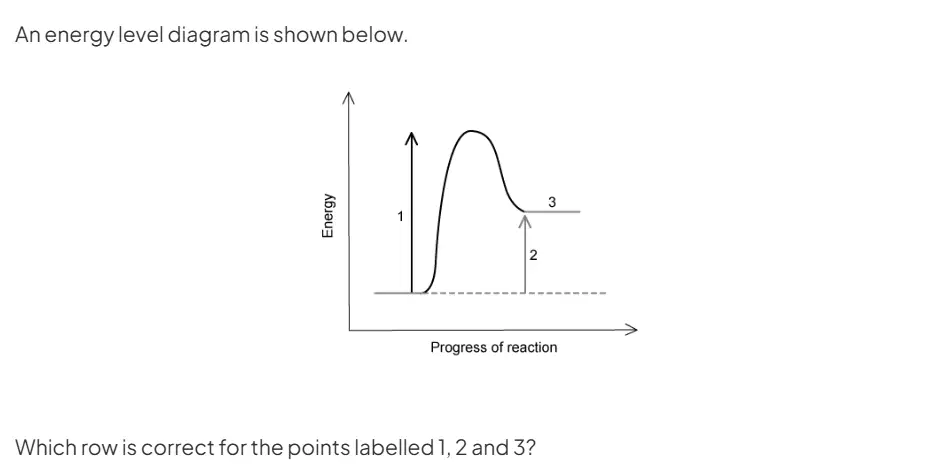
1. Activation Energy
2. enthalpy change
3. reactants
1. enthalpy change
2. Activation Energy
3. products
1. enthalpy change
2. Activation Energy
3. reactants
1. Activation Energy
2. enthalpy change
3. products
In all chemical reactions, bonds in the reactant species are broken and new bonds are formed in the products. Which statement is correct?
Bond breaking requires energy and is thus an exothermic process.
Bond breaking requires energy and is thus an endothermic process.
Bond breaking releases energy and is thus an exothermic process.
Bond breaking releases energy and is thus an endothermic process.
A 10.0 g sample of metal was heated to 100C and then added to 50.0 g of water. The initial temperature of the water was 25.0C and the final temperature of the water was 29.0C. Calculate the specific heat of the metal. (The specific heat of water is 4.18 J/gK)
0.12 J/g°C
1.18 J/g°C
C. 4.18 J/g°C
2.90 J/g°C
Which of the following statements best explains how specific heat capacity affects temperature change when the same amount of heat is added?
A substance with a high specific heat capacity will experience a large temperature change.
A substance with a low specific heat capacity will experience a small temperature change
A substance with a low specific heat capacity will experience a large temperature change.
Specific heat capacity does not affect temperature change.
When the same amount of heat energy is added to two different substances, which statement correctly describes the relationship between thermal energy and temperature?
The substance with more mass will experience a greater increase in temperature because it gains more thermal energy.
Thermal energy and temperature are the same, so both substances will reach the same final temperature.
The substance with less mass will experience a greater temperature change, even though both gain the same amount of thermal energy.
Both substances will experience the same temperature change, regardless of their mass or specific heat.
In a calorimetry experiment, 50.0 mL of 1.00 M HCl is mixed with 50.0 mL of 1.00 M NaOH in a coffee cup calorimeter. The initial temperature of both solutions is 25.0°C, and the final temperature after mixing is 31.0°C. Assuming the solutions have the same density and specific heat capacity as water (4.18 J/g°C, 1.00 g/mL), what is the enthalpy change in kJ/mol for the reaction?
–2.51 kJ/mol
–6.28 kJ/mol
–55.0 kJ/mol
–62.8 kJ/mol

