
 Worksheets
Oceans
Total questions: 12
Worksheet time: 6mins
Name
Class
Date
1.
1. Deep ocean currents form when polar water sinks. Which of the following factors contribute to polar ocean water sinking?
a)
Ocean water at the poles is cold, making it less dense.
b)
Freezing water at the poles leaves salt behind, increasing salinity levels and causing the water to become more dense.
c)
Ocean water evaporates quickly.
2.
2. Density of ocean water can be affected by which of the following factors?
a)
Salinity (amount of salt) and Temperature of water
b)
Salinity (amount of salt) and Wind patterns over the water
c)
Temperature of water and Wind patterns over the water
3.
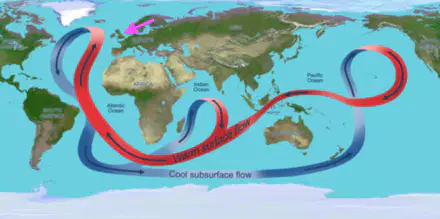
3. Observe the map of the great ocean conveyor belt below. Choose the most likely scenario for what would happen to the climate in Great Britain if the conveyor belt slowed or stopped and why? (The pink arrow is pointing to Great Britain)
a)
The temperature would increase because more warm water would be carried toward Great Britain.
b)
The temperature would decrease as less warm water moves toward Great Britain because the movement of the conveyor belt changes.
c)
The temperature in Great Britain would not change.
d)
The temperature would increase because more cold water would be carried toward Great Britain.
4.
4. Sammy is conducting an experiment in class to learn about ocean currents, water temperature, and density. One pipette contains ice-cold yellow water. The second pipette contains hot red water. What will happen when Sammy adds a drop of both types of water to a beaker containing room temperature water?
a)
The hot red water will sink while the yellow cold water will float on the surface.
b)
The hot red water and cold yellow water will immediately mix to create orange water.
c)
The hot red water will float on the surface while the cold yellow water will sink.
d)
Both water samples will sink to the bottom of the container.
5.
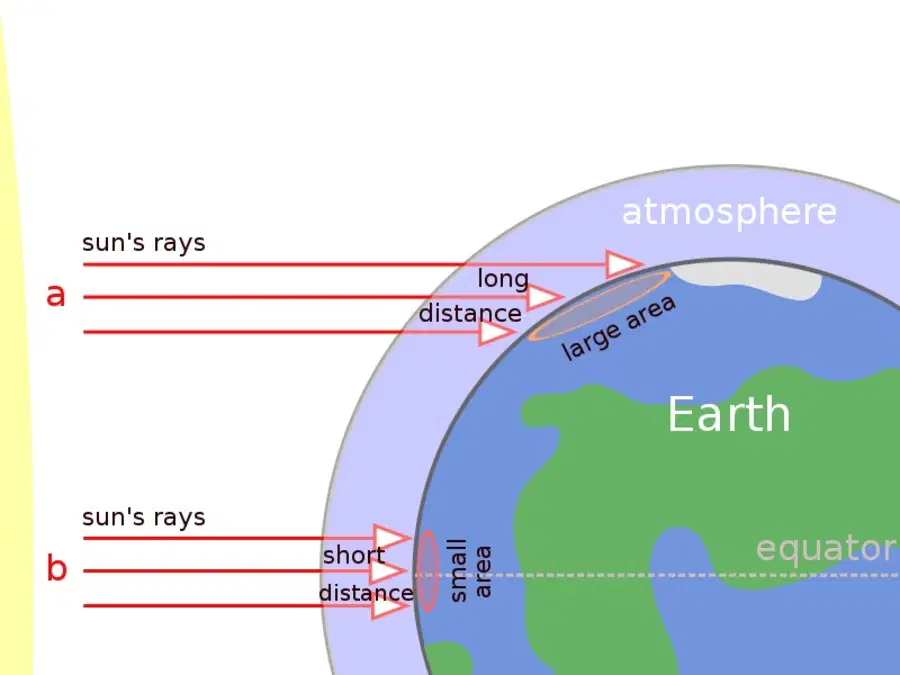
5. Why do warm ocean currents develop at the equator? Refer to the image.
a)
At the equator, sunrays strike the earth more directly, resulting in warmer temperatures.
b)
At the poles, sunrays strike the earth more directly, resulting in warmer temperatures.
c)
At the equator, sunrays travel a longer distance, striking the earth over a larger area, resulting in warmer temperatures.
d)
Warm currents develop all over the earth, as sunrays strike the earth with the same intensity.
6.
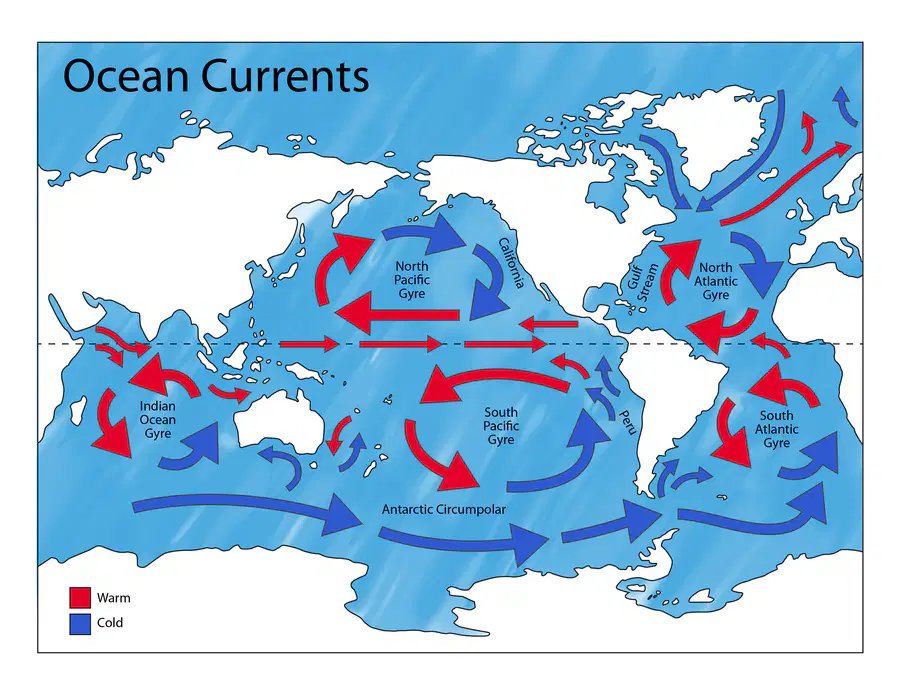
6. Based on the Surface Ocean Currents diagram, which of the following would accurately describe climate in South America.
a)
The climate of the East and West Coast should be exactly the same.
b)
The climate of the East Coast tends to be warmer than the West Coast.
c)
The climate of the West Coast tends to be warmer than the East Coast.
d)
Warm ocean currents run along both coastlines in South America.
7.
7. Select the factors that affect surface currents. (Select 2)
a)
Wind
b)
Coriolis Effect
c)
Salinity of ocean water
d)
Temperature of water
8.
8. Select the factors that affect deep ocean currents. (Select 2)
a)
Wind
b)
Coriolis Effect
c)
Salinity of ocean water
d)
Temperature of water
9.
9. When the wind blows across a body of water, ____ between the water and air causes the water to move.
a)
ions
b)
gravity
c)
friction
d)
density
10.
10. Surface currents affect ____.
a)
the climate on continents
b)
high tides
c)
low tides
d)
the bottom ocean current
11.
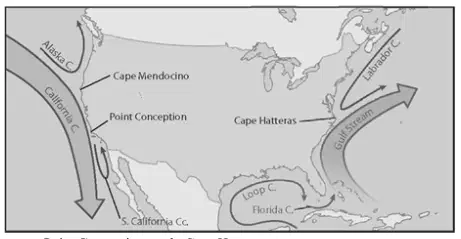
11. Looking at the currents shown in the figure, where would you expect to find a cooler evening?
a)
A city next to the California current at latitude 38 N.
b)
A city next to the Gulf Stream current at latitude 38 N.
c)
There is no way to tell
12.
12. If the California Current stopped flowing, the temperature in San Francisco would probably be ____.
a)
warmer
b)
cooler
c)
the same
d)
more variable
100 %

